turnkey voice agent platforms vs. developer-first AI layers for customer call workflows
Choose your platform based on whether you can own the integration failures yourself.
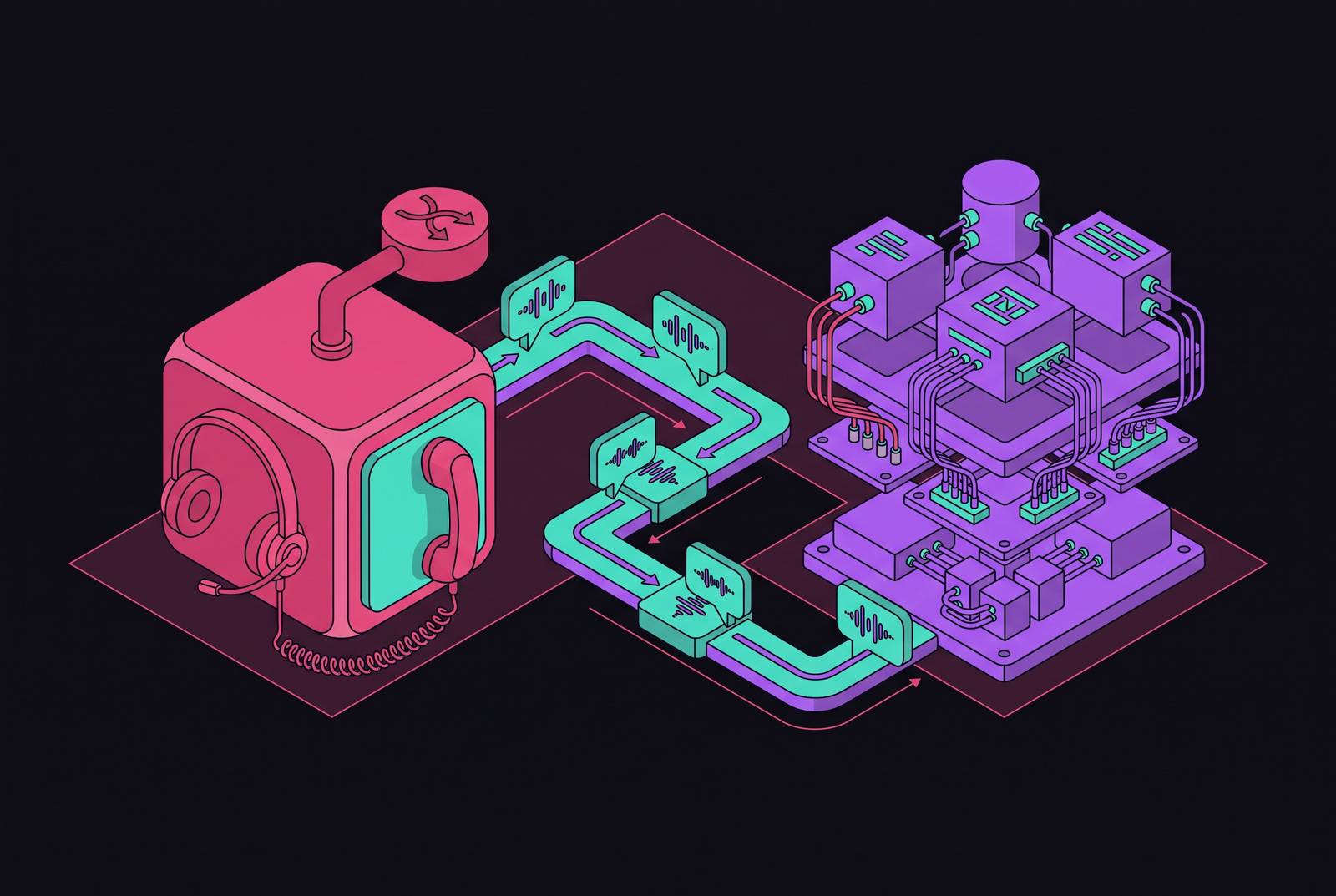
Every voice agent, regardless of vendor, runs on the same basic stack underneath the marketing copy. Something transcribes the caller's speech (ASR), something figures out what the caller wants and what to say back (a reasoning engine, usually an LLM), something turns the response into audio (TTS), and something keeps track of what's already been said so the agent doesn't ask your name three times (memory). The orchestration layer holds those four pieces together and decides how they hand off to each other mid-call. It governs latency, it governs what happens when a caller interrupts mid-sentence, it governs speaker switching, and it's the single biggest determinant of whether the agent feels like a person or a phone tree with better vocabulary.
Platform choice, at bottom, is a decision about how much of that stack you want pre-assembled versus how much you want to wire yourself. Everything downstream (cost, flexibility, time to launch) traces back to this one architectural fork.
Latency is a measurable factor with real consequences. Delays past a certain threshold measurably increase call abandonment, and sub-200ms round-trip has become the baseline expectation for anything called production-ready. Miss that window and callers start talking over the agent, the agent starts talking over the callers, and the whole exchange degrades into the audio equivalent of a bad international phone call from 2003.
Most enterprise deployments still run on a cascaded architecture: ASR feeds an LLM, the LLM feeds a TTS engine, in sequence. Speech-to-speech models that skip the intermediate text step can shave real latency off the round trip, but cascaded wins because it gives teams control over each link in the chain. You can swap the transcription model without touching the voice. You can upgrade the reasoning engine without re-training anything downstream. Speech-to-speech trades that modularity for speed, which is a fine trade if your use case can tolerate a black box and a bad one if it can't.
There's a newer wrinkle worth flagging: hybrid edge-cloud setups, where sensitive audio gets processed on-device or on-prem and the heavier reasoning happens in the cloud. This matters a lot less for a pizza-ordering bot and a lot more for a bank or a hospital, which is a theme that resurfaces later in this piece.
The demo-to-production gap that makes platform choice consequential
Here's the uncomfortable, well-documented pattern in voice AI: demos almost always work. Production deployments, a meaningful share of the time, don't, or they degrade badly within the first week of live calls. The gap between the two is where platform choice stops being a theoretical exercise and starts being an actual business risk.
The gap comes from three predictable places. Real call audio is messier than demo audio (background noise, bad connections, people talking with food in their mouth). Edge cases show up that the demo script never touched, because demo scripts are written by people who know what they're going to say. And integrations fail against live systems of record in ways that sandboxed testing never catches, because sandboxes are polite and production databases are not.
Turnkey platforms narrow this gap by absorbing a lot of that mess internally, but only for the scenarios they were built to handle. Step outside the template and you're on your own, just with less visibility into why things broke. Developer-first platforms expose the gap earlier, during the build itself, which sounds like a disadvantage until you realize that a problem surfaced during development is a problem you fixed before a customer ever heard it.
So the real diagnostic question, before any vendor call, is this: when something breaks, who owns the failure mode? Is it the platform, or your own engineering team? Get the honest answer to that before you sign anything.
What turnkey platforms actually give you and where they stop
Turnkey platforms bundle telephony, voice, conversation logic, and analytics into one managed package, and the appeal is obvious: a team can get to its first live call fast, often without pulling engineering off other work.
Retell AI is a good representative of the category. It offers a visual agent builder, prompt-based conversation flows, multi-step call handling, phone connectivity out of the box, and a testing layer that includes simulations, batch tests, and post-call quality review, all inside the same workflow you use to build the agent. Synthflow leans further into the SMB end of the market: native telephony, phone number provisioning, PSTN support, and pre-built templates that get a business on the phone quickly, at the cost of narrower flexibility in which underlying models you can actually use.
Pricing tends to be usage-based. Retell's published range runs $0.07 to $0.31 per minute depending on configuration, which sounds simple until you start layering telephony fees and model costs on top at real call volume.
The ceiling on this category is architectural. Builder-based platforms make it genuinely hard to swap out the TTS engine, the ASR provider, or the LLM later, because those choices are often baked into the platform's own infrastructure. If your workflow stays simple, that's a non-issue. If it doesn't, you'll feel the walls. This category fits ops-led teams best: fast-moving sales or support functions that want to iterate on what the agent says without touching what the agent runs on.
What developer-first platforms actually give you and where they add friction
Developer-first platforms flip the tradeoff. They give you an API-first orchestration layer and let you choose your own STT, TTS, LLM, and telephony providers, each one swappable independently of the others.
Vapi AI is the clearest example of this approach: built for engineering teams that want a shared orchestration layer while retaining full control over which models and telephony stack sit underneath it. The tradeoff is exactly what you'd expect. There's no real no-code path, no library of pre-built call templates, and analytics you'll largely have to build yourself. All of that operational weight lands on the engineering team, by design.
Google's CCAI sits in a similar tier, and it's worth being blunt about what it is: a platform that requires real design work, real integration effort, and ongoing operational ownership on Google Cloud infrastructure. It's a fine choice if you have the team to run it and a mismatch if you don't. Twilio, meanwhile, sits underneath a lot of these custom builds as the telephony layer, handling phone numbers, call routing, and global voice connectivity. Teams build their AI logic on top of Twilio, treating it as plumbing rather than personality.
This category fits engineering-led organizations best, particularly ones with complex integrations into proprietary back-end systems, or ones that expect their voice architecture to look meaningfully different in 12 to 24 months. If you can't say with confidence that engineering has the bandwidth to own this, don't pretend otherwise. The friction doesn't go away; it just moves from "now" to "the week after launch."
How TTS and STT quality propagate through both platform types
Regardless of which side of the build-versus-buy line a team lands on, the TTS and STT layers decide two things that no amount of clever orchestration can fix after the fact: how human the agent sounds, and how accurately it understands what a real caller, on a real phone line, with a real regional accent, actually said.
Language coverage matters as much as latency here. Native-quality output across a wide range of languages is table stakes for any deployment with global ambitions, not a localization feature you bolt on in year two. Google Cloud's Chirp 3 HD voices, generally available since April 2025, support real-time streaming and batch processing with solid though narrower language coverage than the broadest multi-language platforms on the market. Cartesia, built specifically for real-time agents, tends to win the speaking layer when the absolute lowest latency on a live phone line is the non-negotiable constraint.
For teams carrying compliance or privacy requirements, open-source, self-hosted models like Kokoro and Chatterbox are now a legitimate architectural choice, provided you actually have the engineering resources to run them well. Speechmatics' on-device ASR reportedly runs within 10% of server-grade accuracy on modest hardware, a number that makes an on-prem deployment look like a considered design decision rather than a compromise.
The TTS layer is also where an agent's personality actually lives, and it's one of the only components you can improve without touching latency at all. Platforms like ElevenLabs, which specialize in realistic voice generation and low-latency synthesis across a broad range of languages, let both turnkey and developer-first stacks ship agents that sound naturally conversational rather than like they're reading off a script. The catch is integration path: turnkey platforms generally lock you into their house TTS choice, while developer-first APIs let you swap in a higher-fidelity model the moment production call quality demands it.
The variables that actually determine which build depth fits a given team
Cut through the vendor decks and four variables actually decide this. First, team composition: is there engineering bandwidth that's both available and willing to own infrastructure long-term, not just for the initial build? Second, integration depth: does the workflow require proprietary back-end connections that a templated platform simply can't reach? Third, time-to-first-call pressure: is there a real deadline that makes accepting a platform's constraints worth the speed? Fourth, expected evolution: will this call workflow look meaningfully different 18 months from now, or is it stable enough that flexibility is a cost with no return?
Sector matters too. BFSI and healthcare carry compliance requirements that push naturally toward edge or hybrid architectures and tighter data controls, and platforms with explicit enterprise trust layers (Google CCAI and Salesforce's Agentforce Trust Layer among them) are built with exactly that pressure in mind.
Pricing structure deserves its own scrutiny, separate from the sticker price. Outcome-based pricing (Fin AI's pricing starting at $0.99 per outcome is one example) aligns what the vendor gets paid with what the business actually wanted, a different incentive than a straight per-minute rate. Model both against your real projected volume before deciding either one is cheaper.
And the "build versus buy" framing itself deserves some skepticism. Most production deployments end up combining a platform layer with direct API integrations anyway; the real decision is where you draw that line, not whether you draw it at all. Worth asking, too: can the platform you're evaluating support agentic task-handling as that capability matures, or does it only run scripted call flows? Agentic AI is moving into enterprise workflows fast enough that this shouldn't be an afterthought.
What production readiness looks like across both approaches
Production readiness and demo readiness are different standards, and treating them as interchangeable is the single most common mistake in this whole category. Real call environments bring audio degradation, mid-sentence interruptions, and back-end latency spikes that no demo, however polished, ever surfaces.
For turnkey deployments, the testing layer is the investment that pays for itself before go-live: batch simulations, edge-case evaluations, post-call quality review, run before launch, not bolted on after complaints start coming in. For developer-first deployments, the integration surface is where things actually break: API reliability under load, telephony fallback when a call drops, session persistence when the reasoning engine hiccups mid-conversation. Pressure-test those specifically, because they're the failure points that don't show up until volume does.
Sub-200ms round-trip latency remains the baseline for anything that's supposed to feel conversational, and it needs to be benchmarked against messy real call audio, not a clean studio recording made in a quiet room. Voice agents wired directly into systems of record (CRM, helpdesk, EHR) consistently outperform agents layered on top of those systems, because the agent resolves the request inside the system instead of just handing the work back to a human later with extra steps.
The question that cuts across both platform types, turnkey or developer-first, is whether a failure stays contained or turns into customer-facing degradation nobody notices until a caller complains. Everything else in this piece is just detail in service of answering that honestly, before you sign a contract instead of after.