Conversational AI Agents in CRM and Helpdesk Workflows
Agents embedded in CRM layers outperform static chatbots by reading and updating live customer data.
The most common AI agent deployment in customer service is a chatbot that consults a static knowledge base and returns scripted responses. It cannot tell a customer why their shipment is delayed, cannot update the ticket when the issue resolves, and cannot hand a human agent anything useful when it escalates. The integrated alternative reads live CRM and helpdesk data, acts on it mid-conversation, and writes outcomes back to the record of truth. Most deployments skip that last part entirely, which is precisely what makes them expensive.
Salesforce, HubSpot, and Microsoft have each arrived at a native agent layer through different architectural paths. Salesforce Agentforce is built around the Atlas Reasoning Engine, which handles multi-agent coordination and multi-step action execution, with the entire platform rebranded around agents as the primary interface to its data. HubSpot Breeze operates across three distinct layers: Breeze Assistant for in-platform tasks, Breeze Agents for end-to-end workflows, and Breeze Intelligence for data enrichment and buyer intent, with the CRM integration held consistent across every channel the Customer Agent deploys on, including WhatsApp, Instagram, Telegram, LINE, SMS, and Slack. Microsoft Dynamics 365 Copilot embeds directly into live agent workflows, drafting contextual email responses, summarizing case histories, and surfacing knowledge articles from SharePoint and Teams, with its architectural advantage being stack coherence: everything is already talking to everything else. Across all three, the LLM sits inside the workflow layer rather than outside it calling a chatbot API, which is the architectural choice that allows mid-conversation reads and writes to live CRM data rather than merely returning a response.
How do Salesforce Agentforce, HubSpot Breeze, and Microsoft Dynamics 365 Copilot differ in their approach to building native AI agent layers?
Every major platform has arrived at roughly the same architectural conclusion through a different path, which tells you something about how obvious this direction has become.
Salesforce built Agentforce around its Atlas Reasoning Engine, which handles multi-agent coordination and multi-step action execution. The rebranding of the entire platform around agents rather than cloud products was a strategic statement: Salesforce believes the agent layer will become the primary interface to its data, and it restructured its product nomenclature accordingly.
HubSpot's Breeze operates across three distinct layers. Breeze Assistant handles in-platform tasks; Breeze Agents execute end-to-end workflows; Breeze Intelligence handles data enrichment and buyer intent. The Customer Agent now deploys across WhatsApp, Instagram, Telegram, LINE, SMS, and Slack. Channel breadth matters here because the CRM integration is consistent across all of them, which is actually the harder engineering problem than adding channels.
Microsoft Dynamics 365 Copilot embeds directly into live agent workflows, drafting contextual email responses, summarizing case histories, and surfacing knowledge articles pulled from SharePoint and Teams. The architectural advantage is stack coherence: everything is already talking to everything else, which sounds obvious until you've spent six months trying to get two systems that aren't Microsoft to do the same thing.
Zendesk holds a Visionary position in Gartner's 2025 Magic Quadrant for the CRM Customer Engagement Center. Freshdesk's Freddy AI supports 60 languages, summarizes conversations, and opened agent creation to non-developers through its Agent Studio in 2025. Kore.ai earned a Leader designation in Everest Group's Conversational AI and AI Agents in CXM PEAK Matrix Assessment 2025, with bidirectional CRM data surface and next-best-action guidance among its cited capabilities. Intercom's Fin prices at $0.99 per resolved conversation, a pricing model that only works if the agent actually resolves interactions, which itself depends entirely on integration depth.
Across all of them, the LLM is embedded in the workflow layer, not sitting outside it calling a chatbot API. That architectural choice is what allows the agent to act rather than merely respond.
The technical mechanics of plugging an agent into a live system
The primary integration surface is REST APIs that allow the agent to query and write CRM and helpdesk records in real time. A webhook fires when a new ticket is created, a case status changes, or an SLA threshold is crossed. Those events can trigger agent actions without a human initiating them. Less glamorous than the demos suggest, but this is the actual plumbing.
Authentication and scoping are not optional. Agents need scoped credentials that limit access to records relevant to the current session: an audit requirement, a security requirement, and increasingly a compliance requirement in regulated industries. Skip it and you end up with an agent that can read a platinum enterprise account's billing history during a free-tier support conversation. That scenario is not hypothetical.
Most deployments treat the read path and write path asymmetrically, and vendors know exactly which one they're demoing. Reading customer context before the conversation starts is straightforward: account tier, open tickets, last interaction. Writing back a resolution tag, a case summary, a follow-up task, or an updated status when the conversation closes is where most implementations quietly thin out. If you watch a vendor demo and they never show a record updating after the conversation ends, ask why.
Function calling is the mechanism that makes mid-conversation data retrieval possible without pre-wiring every conditional branch. The LLM layer decides when to fetch or update a record and invokes the relevant API automatically. This is the detail that separates a genuinely agentic deployment from a chatbot with a CRM lookup bolted to the front.
Agent builder tools are democratizing this layer. Salesforce Agentforce Builder, Zoho Zia Agent Studio with its 700-plus built-in actions, and Freshworks Freddy AI Agent Studio all shift custom integration from developer-only work toward something a business analyst can configure. That shift accelerates deployment, but it does not eliminate the need to understand what you're actually configuring; it just relocates the confusion downstream.
Handoff protocol also deserves explicit design attention. When an interaction escalates, a structured context packet should travel to the human agent: account history, issue category, steps the agent already attempted. A transcript dump is not a structured context packet. The difference determines whether the human agent spends 90 seconds reconstructing the situation or two seconds confirming it.
Where voice changes the integration picture
Voice does not just add a channel. It adds a fundamentally different class of constraint, and the industry is discovering this somewhat painfully.
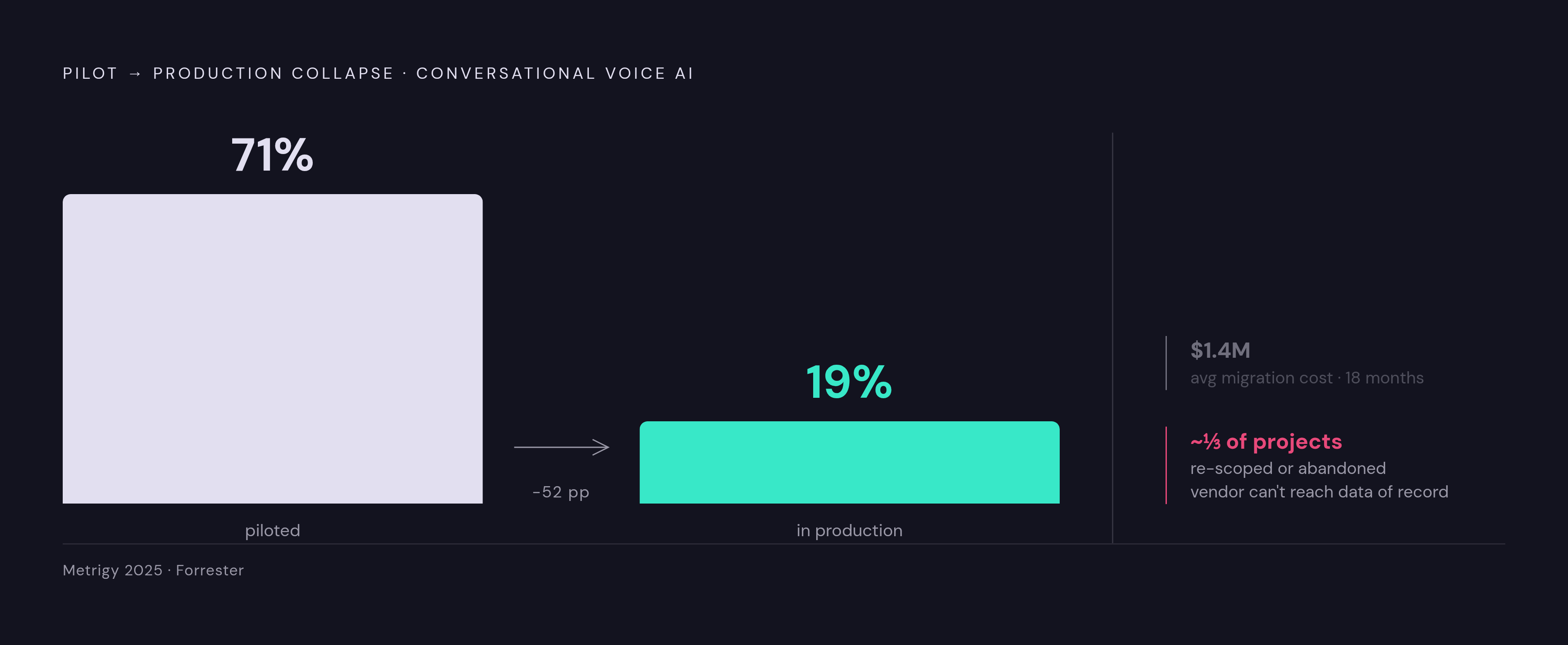
Metrigy's 2025 research found that 71% of enterprises running legacy IVR had piloted conversational voice AI. Only 19% had moved any traffic into production. The blocker in almost every case was integration debt: the gap between the voice layer and the CRM, helpdesk, and telephony infrastructure that actually runs the business. Forrester pegs the average IVR-to-AI migration at $1.4 million over 18 months, with roughly a third of projects re-scoped or abandoned because the vendor could not read and write to the customer data of record. That is a scoping failure that could have been identified in the first week of evaluation.
Voice also introduces a latency constraint that chat simply does not face. The full speech-to-text, LLM reasoning, and text-to-speech pipeline must complete fast enough that the pause sounds like thinking rather than buffering. Traditional transcription engines enforce silence buffers of 700 to 1,000 milliseconds before finalizing text; newer approaches bring that to roughly 250 milliseconds by decoupling turn detection from transcription. The end-to-end target for a conversation that feels natural is sub-second response from the moment the user stops speaking. Miss that target consistently and the agent sounds broken regardless of how accurate its answers are.
SIP integration is where many vendor evaluations break down in practice. A voice agent that works in a contact center must connect to telephony infrastructure, not just a web widget. Real-time voice usage at Speechmatics grew 4x year-on-year in 2025, outpacing batch processing growth of 93% over the same period. Platforms built around conversational voice agents, such as ElevenLabs, expose the full speech-to-text and text-to-speech pipeline via developer APIs precisely to meet this kind of production demand. Enterprise demand is moving toward real-time voice, and the infrastructure requirements are moving with it regardless of whether procurement timelines have caught up.
What low-latency voice infrastructure looks like in a CRM context
The pipeline for a voice agent is speech-to-text, LLM reasoning with CRM function calls, then text-to-speech. Each handoff adds latency. Latency compounds. The math is unforgiving.
Current vendor benchmarks illustrate the range. Cartesia's Sonic-2 architecture, built on State Space Models rather than transformers, reports 75 milliseconds time-to-first-byte as of May 2026, with AWS research citing 40-millisecond delivery for enterprise TTS. State Space Models offer more consistent low latency at P99, which is the number that actually matters in production: average latency is a marketing figure, and P99 latency is what your worst-day customers experience.
Multilingual deployment complicates this further. A voice agent handling contacts across languages needs native-quality output per language, not translated output carrying source-language prosody. That artifact is immediately perceptible to native speakers and accumulates into trust erosion across thousands of interactions in ways that never surface in CSAT scores until they suddenly crater.
The architectural question that carries the most weight: does the voice provider expose a real-time API with function-calling support, so the agent can query the CRM mid-utterance rather than only before or after the call? Without that capability, the voice layer and the data layer are operating independently. The integration promise is technically present but functionally incomplete, which is a polite way of saying it doesn't actually work.
Per the 2026 Voice Agent Report, 87.5% of builders are actively building voice agents in production. These are live engineering decisions, not roadmap considerations.
The business case for integration depth over speed of deployment
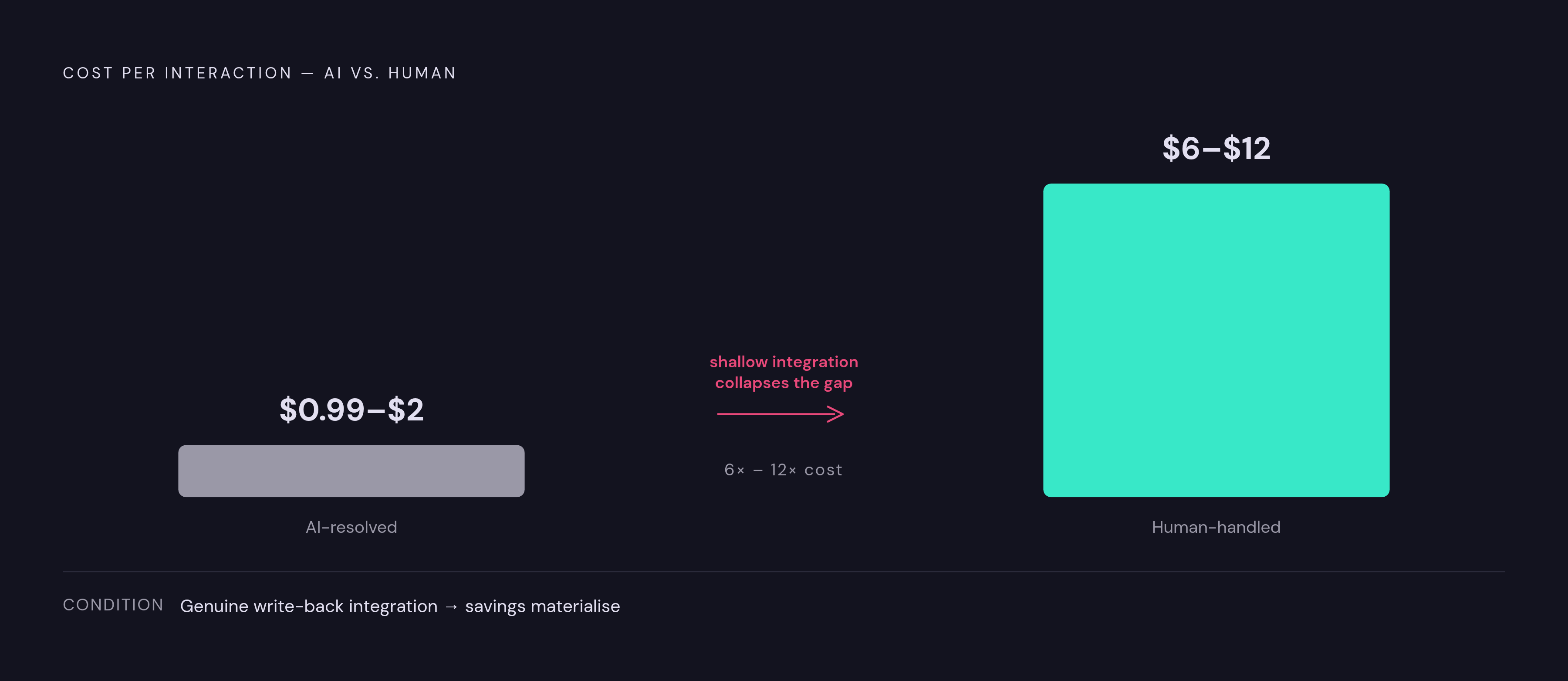
AI-resolved tickets average between $0.99 and $2.00 per interaction in 2026 industry data, compared to $6 to $12 for human-handled tickets. That per-interaction cost reduction is the figure vendors lead with in every sales conversation, and it is real, conditionally.
The condition: the savings assume the agent actually resolves the ticket. Shallow integrations that cannot read live order status or write to ticket fields push interactions to human agents anyway. The cost savings disappear; the overhead of the AI layer remains. You have paid to add a layer that performs the appearance of resolution without achieving it.
Escalation quality is the underrated variable in this math. How much context travels with the handoff determines how long the human agent spends on triage versus resolution. Seamless handoffs, where summaries and structured context travel with the transfer, reduce average handle time for escalated cases even when the AI cannot fully contain the interaction. The customer does not repeat themselves. The agent does not re-triage from scratch. That efficiency compounds across thousands of interactions monthly, and it shows up in handle time metrics before it shows up anywhere in the vendor's marketing materials.
The $1.4 million IVR migration figure is a ceiling, not a floor. Integrations scoped correctly from the start, with a vendor that can demonstrably read and write to the data of record, avoid the re-scoping cycles that inflate that number. The teams that skip the integration audit at the beginning are, reliably, the ones writing retrospective case studies about difficult migrations two years later.
What a well-integrated agent deployment looks like end to end
An inbound voice call or chat initiates a session, and the agent pulls open tickets, account tier, and last interaction from the CRM before generating its first response. The customer does not know this happened. To them, the agent simply already knows who they are. That seamlessness is the entire point, and it requires deliberate engineering to achieve.
Mid-conversation, the agent calls the order management or billing API via function calling, retrieves live data, and responds with a specific answer. Not "I'll look into that for you." A date, a status, a confirmation number.
When the agent resolves the issue, it writes a resolution tag, updates the ticket status, logs an interaction summary to the CRM record, and triggers a follow-up survey if the SLA was met. The CRM record is more complete after the interaction than before it. This is the part most deployments quietly omit.
When it escalates, the agent packages account history, issue category, and steps already attempted into a structured handoff. The human agent receives it in the helpdesk interface before picking up the call or chat. They know the situation before they say hello.
Cognigy's enterprise deployments across Lufthansa, Bosch, Toyota, and Mercedes-Benz represent this pattern operating at scale across both voice and digital channels. The customer experiences one continuous interaction, not a sequence of re-introductions to progressively more frustrated agents.
What to evaluate when choosing or building an integrated agent
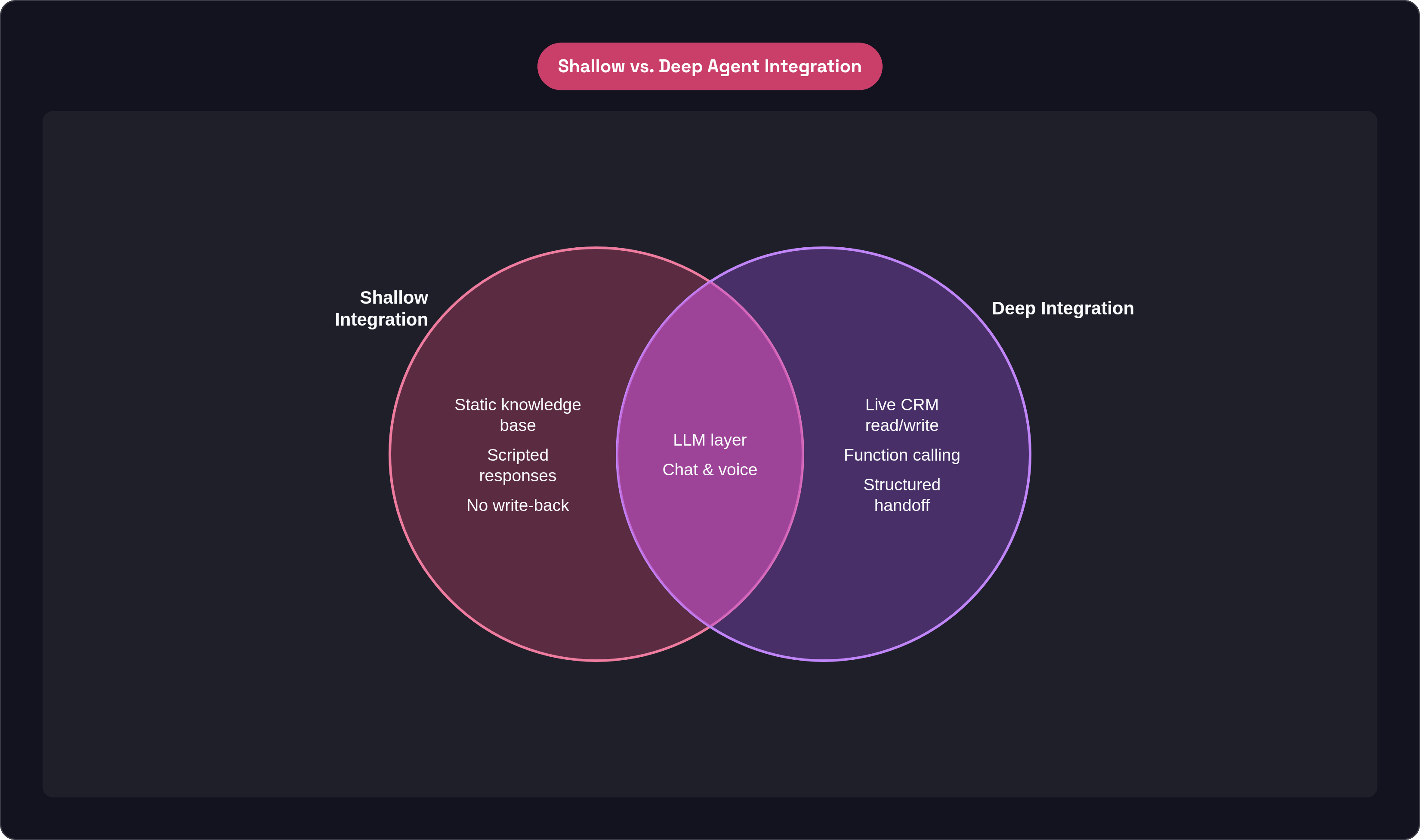
Integration depth. Can the agent read and write to your CRM and helpdesk fields, or only query a knowledge base? Which records are accessible, and are they live or cached? Cached data is a common shortcut that eliminates most of the agent's practical value without appearing anywhere in the demo. Ask specifically.
Latency profile. For voice channels, what is the vendor's time-to-first-byte under production load? Is the pipeline cascaded or end-to-end? Demand P99 latency figures, not averages. P99 is what your customers experience on a bad day, and bad days are when customer service actually matters.
Multilingual coverage. Does the platform deliver native-quality output in the languages your customer base uses, or translated output that carries source-language artifacts? This difference is perceptible at scale and will show up in your NPS before it surfaces in your vendor review.
Handoff protocol. How is context packaged when the agent escalates? Does it arrive in the helpdesk interface, or does the human agent have to check a separate system? That answer determines whether your contact center friction decreases or simply relocates.
Write-back and auditability. After the interaction closes, what data does the agent write to the CRM? Is there a log of what actions were taken, against which records, and under whose authority? In regulated industries this is not optional; in any industry it is how you diagnose what is actually happening at scale.
Build versus buy versus compose. Some teams will use a platform's native agent builder: Agentforce, Breeze, Freddy. Others will compose from API-exposed components, assembling STT, LLM, TTS, and CRM connectors independently. Some tools at this layer are designed specifically for the sub-100-millisecond response window that production voice agents require, with low-latency conversational models built to the constraint rather than adapted to it after the fact.
Vendor model ownership. Platforms that own their foundational models can tune latency and voice quality independently. Platforms fine-tuning commodity models inherit that model's architectural constraints and its latency floor. Know which category your shortlisted vendors fall into before the contract conversation begins, because the answer affects every performance guarantee they can credibly make.
The agents that actually resolve tickets, update records, and hand off context coherently are not the ones with the most sophisticated language models. They are the ones with the most deliberate integrations. Worth knowing before you sign anything.