Streaming TTS for Real-Time Applications
Streaming TTS eliminates the latency gap that makes voice agents sound robotic and unnatural.
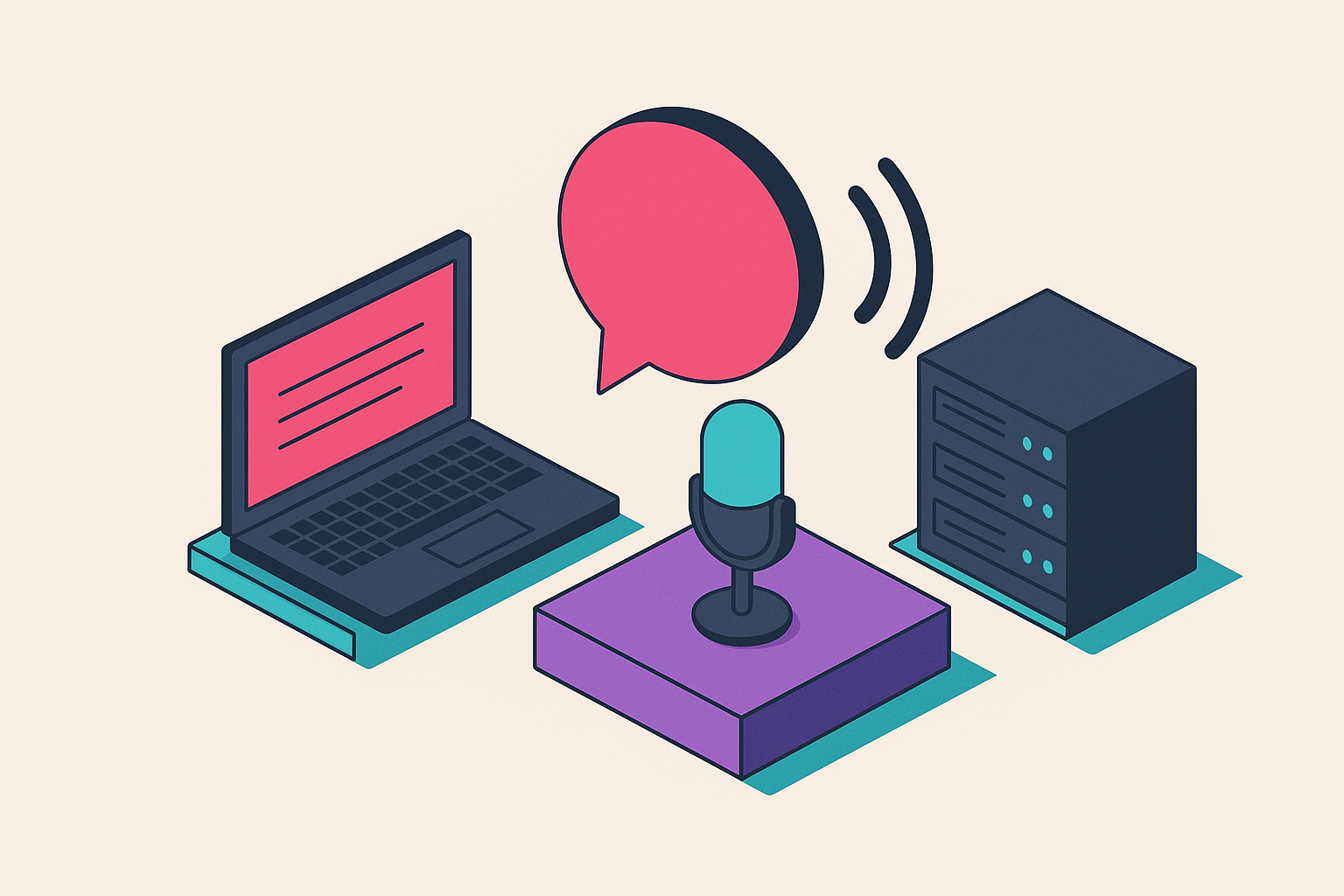
Streaming text-to-speech solves a problem regular TTS was never built for: text that doesn't exist yet. The old pipeline waits for a finished sentence, renders a complete audio file, hands it over. Streaming TTS starts talking before the sentence is done, and put that on a phone call and the difference stops being academic fast.
Batch TTS works fine when the text already exists somewhere. Audiobooks, e-learning modules, corporate training videos: nobody cares if the system takes eleven seconds before handing over the finished file. The trouble starts the second speech has to respond to something happening live: an LLM spitting out tokens one at a time, a live transcription feed, a voice agent that doesn't know what it's about to say until three words ago. There's no finished sentence to hand the renderer, because nobody's finished writing it. Batch TTS wants a manuscript. Real time hands it pages as they come off the typewriter.
A bigger GPU won't fix that gap. It's a mismatch between what the architecture expects and what the job actually is, and mismatches don't care how much hardware you throw at them.
What first-byte latency actually measures and why 300 ms is the threshold that matters
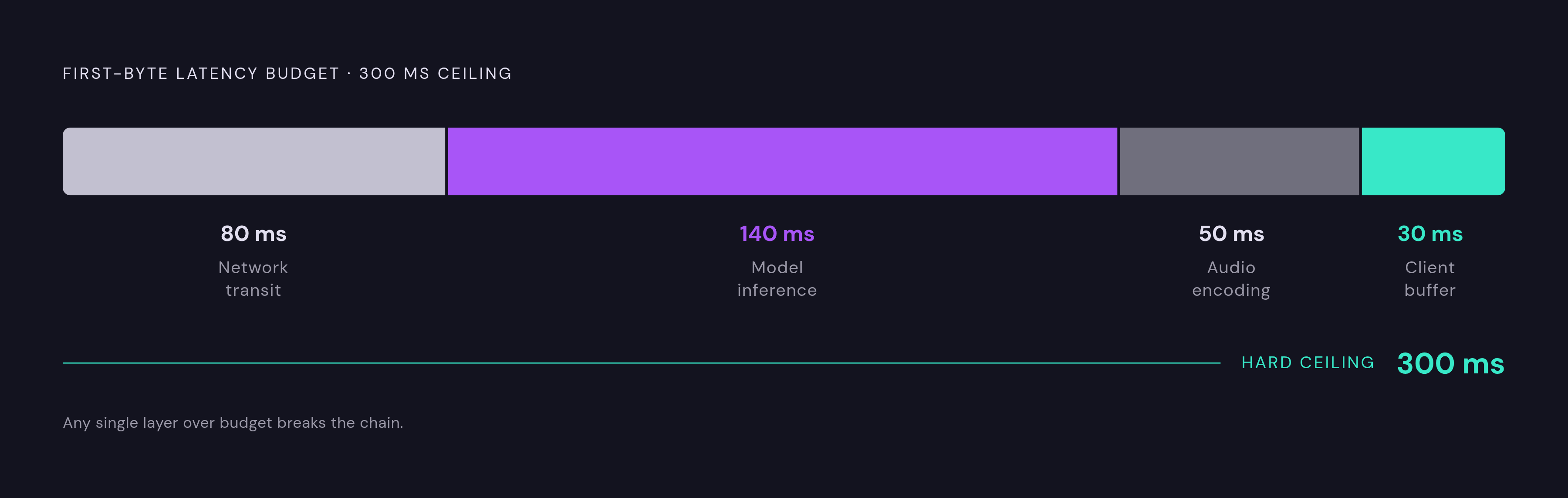
Time-to-first-byte is the clock from the moment text lands in the system to the moment the first chunk of audio hits the listener's ear. It doesn't include total render time, network round-trip, or steady-state throughput once the stream is already running. Keep those numbers separate, because teams that mix them up end up debugging the wrong layer for weeks, chasing a GPU upgrade when the real problem is sitting in the network hop.
The industry has landed on 300 milliseconds for voice bots and phone calls, and the number comes from how people actually talk to each other. The gap between one person finishing a sentence and the next person starting is short. Go much past it and the pause reads as hesitation, whether the listener notices consciously or not. A delay that's unremarkable in a text chat becomes a red flag on a call, since nobody on the other end thinks "the model is thinking." They think the call dropped.
Getting under 300 ms is hard because it's not one thing going right, it's four or five: network transit, model inference, audio encoding, client-side buffering, all stacked in sequence. Blow the budget in any single layer and the whole chain misses the threshold, regardless of how fast the acoustic model itself runs. This is a systems problem before it's a model-quality problem, and it has to get solved in the first draft of the architecture, because bolting it on later doesn't work.
How streaming TTS architecture works: chunked text input, incremental audio output
The idea is simple to say and a pain to build well: feed the model text in pieces, let it start producing audio before it's seen the whole thing. Chunk size is the decision everything else hangs on. Too small, and you get audible seams, little catches in the prosody where the voice sounds like it's gasping for air in the wrong spot. Too large, and you've quietly brought back the latency you were trying to kill.
Most systems split on sentence or clause boundaries, since punctuation gives a natural seam without wrecking the rhythm of the speech. Others split on token count with a short look-ahead so they don't get caught mid-clause. Either way, two jobs have to run at once: the model generates audio for chunk N while it's already ingesting chunk N+1. If either stage sits around waiting on the other, congratulations, you've rebuilt batch processing with extra steps.
Microsoft's VibeVoice-Realtime-0.5B is a decent example of what this looks like in practice. It uses an interleaved windowed design: text gets split into chunks, and the model encodes the next chunk while it's still running diffusion-based generation on the acoustic latents from the one before it. Target time to first audio sits around 300 ms, which lines up with the ceiling everyone in this space is chasing.
Delivery matters as much as generation. Audio goes out over a persistent connection, a WebSocket or HTTP chunked transfer, rather than as a file the client waits to finish downloading. And underneath all of it, the model has to carry prosodic state across chunk boundaries: pitch, speaker identity, pace. Lose that thread and you get audio that's technically fine but sounds like three different narrators took turns, each in a different mood. The same acoustic model, run in batch, can hit identical quality, yet it can't open its mouth until the entire forward pass finishes. The weights alone don't determine whether something feels real-time; the architecture does.
The model research making low-latency, high-quality streaming TTS possible
Early neural TTS treated speech the way language models treat text: one token at a time, sequentially, autoregressively. VALL-E is the reference point. The output sounded good, but it wasn't fast, because sequential generation is sequential generation no matter what GPU you throw at it, and the approach dragged along its own baggage: repetition artifacts that crept in from the token-by-token structure itself.
The real break came from non-autoregressive and flow-matching approaches, which stop tying audio quality to the need to generate one token after another. Once decoding happens in parallel, the bottleneck that made autoregressive models slow by design just goes away. F5-TTS is the model that made this real: it treats TTS as conditional flow matching, drops the explicit phoneme aligners and duration predictors older pipelines needed, and produces expressive output across English, Chinese, and code-switched speech. It's become the baseline everyone building real-time TTS quietly measures against.
The efficiency gains from that lineage aren't small. Fast F5-TTS reports a real-time factor as low as 0.030 at seven generation steps (Interspeech 2025), meaning it synthesizes audio in a fraction of the time it takes to say the words out loud. ZipVoice runs several times faster than earlier diffusion baselines, and shortcut flow matching methods, R-VC included, get generation down to a single step or a handful of them without giving back the quality flow matching bought in the first place.
Once a chunk synthesizes faster than it takes to speak, real-time factor under 1.0, the pipeline keeps audio flowing without the buffer running dry mid-sentence. The model stops being the bottleneck. On voice cloning, flow-matching models have gotten good enough that speaker embedding similarity on unseen speakers can match or beat ground-truth references. That means voice identity can stay stable across a session, even as the model generates audio incrementally.
Where streaming TTS is non-negotiable: voice agents, telephony, and live narration
Picture a voice agent mid-call. The LLM is generating its reply one token at a time, same as always. A streaming TTS layer starts speaking the first sentence while the LLM is still figuring out the second. Two streams running at once, interleaved, sounding like a person talking instead of a machine reading a finished script with a delay bolted to the front. That interleaving is the entire trick, and it only works if both halves actually stream.
Customer service has moved on this fast, going from a small slice of AI-handled interactions a few years ago to the clear majority now, with adoption headed toward near-universal. That's a lot of phone calls resting on sub-300-millisecond TTFB.
Telephony piles its own constraints on top, and none of them are negotiable: fixed sample rates, low-bandwidth codecs, tight jitter tolerance, layered over the latency requirement. A batch system can't meet that list, period, no matter how good the voice sounds played back in isolation. Klarna's AI agent rollout shows what this looks like at scale: workload equivalent to hundreds of employees, tens of millions of dollars saved. At that volume, a latency failure isn't a hiccup; it's a line item.
Live narration is the other place batch rendering simply can't work: financial dashboards reading numbers as they update, sports commentary, real-time translation earpieces. The words don't exist until the instant before they're spoken, so there's nothing sitting around to pre-render. Talkpal AI rolled out real-time TTS to millions of users and saw measurable gains in feature usage and retention within weeks, which is a fairly blunt signal that latency isn't a backend detail. Users feel it.
People also talk over machines, on purpose and by accident, and a streaming pipeline has to cut audio cleanly the second a user starts speaking. That means interrupt signaling built into the streaming layer itself, not stapled on at the application level after the fact.
Comparing streaming TTS APIs on the dimensions developers actually optimize for
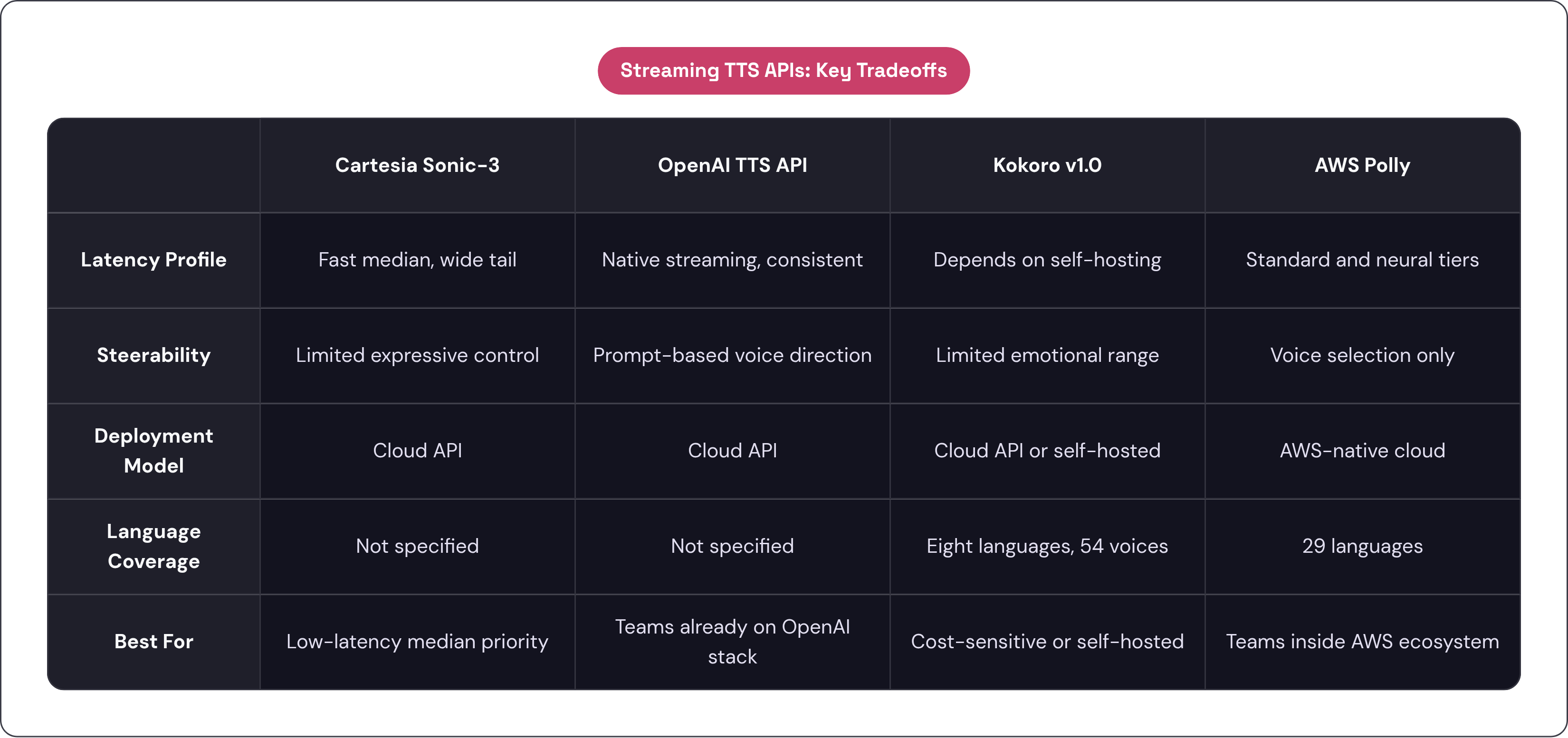
Median TTFB gets all the attention in marketing copy, and it's the wrong number to chase by itself. Tail latency, the worst-case spread, matters just as much: a system with a great median and a wide tail means some fraction of calls feel laggy and unpredictable, and live conversation has no tolerance for unpredictable.
Cartesia Sonic-3 posts a faster median TTFB in comparable benchmarks, but the spread runs several times wider, a contrast that also shows up when comparing against platforms whose voice cloning APIs are built around proprietary foundation models rather than fine-tuned commodity ones. That's the tradeoff in plain terms: a fast average that may not survive contact with real traffic, where variance is what actually costs you user trust.
Some proprietary APIs lean on prompt-based steerability, telling the model how to speak (calm, upbeat, whatever the moment needs) through the same interface pattern teams already know from their existing stacks. That cuts integration work considerably for anyone already building on those platforms, and the best of them stream natively rather than as an afterthought bolted onto a batch system.
On the open-weight side, Kokoro v1.0, an 82-million-parameter open-weight model, runs under a dollar per million characters through a cloud API or self-hosted, and covers 54 voices across eight languages at 24 kHz. The catch: your team now owns the infrastructure, and the emotional range sits below what the top proprietary models manage. AWS Polly covers dozens of voices across 29 languages with standard and neural tiers, and for teams already living inside AWS, it's the path of least resistance, not the path of maximum quality.
No vendor wins on every axis at once. The right pick depends on which constraint is actually binding: latency consistency, language coverage, expressive range, cost per hour of audio, or compliance rules that rule out certain deployments entirely.
Implementation decisions that determine whether a streaming TTS integration actually performs
Format choice matters more than people give it credit for. Telephony wants PCM at 8 or 16 kHz mono. Web streaming does best on MP3 at 128 kbps or OGG Opus. Broadcast wants WAV at 44.1 kHz stereo. Send the wrong format through a codec chain built for something else and you'll get artifacts that make even a genuinely good voice model sound cheap.
Buffer size is its own balancing act. Too small and the client stutters every time the network hiccups. Too large and you've added latency the user can feel even while your TTFB dashboard looks clean. For voice agents specifically, a small buffer paired with aggressive prefetching beats the bigger, safer-looking buffer nearly every time.
On the text side, chunking at sentence or clause boundaries keeps prosody intact in a way fixed token counts don't manage. A short look-ahead, holding one punctuation-terminated unit before sending it downstream, costs a few milliseconds and buys noticeably more natural output. Pronunciation is the other quiet failure point: brand names, product IDs, acronyms, anything domain-specific trips TTS up reliably. Build the custom pronunciation dictionary before launch, not after the first support ticket comes in.
Interrupts need to cut cleanly at the WebSocket or stream level, draining the pipeline instead of leaving orphaned audio sitting in a buffer somewhere. Across a multi-turn conversation, voice consistency doesn't happen by accident either: speaker embedding or voice ID state has to get passed explicitly with each call. Assume the session carries it implicitly and you'll end up with a voice that drifts halfway through a conversation without anyone noticing why. In production, track TTFB per request instead of averaged, watch buffer underrun rates, and monitor chunk delivery timing directly. Those numbers tell you whether the system holds up under real traffic, and a demo environment won't.
What streaming-native architecture makes possible beyond lower latency
Streaming-native models with cross-lingual voice identity let one voice narrate across several languages in a single continuous session, no reset needed. That opens the door to live dubbing and real-time translation that keeps the speaker's identity intact instead of swapping in a generic voice the moment the language changes.
There's a compounding effect when the LLM and the TTS layer both stream: the end-to-end system produces audible speech within the LLM's own first-token latency window, and the two pipelines interleave into something that sounds responsive as a whole, even though neither half is doing anything magical alone. Streaming also opens the door to adjusting prosody mid-stream: pace, emphasis, tone, tuned off live signals like conversation context, without restarting synthesis from zero.
There's an economics angle too. For content that's different every time, personalized responses, live data feeds, generating on the fly is cheaper than pre-rendering and caching audio files that will get played exactly once.
Voice is becoming background infrastructure now, woven into products that used to be text-only by default, and all of it depends on a TTS layer that clears the 300-millisecond bar reliably, at scale, across languages. Teams building on streaming-native architecture now are building on something that keeps working as the product grows. Teams still running batch TTS underneath a real-time product are going to hit this wall eventually, later, with more people watching.