Evaluating Conversational AI Agents with Automated Testing Frameworks
Four evaluation layers transform conversational AI from demo-ready to production-reliable.

Deploying a conversational agent takes an afternoon. Keeping one reliable across thousands of live calls or chats takes discipline most teams don't build until something breaks in front of a customer, and usually not until then. This piece covers what automated testing actually needs to cover: four layers of evaluation (single-turn correctness, multi-turn coherence, goal completion, and latency) that separate a demo from something you can put in front of paying customers at 2am without flinching. Conversational agents fail in ways ordinary software doesn't. There's no crash log, no stack trace — just a user who got confused, an intent that got missed, or a context window that quietly lost the thread three turns back, and none of it trips an alert.
A demo works because someone picked the inputs ahead of time. Production throws thousands of unpredictable, occasionally unhinged real conversations at the agent and waits to see what snaps. Failures pile up quietly, one mishandled intent at a time, until someone notices the drop-off rate climbing and has no idea why. The real question is whether the agent still works once actual humans start typing or talking to it, at scale, with no script and no patience.
What automated testing replaces and why the old approach breaks down
For years, evaluating a conversational system meant putting it in front of people and watching what happened. That's user testing, and it's the oldest trick in the book: heavily manual, dependent on whoever you could round up for the study, and fine when the systems were simple and the stakes were low. It falls apart once you need to check thousands of sessions a day, because no team has the headcount to read every transcript and grade every turn by hand.
Metrics borrowed from machine translation don't fill the gap either. BLEU and ROUGE measure how closely a generated string matches a reference string, word for word or n-gram for n-gram. That's fine for grading a translation, but nearly useless for telling you whether an agent understood what a customer wanted, or just happened to use similar words while missing the point entirely. Two responses can score identically on ROUGE and differ completely on whether either one actually solved the problem.
Testing built for deterministic software, the kind where the same input always produces the same output, doesn't map onto a system that's probabilistic by design. Automated frameworks define expected behaviors once, run them against the agent continuously, and catch regressions before a real user hits them. Most teams still treat this as a one-time checklist rather than a running process.
The four layers of evaluation that matter for a voice agent
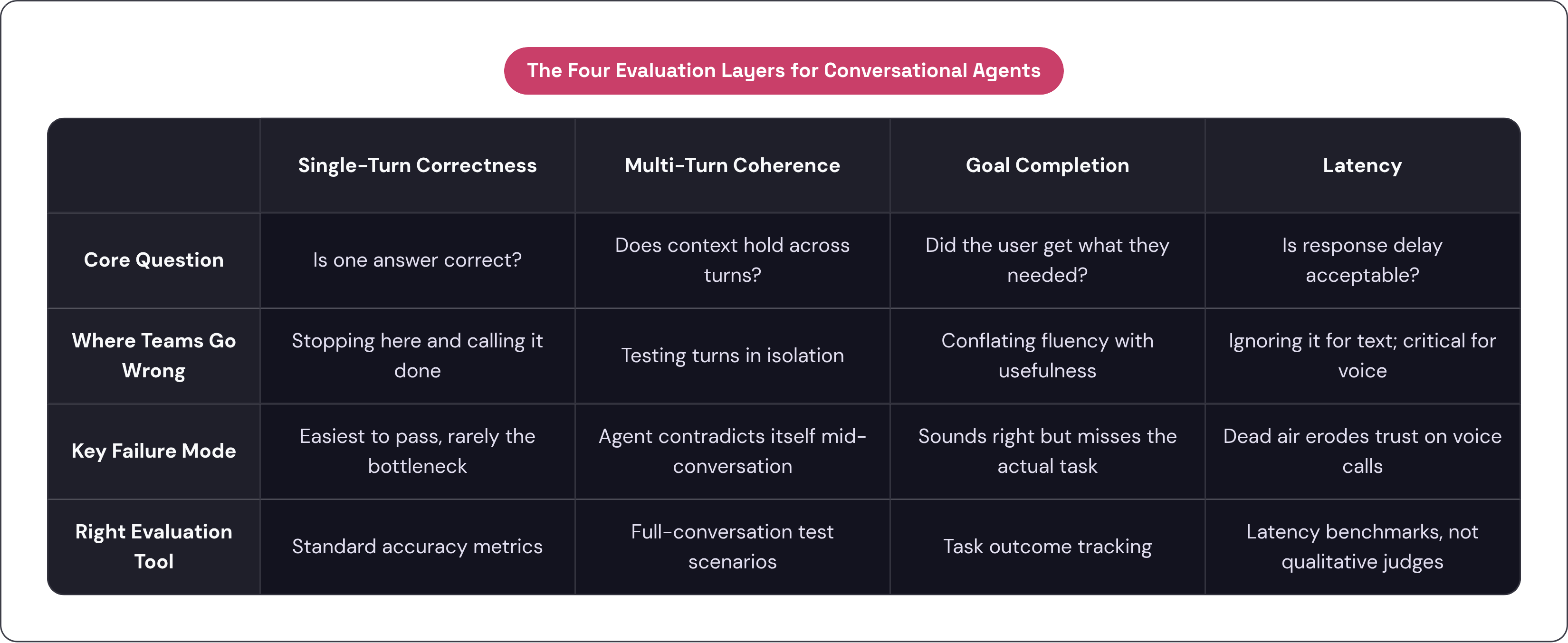
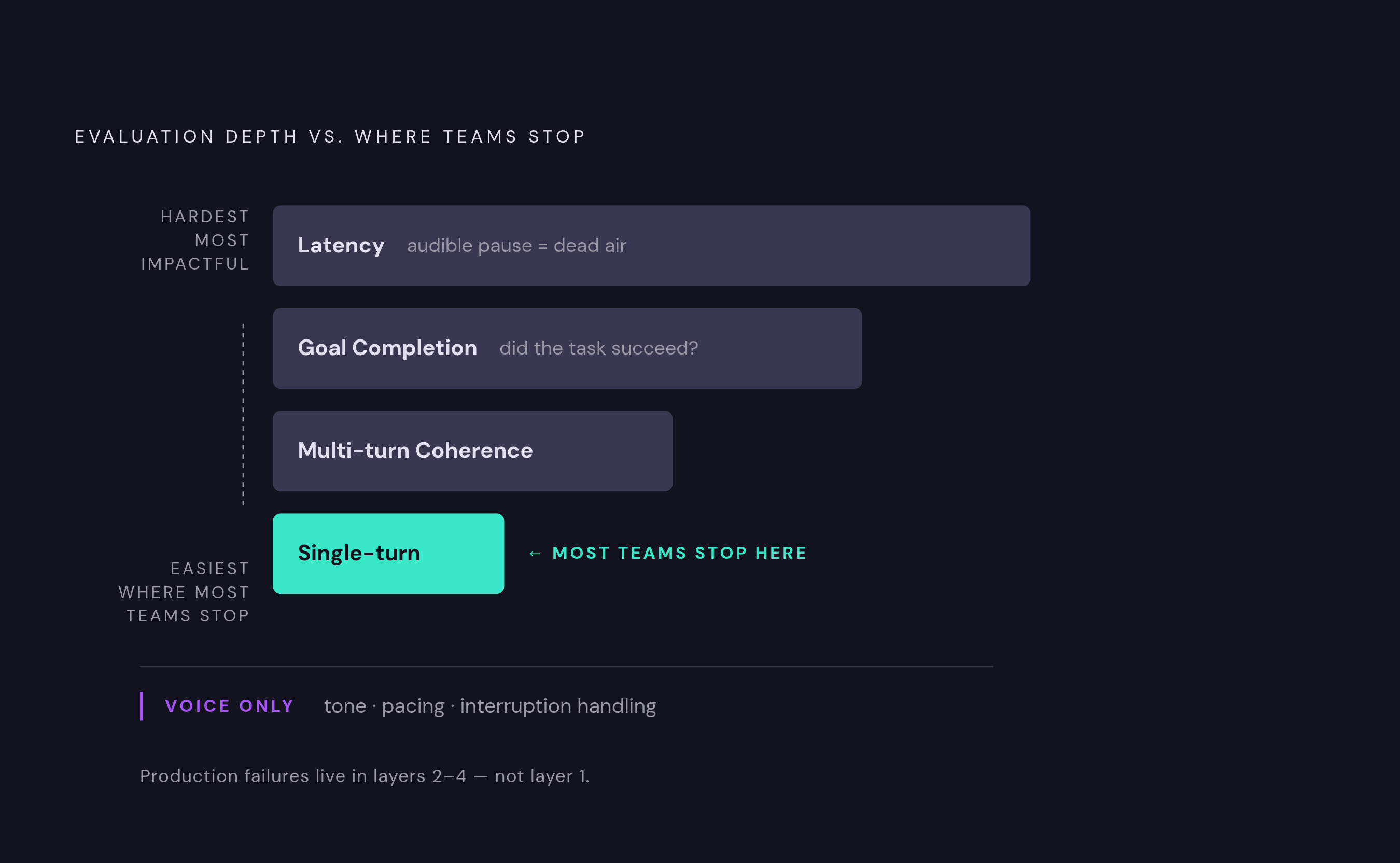
Single-turn correctness is the entry point: does the agent answer a standalone question correctly? It's necessary, and also the easiest thing to get right, which is exactly why so many teams stop there and call it done.
Multi-turn coherence is harder and matters more. Does the agent remember what the user said two exchanges ago? Does it avoid contradicting itself when the user changes their mind mid-conversation? A system can nail every single-turn question in isolation and still fall apart the moment a conversation runs past three exchanges, because coherence lives in the whole conversation, not in any one reply.
Goal completion asks a blunter question: did the user get what they actually needed? An agent can produce fluent, plausible sentences all day and still fail to book the appointment, process the return, or answer the billing question correctly. Sounding right and being useful are different tests, and conflating them is how teams ship agents that read well in a demo and infuriate people in production.
Latency is the layer text can mostly shrug off and voice can't. A brief pause in a chat window barely registers; the same pause on a phone call reads as dead air, and dead air reads as broken, even when the system is still chugging along fine underneath. DeepEval's platform data shows most evaluations running today are still single-turn metrics, even for agents built for long, multi-turn conversations, which is a mismatch between what teams measure and what the product does all day. Voice adds a fifth thing worth watching: tone, pacing, and how the agent handles getting talked over mid-sentence, none of which shows up in a transcript.
How LLM-as-judge evaluation works and where it falls short
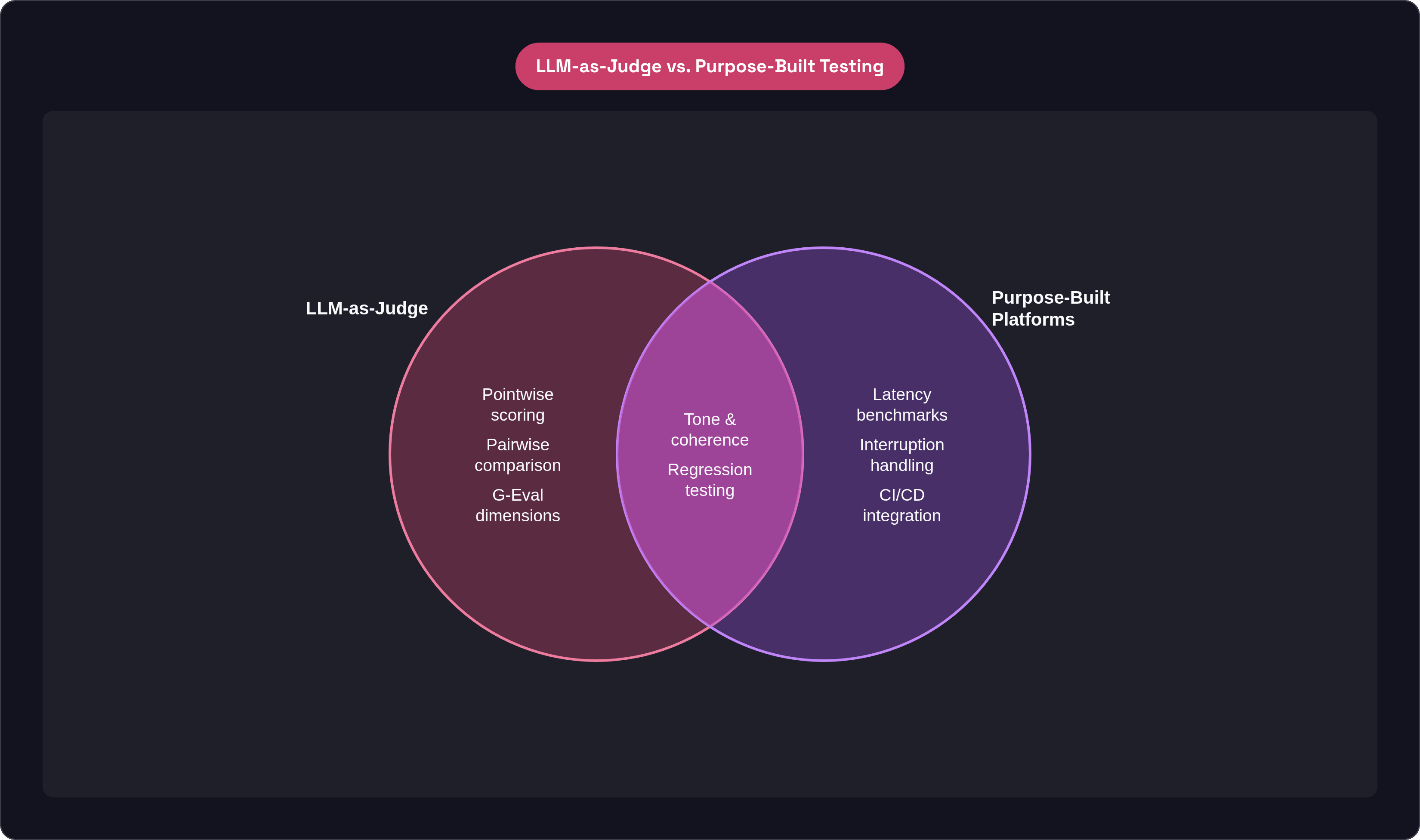
LLM-as-judge means using a language model to grade another language model's output. Write a structured prompt, hand it the response and some criteria, and let the judge score it or pick a winner between two candidates. Two flavors show up in practice: pointwise scoring, where the judge rates one response on something like factuality or tone, and pairwise comparison, where it picks the better of two and explains why.
The appeal is obvious. It scales, it's cheap next to human review, and it catches semantic problems that string-matching metrics miss entirely. But a single LLM judge carries its own preferences, and those preferences aren't neutral: judges tend to favor certain writing styles over others. Nobody's watching for that bias half the time, and the evaluation quietly ends up measuring "sounds confident" instead of "is correct."
G-Eval tries to add some structure here by scoring specific dimensions, things like Human-Likeness, Continuity and Context Understanding, Tone and Clarity, and Task Appropriateness, each on its own scale, instead of asking a judge for one mushy overall impression. A newer approach pushes further: multi-agent evaluation panels, where several LLM agents play distinct roles (one plays the domain expert, one plays the critic, one defends the response) and argue it out before a verdict gets aggregated. It's closer to how a real human review panel works, and it dilutes the single-judge bias instead of pretending the bias isn't there. LLM-as-judge is genuinely useful, though treating it as a rubber stamp is how the whole exercise goes sideways.
What purpose-built voice and chat testing platforms handle that general frameworks don't
LangChain, LangGraph, AutoGen, Rasa: these frameworks handle orchestration and dialogue management, and they're good at that job. Whether a voice agent's latency is acceptable, or whether its tone lands right, was never part of that job description.
Purpose-built testing platforms fill the gap with tools built around the actual failure modes: automated scenario generation pulled from an agent's own description or knowledge base, metrics tuned to voice specifically (latency, how the agent handles interruptions, tone, satisfaction scores), and A/B testing that runs different models or prompts against the same scenario set so the comparison holds up. Cekura, a Y Combinator-backed platform, covers chat testing over WebSocket or API, watches production traffic for conversation drop-offs, and plugs into voice infrastructure providers. Botium takes a different angle: an open testing framework that simulates conversations, runs regression suites, and slots into CI/CD pipelines, which suits teams that want to own their own toolchain instead of buying into someone else's platform wholesale. QBox goes narrower still, focused on NLU accuracy: benchmarking intent recognition and entity extraction so a team catches misclassifications before a customer does.
These tools win by covering the specific ground a general framework skips. A customer-support voice agent needs latency and tone data that a text-only LLM eval harness just doesn't produce, no matter how well that harness does its own job.
The multi-turn and agentic testing gap that most teams underestimate
Here's the trap: an agent that plans, takes actions, and completes a multi-step task can land on the right final answer through completely broken reasoning along the way. Grading only the outcome misses that entirely, and an agent that stumbles into a correct result is fragile; it's one unlucky scenario away from falling apart in front of someone who matters.
Traditional evaluation checks success or failure at the end of a task and stops there. What it skips: whether the agent used its tools correctly along the way, what it decided at each intermediate step, whether it recovered gracefully from an error, whether it drifted off-context somewhere in the middle. Research on the Agent-Testing Agent, published in August 2025, tackles this with a meta-agent approach: static code analysis, interrogating the agent's own designers, mining relevant literature, and generating adversarial test personas whose difficulty adjusts based on how the judge responds. The point is surfacing failures a fixed test suite would never think to go looking for.
Voice agents feel this gap harder than text agents do. A wrong assumption in turn three doesn't stay contained to turn three; it shapes everything that follows, and a person on a phone call rarely stops to correct the agent the way someone typing in a chat window might. A test suite that only runs isolated question-answer pairs is testing an easier, imaginary product, not the one that's actually taking calls.
Fitting automated testing into a deployment pipeline, not just a pre-launch checklist
Testing that happens once, before launch, and never again misses the most common way these systems actually fail: slow drift after a model update or a prompt tweak that looked harmless at the time. Nobody notices the agent got 8% worse at billing questions until three weeks of complaints have piled up in the support queue.
CI/CD integration closes that gap. Frameworks like FastAgency's Tester Class and Botium run inside a deployment pipeline, firing test suites on every push and catching regressions before they reach a live customer. Enterprise setups need a staging environment too, somewhere to run realistic conversation scenarios against a changed agent before it touches production traffic. Versioning matters for the same reason: running two agent versions side by side lets a team compare them honestly before committing to a full rollout. Call it A/B testing at the level of the whole agent, not just a swapped prompt.
Production observability is what actually closes the loop. Watching response speed, success rates, drop-off points, and cost in real time surfaces problems no pre-launch test predicted, because a pre-launch test can only check for what somebody thought to check for. The healthy version of this setup feeds production failures back into the test suite, so coverage grows out of what real users actually did wrong, not out of what the team guessed they might do.
What this means specifically for voice agents built on real-time infrastructure
Voice runs under a constraint text never deals with: a delay a person can hear. There's no chat-window equivalent of dead air, no silence that erodes trust the way a pause on a phone call does.
Latency that a person can hear is the line between an interaction that feels like talking to a person and one that feels like talking to a machine that's thinking too hard about it. Testing for that means latency benchmarks sit next to quality metrics, not somewhere further down the list. The architecture underneath is shifting too: end-to-end speech-to-speech models, audio in and audio out through a single inference loop, remove the seam between speech-to-text, the language model, and text-to-speech that cascaded pipelines used to expose. That seam used to be a common spot for errors to creep in. Its disappearance doesn't mean fewer failure modes; it means new ones show up at the audio input and output layer instead, and those need their own tests, not hand-me-downs from the text world.
Klarna's deployment of real-time conversational agents reaches tens of millions of customers in the US, and Deliveroo runs the same category of system for outbound rider onboarding. Those are the reference points for what a production-grade voice agent looks like once it's carrying real call volume. ElevenLabs, an AI audio platform that provides the text-to-speech, voice cloning, and real-time conversational voice agent infrastructure that teams build on, is one example of the underlying layer where latency and audio quality ultimately get determined. Testing a system like that means simulating the full audio pipeline under realistic conditions, since checking the language model's text output in isolation tells you almost nothing about how the finished product sounds to someone holding a phone to their ear.
Building a testing strategy that scales as the agent does
Start with all four layers covered, not just the easy one. Single-turn correctness, multi-turn coherence, goal completion, and latency each need different tools and different metrics, and skipping one because it's harder to measure just means that failure mode ships quietly and waits.
Match the evaluation method to the failure you're actually hunting. LLM-as-judge earns its keep on qualitative dimensions like tone and coherence; specialized NLU benchmarking is the right tool for intent accuracy; latency needs a stopwatch, not a judge with opinions. Build in adversarial and edge-case scenarios from day one too, because the interactions that feel too unlikely to bother testing are usually the ones a real user stumbles into within the first week of launch.
Treat the test suite as something that keeps growing, not something that sits finished on a shelf after launch day. Production observations should keep expanding what gets tested, continuously, feeding into the same test plan rather than sitting in a separate dashboard nobody checks. What separates a proof-of-concept from a production system was never just model quality; it's whether the team can say, at any given moment, exactly how the agent is performing and why. Most teams that skip this discipline find out the hard way, usually from a customer rather than a dashboard.