Conversational AI vs Generative AI for Customer-Facing Products
Use generative AI for what it writes; use conversational AI for what it decides.
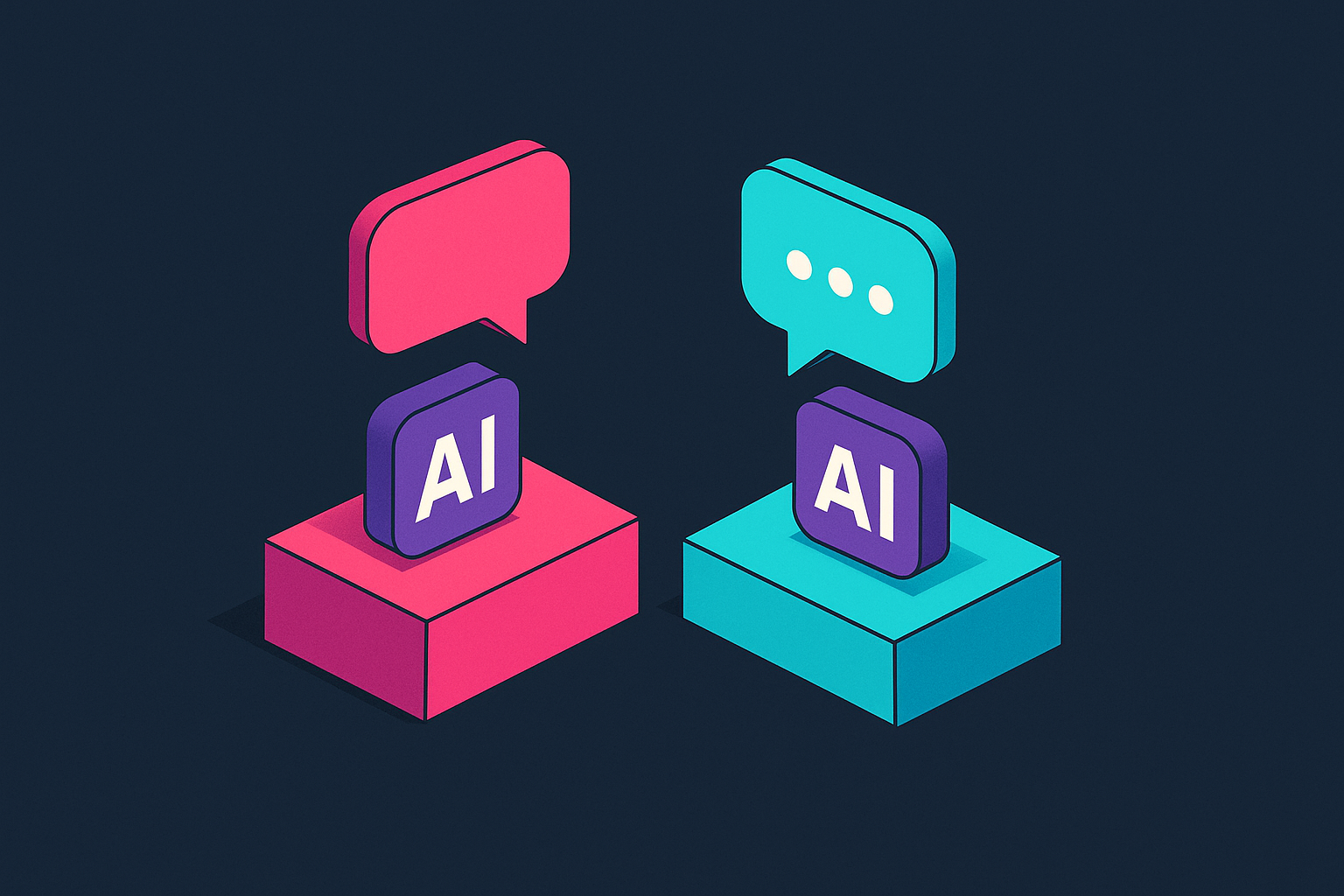
I spent three years watching product teams argue about which "AI" to buy before anyone asked what the AI was actually supposed to do. The fight was never resolved because the question was wrong. Generative AI and conversational AI are different organs doing different jobs, and most of the deployment wreckage I've stepped over traces back to someone using a liver where they needed a heart. Generative AI writes the sentence. Conversational AI decides whether the sentence should exist yet. Mix those up and you either get a chatbot that talks beautifully and accomplishes nothing, or one that gets things done while sounding like a toll-booth from 2009.
What generative AI actually does inside a customer product
A generative model predicts the next token, the next pixel, the next slice of waveform, based on patterns it absorbed during training. That's the whole trick. It has no idea it's mid-conversation, no idea whether the person on the other end is furious or three seconds from hanging up. You hand it a prompt, it hands you an output, and it walks away without checking whether the output actually helped anyone.
On its own, that's a problem. As one piece of a bigger system, it's fine, even good. Generative models are the right tool for drafting a reply, spitting out product copy at a scale no human writing team could match, summarizing a pile of support tickets, or generating narration and dubbed audio. I'd trust one to write ad copy before I'd trust it to know when to stop talking.
The trouble starts when a team ships the generative output as the finished product instead of one ingredient in it. Left unsupervised, it'll invent a refund policy that doesn't exist, or confidently answer a question nobody asked, because "done" was never part of its training signal. This is roughly where a company like ElevenLabs lives in the stack. Its text-to-speech and dubbing models generate the audio. Full stop. They don't decide what the customer needs next; something else in the pipeline has to own that.
I once watched a colleague debug a chatbot that had, with total confidence, offered a customer a lifetime supply of free shipping. The model wasn't broken. It was doing exactly what generative models do: finishing the sentence that sounded most plausible. Nobody had told it that "plausible" and "true" are different zip codes.
What conversational AI actually does inside a customer product
Conversational AI solves the opposite problem: it manages the shape of an interaction across time. It figures out intent, routes that intent to the right workflow, keeps context alive across five or ten exchanges, and knows exactly when to punt to a human. It's judged on outcomes, not on how nicely a sentence reads.
This is where support triage lives, along with appointment booking, account changes, sales qualification, anything where success means a finished task instead of a well-turned phrase. The old version of this layer ran on intent classifiers and decision trees: predictable, rigid, and about as charming as a parking meter. Modern systems bolt generative models underneath that workflow logic so the dialogue sounds human while the actual decisions stay structured. Salesforce puts 77% of service organizations already using or planning to use conversational AI. That number tells you this stopped being a pilot project a while back and turned into a line item with headcount attached to it.
Pull the generative layer back out, though, and you're left with something technically functional that everyone quietly hates. Pure rule-based systems feel like arguing with a phone tree that got a fresh coat of paint. The generative layer is what makes the workflow sound like a person instead of an org chart, and most roadmaps still underrate how much that single detail is worth.
The gap between deployment and measurable results
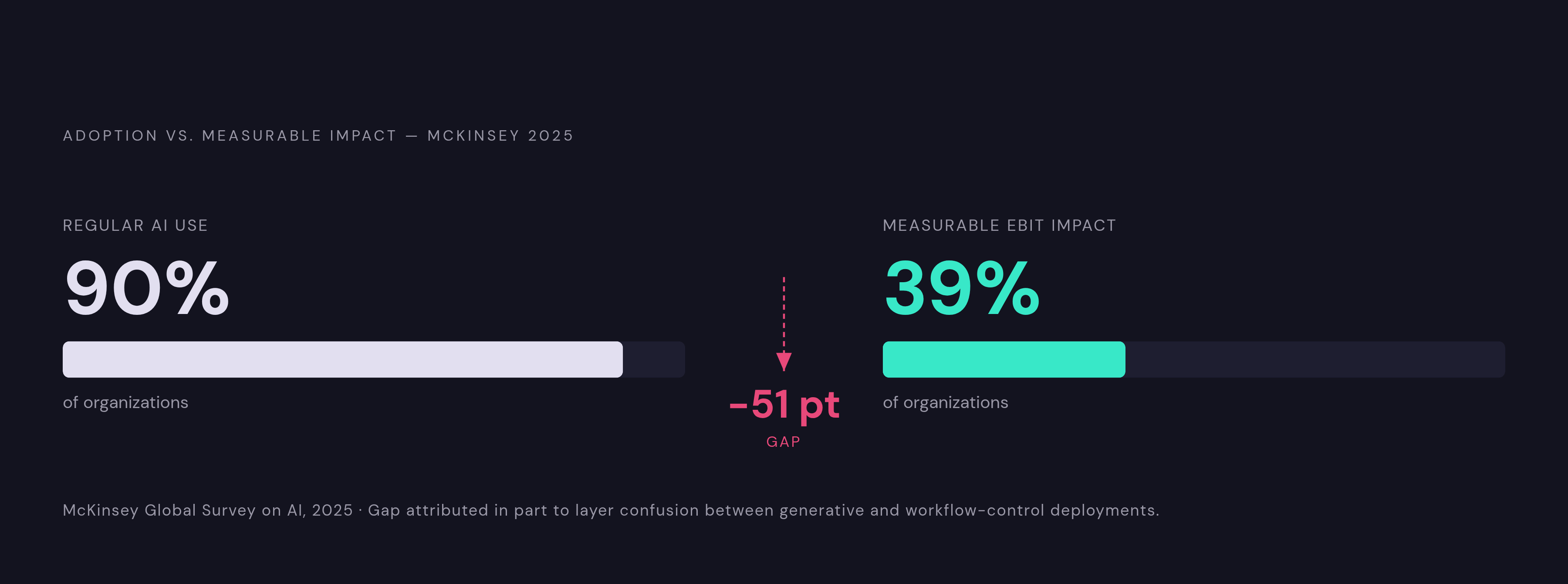
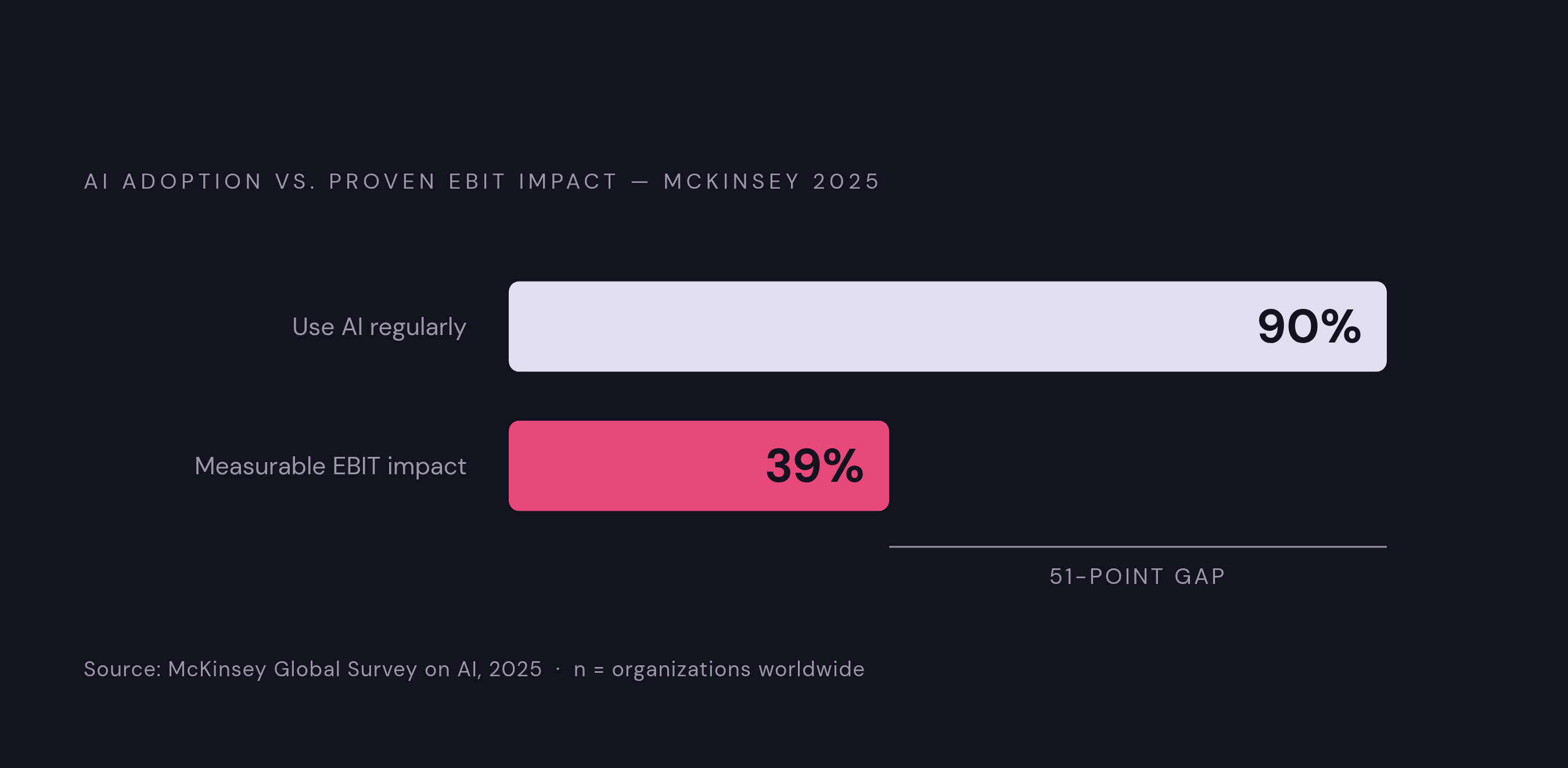
McKinsey's 2025 Global Survey found 90% of organizations use AI regularly. Only 39% report a measurable hit to EBIT. Sit with that for a second: almost everyone's running the thing, almost nobody can point to what it bought them.
A chunk of that gap is exactly this layer confusion. A team deploys a generative model where they actually needed workflow control, and gets eloquent responses that resolve nothing. Or they lock in rigid conversational logic where they needed generative flexibility, and customers bounce off a system that chokes on a question phrased two words differently than the script expected.
There's a customer-side headwind too. Gartner reports 64% of customers still prefer human support, and 53% say they'd switch brands if AI blocks them from reaching a live agent. So companies are racing to deploy AI faster than customers are racing to trust it, which is not a great position to build from. A bad conversational layer doesn't just underperform quietly; it pushes people toward the exit. The real decision was always which layer owns which job, and whether the handoff between them is smooth enough that the customer never notices there were two systems at all.
How the two layers combine in practice
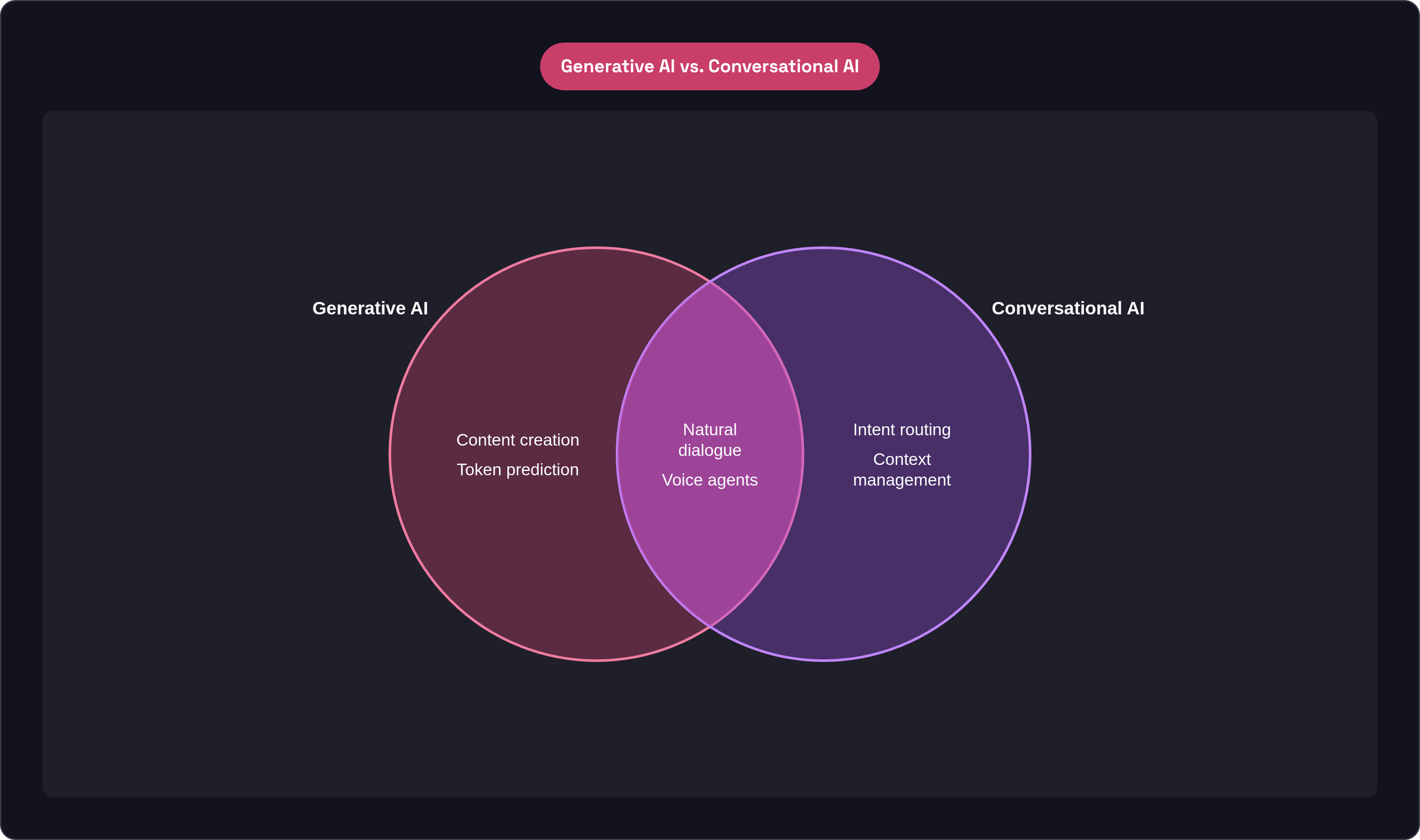
The pattern that keeps winning is hybrid: conversational AI owns the workflow, generative AI supplies the language inside each turn. The conversational system detects intent and routes the user to the right node. A generative model drafts the response within that node. Everything passes through a policy filter before it reaches the customer. Three jobs, three layers, one experience that's supposed to feel like a single conversation instead of a relay race.
Voice makes this obvious in a way text never does. A real-time voice agent needs speech-to-text to hear you, a reasoning layer to decide what to do about it, and text-to-speech to answer you back. Treat that as one blob labeled "AI" and you'll ship something that trips over its own feet mid-sentence. Latency is where the whole architecture either holds together or falls apart in front of a live customer. Real-time voice usage grew 4x year-on-year at some providers in 2025, while batch processing grew 93% over the same stretch. Two different demand curves, stacked on the same infrastructure, and every extra millisecond in the pipeline is something a customer can actually hear.
Fewer seams means fewer places for latency to hide.
What Bank of America's Erica shows about getting the layers right
Erica, Bank of America's assistant, crossed billions of client interactions by August 2025. That's one of the biggest documented conversational AI deployments in financial services, and it's worth a closer look because it shows the workflow layer doing actual work, absorbing traffic that would've otherwise hit a call center and resolving it.
Sixty percent of Erica's interactions are now proactive, meaning the system speaks first. That requires the conversational layer to carry intent forward on its own initiative, deciding a customer needs a nudge about an odd charge before they've typed a word. Integration into the CashPro business banking platform cut live chat volume by more than 40%, which is the kind of number that lands on a cost report, not a satisfaction survey somewhere. Deflection and resolution, both, in the same rollout.
Bank of America also runs a 16-pillar AI governance framework underneath all of it. Which tells you something: at that scale, nobody separates the architecture question from the oversight question. They're the same meeting.
What Erica doesn't show is what happens the moment you take this out of text. It's a chat-first deployment, and voice is a meaner, harder animal entirely.
Why voice is where the layer distinction becomes most consequential
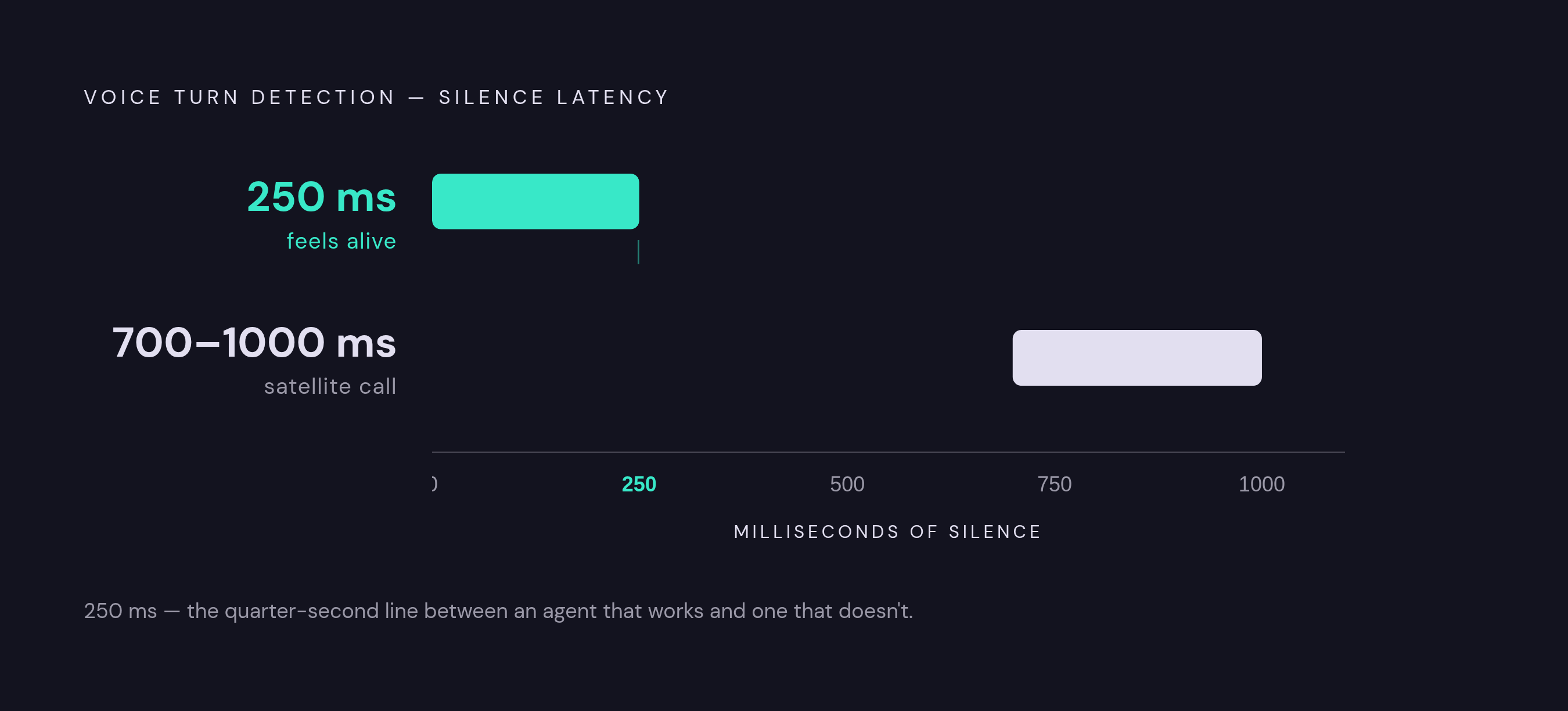
In text, a slightly delayed or clunky response is friction. Annoying, survivable, forgotten in ten seconds. In voice, the same delay shatters the whole illusion, because human speech has a rhythm baked in from childhood, and any break in that rhythm registers instantly, even for someone who couldn't explain why it felt wrong. Latency and naturalness are the experience itself, the way a heartbeat isn't an accessory to being alive.
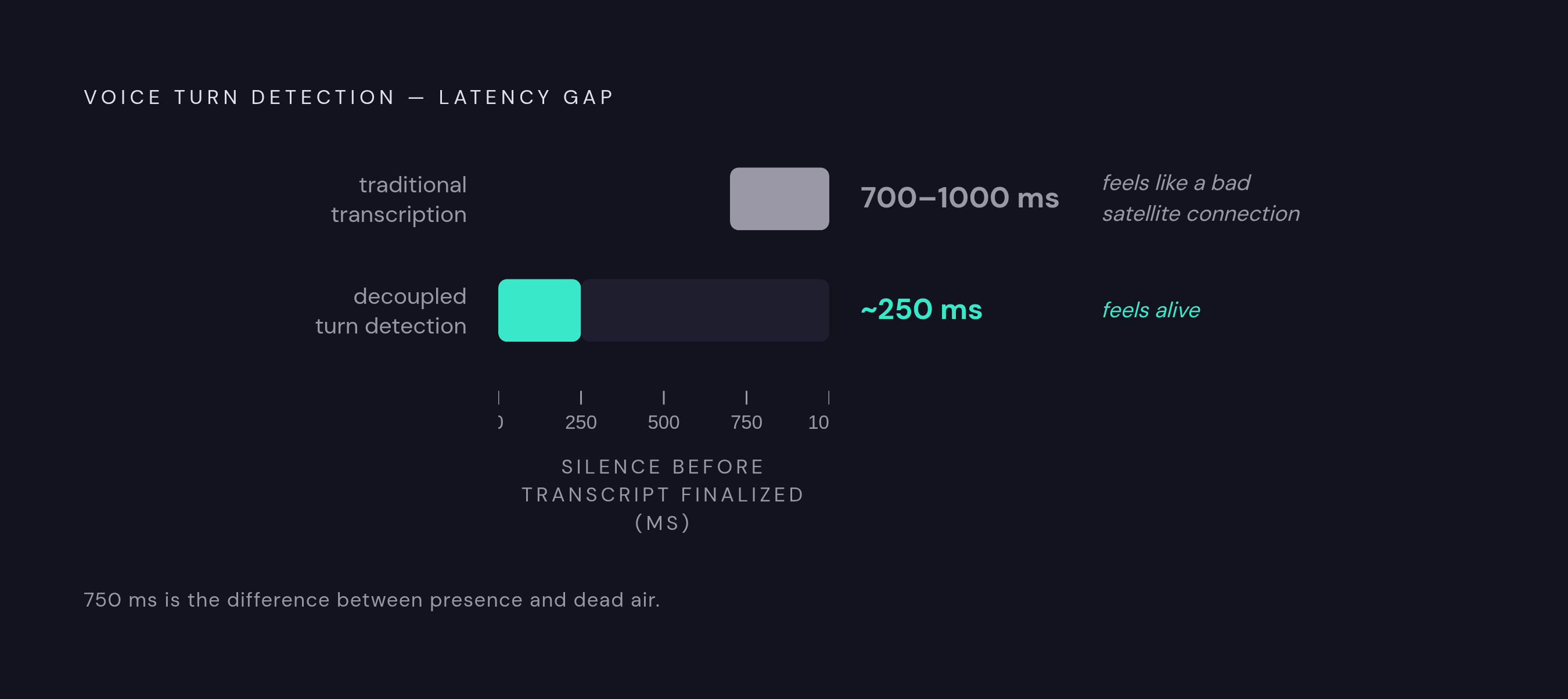
Traditional transcription systems build in 700 to 1000 milliseconds of silence before finalizing what someone said, which is roughly the pause that turns a phone call into a bad satellite connection. Newer approaches decouple turn detection from transcription and get down to around 250 milliseconds from signal to final transcript. Three-quarters of a second versus a quarter second: that's the entire gap between an agent that feels alive and one that feels like it's doing long division in its head before every reply.
The market noticed. The voice AI segment is projected to hit $47.5 billion by 2034, growing at a 34.8% compound annual rate, the kind of curve you see right when a hard technical problem finally becomes solvable at scale. Domain specificity raises the stakes further: medical transcription models trained on clinical conversation show keyword error rates up to 70% lower than general-purpose systems. The same gap almost certainly shows up in legal, financial, and customer service voice work, where flubbing a policy number isn't a bad user experience, it's a liability with a case number attached.
Multilingual deployment as the practical test of both layers
Run your dialogue logic in crisp English and your voice output in a flat, machine-translated approximation of Spanish, and you've built a product with a fault line running straight through the middle. Conversational workflow has to carry intent across languages without losing it in transit, and the voice on the other end has to sound like it belongs to someone who grew up speaking that language, not someone reading it off a translation memo for the first time.
Money is chasing this problem hard. The generative AI market for media localization and multilingual content is projected to grow from $4.18 billion in 2025 to $18.47 billion by 2031, a 28.41% compound annual rate. The common failure mode is lopsided quality: a sharp model for the flagship language, a noticeably worse one for everywhere else, so the conversational experience feels inconsistent across markets even when the underlying workflow logic is identical down to the line.
ElevenLabs covers 70-plus languages at native-sounding quality, and that matters less as a feature on a slide and more as a constraint removed: voice stops being the reason a company can only launch in three markets instead of thirty. Klarna's rollout across 23 markets and 35-plus languages, with measurably faster resolution on routine queries, is a decent example of what it looks like when both layers, workflow and voice, actually pull their weight at the same time instead of one dragging the other down.
How to decide which layer to build or buy, and which to integrate
Start with what the output actually is. Content, narration, a draft, a localized asset: put your money into generative model quality. A completed customer task: put your money into workflow design and dialogue management. Confuse the two and you end up with a gorgeously written chatbot that can't cancel a subscription to save its life. I've watched that exact failure happen at three different companies, and it's never the model's fault; it's always the org chart's fault for putting the wrong team in charge of the wrong layer.
For the generative layer, particularly voice, building in-house rarely pays off. Foundational model quality and latency take years and a mountain of compute to get right, and platform infrastructure usually beats a fine-tuned commodity model on both fidelity and time to market. For the conversational layer, flip the logic: your workflow rules, your escalation paths, your domain knowledge, that's the proprietary part, and it belongs in-house. The speech recognition and speech output underneath it is plumbing. Nobody's competitive moat is built on how well they transcribe audio. As I like to tell teams: buy the pipes, own the water.
The handoff between the two layers is where the real engineering happens, and where most failures are born: the conversational system has to call the generative layer with the right context, and the generative layer has to answer fast enough that the customer never feels the seam. Governance sits under all of it, and it isn't optional. That 90%-use-it, 39%-see-results gap from McKinsey's 2025 survey is partly an oversight gap; monitoring every interaction instead of a sampled slice is achievable now, and it's fast becoming expected rather than admired. Teams that want the generative voice layer and the agent infrastructure on one shared platform, instead of stitched together from separate vendors with separate latency profiles, benefit most from platforms that expose content creation and real-time agents programmatically off the same stack.