Conversational AI System Architecture for Production Deployments
Only five percent of AI projects reach production because the gap is architectural, not algorithmic.

I ran a call center integration for eight months last year. The client wanted an AI agent to handle appointment scheduling for a mid-size dental network, forty offices. The demo killed in the sales meeting. Then we shipped it, and it fell over the first week a patient called from a car with the radio on. That gap between demo and production is the whole story of conversational AI right now, and it has almost nothing to do with model quality.
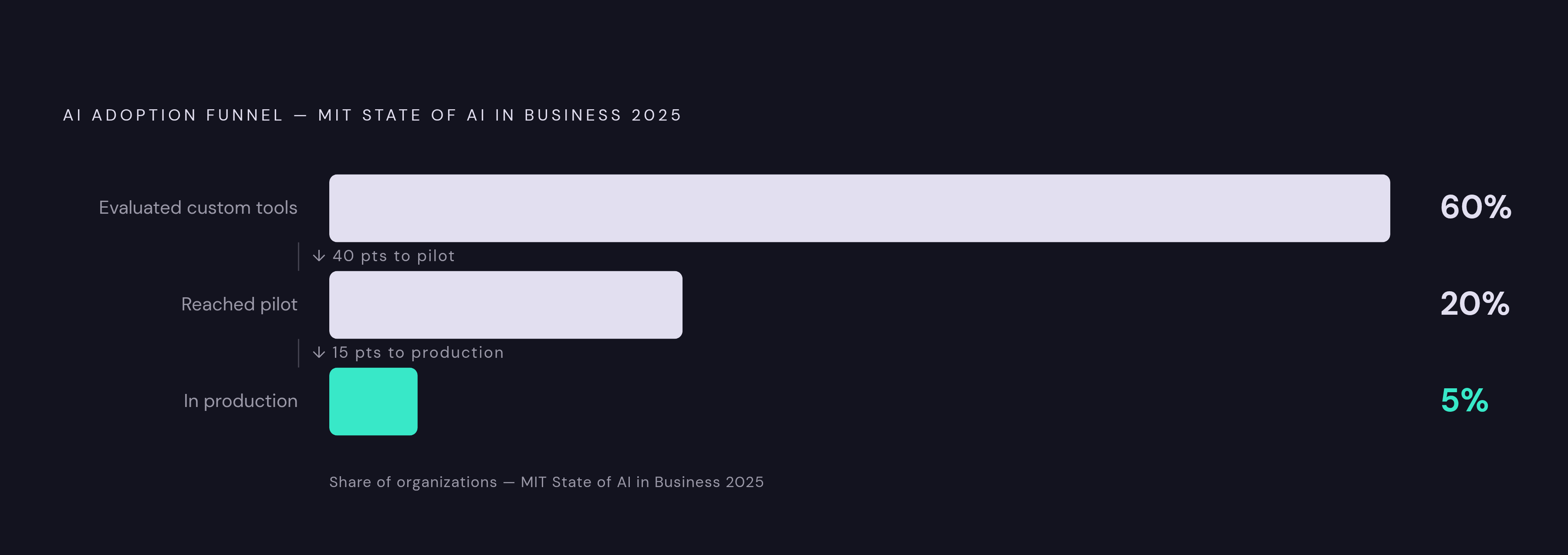
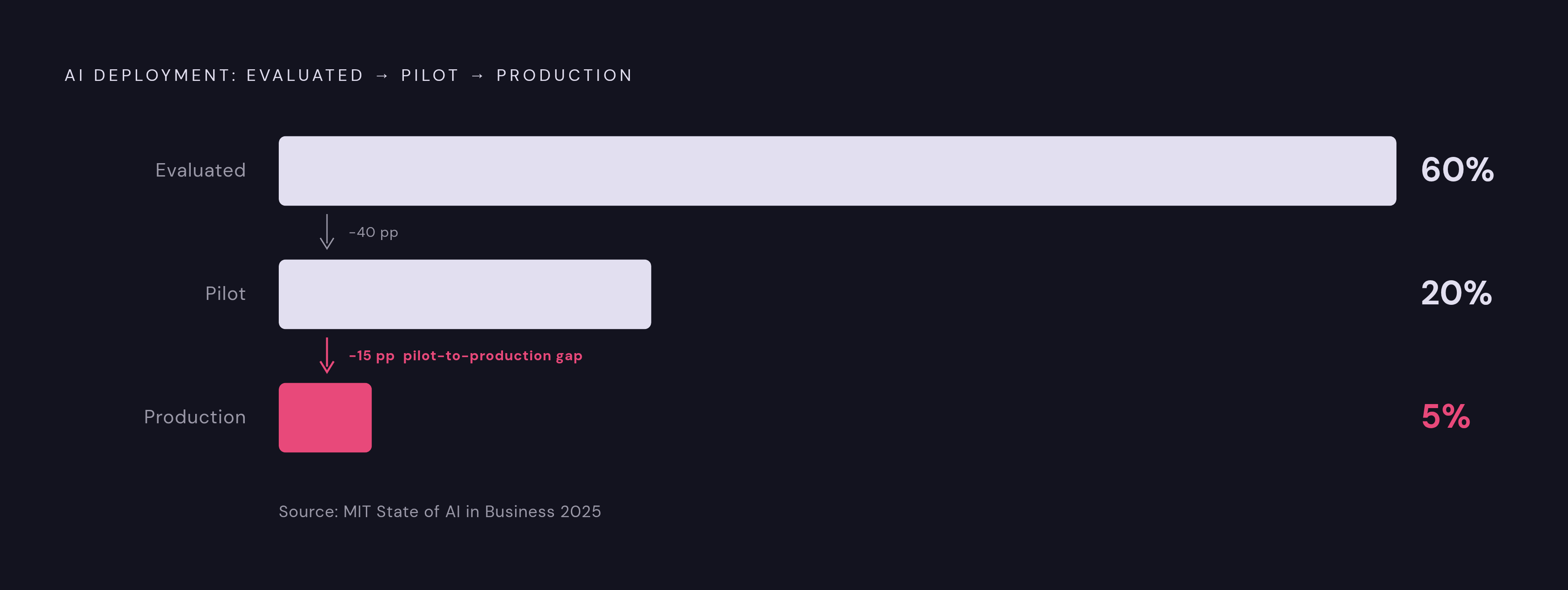
MIT's State of AI in Business 2025 report backs this up with numbers I've watched play out firsthand: 60% of organizations evaluated custom AI tools last year, 20% got a pilot running, and only 5% made it to production. The culprit is systemic rather than algorithmic. Latency spikes. Cascading failures when one component chokes. Edge cases nobody scripted for. Compliance controls bolted on after legal asks why nobody's been logging anything. Production means the thing runs at scale, under real load, with behavior you can explain to an auditor. Nailing the answer in a conference room is a different sport entirely. This piece walks the stack layer by layer, ASR through dialogue management through backend integration through TTS through the real-time plumbing holding it all together, and points at where each one tends to snap.
How the full pipeline is structured and why modularity matters
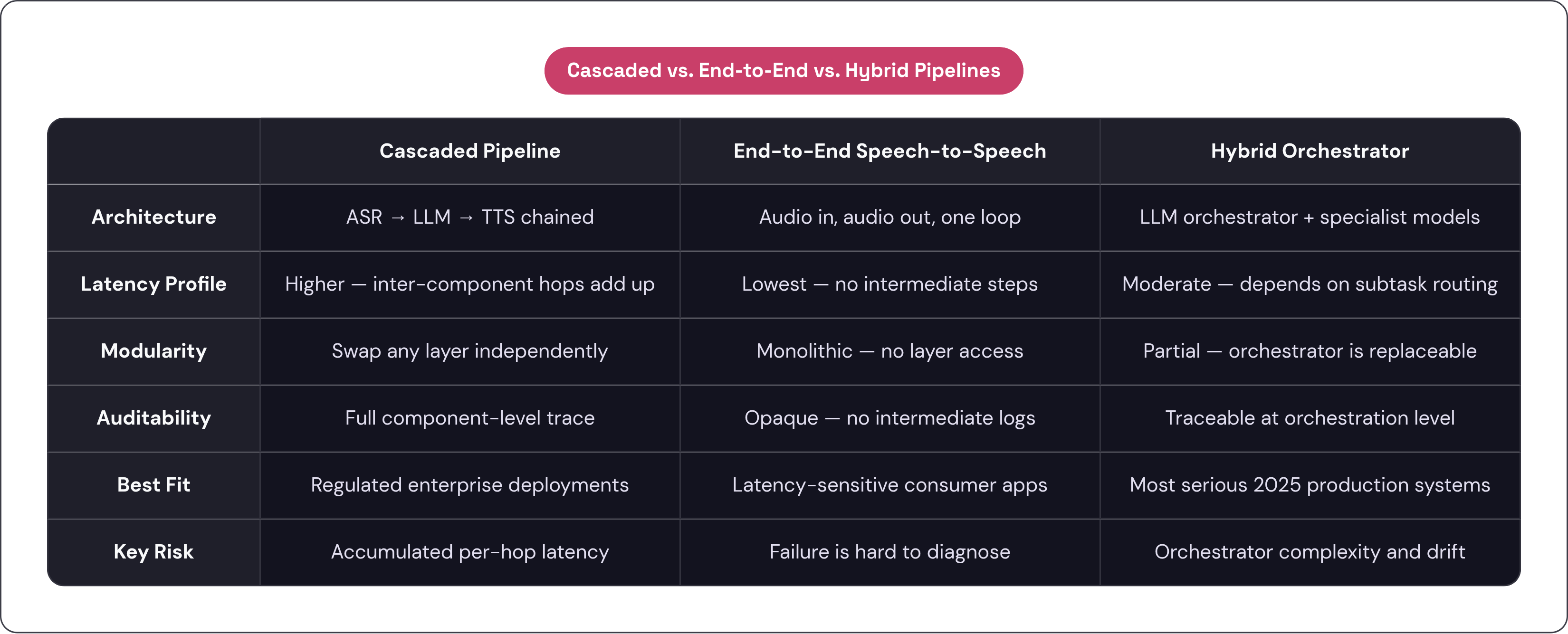
The standard stack: speech goes into an ASR engine, gets parsed for intent, gets handed to a dialogue manager that decides what to do, that decision fires a backend call, the response comes back, gets voiced by TTS, and streams to the user. Five hops, sometimes six. Each one, built right, runs as its own microservice, so a team can swap the ASR vendor on a Tuesday afternoon without touching TTS or paging the on-call engineer at 2am.
Two patterns dominate how teams wire this together. Cascaded pipelines treat ASR, the language model, and TTS as three separate inference calls chained end to end. End-to-end speech-to-speech collapses all three into one inference loop: audio in, audio out, no text in the middle. Cascaded gives you modularity and a way to replace a weak link without touching the rest. End-to-end gives you lower total latency, at the cost of being able to see inside the box when something breaks.
What's actually won out in 2025 deployments is a hybrid: a central orchestrator, usually an LLM playing reasoning engine, hands off subtasks to specialized models, checks their work, and decides when to kick the conversation to a human. Full autonomy wanders too far. A rigid decision tree bends too little. Most serious systems I've seen land somewhere in the middle, and for good reason: it's the only version that survives contact with a real, messy phone call.
There's a floor no matter which pattern you pick. Industry standards put minimum viable production at 85% intent recognition accuracy and sub-500ms response time. Miss either one and you've built a research project with a phone number attached.
What ASR must do in production and where it quietly fails
Transcription itself is the easy part. Production ASR has to survive accents, background noise, somebody's kid screaming two rooms over, industry jargon the base model's never seen, and two people talking over each other. None of that shows up on a clean benchmark, and clean benchmarks are exactly what vendor pitch decks lead with.
The quieter failure is the silence buffer. Traditional ASR waits 700 to 1000 milliseconds of dead air before deciding you're done talking. Call it a tax charged on every turn: ten turns into a call and you've burned several seconds of dead time the user feels but can't quite name. It's the reason so many voice bots feel like they're thinking too hard about nothing.
The fix that's caught on is decoupling turn detection from transcription, letting the client itself signal "I'm done" instead of making the ASR engine guess from silence. Done well, this drops latency from speech-end to final transcript to around 250 milliseconds. That's the difference between a conversation and a walkie-talkie exchange.
Vertical specialization is a real line item on a procurement sheet now, not a marketing footnote. Medical ASR trained on clinical dictation cuts keyword error rates by up to 70% against general-purpose engines trying to parse "myocardial infarction" the same way they'd parse a pizza order. "Medical-grade" and "legal-grade" ASR are measurable categories with real benchmarks behind them.
On-device ASR has quietly stopped being the compromise option, too. Some models land within 10% of server-grade accuracy on mid-spec hardware, and that matters three ways at once: latency drops because you skip the round trip, privacy improves because audio never leaves the device, and the system keeps working when the network doesn't. When you're evaluating a vendor, look at word error rate on your own domain vocabulary, real-time factor, latency to first word, and how it behaves under noise. The WER number on a clean benchmark tells you almost nothing about a call coming in from a parking garage.
Dialogue management (the layer that decides what happens next)
This layer tracks what's been said, figures out what the user actually wants, and decides what happens next. Sounds simple until you realize it has to hold context across ten or twenty turns without losing the thread or inventing a detail nobody said.
Three architectural patterns show up here, each suited to a different job. Single-prompt agents are quick to build and fine for linear flows, an appointment reminder bot, say. Multi-prompt conversation flow agents give you more control over branching, useful when a call could go a dozen directions depending on what the caller says in the first ten seconds. Fully agentic orchestrators offer the most flexibility, and with it, the highest risk of wandering somewhere nobody designed for.
State management is where the real complexity hides. The system carries slot values, prior claims the user made, and session context, all without hallucinating something that was never said or dropping something said three turns back. This is unglamorous work, and it's where demo-stage systems fall apart the first time they meet a real, meandering conversation instead of a scripted one.
Pure autonomy still makes compliance teams nervous in regulated environments, and they're right to be nervous. That's why the hybrid orchestrator, reasoning engine on top, specialized workers underneath, validation in between, has become the 2025 standard rather than the exception.
Failure modes here are specific and worth naming: intent misclassification sends a user down the wrong branch, context loss mid-session happens when state doesn't persist across a hop, and infinite loops happen when the model can't resolve an ambiguous request and just keeps asking the same clarifying question over and over. Tuning alone doesn't fix any of this. It takes architecture.
Human escalation isn't a nice-to-have bolted on for optics, either. a large majority of consumers say companies should always offer a path to a human agent, and a system that can't hand off cleanly, mid-conversation, with context intact, fails in production no matter how sharp its intent recognition looks on paper.
Backend integration and why the edges of the system break first
An agent that can't read from or write to live systems, customer records, inventory, a ticketing queue, a payment processor, is a chatbot wearing a nicer outfit. Production agents act on the world, carrying out tasks rather than merely describing them.
This is where things break first, and it happens the same way every time. Slow API responses blow through the latency budget before the conversation even reaches TTS. Schemas drift between what the agent expects back and what the backend actually sends. Auth tokens expire mid-session, and a turn gets cut off halfway through a write, leaving a half-completed order sitting in the database. Arguably worse than no order at all.
Timeout handling has to be designed, not defaulted into. "I'll look into that" is a shrug wearing a name tag, and it falls apart the second a regulator or an angry customer asks what actually happened. What happens when a backend call times out needs to be decided at design time, tested, and logged, rather than improvised by the model in the moment.
Function calling makes this cleaner on paper: an LLM with native tool-calling hits the backend API directly. But every function call is a round trip, and round trips spend latency out of a budget that's already thin. Batching calls, caching common lookups, pre-fetching data you already know you'll need, none of that is an optimization for later. It's required on day one.
Compliance lives at this layer too, and it doesn't forgive shortcuts. In healthcare, financial services, and insurance, every data touch needs logging detailed enough to reconstruct exactly why the system did what it did. Building that in at design time costs a fraction of retrofitting it after a regulator asks for records that don't exist.
The frontier here is agentic commerce, agents that complete transactions instead of just answering questions about them. SoundHound's Amelia 7 handles food orders, reservations, and payments end to end through voice, a useful data point on how far backend integration has to reach once an agent starts acting instead of just talking.
TTS in a real-time pipeline — latency, quality, and the tradeoffs between them
TTS for a conversational agent is a different problem than TTS for narrating an audiobook, and treating the two the same is a common, expensive mistake. The goal is the lowest-latency voice that's still good enough, streamed in chunks so the user hears the first words before the rest of the sentence has finished synthesizing.
Latency benchmarks across vendors vary a lot. Cartesia's Sonic reports 40 milliseconds. Voila demonstrated a 195 millisecond end-to-end response back in May 2025. ElevenLabs sits on the other side of that tradeoff, known for lifelike, high-fidelity output across creative and enterprise use, with an API that exposes those same models to developers building real-time agents, including a low-latency streaming path built for this exact job.
Streaming architecture matters more than nearly anything else at this layer. TTS should start returning audio on the first sentence or clause, rather than waiting for the whole response to finish generating. Sentence-boundary streaming is table stakes if you want to land under that 500 millisecond perceived-response threshold.
Voice quality carries real engineering weight rather than sitting on top as decoration. It's tied directly to whether the user trusts the system at all. A December 2025 SurveyMonkey study found a strong majority of consumers still prefer a human agent, and handing that already-skeptical caller a flat, robotic voice just confirms their suspicion that they've been routed to something cheap.
Model choice should track your deployment context, not just your latency spreadsheet. ElevenLabs leads on expressive output for content-adjacent and enterprise use, and its lower-latency streaming options are built specifically for real-time agents rather than narration. Enterprise deployments increasingly want a consistent brand voice too, the same voice on every call, no drift session to session. That's a stability requirement as much as a quality one, and it rules out any TTS system whose voice identity wanders between generations.
Real-time infrastructure — how the layers connect without accumulating latency
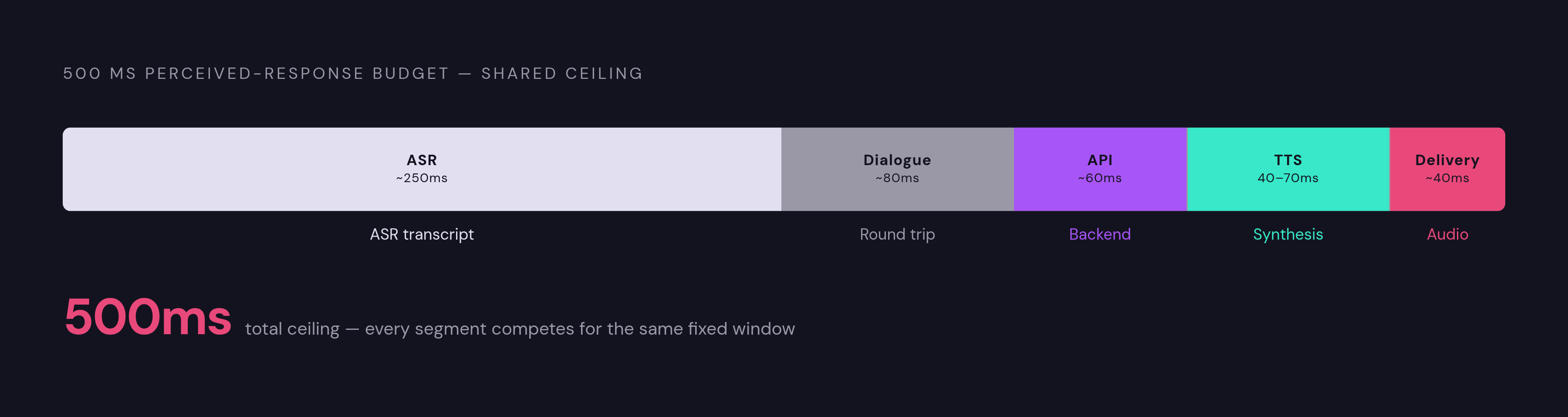
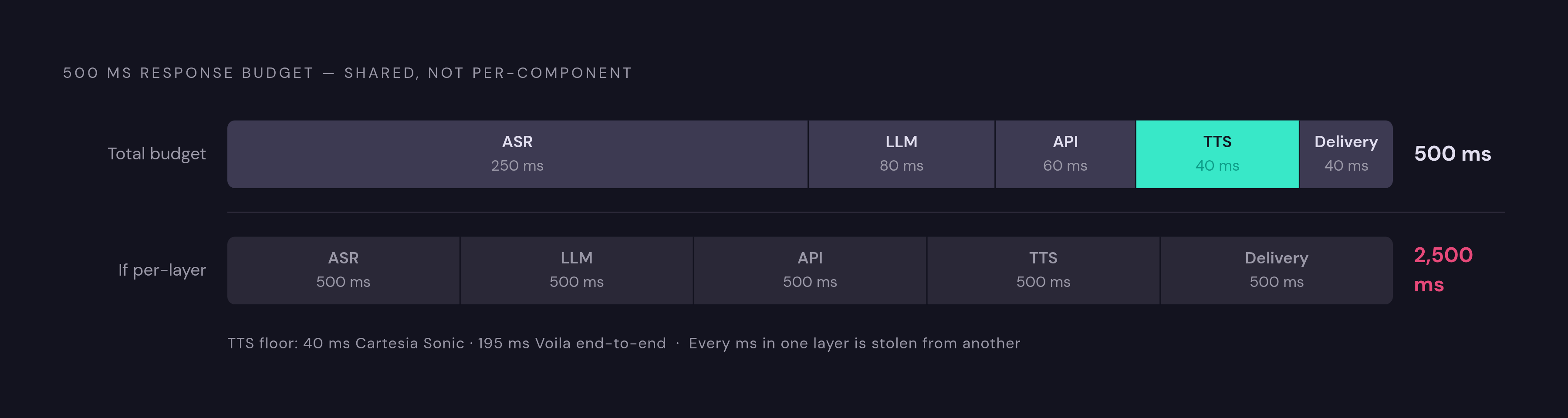
Here's what everyone underestimates: the 500 millisecond budget isn't per component. It's total. ASR processing, the dialogue round trip, the backend call, TTS synthesis, and audio delivery all have to fit inside one shared window. Give each layer "its own" 500ms and you've built a two-and-a-half-second conversation, an unusable one in practice.
WebSockets and WebRTC are the two standard transports, and they solve different problems. WebSockets work well for server-side streaming with low overhead. WebRTC is built for browser and mobile clients, where peer-to-peer audio delivery skips server hops that would otherwise eat into the budget.
Everything has to stream, at every stage, or the budget resets. Partial ASR results need to reach the dialogue layer before the user finishes talking. Partial LLM output needs to reach TTS before the full response finishes generating. Partial TTS audio needs to reach the client before synthesis wraps up. Buffer at any single stage and you reset the clock on the entire pipeline, even if every individual component is fast on its own.
Real-time voice traffic overtook batch processing for the first time in 2025 at Speechmatics, with real-time usage growing 4x year on year. That's a meaningful shift: infrastructure built for batch workloads, the kind that chews through a queue overnight and emails you results in the morning, doesn't scale up to real-time demand and has to be rebuilt from the ground up.
Voice sessions are stateful in a way most web traffic isn't, too. The same session needs to keep routing to the same instance, or its state needs to live in a shared store fast enough for any instance to reach. Naive round-robin load balancing will happily route turn three of a conversation to a server that has no idea turns one and two ever happened.
And you need to actually see this happening, not guess at it after the fact. Latency percentiles by component, not averages (averages hide the tail that's killing your user experience), turn completion rates, escalation rates, a real error taxonomy. Without per-component telemetry, debugging a degraded session is basically astrology.
Where end-to-end speech-to-speech models change the architectural calculus
End-to-end speech-to-speech models take audio in, produce audio out, one inference loop, no separate ASR step, no separate TTS step. That's a genuine simplification, and it kills the inter-component latency a cascaded pipeline can never fully escape by design.
Some end-to-end models hit general availability in 2025, with native audio processing and SIP phone integration built in. Pricing on leading options lands around $32 per million input tokens, which tells you these models have crossed from research curiosity into a range enterprises can actually plan a budget around. Moonshot AI's Kimi-Audio packs recognition, understanding, and generation into a 7-billion-parameter model pretrained on 13 million hours of audio, and outperforms models many times its size. That's a real signal for how much headroom is still on the table for on-device and low-latency work.
The tradeoff is real, and it's not a footnote. End-to-end models give up the modularity that makes cascaded systems easy to audit and fix one piece at a time. When a cascaded pipeline fails, you can usually point to the component responsible. A unified model's failure is opaque by comparison: no ASR log to check, no intermediate transcript to inspect, just a bad output and a shrug.
For regulated industries, that gap in auditability often carries the whole decision. A system that can't produce a component-level trace of how it reached an answer may not clear a compliance bar no matter how good its latency number looks in a slide deck.
So the practical split looks like this: cascaded pipelines stay the safer bet for enterprise deployments where compliance, debuggability, and upgrading one piece at a time actually matter. End-to-end models are genuinely compelling for latency-sensitive consumer apps where the regulatory stakes are lower and shaving 200 milliseconds off a response actually changes how the thing feels to use.
Scaling, reliability, and what production load actually looks like
97% of enterprises have adopted voice AI in some form, per Mordor Intelligence, and 67% now call it foundational to how they operate. At that level of adoption, a production failure isn't a bug ticket. It's the kind of thing that shows up in a board meeting.
Voice AI load doesn't behave like typical web traffic, and treating it like a standard REST API scaling problem is a mistake I've watched teams make more than once. Sessions run long and carry state the whole way through. Audio streams eat bandwidth a JSON payload never would. A spike in concurrent sessions hits ASR and TTS capacity at the same instant, because every active call needs both at once.
Autoscaling only works if session state lives somewhere outside any single instance. Spinning up a new server does nothing if that server has no idea what the caller already said three turns ago. Every stateful system learns this lesson eventually; voice AI just learns it faster, because the user notices the second context vanishes mid-call.
Keep this list on a whiteboard somewhere: ASR degrading under background noise, the LLM timing out on a genuinely hard query, the TTS queue backing up under burst load, backend APIs rate-limiting you at the worst possible moment, WebSocket connections dropping mid-session. Every one of these needs a fallback decided ahead of time, not improvised live on a call with a customer already annoyed.
The economics are the reason anyone bothers with any of this: AI-powered interactions run $0.25 to $0.50 against $3.00 to $6.00 for a human agent handling the same call. But that math only pays off if the system resolves a high enough share of calls without escalating, and that's an architecture and quality problem wearing a cost-model costume.
Performance drifts too, as products change, policies change, and the words customers use to describe your product shift right along with them. Scheduled regression testing against real call samples, on a calendar, is a production discipline the same way a restaurant checks its walk-in cooler every morning instead of waiting for someone to get sick. The teams actually closing the gap between pilot and production treat the whole stack as an ongoing commitment: observability, defined failure budgets, components upgraded a piece at a time, sustained well past the initial launch.