Speaker Verification Systems in Enterprise Security
Voice biometrics replaces security theater with real authentication in customer service.
Speaker verification stopped being a biometric party trick around the time contact centers realized it could replace the "what's your mother's maiden name" script that every fraudster already knew the answer to. This piece breaks down how the technology actually works, where it earns its keep in the enterprise stack, and why the same AI that makes verification possible is also what's currently eating its lunch. Two ideas run through everything below: verification is a one-to-one match (is this person who they claim to be), while identification is a one-to-many search (who, out of everyone in the database, is this). Enterprises that confuse the two end up buying surveillance tools for authentication problems, or vice versa, and neither substitution ends well.
Voice sits in an odd spot among biometrics. It comes from a mix of physiology, the shape of your vocal tract, how your throat and nasal cavity resonate, and behavior: pacing, rhythm, the verbal tics nobody notices they have. You can't forget your voice the way you forget a password, and you can't leave it at home the way you leave a badge on the kitchen counter. But it can be recorded, and recorded audio can now be turned into something convincing enough to fool a system that isn't looking for it. That last part is the whole story of the last three years, and we'll get there.
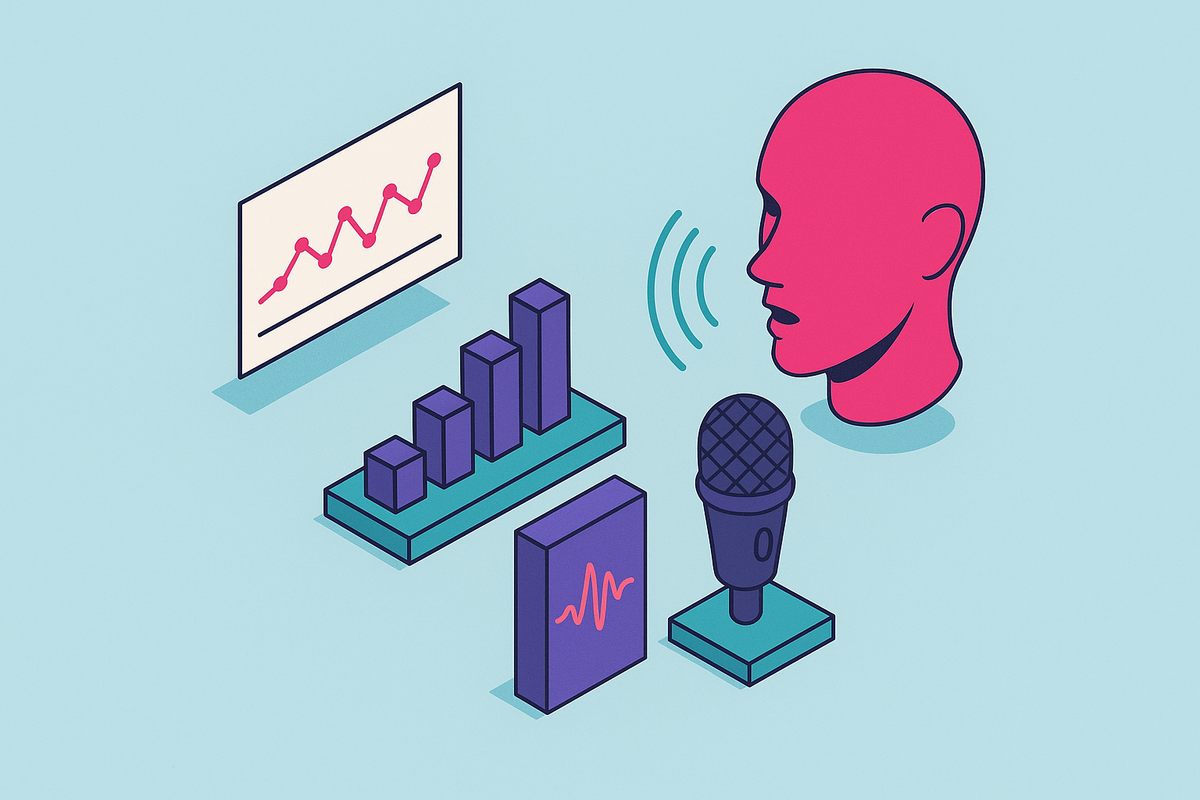
The mechanics are simpler than the biometric hand-waving usually suggests. Enrollment captures a sample of someone's voice; a neural network turns that variable-length audio into a fixed-length numeric fingerprint, the voiceprint; every future verification attempt gets scored against that stored embedding. Enterprises choose between active enrollment (say "my voice is my password," or some prompted phrase) and passive enrollment (the system builds the voiceprint quietly from normal conversation). That choice cascades into almost every downstream decision about cost, friction, and legal exposure, which is why it gets its own section below.
The neural architecture underneath modern speaker verification
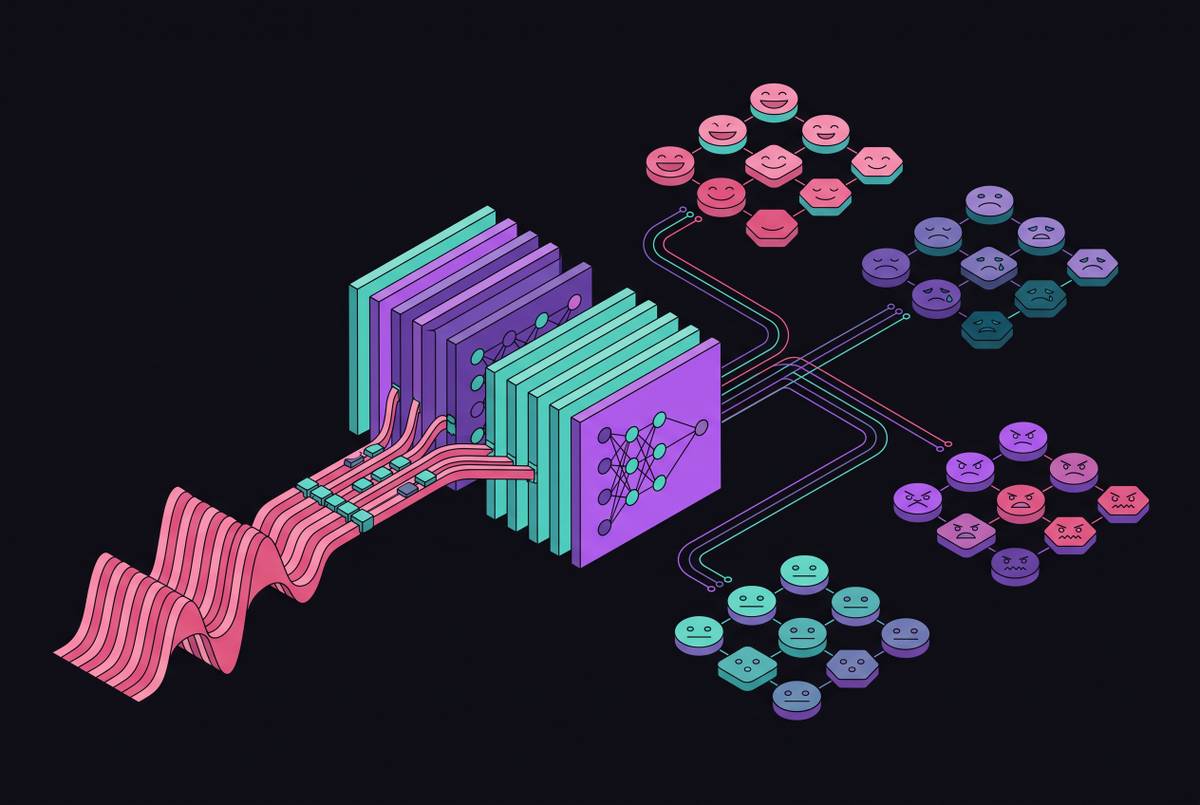
The workhorse architecture is the Time Delay Neural Network, better known through its output: the x-vector. TDNNs take audio of any length and, through statistics pooling, compress it into a fixed-size speaker embedding. That single trick, turning a messy, variable-length signal into something you can compare with simple distance math, is what made production-grade verification possible instead of a lab curiosity.
ECAPA-TDNN, introduced at Interspeech in 2020, built on that foundation by adding multi-scale feature aggregation and channel-attention mechanisms, letting the model weigh which parts of the audio actually carry speaker identity versus background noise. It's now the architecture you'll find humming in the background of most enterprise deployments. Transformer-based and CNN-based alternatives compete on benchmarks, and WavLM, a large-scale self-supervised model, has become a favorite foundation for building verification systems on top of, mostly because it learns useful audio representations from huge amounts of unlabeled speech before anyone even points it at the verification task.
There's a second axis worth knowing: text-dependent versus text-independent verification. Text-dependent systems (TdSV) require a specific phrase, so the model checks both who's speaking and what they said. Text-independent systems (TiSV) verify from whatever the person happens to say, which deploys faster and feels more natural but gives up a layer of protection. Fusing identity with required phrase content makes replay attacks and phrase-specific clone attacks measurably harder to pull off. It's not foolproof, nothing here is, but it raises the bar.
On measurement: Equal Error Rate used to be the industry's favorite single number, the point where false acceptances and false rejections cross. It's tidy but incomplete. Enterprise-grade evaluation has moved to Tandem DCF and the newer Architecture-agnostic DCF, both of which weigh the combined cost of rejecting genuine speakers, accepting impostors, and accepting spoofed audio. That's closer to how a fraud team actually thinks about risk, because a missed genuine customer and an accepted fraudster don't cost the business the same amount, and pretending they do is how procurement teams get fooled by a flattering EER number.
Active versus passive verification, and what each costs the enterprise
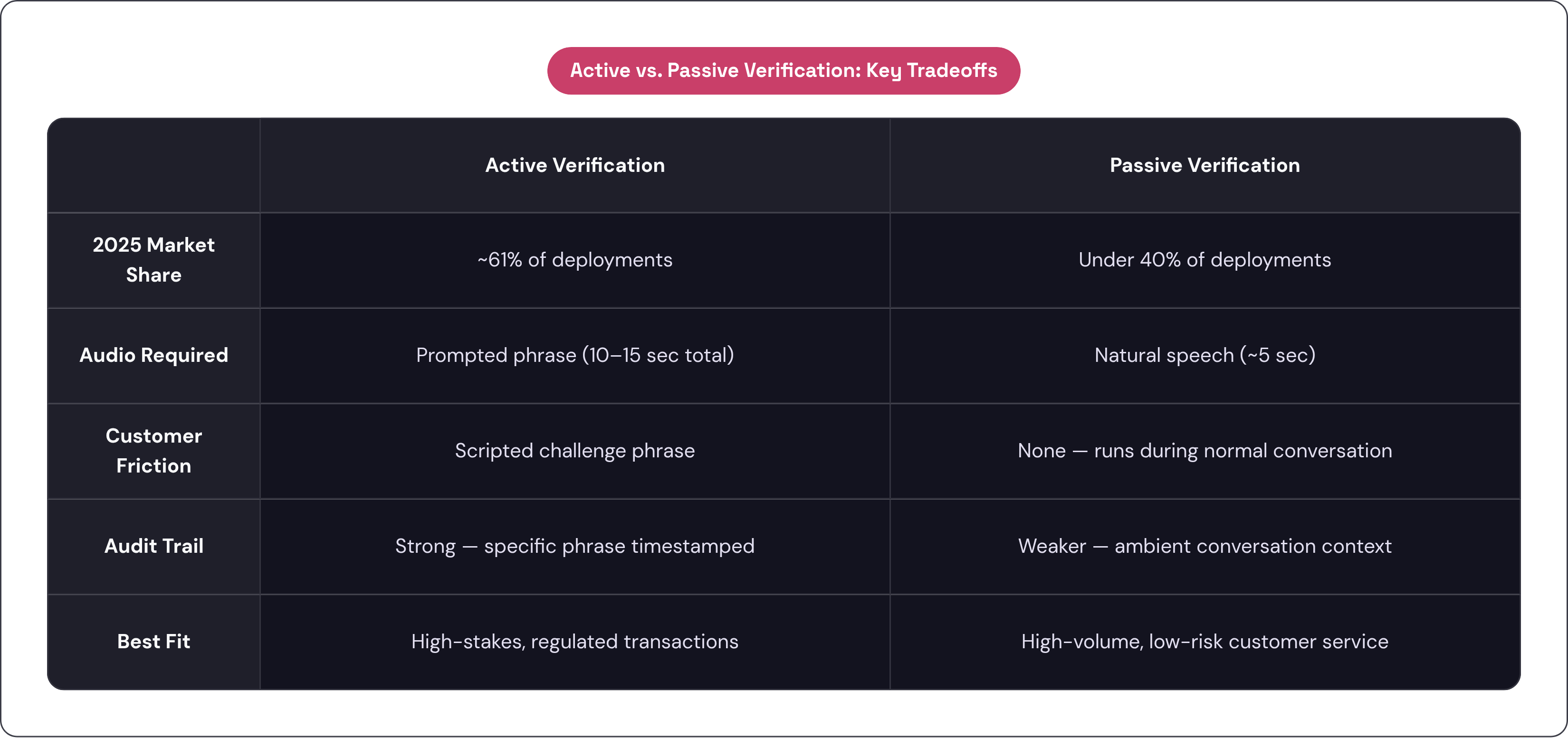
Active verification, the scripted challenge phrase, holds the larger share of the market: 61.20% as of 2025, according to Mordor Intelligence. The reason is boring but important: a scripted phrase produces an auditable trail. When a regulator or a fraud investigator wants to know exactly what happened during a high-value wire transfer, "the system confirmed the customer said this specific phrase at this specific time" holds up a lot better than "the model was pretty confident based on ambient conversation."
Passive verification, sitting under 40% of the market in 2025 by the same estimate, skips the scripted step entirely and authenticates while the customer is just talking to an agent about their billing question. No added friction, no "please say the following phrase" moment. Mordor Intelligence puts the payoff at up to 45 seconds shaved off average handle time. That number sounds small until you multiply it across a call center running millions of interactions a year, at which point it becomes a capacity and staffing conversation, not a nice-to-have.
The audio math is straightforward. Passive verification generally needs around five seconds of speech to work with. Active challenge-phrase methods tack on another five to ten seconds, trading time for a bit more accuracy and, more importantly, for that audit trail. IVR and contact centers make up 45.30% of deployment by channel, per Mordor Intelligence, which is exactly where this tradeoff plays out daily. The sensible split most enterprises land on: passive for high-volume, low-stakes journeys like general customer service, active where the transaction is big enough that someone might have to defend the decision in front of a regulator later. Cloud delivery, running 67.10% of the market in 2025, makes both modes easier to stand up fast, since enrollment and model updates don't require a hardware refresh cycle every time the vendor ships an improvement.
Where speaker verification fits in the enterprise security stack
Four zones dominate deployment: contact center authentication, workforce access for remote or phone-based employees, financial transaction authorization, and privileged-access checkpoints. Financial services (BFSI) leads all end-use verticals with 31.40% share, per Mordor Intelligence, and it's the cleanest example of voice biometrics being used as an actual security control rather than a UX polish item. Healthcare is the vertical to watch next, with a projected 19.05% compound annual growth rate through 2031; expect that to show up as phone-based patient authentication and HIPAA-adjacent access control.
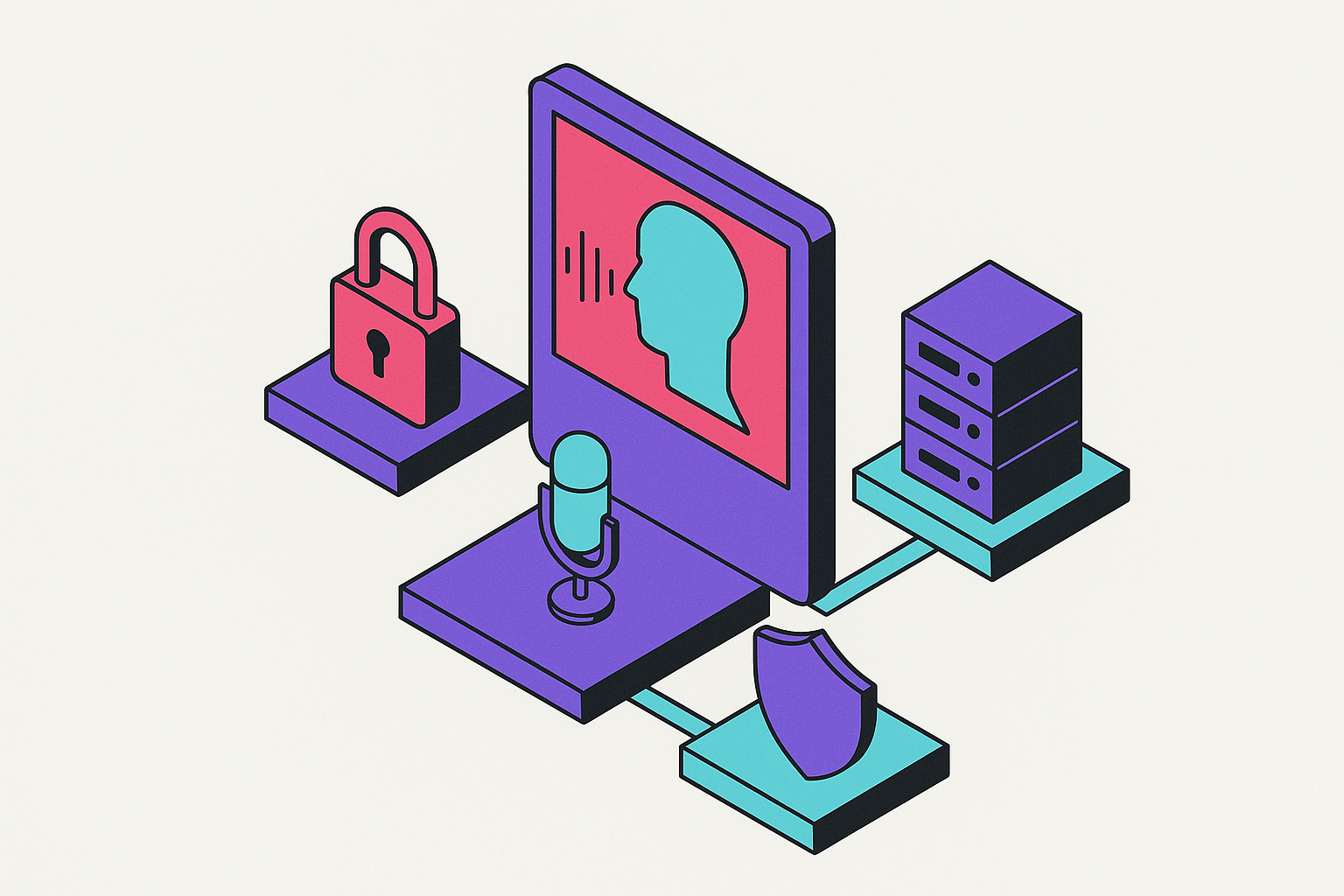
None of this replaces multi-factor authentication; it slots into it. Voice covers "something you are," which pairs naturally with a PIN ("something you know") or a registered device ("something you have"). Treating voice as a standalone silver bullet is how a system designed to reduce fraud ends up creating a single point of failure instead.
Adoption skews toward large organizations right now, 57.20% share, but small and mid-sized businesses are catching up fast, growing at 18.89% CAGR, largely because cloud delivery removes the old excuse that voice biometrics required a data center and a systems integrator on retainer. North America holds 36.92% of the global market, valued at USD 1.06 billion in 2025 according to Fortune Business Insights, driven by regulatory pressure and contact-center infrastructure that's already mature. That regional concentration is itself a signal: wherever compliance regimes have matured, adoption follows.
The part enterprises consistently underrate is integration. A speaker verification system doesn't just sit in front of an IVR greeting; it has to talk to identity providers, plug into call recording infrastructure, and feed fraud operations teams in near real time. Buy the model, sure, but budget for the plumbing.
How AI voice cloning has restructured the threat model
In 2019, a UK energy firm's executive got a phone call from what sounded exactly like his boss's boss, the German parent company's CEO, instructing an urgent wire transfer. It was a clone, and it worked, to the tune of €220,000. At the time, that case was treated as a sophisticated outlier, the kind of thing you'd see once a year and write a conference talk about.
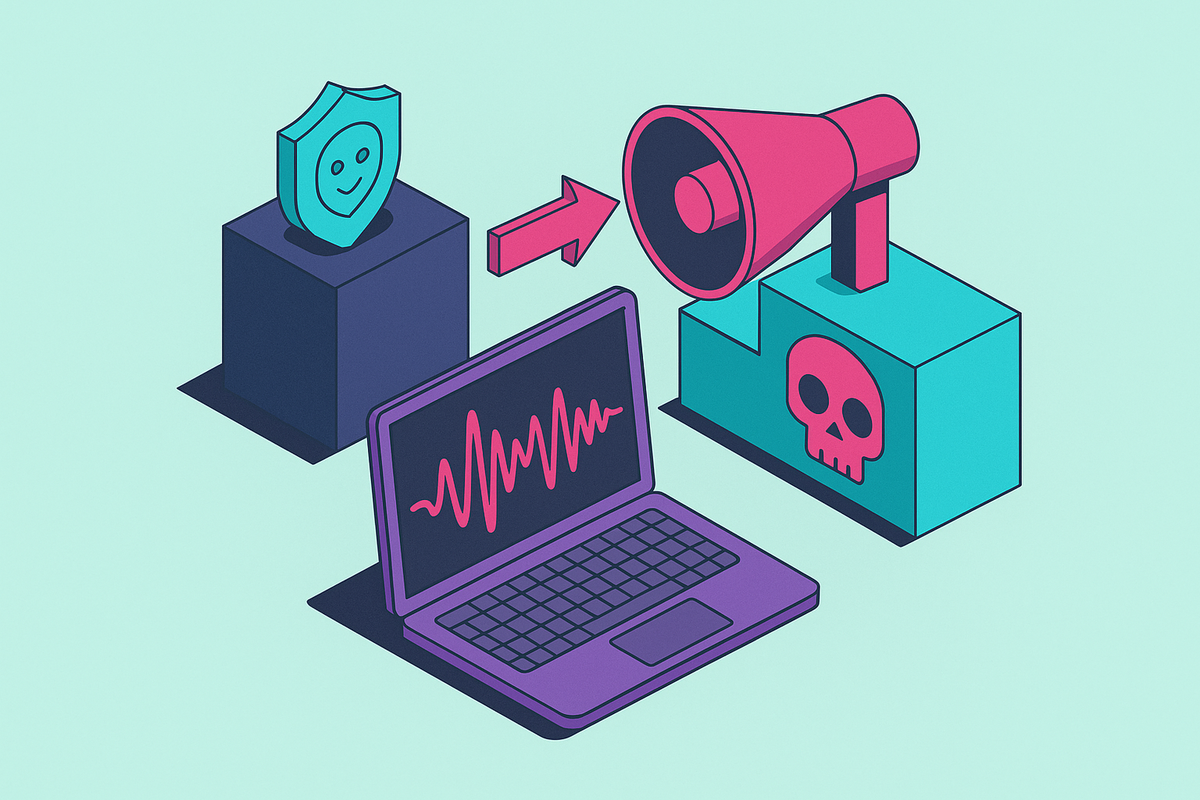
By 2025, the same style of attack hits an estimated 400 companies per day, according to DeepStrike. Over 8,400 documented fraud incidents tied to AI voice cloning produced $410 million in losses in the first half of 2025 alone, per AllAboutAI's 2025 report. Deepfake vishing (voice phishing) attacks rose 1,633% in Q1 2025 compared to the previous quarter, according to Right-Hand AI. AI-powered scams broadly surged 1,210% across 2025, per Vectra AI's 2026 report, and the FBI logged more than 22,000 AI-related complaints in 2025 with adjusted losses exceeding $893 million, specifically calling out voice cloning in wire-payment fraud and distress scams (the "grandma, I've been arrested" call, now with an actual grandchild's voice attached).
None of this required a nation-state lab. Roughly three seconds of source audio can now produce a clone with 85% accuracy, and the tools to do it sit behind consumer-grade APIs and mobile apps that ask for no special expertise. Average enterprise loss per voice fraud incident runs around $680,000, which moves this from a fraud-ops line item to a board-level risk conversation. Layer in synthetic video alongside cloned audio, and the old fallback of "let's get on a video call to confirm it's really you" stops being reliable too. Analysts project $40 billion in global deepfake-enabled losses by 2027. Any enterprise still treating speaker verification as a solved, static problem is pricing its risk using numbers from a world that no longer exists.
The detection gap and why it is widening
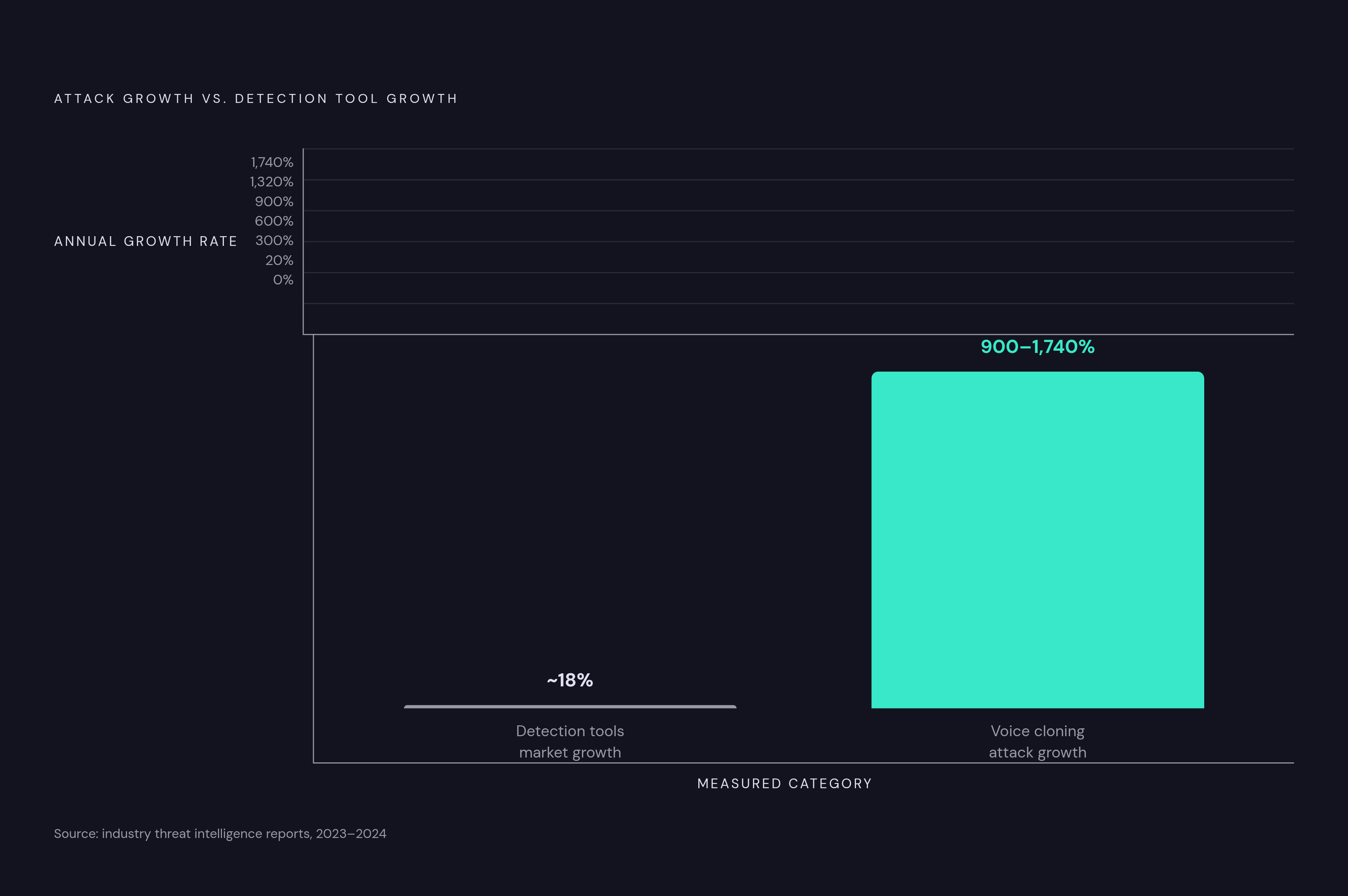
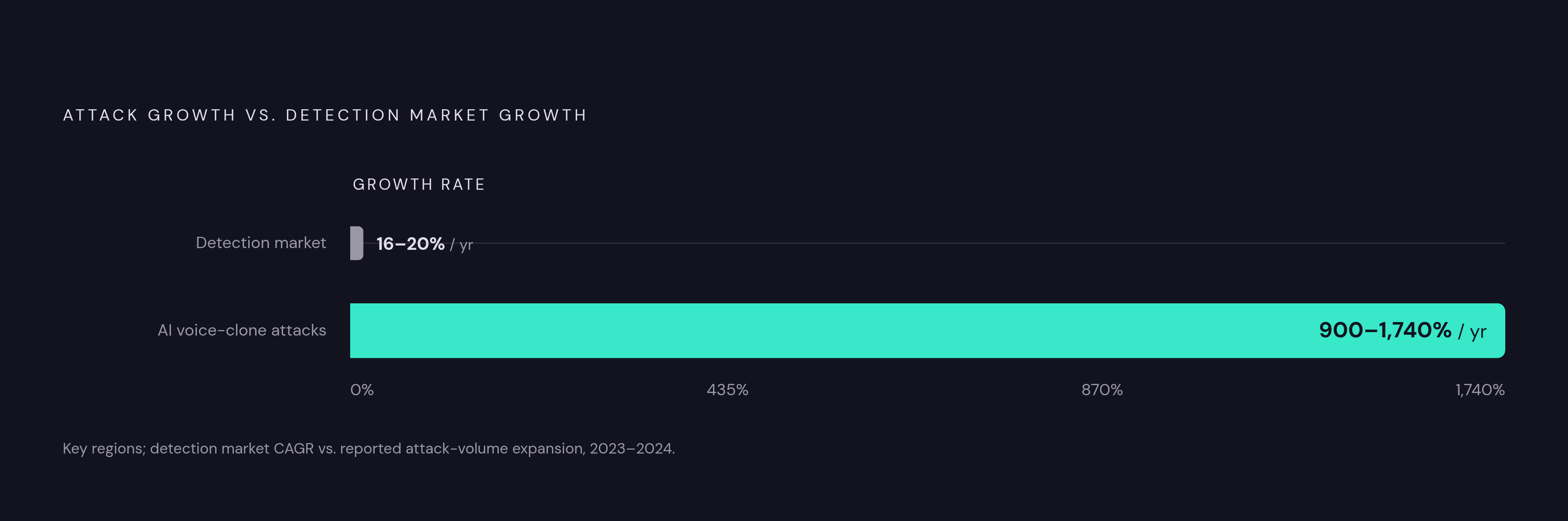
Here's the uncomfortable asymmetry: voice synthesis models improve on a cycle measured in months. Enterprise detection tools improve on a cycle measured in years. A countermeasure trained to catch last year's clone quality will often miss this year's, and that's not a flaw specific to any one vendor's product; it's a structural property of chasing a moving research frontier.
The numbers make the gap concrete. The detection tools market grows at roughly 16 to over 20% a year. The threat itself, measured by attack volume in key regions, is expanding at 900 to 1,740%. That's not a rounding error, that's a different order of magnitude entirely, and it means the gap between attacker capability and defender readiness is widening, not narrowing, year over year.
It gets worse once you leave the lab. DeepStrike's 2025 analysis found that defensive tools lose roughly 45 to half or more of their effectiveness moving from controlled benchmark conditions to real-world deployment, where audio is compressed, noisy, and inconsistent. Consumer Reports reviewed six voice cloning apps and found four had no meaningful guardrails against cloning someone's voice without their consent. You don't need a PhD to weaponize this; you need a free weekend and a few seconds of someone's voicemail greeting.
There's also a quieter research problem: detection models trained on fixed datasets tend to learn shortcuts, spurious patterns that happen to correlate with "fake" in that specific dataset, rather than the actual acoustic fingerprints of synthesis. That produces inflated benchmark scores that fall apart against attack types the model has never seen. For enterprise buyers, the practical takeaway is blunt: a vendor's published EER number tells you almost nothing about how the system performs against a synthesis model released last month. Ask that question directly, because the vendor's marketing deck won't volunteer the answer.
How the research community is responding: anti-spoofing architectures and the ASVspoof benchmark
The field's shared reference point is the ASVspoof challenge series, running since 2015 with major editions in 2017, 2019, and 2021, and the most recent, ASVspoof 5, in 2024. It's the closest thing this research community has to a common ruler, and it matters because without it, every vendor's spoofing claim would be graded on its own curve.
ASVspoof 5 made a deliberate effort to close the lab-to-real-world gap by introducing crowdsourced speech, deepfakes, and adversarial attacks at scale, rather than relying on the cleaner, more controlled audio of earlier editions. Top systems on that benchmark now report a minimum a-DCF below 0.20 and SPF-EER in the high single digits, achieved through modular designs that align each sub-task separately and fuse the results nonlinearly rather than averaging them naively. Self-supervised countermeasure branches, like SSL-AASIST, generalize better to attack types the model wasn't explicitly trained on, which directly targets the fixed-dataset weakness described above.
A 2025 paper published through Springer took the idea a step further: instead of just flagging a spoofed voice and rejecting it, the proposed system builds a profile of the attacker's synthesized voice on the spot, essentially fingerprinting the fake. That's a shift from passive defense to something closer to active intelligence gathering. Liveness detection, checking that the audio came from a live human speaking in real time rather than a replay or synthetic feed, has moved from optional add-on to expected baseline component in 2025-era systems. Newer benchmarks like SpoofCeleb, built from in-the-wild recordings and codec-compressed audio, push evaluation closer to how a phone call actually sounds after it's been squeezed through a cellular network, which turns out to complicate both verification accuracy and spoof detection in ways cleaner lab audio never revealed.
Practical deployment decisions: enrollment, liveness, thresholds, and layering
Enrollment quality is the variable everyone underrates. A noisy, rushed, or coerced enrollment recording degrades every single verification attempt that follows, because the model is only ever as good as the voiceprint it's comparing against. Garbage in, garbage matched against, forever.
Threshold calibration isn't a technical footnote, it's a policy call dressed up in math. Set the false-accept rate too low and you'll reject legitimate customers constantly, pushing them into a fallback authentication flow that has its own cost and its own friction. Set it too high and you've built a welcome mat for fraud. Given how cheap a 3-second voice clone has become and how fast vishing attacks grew through early 2025, leaving liveness detection off by default isn't a configuration choice, it's a decision to lose money slowly and then all at once.
Channel conditions deserve more attention than they usually get. Audio that's been compressed through a phone codec doesn't behave like the clean, high-fidelity audio captured during a lab demo, so systems need testing on the actual pipeline they'll run on in production, not the vendor's sample data. And speaker verification should never be the entire security stack: pair it with behavioral analytics, device fingerprinting, and out-of-band confirmation for anything involving real money moving. Match enrollment mode to risk level, text-dependent for high-stakes access points, passive for high-volume low-risk traffic, rather than forcing one mode to do every job. Voiceprints also drift over time with age, illness, or even a bad cold, so a deployment without a re-enrollment policy will quietly degrade until someone notices the false-reject rate creeping up and can't figure out why. When evaluating vendors, ask for out-of-distribution performance numbers, not just the headline EER, ask specifically how the system holds up against current-generation text-to-speech models, and confirm whether liveness detection ships included or gets billed as a separate line item.
Regulatory, ethical, and consent obligations enterprises cannot ignore
A voiceprint is biometric data under GDPR, CCPA, Illinois's BIPA, and similar frameworks worldwide, which means collecting or storing it without clear, informed consent is a legal exposure, not a hypothetical one. BIPA in particular has already generated serious litigation, and enterprises collecting voice data from Illinois residents face statutory damages per violation. That's not an abstract compliance checkbox; that's a number on a spreadsheet that a general counsel needs to see before launch, not after.
Consent architecture matters in practice, not just on paper. Active enrollment paired with a clear, upfront disclosure holds up far better under audit or litigation than passive collection buried in a terms-of-service document nobody reads. Retention and deletion obligations follow the same logic: if a user revokes consent, the enterprise needs the infrastructure to actually delete that embedding, not just flag it as inactive somewhere in a database. Cross-border operations compound all of this; a contact center running across the EU, US, and Asia-Pacific is juggling multiple overlapping biometric regimes simultaneously, and "we'll figure it out region by region" is not a strategy so much as a confession.
There's a sharper ethical wrinkle worth naming directly: the same AI infrastructure used to build liveness detection and anti-spoofing tools can, if sourced carelessly, be repurposed to clone the very voices those tools are meant to protect. That's not a reason to avoid the technology, but it is a reason to vet where synthesis and detection research comes from with the same rigor applied to any other supply chain. North America's outsized 36.92% share of the global market isn't just commercial momentum; it's partly a reflection of regulatory pressure already shaping how enterprises there build and deploy this stuff.
Where the market is heading and what enterprises should be watching
Analyst estimates for the voice biometrics market in 2025 land between $2.63 billion and $2.87 billion, depending on methodology, with directional growth in the 16 to 26% range annually projected through the early 2030s. Fortune Business Insights puts the more aggressive end of that at $22.76 billion by 2034, a 25.88% CAGR. The exact terminal number matters less than the direction: this market is not plateauing.
Asia-Pacific is growing fastest, pushed by fintech expansion and smartphone penetration, which means the global baseline for deployment is expanding into markets where regulatory frameworks are still catching up to the technology rather than the other way around. SMB adoption, growing at that 18.89% CAGR mentioned earlier, is the other structural shift: cloud delivery has quietly turned speaker verification from an enterprise-only capability into something a mid-sized regional bank or a healthcare clinic chain can deploy without a six-figure infrastructure investment.
The next real technical frontier is multimodal verification, systems that combine voice with behavioral signals, device context, and network telemetry, because relying on a single modality (just the voice) is increasingly vulnerable to a single-modality attack (just a cloned voice). Real-time conversational AI agents, systems that authenticate a caller, respond, and route the interaction all within one live voice exchange, represent the sharpest version of this tension: the same technology that makes frictionless authentication possible is also the technology that, in the wrong hands, becomes the attack. Enterprises evaluating this space should stop asking whether voice biometrics work and start asking how the system fails, because that's the question that actually determines whether it's worth deploying.