Telephony Integration for AI Voice Agents at Enterprise Scale
Real enterprise voice AI breaks on telephony integration, not model quality.
Deploying an AI voice agent at enterprise scale is fundamentally a telephony integration problem. The model gets the credit when a call goes well and the blame when it doesn't, but nine times out of ten, the thing that actually breaks is a SIP trunk, a codec mismatch, or a failover path nobody tested past the demo. Enterprises don't walk in with a blank slate, either. Existing phone numbers, PBX systems, IVR trees built up over a decade, and carrier contracts with termination clauses nobody wants to reread are already sitting there waiting for you, and the AI agent has to fit into that mess, work alongside it, and earn its place over time. What follows is a map of the architecture and the grunt work that separates a voice AI pilot from something that survives 500 people calling in at once.
What the telephony stack looks like when an AI agent answers a real phone call
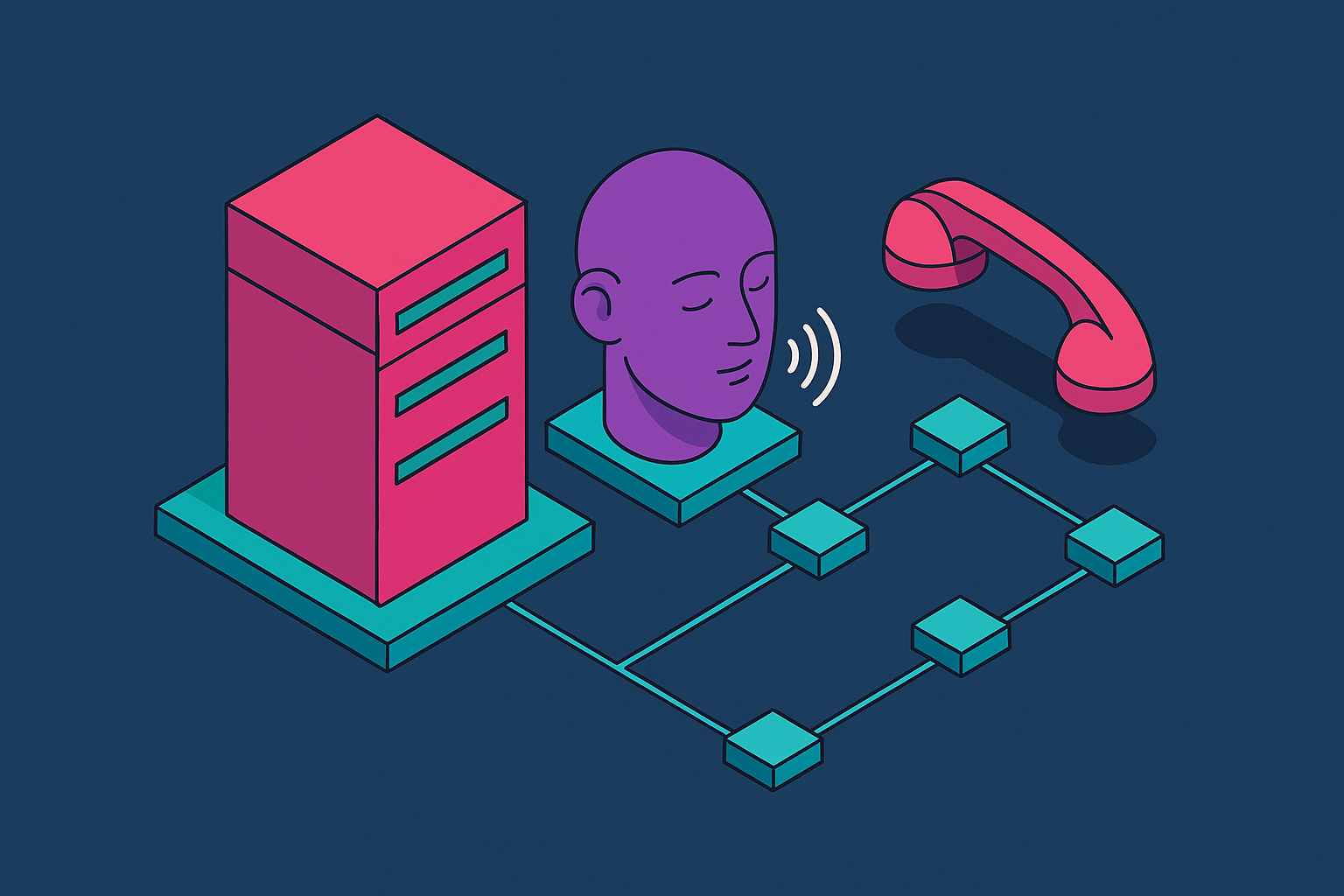
Four layers, in order, every single time. The voice network (PSTN or SIP) hands off to real-time audio transport, which feeds the AI pipeline (speech-to-text, then the language model, then text-to-speech), which then triggers whatever happens once the call ends.
A call comes in over PSTN or a SIP trunk. A media gateway turns it into an RTP audio stream. That stream gets transcribed, the transcript goes to the LLM, the answer gets turned back into speech, and the audio travels the same path in reverse. WebRTC handles browser calls fine; SIP trunking is the bridge when the call comes from actual carrier infrastructure, which covers most enterprise call volume. Somewhere inside that same round trip, ideally rather than after it, the system usually has to do a CRM lookup, run an authentication check, maybe hit three backend APIs. If any of that work slides to after the call instead of during it, the agent sounds like it's guessing, because it is.
Cloud deployments lead this market, favored by a large share of enterprise voice AI deployments in 2025, mostly because cloud platforms ship with pre-built hooks into telephony, CRM, and workforce tools that would otherwise take months to wire up by hand. On-prem and hybrid setups still matter, usually where data residency law or latency to the nearest cloud region rules cloud out entirely. Nobody's ripping out a hospital's on-prem voice stack because a cloud version would be nice to have, and migrations like that get planned in years, not quarters.
The latency budget and why every millisecond is already spoken for
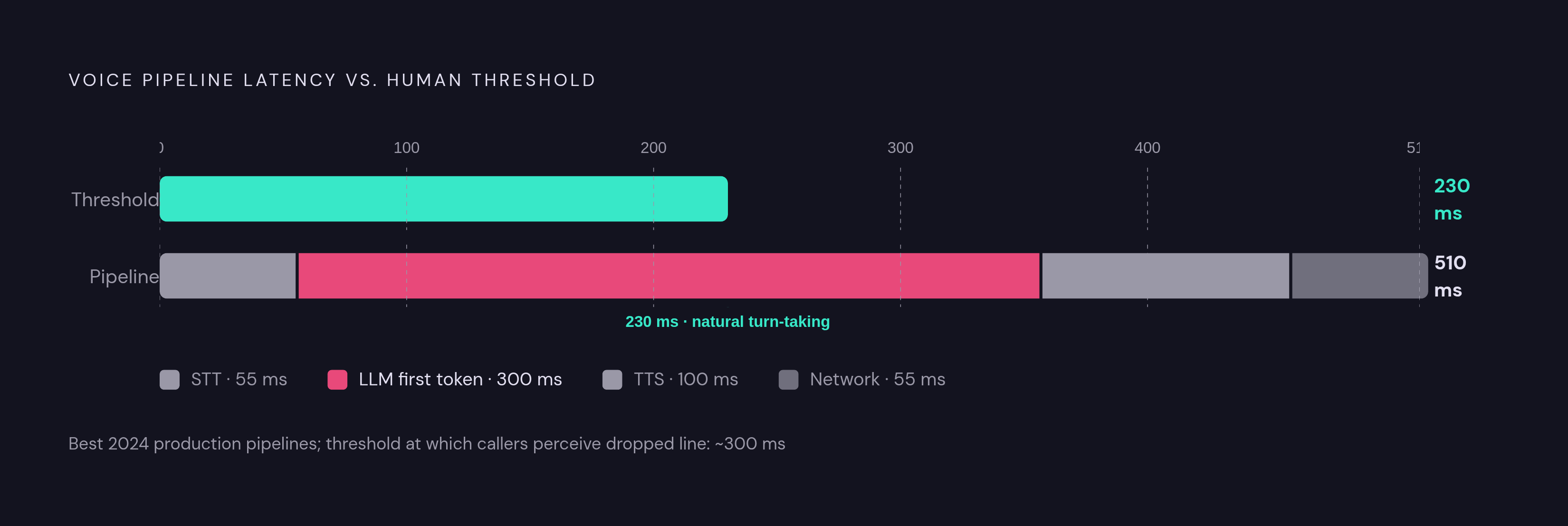
People expect a response inside roughly 230 milliseconds, and crossing 300 makes the caller start wondering if the line dropped. That expectation comes from how turn-taking works between two humans talking, and it doesn't bend just because one side is software.
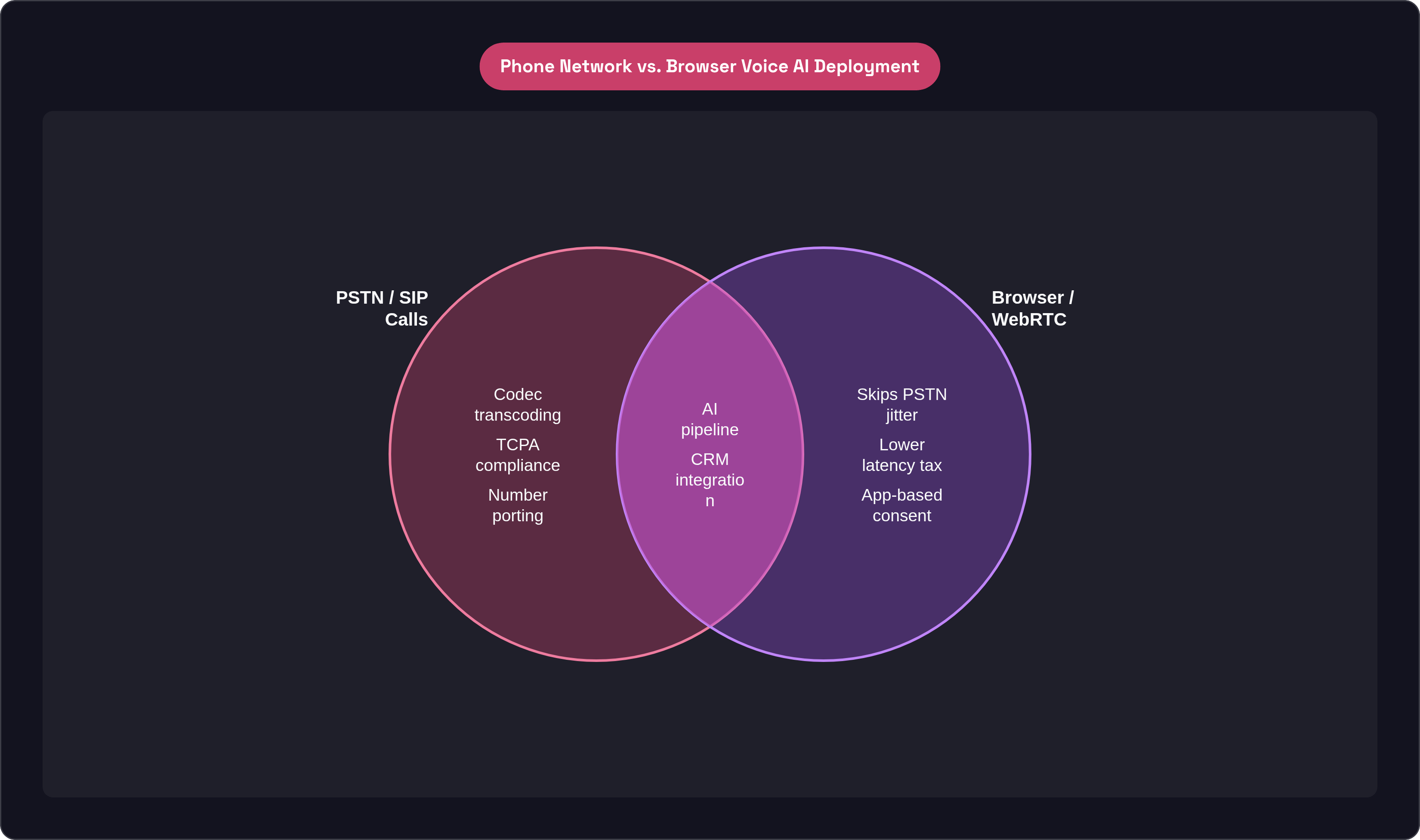
Add up a realistic production pipeline and the components stack fast: STT, LLM time-to-first-token, TTS, and network transit each take their cut. The LLM eats most of that budget every time. The fastest pipelines out there in 2024 got the full round trip down near 510ms by pairing a quick STT model with a quick LLM and quick TTS, and that's still close to double what a human on the other end of the line would give you. Phone calls make it worse: codec transcoding, PSTN jitter buffers, and carrier-side processing all take a bite before the AI even sees clean audio. Browser-based voice skips most of that tax.
Streaming TTS, sending audio out in chunks as tokens generate instead of waiting on a full sentence, is the last lever left on the output side. Swapping in one fast piece doesn't fix a slow pipeline, though. Pair a quick STT model with a sluggish LLM and the caller still sits there in silence, unsure if they're talking to a machine or just a bad connection. Every piece needs picking and tuning as one system, since shopping for the parts separately doesn't add up to something that works.
SIP trunking, PSTN connectivity, and the carrier compatibility problem
SIP trunking is the standard handshake between enterprise phone systems and AI voice platforms. It's also where things quietly fall apart, because "SIP" isn't one thing: it's a protocol every carrier and PBX vendor implements a bit differently, and that "a bit" carries a lot of weight.
The usual suspects: codec mismatch between G.711 and G.729, NAT traversal failures, DTMF signaling that doesn't translate cleanly, SIP OPTIONS keep-alive settings that two systems read differently and just stop talking to each other. None of this shows up in a sales demo. All of it shows up in week three of the actual rollout.
Enterprises with existing carrier contracts usually can't just point their trunks somewhere new and call it a day. Number porting takes time, geographic routing rules have to survive the move, and toll-free infrastructure comes with its own legal lead time, often weeks rather than days. That's why bring-your-own-carrier support belongs on the evaluation checklist and not the nice-to-have pile: it lets a company keep its numbers and its carrier relationships while routing the actual media through the AI platform. Platforms that offer their own telephony infrastructure alongside BYOC give enterprises a tested default path, plus an exit if the carrier they've used since 2011 starts introducing jitter nobody can explain. Leading platforms have responded by offering SIP connectivity for enterprises plugging into existing telephony setups, alongside WebRTC for anything browser or app-based.
Concurrency, call routing, and what "scale" actually means for voice infrastructure
One call is a demo. Five hundred calls at once during a marketing push tests infrastructure in a different, much harder way.
Concurrency means parallel SIP sessions that don't step on each other, enough GPU or accelerator capacity to run STT and TTS inference for all of them at once, and an LLM that doesn't slow to a crawl the moment load triples. It also means redoing call routing logic that most enterprises assumed got solved years ago: skills-based routing, time-of-day rules, geographic routing, escalation to a human when the AI hits a wall. All of that has to wire directly into the AI layer instead of sitting next to it hoping for the best.
Most vendors skip past one question that decides a lot: does the AI agent replace the IVR, or run next to it? Plenty of enterprises keep the old IVR running and bolt the AI agent on in parallel, which sounds reasonable until it turns into dual-path routing, two systems that both think they're driving the call. Outbound dialing adds its own mess. Predictive dialing, answering machine detection, Do Not Call list compliance, all of it has to clear before the AI agent gets to say a single word. When routing breaks, when calls land in the wrong queue or a transfer drops mid-handoff, that costs more enterprise trust than a mediocre model response ever will, and customers who'll tolerate flat small talk won't tolerate a call that vanishes.
Failover, redundancy, and the operational commitments carriers don't cover
Carrier SLAs cover the network, but they say nothing about the AI inference stack, the SIP gateway, or the integration middleware sitting between them, which means enterprises have to build redundancy across all four layers themselves. Nobody's coming to save you by contract.
Active-active failover across cloud regions is the baseline for voice infrastructure that can't afford to drop calls during a regional outage. SIP failover, a standby trunk that reroutes automatically on 5xx errors, is a separate problem from AI service failover, and treating the two as one is how outages happen twice instead of once. Graceful degradation is the part that actually protects the customer relationship: when the pipeline starts to slip, the fallback has to be a clean handoff to a human queue, no dropped call, no dead air pretending to be hold music.
The industry numbers back up how unsettled this still is. Most contact centers report using some form of AI, industry surveys put it near 9 in 10, yet only about a quarter say it's fully built into daily operations. That gap points to a reliability problem, and reliability comes from watching every layer on its own, SIP error rates, STT word error rate drift, LLM latency spikes, TTS audio degradation, all in real time, because by the time a customer complains, the failure already happened three times over.
Compliance obligations that are specific to voice on the phone network
Voice on the actual phone network drags along a pile of regulation that app-based or web-based voice never has to touch. TCPA governs outbound consent in the US, Ofcom runs its own rules in the UK, and the EU, APAC, and LATAM each bring frameworks that don't line up cleanly with each other, which is a polite way of saying compliance teams don't sleep much.
Call recording consent alone swings wildly by jurisdiction. Some US states allow single-party consent, others need everyone on the line to agree, and the EU under GDPR expects explicit opt-in. AI disclosure rules are newer and messier still. Several US states now require telling the caller they're talking to an AI, and a company operating across state lines has to handle that dynamically based on where the call lands, rather than as one fixed setting at the platform level. HIPAA enters the picture the moment protected health information touches the call, which shapes where audio gets processed, stored, and logged from day one of the build rather than as an afterthought. PCI-DSS scope expands the instant a voice agent can take a card number out loud, which is why DTMF-based payment capture, where the AI goes quiet and the IVR collects the digits instead, is the standard workaround. Data residency rules also mean the cloud region running STT and TTS inference carries real weight. For some enterprises it's the whole deal: the audio legally can't leave a specific country, full stop.
How voice quality and model capability depend on the telephony foundation being solid first
Callers size up trust in the first two or three seconds, and that judgment rides on line quality just as much as it rides on how expressive the AI sounds. Even the most emotionally nuanced text-to-speech model on the market, squeezed through a narrowband phone line, leaves the caller hearing a robot with a cold.
Default PSTN audio is narrowband by design, and that's the ceiling unless something changes upstream of it. Wideband and HD voice codecs need explicit support from both the carrier and the PBX, and most enterprise phone setups were never built with that in mind. Running a high-fidelity TTS model into a narrowband call doesn't help much if the line itself is the bottleneck, since the model can be perfect and the caller still hears mud.
Neural and AI-based TTS models now account for the dominant share of TTS market revenue, having displaced older synthesis approaches on the strength of their naturalness and expressiveness, which is the gap ElevenLabs, a conversational voice agent platform built on its own TTS foundation models, was designed to close. That expressiveness only survives if the codec and jitter along the way don't chew it up first. Speech-to-text has the same problem in reverse: accuracy that looks great in a lab gets noticeably worse on an actual call center line, with background noise, regional accents, and a low-bitrate codec doing its best impression of clarity. Any TTS model, regardless of the research behind it, still has to survive the codec and jitter of real phone infrastructure. Spend on voice model quality only after the telephony layer holds up on its own, because a great voice on top of a broken pipe just gets you a dial tone that happens to be well-spoken.
What enterprise teams should evaluate when selecting a telephony-capable AI voice platform
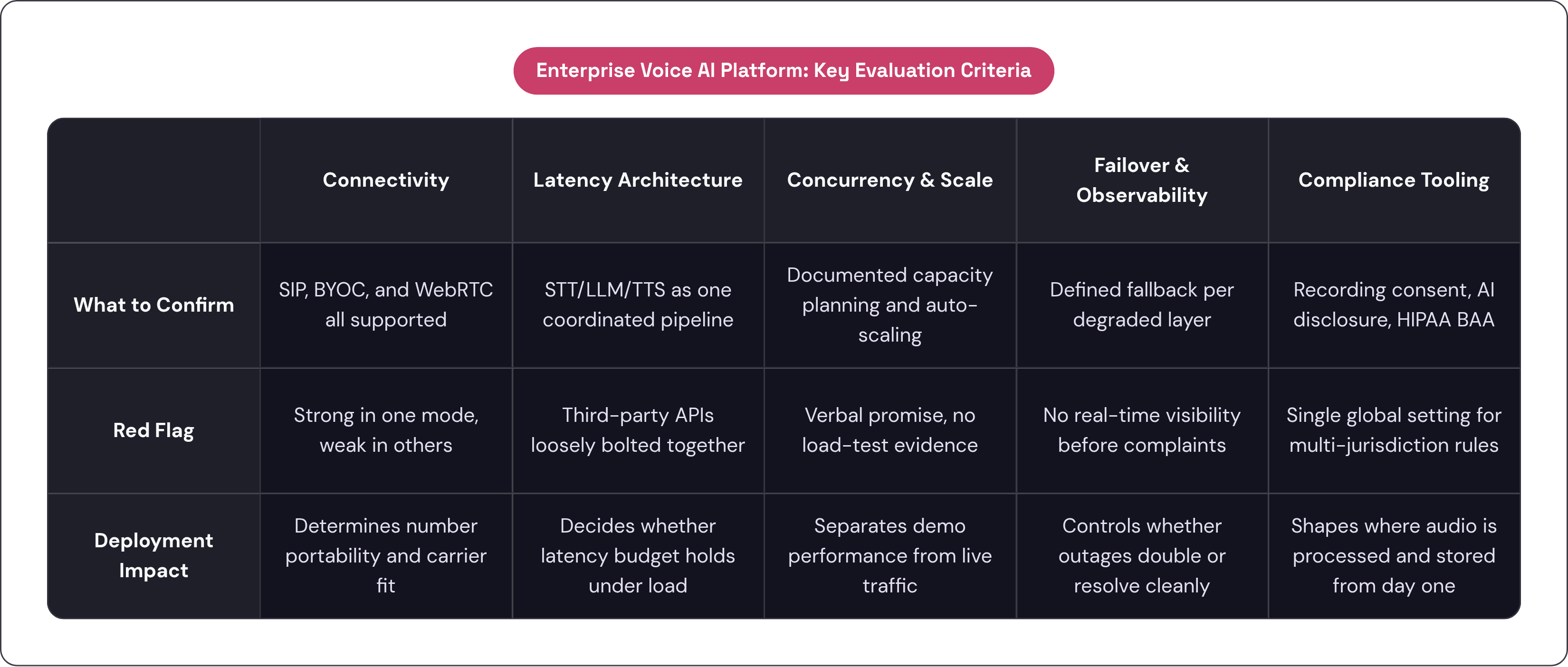
Start with connectivity. Does the platform support SIP trunking natively, offer BYOC, and handle WebRTC, or does it do one of the three well and hope nobody checks the other two?
Latency architecture matters just as much. Are STT, LLM, and TTS built as one coordinated pipeline with a real latency SLA, or bolted together out of whatever third-party APIs happened to be cheap that quarter? Concurrency planning needs a real answer too, not a shrug. Ask what happens at 500 calls running at the same time, and whether there's documented capacity planning and auto-scaling behind that number, rather than just a promise. Failover and observability come next. What's the fallback when a layer degrades, and what does the platform actually show a team so they catch trouble before a customer does?
Compliance tooling deserves its own line item: call recording consent handling, AI disclosure prompts by jurisdiction, HIPAA BAA availability, data residency controls. Language coverage matters more than most buyers expect going in, too. For a global enterprise, native-quality multilingual output, rather than machine-translated audio bolted onto a TTS engine after the fact, carries real weight; customer service and IVR use cases already make up a large chunk of TTS market revenue, which says plenty about where the real demand sits. The strongest platforms bring that stack together in one coordinated offering: SIP and WebRTC connectivity, low-latency TTS, broad language coverage, and a developer API surface. Last thing worth checking: pre-built connectors to CRM, ticketing, and workforce management tools. That integration surface usually decides whether deployment takes six weeks or six months, and six months is often the gap between shipping and getting shelved.