Conversational AI vs Generative AI for Enterprise Use Cases
Choosing the wrong AI type for your enterprise job costs millions in failed deployments.

Conversational AI and generative AI keep getting lumped together, and that mix-up costs enterprises real money in wrong-fit deployments. Conversational AI runs two-way, stateful dialogue: it tracks turns, holds context, and talks to backend systems. Generative AI makes new content by predicting patterns from training data. One runs the interaction, the other makes the thing, and picking the wrong one for the job is like hiring a translator to do your taxes. Sure, both jobs involve words, but you're still going to have a bad afternoon.
The confusion makes sense given how these get sold today. Most conversational AI platforms now run generative models underneath, so a customer service bot and a copywriting tool look like siblings from the outside. What actually matters is the function: one layer gets built for structured dialogue execution, the other for open-ended content quality. There's a third tier worth naming too, agentic AI, which pushes conversational AI into autonomous, multi-step task completion (authenticating a user, updating a record, routing a ticket, summarizing an outcome) rather than just holding up its end of a conversation. There are no numbers yet, since this part's only job is getting the definitions straight before the data starts flying.
How each technology evolved into its current enterprise form
Conversational AI's family tree runs through rule-based systems, intent classifiers, and dialogue trees, tools built for reliability, not flair. Early customer service bots weren't trying to sound clever; they were trying not to break, which for a support bot circa 2012 was already asking a lot. Support staff at the time often described their role as a human circuit breaker: standing by so the whole system didn't blow when the bot inevitably hit a question it had no script for. She used to joke that her real job title was "Ctrl+Alt+Delete, but for humans."
Generative AI comes from somewhere else entirely: language modeling and pattern prediction, trained on huge piles of text, optimized for fluency and breadth rather than workflow precision. It doesn't know what a "workflow" is. It knows what word probably comes next, and it's right often enough to be dangerous.
2024 was the year voice crossed from novelty into infrastructure. Speech-to-text, a language model, and text-to-speech, chained together and orchestrated well, hit a quality bar that made voice a real enterprise channel instead of a demo booth gimmick. Then 2025 brought domain-specific tiering. Medical models trained on large volumes of clinical dialogue have posted substantially lower keyword error rates than general-purpose systems. "Medical-grade" and "legal-grade" started showing up as line items in procurement documents, not marketing flourishes.
That kills an old assumption. Conversational AI used to get treated like the boring cousin, the one who does the dishes while generative AI writes poetry. A domain-tuned conversational system will beat a general model cold on the exact tasks that matter in regulated industries, where a misheard drug name or a garbled contract clause carries real liability.
The jobs conversational AI is actually built to do in an enterprise
Conversational AI handles high-volume, structured interactions and hooks dialogue into live systems: CRM, ERP, ticketing, payment gateways. It routes, authenticates, updates records, and summarizes, all while talking. That's the whole point of the thing.
That system-integration layer is what separates real enterprise conversational AI from a chatbot demo that wows a room and falls apart in production. An agent that can update your shipping address inside your logistics platform delivers more value than one that chats pleasantly about where your package might currently be.
Picture a support desk mid-crisis. Call volume spikes past anything a human team could reasonably absorb, phones ringing like it's the last day of a clearance sale, supervisors pacing the floor doing math on hold times. Deployments at that scale have happened across industries, with platforms like Cognigy built precisely to handle that kind of volume across channels and languages; the value is scale and consistency, full stop. Vodafone tells a similar story on resolution: its AI agent-based support system now handles more than 70% of customer inquiries without a human stepping in, and cuts average resolution time by 47%.
Latency is structural here, not a nice-to-have. Response latency is a structural constraint for a voice exchange that feels natural instead of robotic. The technical choices behind that number (which speech recognition engine, which text-to-speech model, how the language model gets routed) decide whether a caller feels like they're talking to something competent or something that just woke up. Gartner puts a number on where this is headed: agentic AI is expected to autonomously resolve 80% of common customer service requests by 2029. Today's deployments are partial, but the direction of the money is not in question.
The jobs generative AI is actually built to do in an enterprise
Generative AI's job list looks nothing like that. Marketing copy, product descriptions, audio narration, multilingual content adaptation, code generation, fast prototyping, summarizing piles of unstructured documents nobody wants to read by hand.
Its real strength is production at scale. The model that writes one product description can write a thousand variants overnight. The text-to-speech model that narrates one audiobook chapter can, in theory, narrate an entire library while the narrator sleeps in.
On the audio side, neural text-to-speech has moved well past the robotic, stitched-together phonemes of a decade ago. Current models produce speech with real prosody, emotional shading, and intonation, and in plenty of deployments a listener genuinely can't tell it from a human recording. Multilingual content is the flagship case here: localizing at scale means generating native-quality output in each language, not running text through a translator and calling it done. The voice has to sound just as natural in Portuguese as it does in Thai, across dozens of languages running at once.
ElevenLabs sits in this space, spanning the creative side through ElevenCreative (narration, dubbing, sound generation) and the developer layer through ElevenAPI, worth knowing as a reference point for enterprises building generative audio straight into content pipelines instead of bolting it on afterward.
Generative AI hits a hard ceiling in enterprise settings: it makes content. Managing dialogue, connecting to systems, enforcing a workflow, none of that is in scope. That's why it can't substitute for conversational AI when the use case is interactive rather than one-directional. A generative model can write you a great apology email, but looking up your order, confirming your refund status, and processing the refund is a different job entirely.
Where the two layers meet (and how modern enterprise deployments actually combine them)
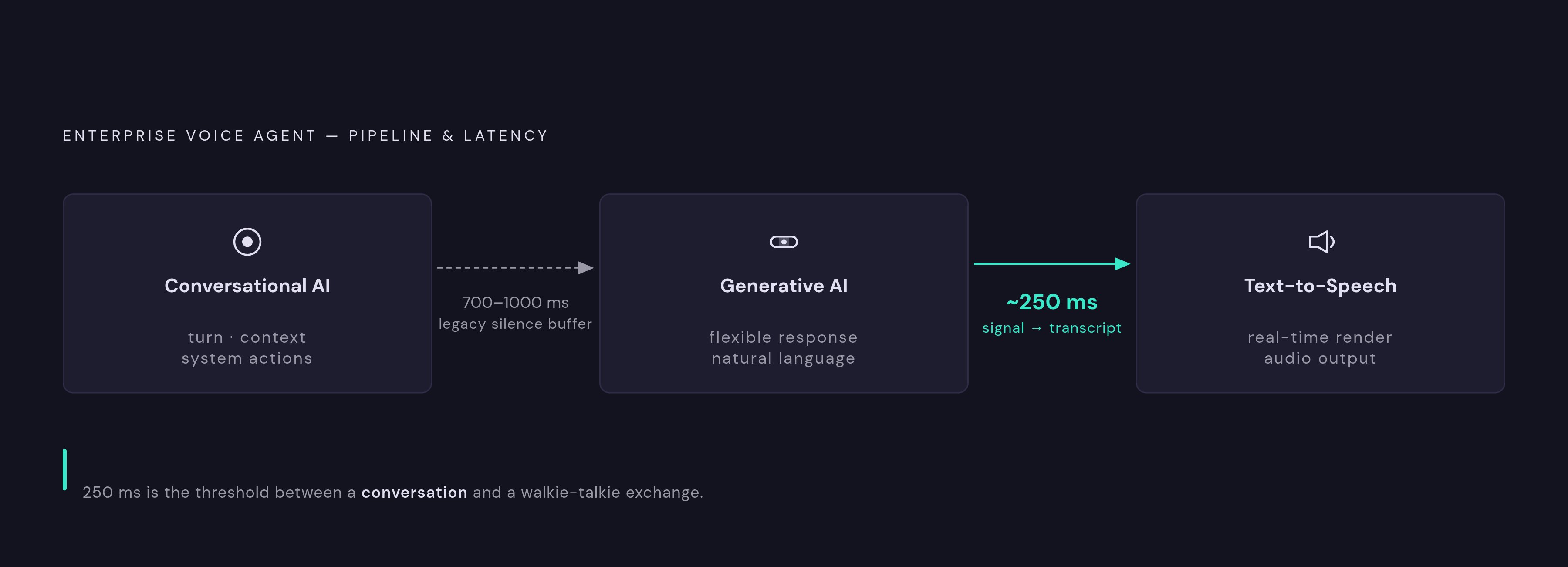
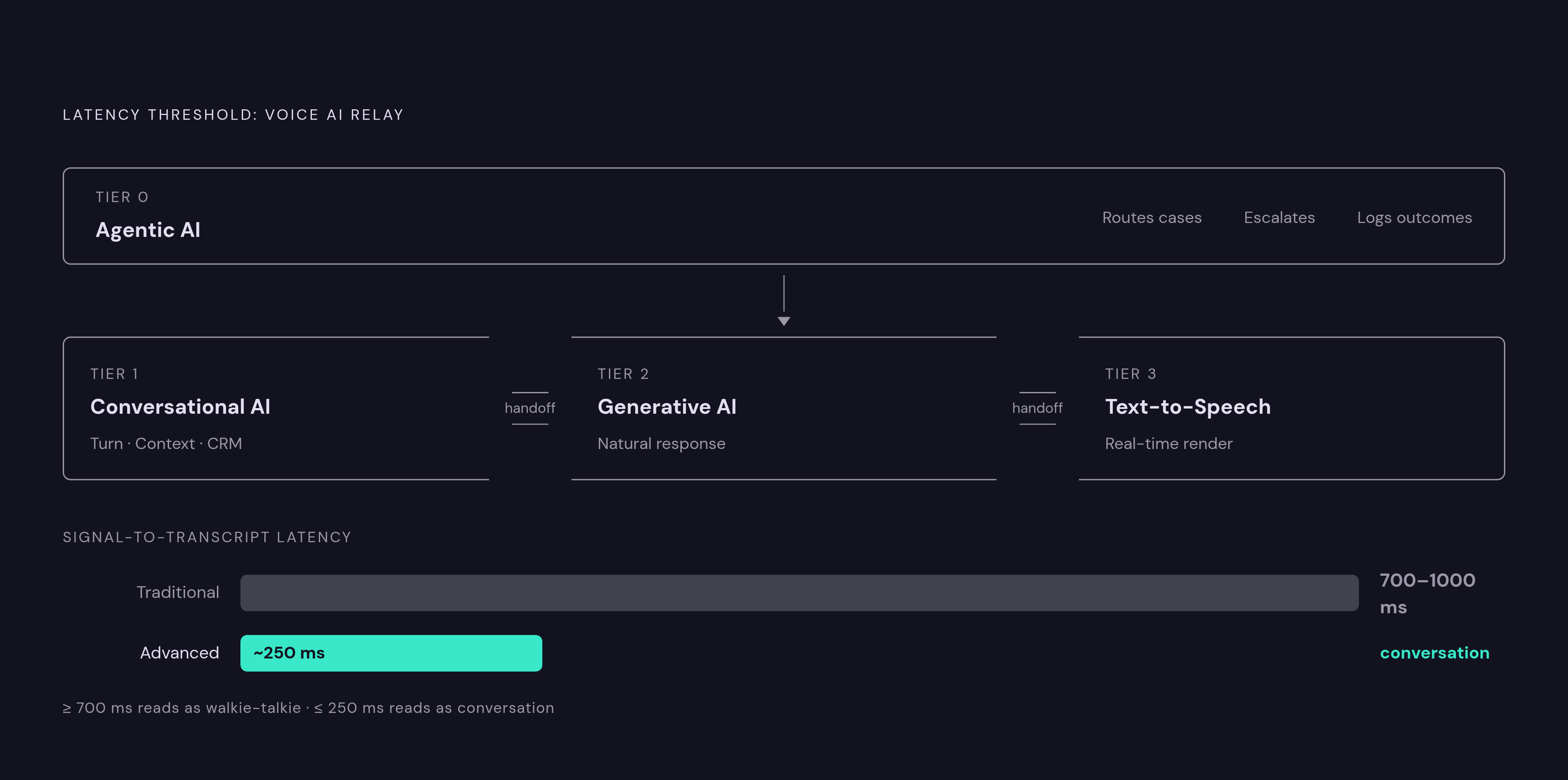
A well-built voice agent runs both layers at once. Think of it as a relay: conversational AI manages the turn, the context, and the system actions, then hands off to generative AI, which produces the flexible, natural-sounding response inside that turn. Text-to-speech renders the whole thing in real time. Three runners, one race, and the customer never sees the handoffs, ideally.
Those handoffs are exactly where latency hides. Every transition (speech-to-text to language model to text-to-speech) adds delay. Traditional speech recognition alone used to force silence buffers of 700 to 1000 milliseconds per turn, which doesn't sound like much until you're the one on hold wondering if the call dropped. Advanced systems have pushed that down to roughly 250 milliseconds from signal to transcript, a real jump toward something that feels like conversation instead of a walkie-talkie exchange.
The usage numbers back this up. Speechmatics saw real-time usage grow 4x year-on-year in 2025, while batch processing grew 93% over the same stretch. Enterprise expectations have shifted hard toward live interaction over sending something off and checking back later.
Agentic AI stacks a third layer on top of all this. The agent acts as well as responds: routing a case, updating a database, escalating to a human, logging what happened. That autonomy only works if the conversational and generative layers underneath are already reliable. You don't hand the car keys to a system that still stalls at red lights. Deloitte's 2025 forecast puts real numbers on the urgency: 25% of enterprises already using generative AI are expected to deploy autonomous agents in 2025, rising to 50% by 2027. The composition question isn't a someday problem.
What adoption actually looks like (the market signals and the organizational friction)
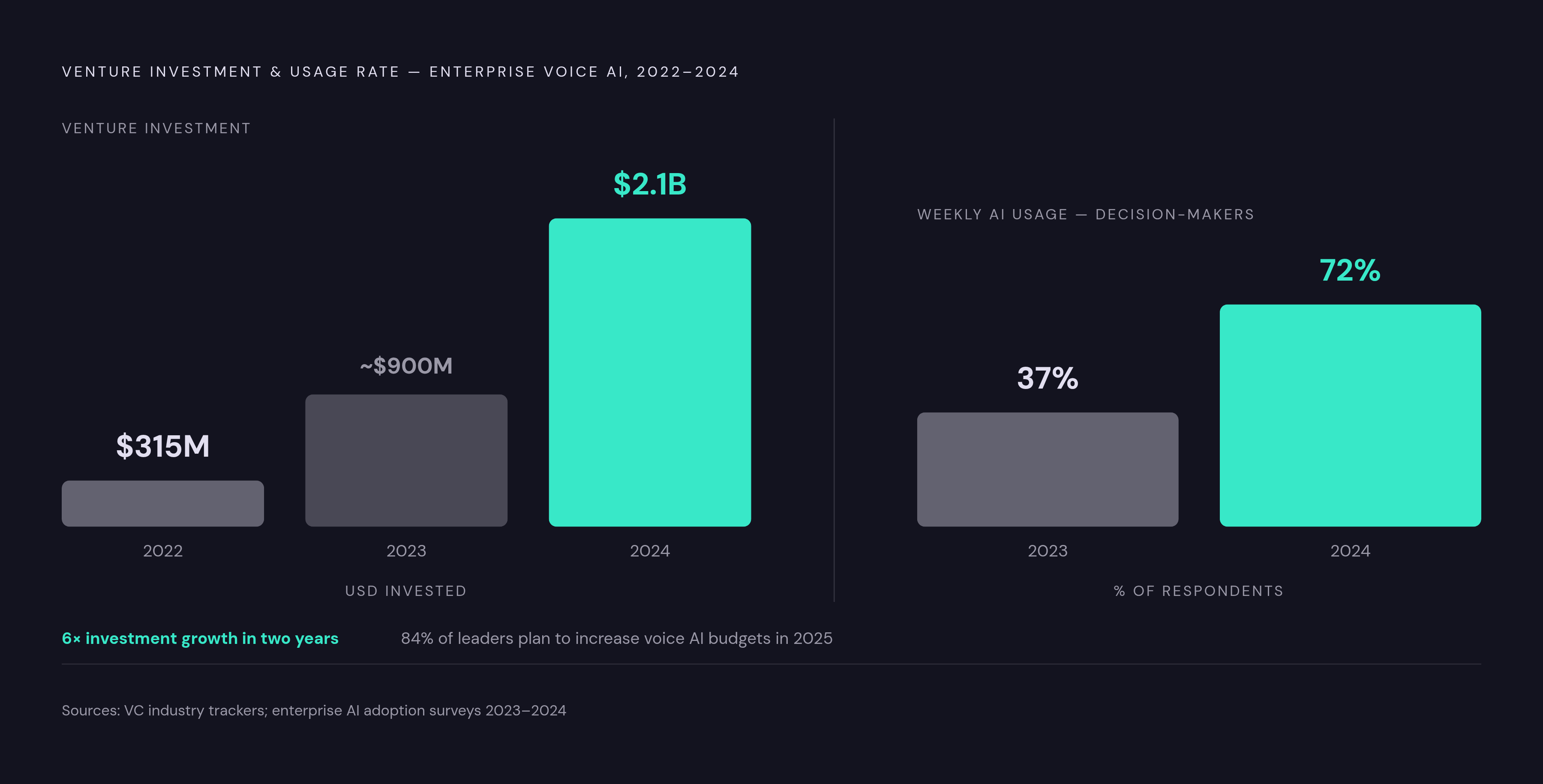
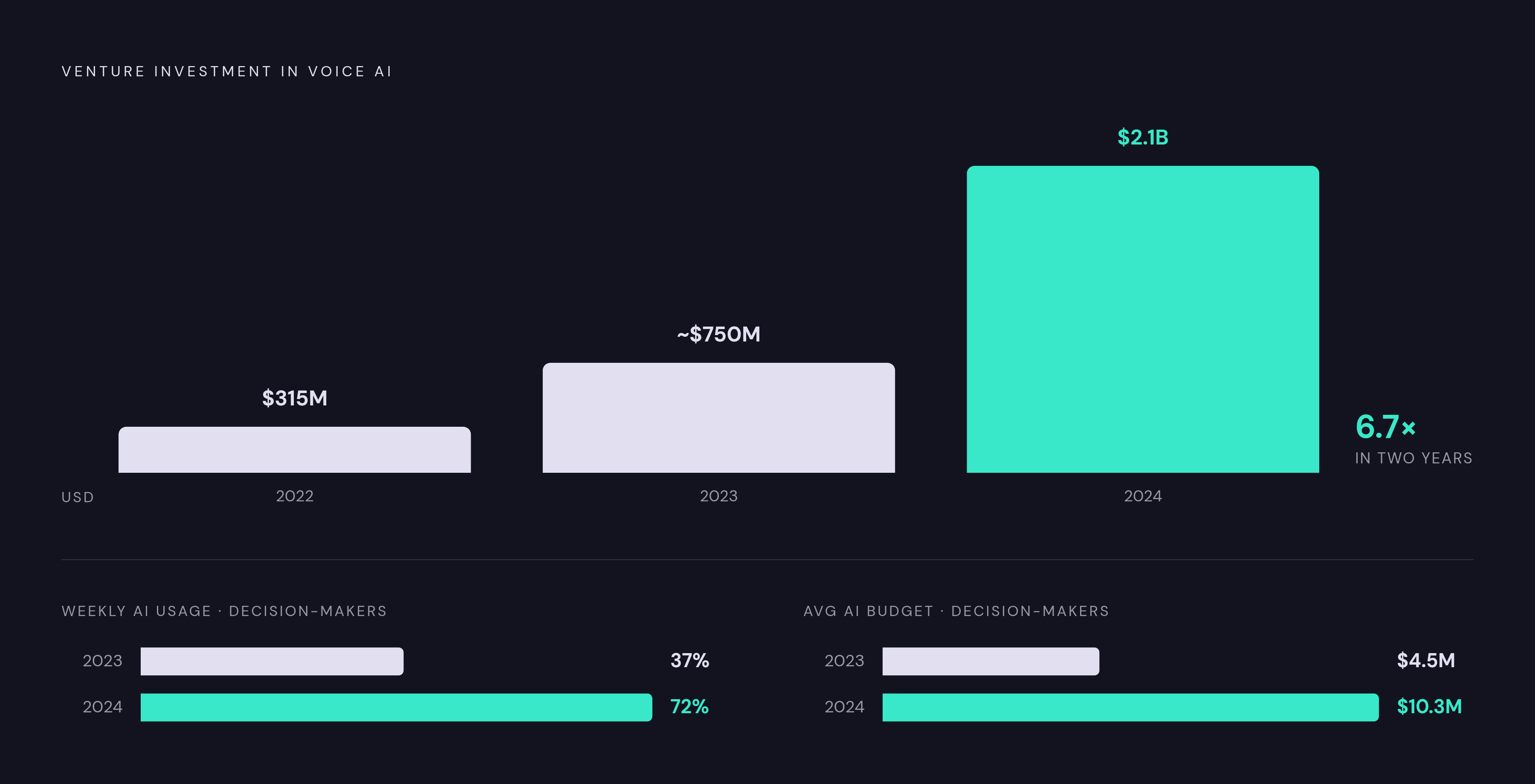
The demand numbers aren't subtle. Weekly conversational AI usage among decision-makers jumped from 37% to 72% in a single year, and average AI budgets more than doubled, from $4.5 million to $10.3 million. In a 2025 industry survey, 84% of business leaders said they plan to increase voice technology spending over the next year. Venture money backs this up: voice AI investment went from roughly $315 million in 2022 to $2.1 billion in 2024. That's a market building conviction, not hedging a bet.
Friction is just as real, and it doesn't get to be an afterthought. Consumer research consistently shows that many people still strongly prefer talking to a human, and a significant share feel negatively about companies weaving AI into the customer experience at all. Surveys in this space also find that a majority of respondents believe companies deploy AI mainly to cut costs, not to improve service. This is a trust problem, and trust problems get fixed by better framing and better design, not by a slightly smarter model.
The clearest signal from this kind of research: a large majority say companies should always offer a human option. For enterprise design teams, that's close to a mandate. Escalation paths and human handoffs aren't a feature to trim in the name of efficiency; they're what keeps the whole deployment from feeling like a trap. Budgets are climbing fast, but legitimacy depends on how the customer experiences the AI, not how well it scores on a vendor's internal benchmark.
How to match the technology to the task (a practical decision framework)
Start with the job, not the technology. Is the enterprise trying to run an interactive, system-connected workflow, or produce content at scale? That question alone decides which layer leads.
Conversational AI should lead when the interaction is real-time, stateful, and needs to touch a system directly: resolving a billing dispute, booking an appointment, updating a record. Failure modes here need to stay structured and controllable, not creative.
Generative AI should lead when the output itself is the product: narration, copy, localized audio, generated code. Quality and range matter more than managing a back-and-forth, and the person on the receiving end usually isn't in a live conversation with the system at all.
Agentic AI only makes sense once the conversational and generative layers underneath are already solid. Multi-step tasks that require judgment across systems are a bad place to discover your voice recognition falls apart under background noise. Get the foundation right first, since, as the old builder's saying goes, measure twice, deploy once.
Latency is a hard filter, not a soft preference. If an interaction needs to feel natural in real time, the whole stack (speech recognition, language model, text-to-speech) has to get judged together as one system, not graded piece by piece. And domain specificity beats general leaderboard bragging every time: a model that tops the chart on general voice quality can still choke on medical, legal, or financial terms that a domain-tuned system handles without blinking. Buy on the error rate for your actual content, not the number on someone's slide.
Most real deployments end up needing more than one layer at once, combining content generation and localization, production voice agents, and developer APIs for assembling a custom stack. The unified-platform pitch only means something once you've accepted the premise this piece has been making all along. Conversational AI and generative AI do two different jobs, and the enterprises getting this right have stopped asking which one is better in favor of asking which one they actually need.