Whisper as a Speech Emotion Recognition Backbone
Whisper wasn't built for emotions, but researchers extracted real signal anyway.
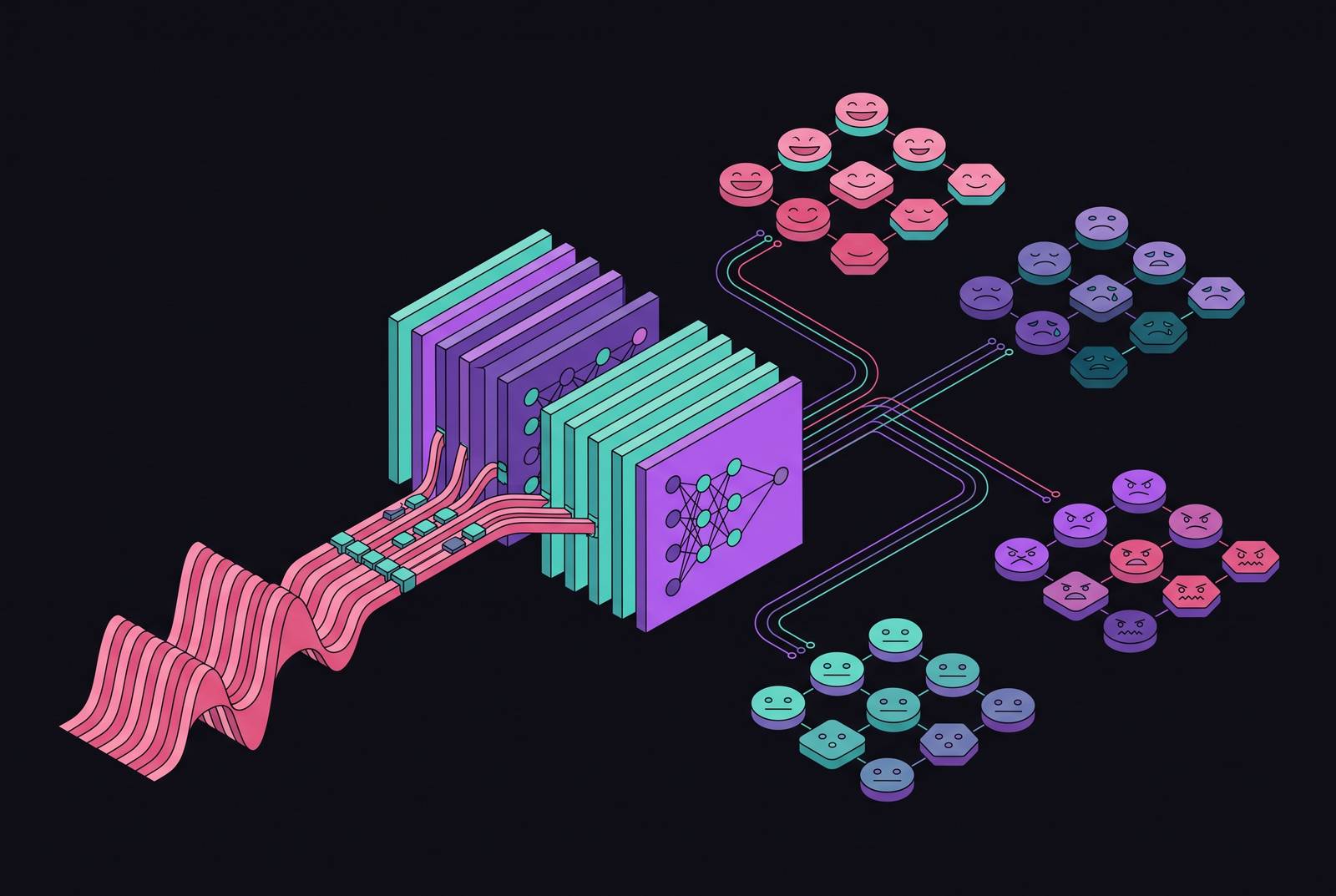
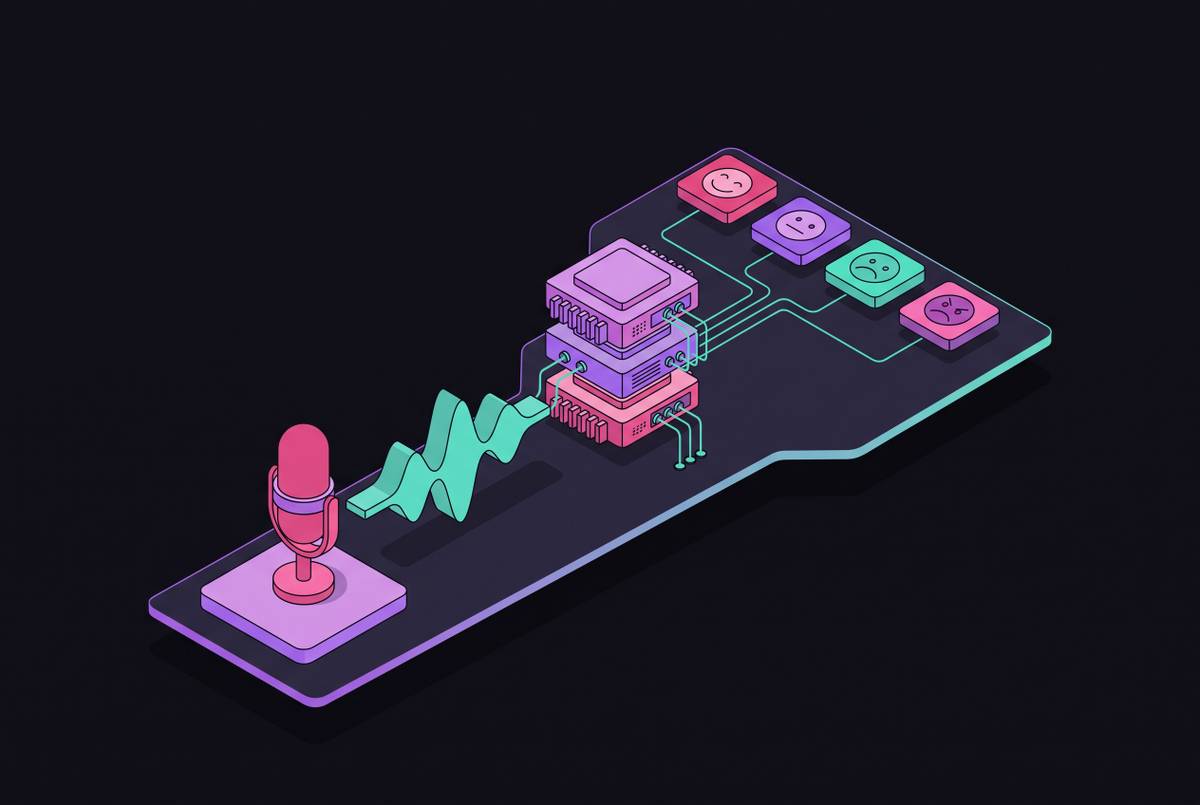
Whisper turns speech into text. That's the whole job description, and nobody trained it to notice anger, sadness, or the strained cheerfulness of a customer who wants a refund and wants you to know it. Researchers keep pulling emotion signal out of Whisper's encoder anyway, and the numbers are good enough to build products on. What follows is the story of a side effect: what happens when you repurpose a transcription machine into something closer to a mood detector, and where that repurposing quietly breaks.
How emotion information survives an ASR training objective
Transcription and emotion recognition want different things from the same waveform. ASR training rewards a model for stripping out everything except the phoneme-to-text mapping. Pitch, tempo, breathiness, vocal strain: all noise from the decoder's point of view, none of it signal. SER runs on exactly the acoustic detail ASR is trying to throw away.
Except the encoder doesn't get to throw it away first. Before the decoder picks which variation matters for text, the encoder has to compress the full mess of the input, accent, background noise, speaking style, emotional coloring, into a sequence of hidden states. Whisper's encoder trained on roughly 680,000 hours of weakly labeled, multilingual speech pulled from the open web, with no self-supervised pretraining stage to lean on first. Fully supervised, end to end, straight to text. So the encoder has to represent everything present in the signal before the decoder ever gets to be selective about it. The paralinguistic stuff rides along in the leftover dimensions the decoder never bothered to zero out.
Ma and colleagues found evidence of this using LoRA-adapted Whisper encoders and mechanistic interpretability tools: early layers hold onto general acoustic features before later layers consolidate toward the task at hand, a pattern they call delayed specialization. Emotional information is spread across the hierarchy rather than sitting in one tidy layer waiting to be scooped out. Benchmarking results on standard datasets confirm there's real structure to find, but the EmoNet-Voice project found the limits of that structure fast: fine-grained emotion classification across 40 categories required building on top of Whisper with a dedicated continual pretraining stage, because the stock encoder doesn't resolve emotion at that resolution out of the box.
Extracting usable representations: pooling, probing, and the bimodal option
Getting a usable emotion signal out of Whisper comes down to three basic moves. Pool the encoder's hidden states on their own. Fuse encoder and decoder outputs so linguistic content rides alongside acoustic cues. Or fine-tune the whole encoder-decoder stack jointly for the SER task.
Pooling sounds like a footnote, but it decides how much signal survives, and simple averaging is the wrong default. Averaging over encoder hidden states throws away a lot of what makes the representation useful, since not every timestep or every layer carries the same weight. Attentive pooling schemes, including Multi-head Attentive Average Pooling and a query-key-value-based pooling architecture, were built specifically to shrink Whisper's representations down without losing what matters for emotion. On the Persian ShEMO dataset, QKV pooling beat baseline pooling by 2.47 percentage points in unweighted accuracy. That's a small architectural choice for a real gain, and it costs nothing beyond design effort.
Bimodal fusion, combining audio embeddings with the words Whisper's decoder actually produces, does better still in some settings, and skipping it is leaving accuracy on the table. One set of peer-reviewed 2025 results on five-class emotion classification put fusion at 0.83 accuracy, against 0.75 for voice alone and 0.78 for text alone. Neither single-modality number wins outright, and that's the real point: text carries emotional information too, word choice, negation, intensifiers, and ignoring it to focus purely on acoustics throws away half the story.
Then there's the question of which layer to pool from. Because early Whisper layers encode general acoustic structure and later layers consolidate toward transcription, the layer chosen changes what gets captured. Grab a layer too early and the representation is generic. Grab one too late and it's been squeezed toward text prediction at the expense of the acoustic variation SER needs. No universal best layer exists; it depends on the downstream classifier and the emotion taxonomy in use.
Scaling, benchmarks, and what accuracy numbers measure
Bigger Whisper models generally produce better SER embeddings, and "generally" is doing real work in that sentence. Across EMODB and RAVDESS, medium and large variants beat smaller Whisper models and prior hand-crafted baselines. Yet the single best EMODB result in George and Ilyas's study belongs to Whisper medium, not large: 97.74% average accuracy using medium embeddings combined with hand-crafted features under five-fold cross-validation, against 91.67% for Whisper large with an MLP on RAVDESS. Scaling helps, but it isn't monotonic. Anyone who assumes "large is always better" is going to get burned at least once; betting the larger checkpoint automatically wins costs a benchmarking cycle to unlearn.
Compared against the pre-Whisper baseline, the size of the leap gets obvious fast. RAVDESS accuracy moved from 71.61% with an MFCC/CNN pipeline, to 96.25% with a 1D-CNN, to 98.28% with a Whisper medium model using hand-tuned features and a logistic regression classifier. The jump from hand-crafted features to Whisper embeddings dwarfs the jump between two generations of deep learning architecture. The representation does more work than the classifier sitting on top of it, and that ordering of importance is easy to get backwards.
The caveat affects how these headline numbers should be read in practice. EMODB and RAVDESS are acted, lab-recorded, and small. An actor performing "angry" in a quiet studio booth is not the same signal as an actual furious customer on a scratchy phone line, and treating lab benchmarks as production forecasts is the single most common mistake in this space. High-arousal emotions like anger hit 95% accuracy on the EmpathicInsight-Voice benchmark, while distinguishing sadness from distress, two states that sound similar but mean very different things to a downstream system, drops to 63%. Leave-one-speaker-out validation tells a similarly humbling story. George and Ilyas report Whisper large falling from its five-fold numbers to 93.87% on EMODB and 79.72% on RAVDESS under LOSO. The gap between five-fold and LOSO is the gap between a benchmark result and a speaker the model has never heard before, which describes every speaker in production.
Fine-tuning strategies and the ASR-SER conflict they must navigate
Training Whisper for both transcription and emotion at once runs into a structural fight, and pretending it isn't a fight is how projects lose months. ASR training actively suppresses the acoustic variation SER depends on, so naive multi-task learning produces gradient interference: the two objectives pull the shared parameters in opposite directions, and neither task gets the model it wants.
A few groups have found workarounds instead of fighting it head-on. Some researchers have sidestpped the conflict with lightweight adapter-based approaches built specifically to keep the two objectives from interfering with each other. Such approaches aim to handle the nuance that emotions rarely present as clean, mutually exclusive categories.
Another direction skips joint training entirely, keeping linguistic and paralinguistic objectives separate rather than asking one loss function to referee a fight it can't win.
On the parameter-efficient side, Results vary by dataset and task, and LoRA adapters get remarkably close to full fine-tuning results while touching fewer than 5% of the model's parameters. Where LoRA does fall short of full fine-tuning, the gap points to components that adapters don't typically touch, and understanding exactly which parts of the architecture require direct optimization remains an open question.
Whisper-KAN and EmpathicInsight-Voice: what novel architectures reveal about the backbone's ceiling
Whisper-KAN swaps a conventional dense classification head for a Kolmogorov-Arnold Network, and on IEMOCAP it produces state-of-the-art results, with a particular edge on harder-to-distinguish emotions like anger and sadness. The accuracy bump isn't the interesting part. KAN layers use learnable activation functions instead of fixed ones sitting behind fixed weights, which gives researchers a clearer window into which acoustic features actually drive a given prediction. For a field that often can't explain why a model called something "sad" instead of "tired," that interpretability is worth more than a percentage point or two.
EmpathicInsight-Voice is the more ambitious build, and probably the most complete Whisper-backbone SER system running today. It starts with continual pretraining of the Whisper encoder on EmoNet-Voice BIG, a 4,500-hour synthetic corpus spanning eleven synthetic voices, four languages, and 40 distinct emotion categories, before any classification head gets attached. The pipeline runs in two stages: stage one adapts the encoder itself, stage two freezes that encoder and trains MLP expert heads on top, with a compact Whisper backbone chosen to balance performance against inference cost. The project ships two sizes, a Small configuration with a 74M-parameter MLP head and a Large configuration at 148M parameters, evaluated on the EmoNet-Voice Bench, a set of 12,600 synthetic audio clips (about 35.8 hours total) built to evoke each of the 40 emotion categories and annotated using an iterative Gemini Flash 2.0 pipeline.
Both projects point at the same wall. The raw Whisper backbone has a ceiling, and getting past it takes real architectural or data investment, not a bigger classifier bolted on top. Continual pretraining and custom heads are essential here. They're what separates "captures some emotional structure" from "resolves 40 categories reliably," and skipping that investment is how a team ends up with a demo that works on the sales call and falls apart on call three.
Cross-lingual SER with Whisper and language-specific adaptation
Whisper pretrained across 100 languages on those same 680,000 hours, which sets up a reasonable expectation: emotion recognition should transfer across languages fairly well, since prosody (the rise and fall of pitch, the stretching of syllables under stress) works similarly across a lot of the world's languages even when the words don't. The research says that expectation is half right, and the half that's wrong is the one people bet real engineering time on.
Persian is the instructive case. It's underrepresented in Whisper's training data, and the working hypothesis was that language-specific ASR fine-tuning on Persian speech would meaningfully sharpen the encoder's representations for downstream Persian SER. The gains observed were real but modest, and that modesty is itself the finding: the base multilingual encoder already picks up cross-lingual prosodic patterns reasonably well, even for a language it saw comparatively little of during pretraining. Better representation extraction, not more language-specific data, is where the bigger wins sit. The same QKV pooling architecture mentioned earlier delivered a solid gain on ShEMO without any language-specific retraining, which undercuts the instinct to throw more localized data at the problem before fixing how the representation gets pooled.
The harder problem occurs in bimodal approaches that lean on Whisper's own transcription output as the text modality. If the ASR is wrong, the text modality is polluted, and for underrepresented languages, ASR error rates run higher to start with. Worse, the errors aren't random. Research has documented that ASR mistakes can follow a systematic pattern tied to emotional intensity: highly emotional speech may be transcribed less accurately than neutral speech. The text modality degrades exactly when the SER system needs it most, at the moment someone is genuinely upset. A fusion architecture built assuming clean transcripts is quietly betting against the emotional states it's supposed to be best at catching.
Production constraints: latency, model size, and the 1–3 second input window
SER doesn't get to think for long. Reliable classification needs somewhere between 1 and 3 seconds of speech. Feeding it less makes the prediction a guess; feeding it more makes a live voice agent start to feel sluggish. That window isn't a soft guideline, it's a hard constraint that shapes every architecture decision downstream of it.
Lay out a typical voice-agent latency budget and the SER slice looks small but unforgiving. Audio buffering eats 150 to 300 milliseconds. SER inference itself, running as a quantized ONNX model or on GPU, needs 50 to 150 milliseconds. An optional fusion layer combining audio and text adds another 100 to 200. Then the downstream LLM response takes 200 to 400 milliseconds, and text-to-speech needs 100 to 300 milliseconds before the first audio sample plays back. SER has to do its job inside its slice without eating into anyone else's, because nobody downstream waits around for it to finish thinking.
Model size is a real tradeoff, and the honest answer is Whisper Large is usually the wrong choice for production. It produces the richest SER embeddings, sure, but it's also the heaviest to run, and George and Ilyas call out explicitly that the larger models introduce real latency bottlenecks in deployment settings. Distillation offers a way out: one reported result achieved a substantial reduction in model size while keeping 99.99% of recall, close enough to lossless that the compression looks almost free. Accuracy gains from scaling up have to be weighed against a latency budget that doesn't care how good the embeddings are if they show up late.
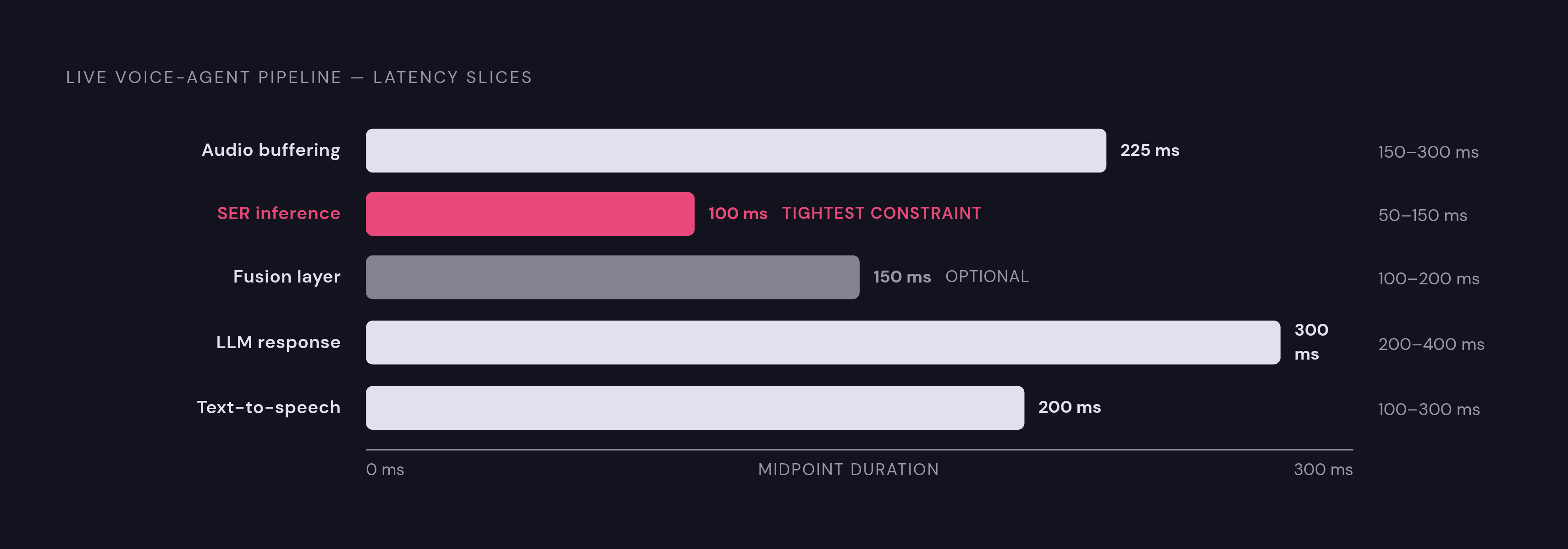
Where Whisper-based SER fits in a production
Whisper was never asked to understand feelings, and it ended up carrying enough acoustic detail to make a decent stab at it anyway. That says less about Whisper's cleverness and more about what any sufficiently large, sufficiently supervised speech model has to encode just to do its actual job. The paralinguistic signal survives as a byproduct of compression, not as a design intention, and every technique covered here, pooling strategy, bimodal fusion, task-vector merging, KAN heads, continual pretraining, exists to reclaim signal that the original training objective was actively trying to throw out.
For a production voice pipeline, that puts Whisper-based SER in one specific, useful slot, and stretching it past that slot is where teams get burned. It's fast enough to run inside a tight latency budget when properly sized and quantized. It's accurate enough on high-arousal, easily separated emotions to be genuinely useful for routing and prioritization. It is not yet reliable on fine-grained distinctions, sadness versus distress, mild irritation versus real anger, resolution that took EmpathicInsight-Voice a full continual-pretraining pass to reach. Treating it as a strong, cheap signal that flags mood shifts and escalation risk in real time is appropriate, but it is nothing more than that yet. The backbone was built to know what someone said. What it also picked up, almost by accident, is a rough sense of how they felt saying it, and rough is the operative word until the next round of adaptation narrows the gap further.
Sources
- Whisper-KAN for Speech Emotion Recognition | Springer Nature Link
- Advancing speech emotion recognition with whisper model embeddings and hand-crafted audio descriptors - ScienceDirect
- (PDF) Behind the Scenes: Mechanistic Interpretability of LoRA-adapted Whisper for Speech Emotion Recognition
- (PDF) Advancing Speech Emotion Recognition with Whisper Model Embeddings and Hand-crafted Audio Descriptors
- Speech Emotion Recognition Leveraging OpenAI’s Whisper Representations and Attentive Pooling Methods
- Behind the Scenes: Mechanistic Interpretability of LoRA-adapted Whisper for Speech Emotion Recognition