Adversarial Attacks on Audio Deepfake Detectors
Researchers reveal how attackers slip past audio deepfake detectors—and how to patch them.
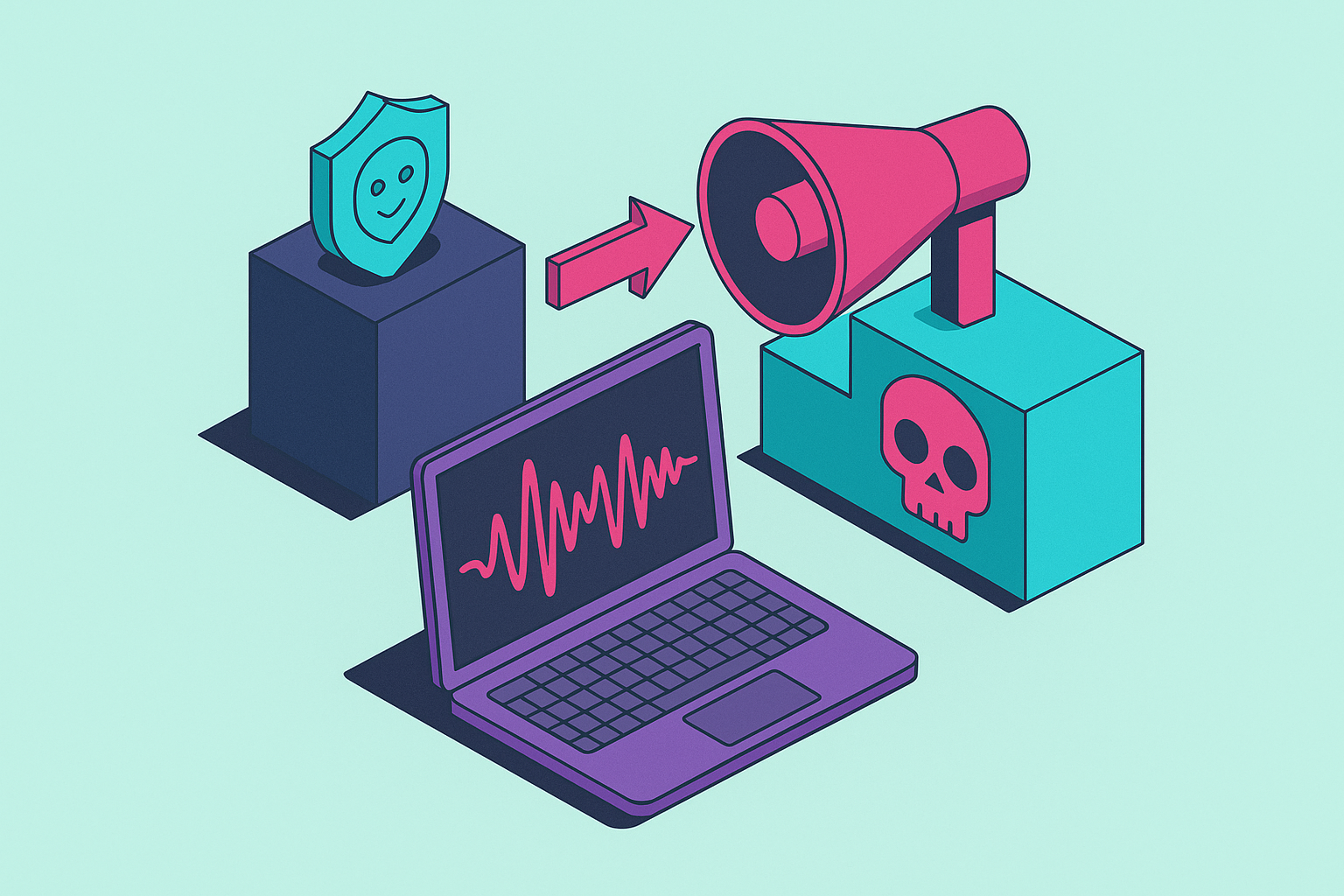
Adversarial attacks on audio deepfake detectors sit at the center of the fight against synthetic voice fraud. Cloning a voice now takes a few seconds of sample audio, and the output fools most listeners cold. Detection has become the last line of defense, and attackers know it: the same methods researchers use to break a detector are, more and more, the methods used to patch it. Strip away the jargon and that's the whole field.
The AI voice cloning market hit $2,430.3 million in 2024, and analysts expect $20,943.8 million by 2033. That's a market going vertical, and every dollar riding on it is a reason to slip past whatever's standing guard. Professional cloning tools now copy vocal characteristics at around 97% accuracy, and 59% of people can't tell an AI voice from a real one when you play it straight. Human ears lost this fight already, and what's left is algorithms trying to catch other algorithms, while the people building the fakes know that too.
How modern deepfake detectors are built and what they are trying to catch
Detectors take one of two views into the audio. Some work straight on the raw waveform, while others convert the signal into spectral representations, things like MFCCs, LFCCs, spectrograms, and hunt for artifacts there. Each view catches different things and misses different things, which is worth remembering next time someone tells you a single detector "solves" this.
The current generation leans on end-to-end deep learning and fine-tuned foundation models. Research on picking the right wav2vec 2.0 layer got equal error rates down to 0.22% on ASVspoof 2019 LA, a genuinely good number. AASIST brought graph-based spatial analysis of audio artifacts into the mix, and its successor AASIST3, built with Kolmogorov-Arnold Network components, pushes that same architecture further. XLS-R-SLS mines multiple layers of the foundation model as a feature pyramid, since low-level acoustic glitches and high-level semantic weirdness tend to surface in different parts of the network.
Here's the catch. These systems train and get graded against known generation methods, sitting inside fixed datasets, and a benchmark score is a report card on yesterday's homework. It says nothing about the exam question nobody's written yet. Adversarial attacks live exactly in that gap, between what a detector has already seen and what's coming next.
The attack surface: what adversarial perturbations actually do to a detector
An adversarial perturbation is a small, deliberate edit to an audio signal, often too subtle for a human to notice, built to push a detector's output from "fake" to "bonafide." White-box attacks mean the attacker has full access to the model's weights and gradients, while black-box attacks mean the attacker only sees inputs and outputs. That split maps almost exactly onto how abuse actually plays out.
White-box attacks are brutal when they land. Documented success rates approach near-total rates for flipping a detector's prediction, and that sets the ceiling for how bad this gets under conditions ideal for the attacker. Four methods dominate the waveform and STFT domains: FGSM, a single gradient nudge; BIM and PGD, iterative versions of the same idea; and CW, an optimization method that goes straight for the decision boundary instead of the gradient.
The part that should bother you: the same clip can sound completely untouched to a human ear while a state-of-the-art detector flips its verdict entirely, because the attack is invisible on purpose. This isn't confined to speech either. Singing voice deepfake detection runs into the identical wall, so a fabricated song can get adversarially massaged to slide past detection before it's ever uploaded or monetized. Fraud doesn't care if you're singing or talking; it just wants past the gate.
Why black-box transferability is the harder and more dangerous problem
White-box attacks make for great papers and terrible real-world scenarios, because almost nobody attacking your system actually has your model's internals in front of them. What they have is a public API: audio goes in, a verdict comes out. That's the black-box setting, and it's the version that actually keeps security teams up at night.
Here's the complication. White-box perturbations tend to overfit the specific surrogate model they were built against; a perturbation tuned to one model's loss surface often falls apart the moment it meets a different, unseen target, because it was built to win one fight rather than survive many. Random Masking Perturbation gets around this by leaning less on full gradient information, so perturbations built this way transfer more reliably across models precisely because they were never chasing one model's quirks in the first place.
The takeaway for anyone building a detector: resisting known white-box attacks tells you almost nothing about your exposure to a perturbation transferred in from a surrogate model you've never seen. A robustness claim that stops at "we tested against attack X" is a footnote, not a defense.
The benchmark gap that leaves detectors blind to current threats
ASVspoof2024 is the current heavyweight: 182,000 training samples, 140,000 development, 680,000 test, spanning multiple languages and adversarial spoofing conditions. WaveFake adds over 117,000 clips pulled from state-of-the-art vocoders and GANs. CodecFake extends coverage into audio generated by language models. On paper, that's a fortress.
The gaps show up fast. None of these benchmarks include audio from TTS architectures released in 2024 or 2025. IndexTTS, with its LLM features, FSQ quantization, and conformer encoder, is nowhere in the training or evaluation data, and neither are VALL-E-style codec language models. A detector trained and checked against 2023-vintage synthesis is being asked to catch 2025-vintage fakes, which is a bit like training airport security on last decade's smuggling tricks and calling it a day.
There's a second blind spot, and it might be worse, because it's structural rather than a matter of timing. Nearly all benchmark audio is neutral, read-aloud speech, yet modern TTS systems generate laughter, whispers, sighs, and other expressive speech that detectors have simply never trained on. Nobody thought to teach the detector what a fake sigh sounds like, so these fakes walk right through. The best ASVspoof5 detector hit a min DCF of 0.589 in the closed setting and 0.174 in the open (SSL) condition, strong numbers, sure, but strong against what was already known when the benchmark got built. New synthesis architectures will always arrive before the datasets meant to catch them do, and that's just the order of operations, no amount of benchmark expansion changes it.
How adversarial attacks are being turned into defense tools
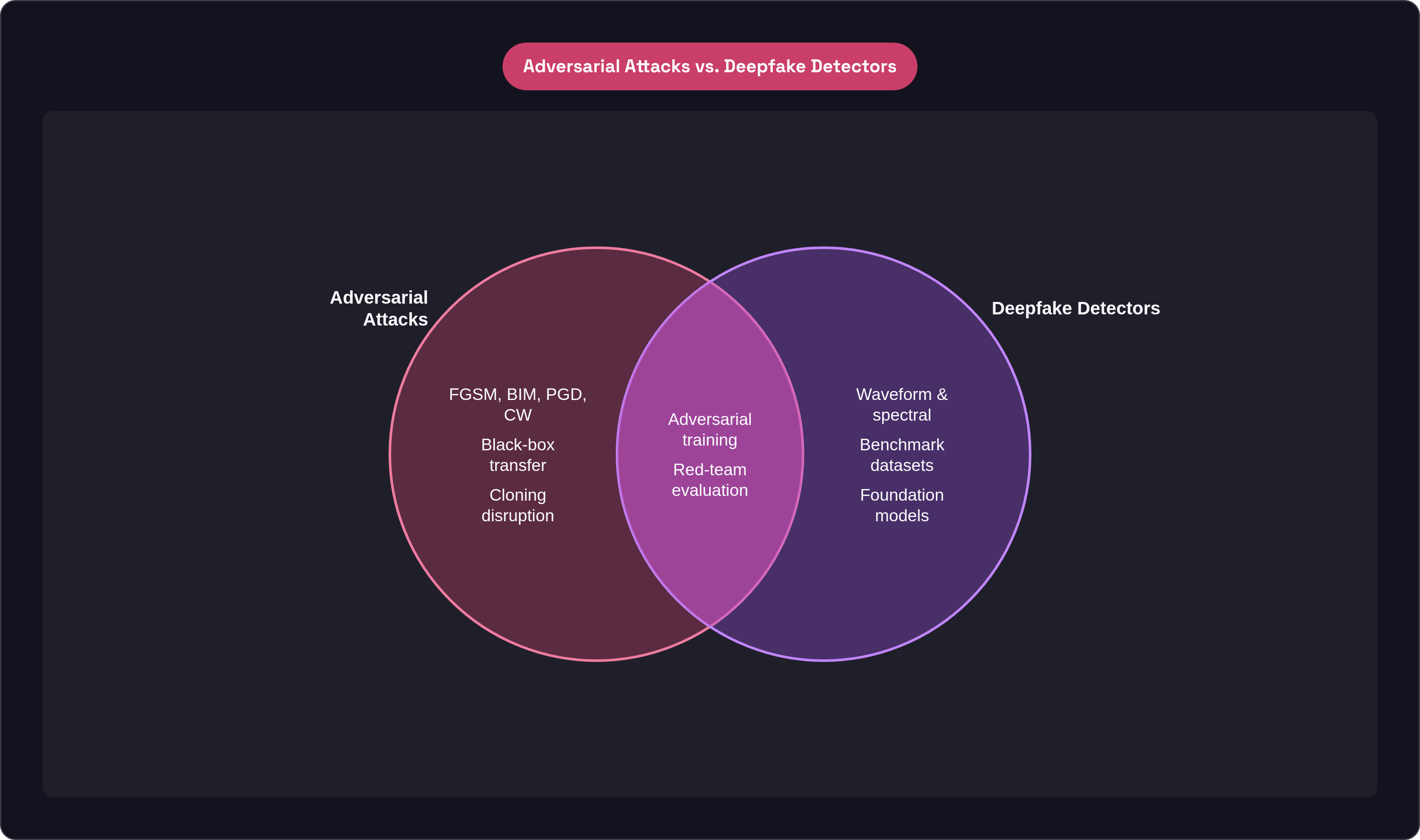
Here's where the story loops back on itself. Adversarial training takes perturbed examples, the exact kind used to break a detector, and feeds them back into the training set so the detector learns to classify them correctly. The attack becomes the data-augmentation strategy, a bit like a vaccine: expose the system to a weakened version of the threat so it builds resistance before the real thing shows up.
SHIELD, introduced in 2025, pushes this further with a collaborative learning approach against generative adversarial anti-forensic attacks. It uses an auxiliary generative model that combines input and output to expose anti-forensic signatures, a defense that turns generative to catch something generative. There's a nice symmetry to that, if you're the type who notices these things.
None of this is a permanent fix, and pretending otherwise would be dishonest. Adversarial training builds resistance to the perturbation types the model has already met; it doesn't generalize automatically to attack families nobody's invented yet. The arms race doesn't end once you bolt on adversarial training; it just moves one floor down, into the defense pipeline itself.
CloneShield takes a different posture entirely. It applies universal perturbations to a legitimate voice recording upfront, disrupting cloning models at the input stage before a fake ever gets made, prevention deployed at the source rather than cleanup after the output ships. The practical upshot is that running adversarial attacks against your own detector before shipping it stopped being optional red-teaming, the kind you do if there's budget left over. It's the evaluation methodology now, full stop.
What a credible detection pipeline looks like given these constraints
No single detector generalizes across every threat, and pretending otherwise is how organizations get burned. Commercial speaker verification systems have been bypassed by voice cloning models trained on almost nothing, and anti-spoofing detectors reliably fail against generation methods they weren't built to recognize. That's the track record, observed and repeated.
Ensemble approaches, stacking acoustic-feature models alongside foundation-model feature pyramids, cut down single-point failure risk without erasing it. Adversarial evaluation needs to live inside the development cycle as standing practice, not a pre-launch afterthought: white-box probing to find where the model actually breaks, black-box transfer testing to simulate what an attacker with zero internal access would actually throw at it.
Dataset hygiene matters just as much. Detectors need retraining on a regular schedule against the newest synthesis architectures, because treating a strong score on a 2021 dataset as a production guarantee in 2025 is a category error, plain and simple. Emotional and expressive speech coverage deserves the same seriousness: any detector deployed against modern TTS output needs training and evaluation data that includes laughter, whispers, and the rest of the non-neutral vocal range, because that's exactly where current systems go quiet.
Voice AI platforms built on original research, rather than fine-tuned commodity models, sit in a stronger spot here, mostly because they watch synthesis architecture evolve from the inside. ElevenLabs works this way: building the synthesis engine itself gives it a direct view of how its own generation pipeline interacts with the detectors trying to catch it, a vantage point different from bolting a detector onto someone else's black box and hoping for the best.
Where the arms race is heading and what it means for trust in audio
This race is structural, a permanent condition rather than a rough patch that better engineering smooths over eventually. Every gain in synthesis quality widens the window before detection catches up, and every gain in detection pushes synthesis research toward the next evasion trick. Neither side gets to declare victory, because declaring victory is exactly what triggers the other side's next move.
The market context makes the stakes concrete. The AI voice generator market is set to grow from several billion dollars in 2025 to tens of billions by 2031, meaning synthesis capability is rolling out faster than detection infrastructure can possibly keep pace with. Detection alone was never going to close that gap by itself. That's part of why provenance and watermarking, embedding verifiable metadata at the moment of generation, are getting serious attention as a complement to after-the-fact detection.
The deeper shift concerns what trust in audio actually rests on. Whether a listener, or even a detector, can tell real from fake matters less than the integrity of the pipeline that made the audio in the first place: who made it, under what consent, with what audit trail attached. That's a harder problem than building a better classifier, and a more honest one to sit with.
Adversarial attacks function less as a scoreboard proving the defense is losing and more as the mechanism the defense actually improves through. Locks get better once someone proves they can be picked, and detectors get better the same way. Organizations that treat adversarial testing as baseline practice, not a headline-grabbing stunt, are the ones building defenses that hold up under real pressure. Everyone else is just waiting for their benchmark to expire quietly.