Prosody Modeling and Expressive Speech Synthesis Research
Researchers finally crack synthetic speech's most annoying problem with stochastic models.
I've spent enough years listening to synthetic voices flub the word "actually" to have opinions about why. Prosody is what makes speech sound like it's coming from a person: pitch, rhythm, duration, stress, loudness, the whole layer of sound sitting above the words that tells you how to feel about them. Intelligibility got solved years back. Vocabulary coverage followed not long after. Voice quality, the raw texture of a synthetic voice, is close enough to human now that most people stop noticing within a sentence or two. Prosody's still the holdout, and it's a holdout full of potholes.
The uncanny valley in 2025 text-to-speech systems lives not in intelligibility or voice texture but in prosody: the layer of pitch, rhythm, duration, stress, and loudness that sits above the words themselves. A synthetic voice trips a listener when it says the right words in the wrong shape, a flat monotone delivering a joke straight, or an emphasis landing on "the" when it should land on "never." Intelligibility was solved years ago, vocabulary coverage followed, and raw voice quality is now close enough to human that most listeners stop noticing within a sentence or two; prosody remains the holdout because it carries meaning that the text itself does not fully encode, which makes it resistant to the kinds of straightforward optimization that resolved those earlier problems.
Here's the part that trips people up: listeners catch synthetic speech when the voice says the right words in the wrong shape. A flat monotone reads a joke straight. An emphasis lands on "the" when it should land on "never." That's where the uncanny valley actually lives in 2025's text-to-speech systems, and it's why the research world has spent two years throwing new architectures at what used to be treated as a rounding-error problem.
Why does prosody remain unsolved even after intelligibility and voice quality have been largely addressed?
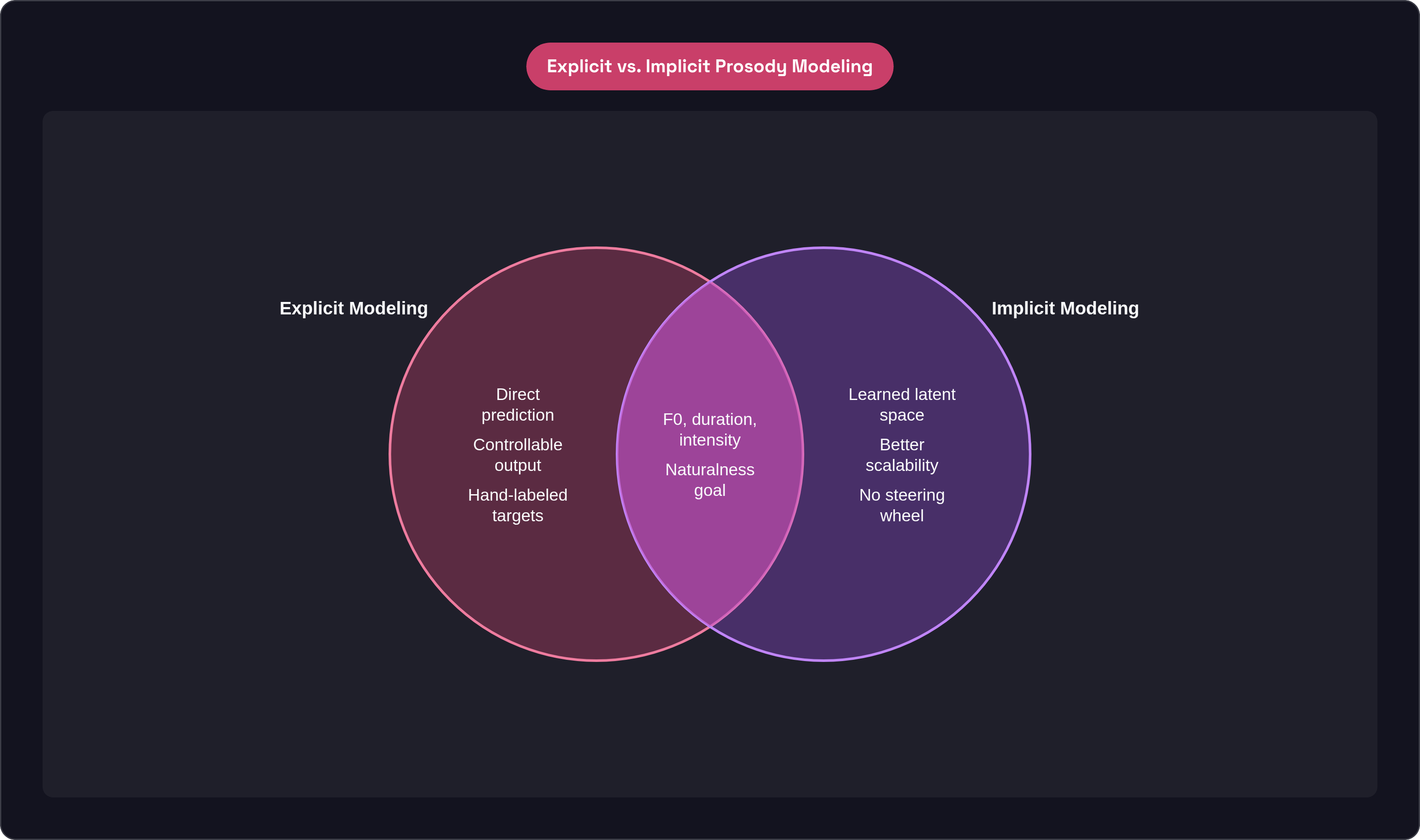
Three things do most of the work: fundamental frequency (F0, the pitch contour), duration (how long each sound and word gets held), and intensity (loudness and energy over time). A 2025 systematic review of TTS prosody research treats these as the standard measuring sticks almost every model gets judged on. Each one is its own headache.
Pitch is continuous, tied to the speaker, and changes what a sentence means depending on where it moves. Duration depends on grammar and meaning in ways that resist simple rules; try explaining out loud why you pause slightly longer before "actually" than before "obviously" in the same sentence. Intensity ties both together and shifts with mood, which means a model can't treat these three things independently even though most training setups still try to.
That same review points to a deeper problem. A lot of published work reduces prosody evaluation to one number, average pitch, when what actually signals naturalness is the shape of the pitch line and how much it moves over time. Measuring an average and calling it done is like judging a rollercoaster by its average altitude, when the whole ride is the point.
Researchers split into two camps here. Explicit modeling pulls out pitch, energy, and duration as separate values and predicts them directly. It's controllable, you can turn a knob and raise the pitch, but it tends to sound stiff because real prosody doesn't move in the clean, separable way explicit models assume. Implicit modeling lets prosody emerge from a learned space with no hand-labeled targets, which scales better but hands you almost no steering wheel.
Underneath both sits a nastier problem: human prosody isn't fixed. Ask the same person to say the same sentence in the same mood five times and you get five measurably different pitch lines. A model trained to minimize error doesn't know that; it just averages the training examples and spits out the statistical middle. That middle sounds like nothing a human would ever say: flat, careful, embalmed.
How stochastic modeling reframes the variability problem as a feature rather than noise
Once researchers named the problem correctly, the fix was almost obvious: model the whole range of plausible prosodies rather than predicting one "correct" version. Mayer, Lux, and colleagues at Stuttgart, presenting at Interspeech 2025, tested this head-on, running Normalizing Flows, Conditional Flow Matching, and Rectified Flows against each other as stochastic prosody generators. Across their evaluations, these methods produced prosody rated on par with actual human speakers, a bar that deterministic models had been quietly missing for years.
There's also a knob nobody expected: sampling temperature. Turn it down and you get a steady, even-keeled narration voice for reading an insurance disclosure. Turn it up and you get livelier, more varied delivery, the kind that suits anything meant to sound like a person with opinions. One model does both jobs, just by adjusting how much randomness gets let into the sampling.
This changes evaluation too, and not in a convenient way. If a model can legitimately produce six different, all-correct prosodic readings of one sentence, judging it against a single reference recording stops making sense. The variability stochastic modeling was built to capture is the same variability that breaks the old benchmarks. More on that later.
Diffusion models and flow matching as the dominant architectural approaches replacing autoregressive prosody
Autoregressive TTS models build speech token by token. Fine for content, rough for prosody, because small pitch or timing errors stack up across a sentence the way a slightly-off metronome drifts badly by the second verse. Over long stretches this shows up as rhythmic drift, a slow-motion stumble that's hard to catch moment to moment but obvious after thirty seconds.
Diffusion sidesteps the problem at the structural level. It starts from noise and denoises toward a target, which handles the tangled, many-branched nature of pitch and duration patterns better than forcing them through a single sequential guess.
A few papers from 2024 and 2025 show what this buys in practice. ProsodyFlow, presented at COLING 2025, pulls acoustic features using a speech LLM, maps them into a dedicated prosody space, and generates prosodic vectors with conditional flow matching, conditioned on the input text. Tested on LJSpeech, it beat prior baselines on both quality and efficiency. A separate 2025 zero-shot diffusion prosody predictor pairs a hierarchical prosody adaptor with a diffusion-based generator built specifically for unseen speakers, pulling loudness, duration, and pitch patterns from a short reference clip instead of a full training set.
DiTTo-TTS, at ICLR 2025, offers a clear data point on diffusion's speed and quality tradeoffs. Its diffusion transformer beat autoregressive state-of-the-art on naturalness, intelligibility, and speaker similarity, while running 4.6 times faster at inference and shipping at 3.84 times smaller. That's not an incremental win, it's a different category of result.
Microsoft's NaturalSpeech 3, released in 2024, went further on the architecture side: factorized vector quantization splits speech into separate subspaces for content, prosody, timbre, and acoustic detail, then a factorized diffusion model generates each subspace on its own. Scaled to one billion parameters and hundreds of thousands of hours of training audio, it reaches quality on par with human recordings. Pulling prosody apart from timbre turns out to matter a great deal, because it lets you change one without dragging the other along.
Zero-shot prosody and what it demands from models that have never heard a speaker before
Zero-shot prosody synthesis means cloning a speaker's delivery style from a short clip without ever training on that person's voice. It's the TTS version of meeting someone at a party and, ten seconds later, doing a passable impression not just of their voice but their sense of comic timing.
Timbre is the easy part; a few seconds of audio gets you close enough to someone's vocal texture. Prosodic style is the hard part, because it's a habit, slow to reveal itself: how wide someone's pitch range runs, where they tend to pause, which words they lean into. Three seconds of audio might not contain a single moment of the speaker getting excited, sarcastic, or short with someone, and the model has to guess at all three anyway.
The hierarchical prosody adaptor mentioned above tackles this by breaking the reference clip into multiple levels, coarse patterns and fine-grained ones, before feeding the result into the synthesis model. It's a reasonable answer, not a complete one; a three-second clip is still a keyhole view of someone's full prosodic range.
Microsoft's VALL-E, back in 2023, proved zero-shot voice synthesis worked at scale using autoregressive modeling, and NaturalSpeech 2 (ICLR 2024) stretched the same idea to singing. Both papers showed that cloning a voice from a short sample was doable. Neither fully cracked prosodic style transfer, which is exactly the gap the 2024 to 2025 diffusion work has been chasing.
Scale has helped regardless of architecture. Audio and voice training datasets have grown roughly fourfold since 2022, and TTS systems have gone from covering a few dozen languages to over a thousand. More data means more exposure to how humans stress, pause, and pitch their sentences, which directly improves how well a model handles a speaker it's never met. But the residue doesn't go away: a three-second clip is still a slice of a distribution the model can't fully see, so it's always guessing at the edges, and the edges are where errors live.
Emotion and context as the next layer prosody modeling must represent
A pitch line can be statistically flawless and still land emotionally wrong. That's the gap between sounding natural and sounding appropriate, and it sits above everything covered so far.
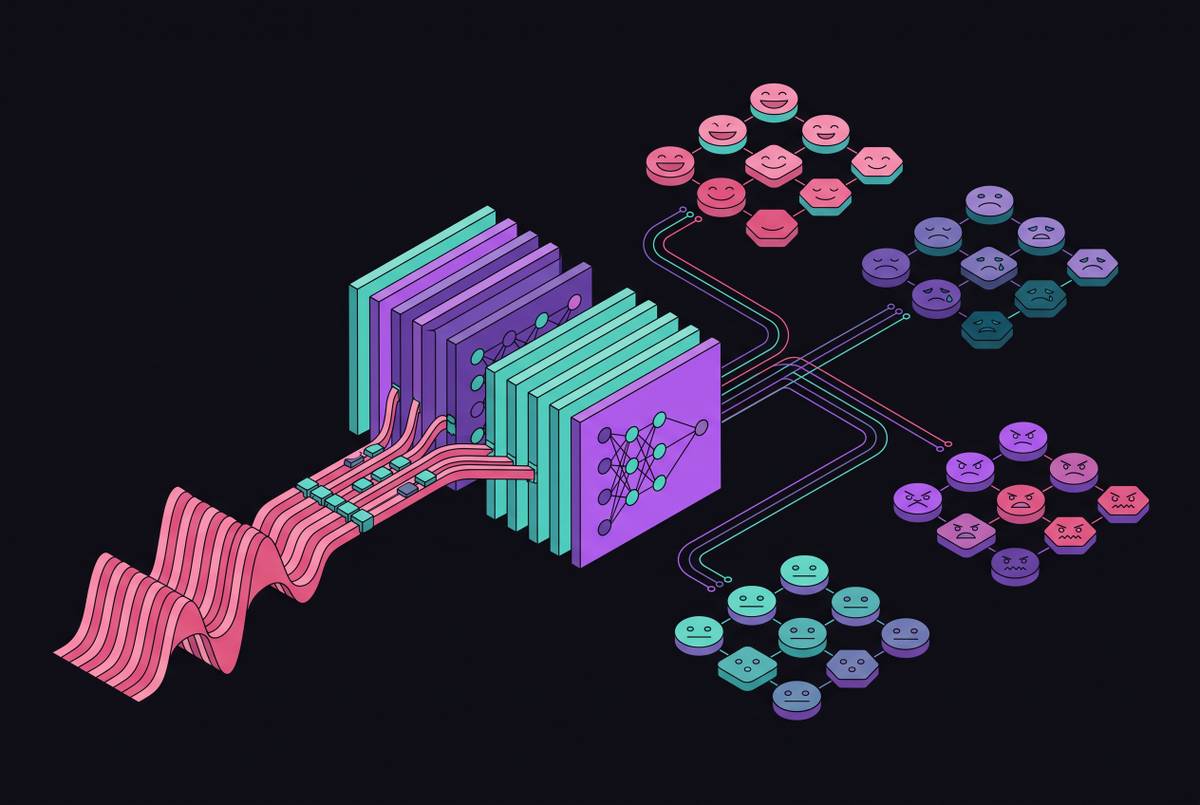
Emotion doesn't sit on one dial. Anger, surprise, sadness, and warmth all produce overlapping pitch and duration signatures, and the overlap shifts by speaker, language, and culture; a rising pitch that reads as excitement in one context reads as anxiety in another. A model that treats emotion as a single label, happy or sad, is working with a crayon when the job calls for a full palette.
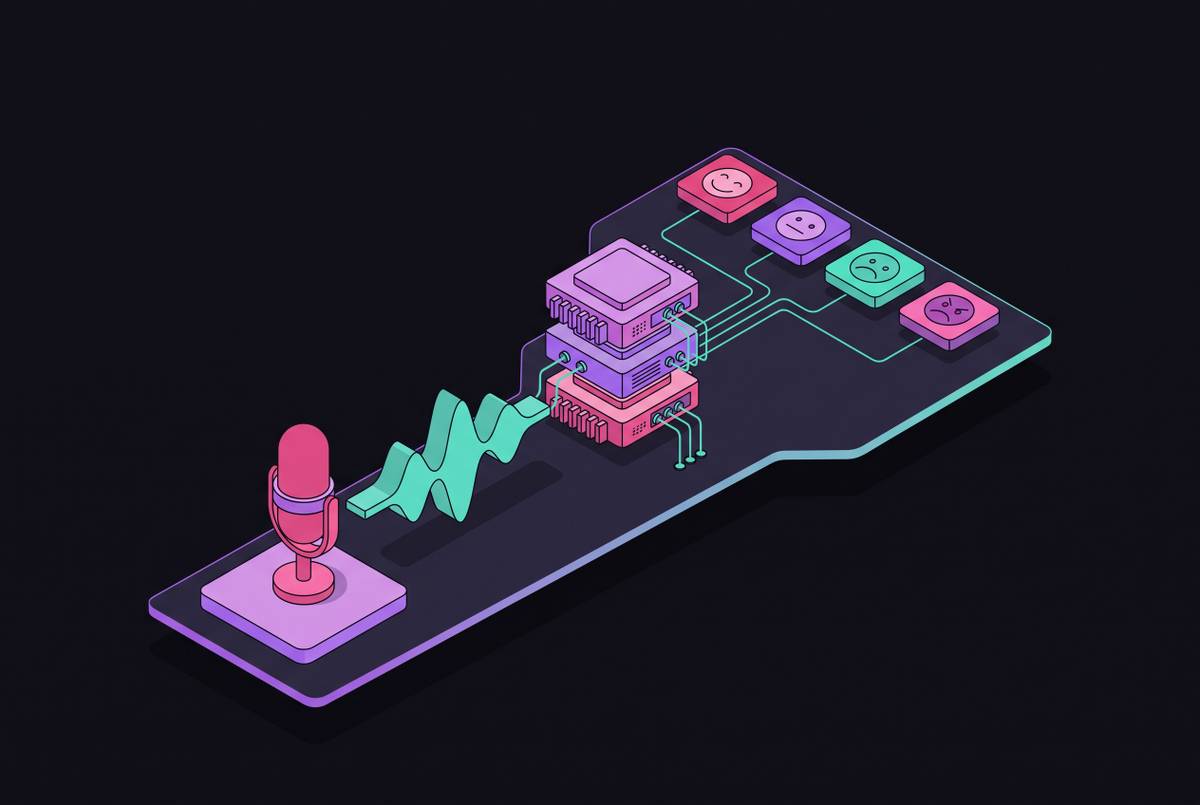
Take a question asked in frustration versus the same question asked out of genuine curiosity. Same words, similar pitch rise at the end, but any human ear tells them apart instantly. The difference hides in onset speed, how fast the pitch climbs, in the exact F0 range, and in micro-pauses lasting a few hundred milliseconds. Get any one of those wrong and the line reads sarcastic when it was meant sincere.
Current research leans on large language models to fill in the missing context: pull a semantic read of the whole sentence, or the whole conversation, and feed it to the prosody model as conditioning instead of just the local sound sequence. ProsodyFlow's use of a speech LLM for feature extraction is one version of this. Nobody's cracked it fully. No system in 2025 reliably produces contextually correct prosody across narrative, dialogue, argument, and instruction all at once, and that's the gap separating the best research systems from a native speaker just having a conversation.
How multilingual prosody compounds the difficulty and why language-specific modeling matters
Prosody doesn't carry across languages, full stop. Every language bakes its own cadence, stress rules, and social signaling into pitch, and a sentence that sounds warm in English can sound abrupt or even rude in Japanese if you import the intonation wholesale.
Tonal languages raise the stakes further. In Mandarin, Yoruba, or Vietnamese, a pitch error doesn't just sound off, it changes the word entirely. That's a much higher bar than "sounds slightly robotic."
Question intonation, emphasis patterns, markers of deference or formality: these differ structurally across languages, not just stylistically. A model trained mostly on English will confidently slap English intonation rules onto Thai or Arabic output, and the result reads as foreign in a way that has nothing to do with vocabulary.
Some recent systems now cover over a thousand languages, which sounds like the problem's solved. But coverage and depth are different axes. Having a voice available in Hausa isn't the same as having a voice that natively understands Hausa prosody. Cross-lingual voice cloning makes this worse, since it asks the model to carry a speaker's timbre and prosodic habits into a language that speaker may have never spoken a word of.
This isn't an academic footnote either. The AI voice market is set to grow from $6.4 billion in 2025 to $71.28 billion by 2034, and a meaningful chunk of that growth sits in non-English markets, where prosodic mistakes are the most obvious to the people actually listening.
How leading platforms translate prosody research into production systems
Academic prosody models get built and judged on tidy benchmark datasets. Production systems have to survive arbitrary user input, real-time constraints, and speakers the engineering team never planned for. That gap between lab conditions and a Tuesday-afternoon customer support call is where a lot of promising research quietly stalls.
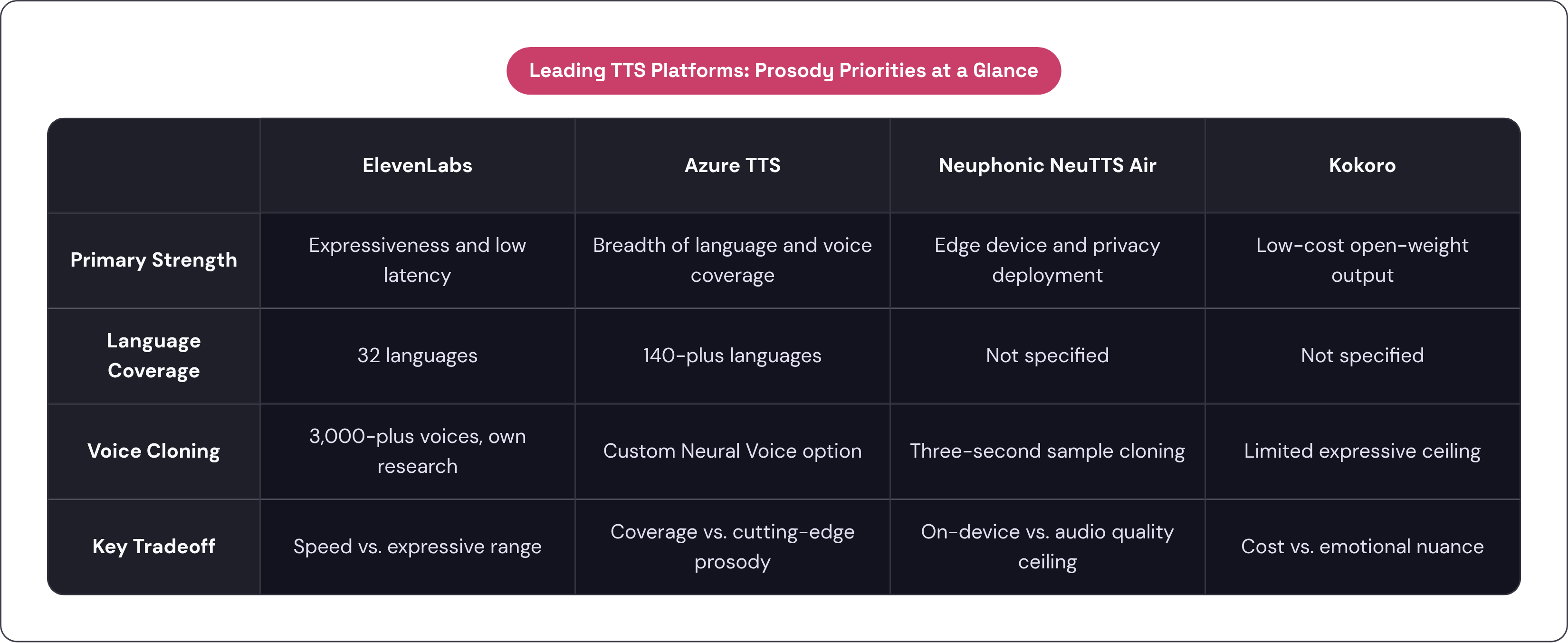
ElevenLabs sits at one end of this, treating expressiveness and speed as goals that reinforce each other rather than compete. Independent evaluation put its voice cloning at a 44.98% high-naturalness score with a 2.83% word error rate, and its Flash v2.5 model runs at 75 millisecond latency, low enough for real-time conversation. It covers 32 languages and over 3,000 voices, built on its own research rather than off-the-shelf components, which matters because prosody control tends to break exactly at the seams of a fine-tuned system.
Azure TTS leads with sheer breadth: over 140 languages, 400-plus voices, and a Custom Neural Voice option for training a bespoke model on a client's own audio. It's the platform teams reach for when coverage matters more than cutting-edge expressive range.
Neuphonic's NeuTTS Air occupies a narrower niche: a 748-million-parameter speech LLM that runs inference on a mid-tier CPU with no cloud round-trip, cloning a voice from a three-second sample and outputting 24kHz audio. Built for edge devices and privacy-sensitive deployments, where sending audio to a server isn't an option no matter how good the quality is.
Kokoro trades expressive ceiling for cost: an 82-million-parameter open-weight model priced around $0.65 to $0.80 per million characters, useful when the budget matters more than nailing every emotional inflection.
Underneath all of this sits a real engineering tension. Sub-300 millisecond response latency is becoming the baseline expectation for conversational voice agents, and running the stochastic, diffusion-based prosody models described earlier inside that latency budget takes different architectural choices than a batch pipeline reading an audiobook overnight. That constraint shapes which research actually makes it into a shipped product, and which stays a paper.
What current evaluation methods miss and why prosody progress is harder to measure than accuracy
Mean opinion score, MOS, is the metric everyone reports and almost nobody fully trusts. It captures whether listeners liked what they heard, but it can't tell you whether a low score came from flat delivery, misplaced emphasis, or an emotional tone that missed the context. One number stands in for three possible causes with no way to tell which one's to blame.
The 2025 systematic review found that most work from 2020 to 2024 evaluates prosody through F0, duration, and intensity treated separately, and models get rewarded for matching an average pitch value rather than the shape and movement of the line over time. That's like grading a song on its average note.
Then there's the reference problem. A single sentence has multiple valid prosodic readings, and scoring a model against one reference recording punishes it for producing a different, equally natural version. Stochastic models expose this hardest: if a system generates six plausible readings of an ambiguous sentence, the benchmark has no principled way to say which one counts as correct.
Some fixes are underway. Prosody-specific automatic metrics, F0 dynamic time warping and rhythm correlation among them, plus discriminator-based naturalness probes and listener studies with explicit prosodic annotation, are gaining ground in papers. None of it has become a field-wide standard yet. Practically speaking, that means when two vendors report "naturalness scores," those numbers likely aren't measuring the same thing, and anyone comparing platforms should treat those figures as a rough pointer, not a scoreboard.
Where prosody research goes next and what it means for the gap between synthetic and human speech
Here's the honest state of the field: current systems produce natural prosody in controlled, sentence-length conditions and start falling apart on discourse-level coherence, on holding a steady emotional register across a five-minute monologue, on speaker quirks a three-second clip can't reveal, and on emotional contexts thin on training data.
The near-term path runs through three things. LLM-conditioned prosody generation, giving the model access to full discourse context instead of one sentence at a time, is the most active direction right now, with better cross-lingual transfer close behind. Scaling up multilingual training data keeps paying off too, even if it's the least glamorous of the three.
Diffusion transformers have already settled the argument that quality and speed don't have to trade off against each other; DiTTo-TTS closed that case. The open question now is how to bolt richer semantic conditioning onto diffusion transformer pipelines without dragging latency back up.
None of this matters much without better measurement, though. If a new architecture can't be judged against what actually counts, contour shape, discourse consistency, contextual fit, the field is optimizing in the dark and calling it daylight. Fixing measurement isn't a side project here. It's the thing everything else depends on.
Picture what "solved" looks like: a trained listener, given multiple kinds of speech, emotional registers, and languages, can't reliably tell synthetic speech from a native speaker's, even while trying hard to catch it. That's a real bar, one that survives someone actually listening for the seams, not a marketing claim.
The pressure to get there isn't theoretical. Business adoption of voice AI has jumped from 45% two years ago to 78% today, either deployed or in active piloting. The demand for speech that doesn't sound like it's reading off a teleprompter is already here, and the distance between what's shipping and what's possible in the research is, for now, still audible to anyone paying attention.