Zero-Shot Voice Cloning Model Architectures
How modern speech systems extract and inject speaker identity without retraining.

Tacotron 2 and FastSpeech were significant advances in neural text-to-speech synthesis. Tacotron 2's sequence-to-sequence architecture with attention produced speech that represented a substantial improvement over concatenative synthesis. FastSpeech's duration predictor made inference faster and more controllable. But both systems had speaker identity baked into their weights. Adapting to a new voice meant hours of target-speaker recordings, a fine-tuning pass, and patience. Zero-shot generalization was not on the menu.
VITS changed the underlying calculus. By unifying text encoding, duration modeling, and waveform generation inside a single variational framework, it demonstrated that end-to-end probabilistic modeling could handle the full synthesis pipeline with faster inference and more expressive output. Injecting conditioning signals into a unified latent space is considerably cleaner than bolting them onto a pipeline of discrete stages, and VITS-lineage systems became the direct ancestors of many contemporary zero-shot architectures for precisely that reason.
The missing piece in these early systems was not quality. It was a mechanism to extract and inject speaker identity at inference time without touching model weights, which is the gap that text-to-speech platforms like ElevenLabs are built to close through voice cloning at inference time. That is the specific problem the speaker encoder was designed to solve.
The Speaker Encoder: How a System Extracts Identity from a Few Seconds of Audio
The speaker encoder's job sounds deceptively simple: take a short reference utterance, produce a compact vector capturing the speaker's vocal identity, independent of what words were actually spoken. In practice it is one of the harder subproblems in the entire pipeline, and getting it wrong poisons everything downstream.
Pre-trained speaker verification models, particularly GE2E and ECAPA-TDNN, are commonly repurposed here because they were trained to distinguish between speakers, which means they already encode the features most relevant to vocal identity. Repurposing a verification backbone as a speaker encoder has become standard practice, not because it is elegant but because it works well enough that no one has seriously bothered to replace it.
Global embeddings compress a reference utterance into a single fixed-size vector. They capture timbre efficiently; the speaker sounds recognizably like themselves. What they lose is temporal granularity. The voice sounds right on average, but the moment-to-moment variation in pitch, rhythm, and emphasis that characterizes a real person gets averaged away. Multi-level representations address this by extracting both a global timbre vector and local prosodic features, giving downstream components richer signal about how a speaker moves through an utterance rather than just what they sound like standing still.
The Perceiver Resampler approach, used in certain architectures including XTTS, takes a different path. Instead of collapsing the reference to a single vector, a cross-attention mechanism attends over the full reference sequence and produces a fixed set of learned summary tokens. More temporal structure survives, at the cost of a larger conditioning representation.
There is a design tension introduced here that carries through everything downstream. A richer speaker representation increases acoustic similarity between the clone and the reference. It also increases the risk of leaking reference content — specifically the words, background noise, or emotional context of the recording — into the embedding rather than pure identity. You want to capture how the speaker sounds, not what they happened to be saying when you recorded them. These are not the same thing, and conflating them is a failure mode that shows up in production far more than benchmarks suggest.
How the Acoustic Model Uses Speaker Identity to Generate Speech Tokens or Features
Once the speaker encoder produces its representation, the acoustic model has to actually use it. How it does that depends heavily on the model family, and the differences are more consequential than they initially appear.
In spectrogram-based systems using Tacotron 2 or VITS backbones, the speaker embedding is injected via learned projection layers that bias every decoding step toward the target speaker's characteristics. Functional, architecturally conservative. The speaker vector modulates an otherwise conventional mel spectrogram generation process, which works fine until you want something more expressive or more scalable.
VALL-E represented a more fundamental shift. Rather than generating mel spectrograms, it treats speech as a sequence of discrete tokens produced by a neural audio codec, making synthesis a language modeling task and zero-shot identity transfer a form of in-context learning from a prefix of the target speaker's codec tokens. The framing matters because it lets the acoustic model benefit from the same scaling laws and architectural advances that drove progress in large text language models. Zero-shot generalization improves as scale and training data volume increase, a pattern the language modeling community has studied extensively and one that audio researchers are now exploiting.
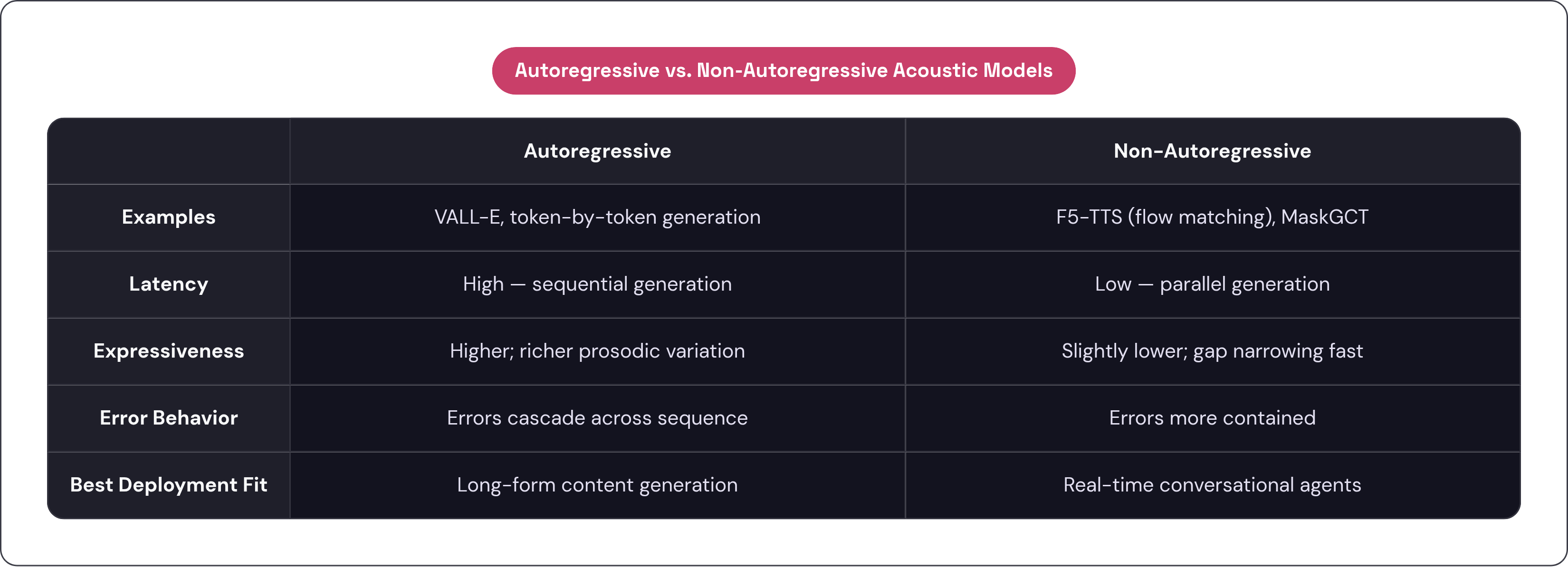
The autoregressive versus non-autoregressive tradeoff is where practitioners feel the architectural choices most viscerally. Autoregressive token generation is expressive but slow; errors accumulate across the sequence, and generating a long utterance can take multiples of its own duration. Non-autoregressive approaches, including flow matching as used in F5-TTS and masked generation as used in MaskGCT, generate tokens in parallel. Latency drops substantially, and while some expressiveness is sacrificed, the gap has narrowed enough that the tradeoff calculus has shifted over the past two years.
Flow matching is not simply a faster diffusion model, which is a common misconception. Flow-matching ODEs learn a straighter generative trajectory from noise to target features, requiring fewer solver steps than diffusion-based alternatives. That is why it keeps appearing in production systems rather than just papers.
NaturalSpeech 3 pushed factorization further by splitting speech into separate subspaces for prosody, timbre, and acoustic detail. Each subspace can be controlled or transferred independently, meaning a system can clone a speaker's vocal identity without inheriting their emotional state or speaking rate from the reference clip. When reference material is limited or contextually awkward, that capability is useful.
IndexTTS's adoption of Finite Scalar Quantization over traditional VQ-VAE codebooks illustrates how codec design choices propagate upward into output quality. More stable discrete representations at the token level produce fewer token-level errors, and token-level errors in autoregressive generation have an unfortunate tendency to cascade into audible artifacts that are immediately obvious to a human listener, even one who cannot explain why.
The Vocoder Layer and Why Waveform Reconstruction Remains an Open Problem
The vocoder is where everything becomes physically real. Its job is to convert the acoustic model's output, whether mel spectrograms, codec tokens, or latent features, into a time-domain audio waveform. The gap between "technically correct" and "sounds good to an actual human" lives largely here, which is why it keeps attracting research attention despite being nobody's favorite part of the stack.
Neural vocoders including WaveRNN and HiFi-GAN replaced earlier deterministic methods and eliminated the characteristic buzziness that made early neural TTS immediately identifiable. BigVGAN pushed fidelity further through large-scale generative adversarial training, and the improvement was audible rather than merely measurable. Universal vocoders, trained across many speakers and conditions rather than tuned per system, are essential for zero-shot pipelines: the vocoder must handle voices it has never encountered, by definition, and a vocoder trained on a narrow speaker distribution makes that problem obvious fast.
Residual vector quantization in codecs like EnCodec introduces a hierarchy of token streams. Coarse tokens capture content and coarse identity; fine tokens recover acoustic detail. Vocoders that reconstruct across all levels of this hierarchy produce higher fidelity than those using only coarse tokens, though the computational cost scales accordingly.
The latency split between autoregressive and GAN-based vocoders is where deployment context becomes determinative. Autoregressive vocoders generate sample by sample and produce the highest quality. GAN-based vocoders run in parallel and are fast enough for near-real-time use. These are not equivalent options with a simple quality tradeoff; they are architecturally different tools for different deployment targets. Picking the wrong one is a surprisingly common mistake that tends to surface late in a project.
One thing that emerges quickly in practice: background noise or recording artifacts in the reference clip propagate into the output. The vocoder faithfully reconstructs what the acoustic model provides, including inherited imperfections. A noisy reference produces a noisier clone. Before blaming the vocoder, check the reference material.
How Training Data Scale and Diversity Shape Zero-Shot Generalization
The architectural machinery described above will fail on any speaker type it has never learned to represent. Zero-shot generalization is not purely an architecture problem; it is a data coverage problem, and no amount of architectural elegance compensates for a training distribution that simply does not include the speaker type you are trying to clone.
CosyVoice's training at substantial scale across multilingual speech illustrates the direct relationship between coverage breadth and inference-time generalization. A model that has encountered many languages and many speaker types during training will clone more convincingly across a wider range of reference inputs than one trained on a narrow distribution. A model trained primarily on broadcast-quality speech from a narrow demographic will clone poorly from noisy, accented, or non-standard reference clips, and it will do so systematically and predictably.
Speaker diversity within a single language matters as much as language count. Age, accent, vocal quality, and recording conditions vary enormously among speakers of any given language, and a model that has seen only a narrow slice of that variation during training will exhibit failure modes that are difficult to fix without retraining at scale.
The multilingual evaluation gap is a recognized limitation of the field. Despite rapid architectural progress, there is no widely adopted multilingual benchmark for zero-shot TTS quality. X-Voice's construction of a test set spanning many languages drawn from Common Voice is a direct response to this gap. Comparing systems across languages currently requires assembling custom evaluation sets, which most practitioners simply do not have the resources to do rigorously. As a result, many architectural claims about multilingual capability remain untested against evidence others can reproduce.
Cross-Lingual Cloning: Generating Speech in a Different Language Than the Reference
Cross-lingual cloning asks the system to clone a speaker's vocal identity into a language they were not speaking in the reference clip. This requires disentangling acoustic characteristics from the phoneme inventory, rhythm, and prosodic patterns of the source language. Those things are entangled in ways that are easy to underestimate until you actually run the experiment.
VALL-E X demonstrated that prompt-based conditioning served as a cross-lingual prefix, with the model learning to preserve timbre and prosody while ignoring source-language phonetic patterns. This works within limits that become apparent on harder language pairs.
Dual speaker embedding approaches, as explored in DSE-TTS style architectures, maintain separate embeddings for cross-lingual and monolingual identity. The motivation is direct: a single embedding conflates language-specific phonetics with speaker-specific timbre, producing accent bleed when crossing language boundaries. Separate embeddings give each dimension cleaner signal, at the cost of a more complex training regime.
Latent linguistic embedding approaches, as in NAUTILUS-style architectures, encode language-neutral content representations separately from speaker representations, giving the acoustic model cleaner disentanglement between what is being said and who is saying it. The architectural logic is sound. The execution remains imperfect, and the field has not fully solved this.
Where systems still struggle is generating natural prosody in the target language while preserving the source speaker's rhythmic identity. These two requirements pull against each other in ways that simple disentanglement architectures do not fully resolve. CosyVoice 3's cross-lingual performance on Chinese-English and English-Chinese transfer represents a meaningful narrowing of this gap while also demonstrating that certain language pairs remain harder than others, typically because the prosodic systems are farther apart structurally.
Hierarchical Architectures and What Multi-Stage Generation Actually Buys You
The insight behind hierarchical architectures is unglamorous but sound: forcing a single model to simultaneously plan prosodic structure and recover fine acoustic detail is asking it to solve two problems with fundamentally different granularities at once. Separating those tasks lets each stage be optimized for its own objective. That turns out to matter, though it took a while for the field to take the idea seriously rather than treating it as added complexity.
VoxCPM's two-stage design makes this explicit. A Text-Semantic LLM generates prosodic planning signals; a Residual Acoustic LLM recovers fine acoustic detail; both feed a local diffusion decoder. Each layer specializes, and errors at one stage do not fully propagate into the others. The practical result is low word error rates in both English and Chinese alongside high speaker similarity scores, which suggests the separation is productive rather than architectural complexity for its own sake.
The same coarse-to-fine logic appears in codec RVQ hierarchies: coarse tokens first, fine tokens filling in detail afterward. Hierarchical architectures extend that design principle to the system level rather than just within the codec.
The tradeoff is real. More stages mean more inference complexity, higher memory requirements, and more latency surface area. This is why hierarchical designs appear predominantly in high-quality content generation pipelines rather than real-time conversational systems. The quality ceiling is higher; the latency floor is also higher. Choosing between them is less a technical question than a product question about what you are actually building, and answering the product question first saves a significant amount of engineering pain later.
The Architectural Gap Between Content Generation and Real-Time Voice Agents
These are not two points on a quality spectrum. They are different engineering problems that happen to share some underlying acoustic technology. Conflating them early in a project is an efficient way to waste several months, a fact that has been independently rediscovered by a number of teams.
Content generation has no hard latency constraint. A pipeline can run an autoregressive acoustic model and a high-quality universal vocoder sequentially, take several seconds to produce a finished clip, and the output is indistinguishable from a human recording. Quality is the primary objective, and the architecture can afford to chase it.
Real-time conversational agents operate under a hard sub-hundred-millisecond constraint from text input to audio output. Autoregressive generation, token by token, is incompatible with this constraint at current hardware speeds unless aggressively optimized. Non-autoregressive architectures, including FFT-based blocks, flow matching, and masked generation, become the preferred path because they generate in parallel.
Streaming synthesis adds another requirement: the system must begin emitting audio before it has finished synthesizing the full response. The first audio chunk must start playing while later chunks are still being generated. This is an architectural prerequisite for conversational naturalness, not merely an optimization. CosyVoice 2's scalable streaming synthesis attempts to provide the same voice identity transfer capability in both batch and streaming modes within a single model family, which is harder than it sounds and remains an active engineering challenge rather than a solved one.
End-to-end speech-to-speech models, processing audio in and emitting audio out through a single inference loop, represent the furthest evolution of this direction, eliminating the cascaded pipeline of speech recognition, language modeling, and speech synthesis entirely to keep latency at its theoretical minimum.
The choice of acoustic model and vocoder cannot be made without knowing the deployment context. An architecture optimized for long-form audiobook production will require significant re-engineering before it can serve a live voice agent. Treating this as a detail to sort out later is how projects end up technically impressive and practically unusable.
How Leading Platforms Expose Zero-Shot Cloning Capabilities to Developers
What a model can do in research and what a developer can build against an API are related but distinct questions. The gap between them is determined by tooling, latency profile, language coverage depth, and how honestly a platform represents its own architectural tradeoffs.
Some platforms expose zero-shot voice cloning through both a creator interface and a programmatic API, with the same underlying models serving content generation workflows and production voice agents. Certain architectures attend over the full reference sequence using a Perceiver Resampler-style mechanism rather than collapsing identity to a single vector, a design choice that preserves more of the moment-to-moment prosodic variation that distinguishes convincing clones from merely passable ones. Broad language coverage, across seventy or more languages in some cases, is a prerequisite for genuine zero-shot generalization, as the preceding sections establish.
Developers evaluating any platform should examine four things: the latency profile across batch and streaming modes; language coverage depth, meaning actual quality in lower-resource languages rather than just the count of supported ones; speaker similarity on their own reference material rather than benchmark averages; and whether the platform's models are built on original foundational research or fine-tuned from a commodity base.
The API surface beyond model quality is also determinative. Tooling for managing voice libraries, webhook-based streaming, and programmatic control over prosody determine how much a developer can build without writing their own post-processing layer.
One practical signal worth applying: platforms that maintain separate models for content generation and real-time agents are being architecturally honest about a genuine tradeoff. Platforms claiming a single model handles both use cases equally well at high quality and low latency deserve additional scrutiny before a production commitment.
Evaluation Metrics and What They Actually Measure About Cloning Quality
The metrics the field relies on are useful, incomplete, and occasionally misleading. That combination is worth understanding before trusting a benchmark comparison.
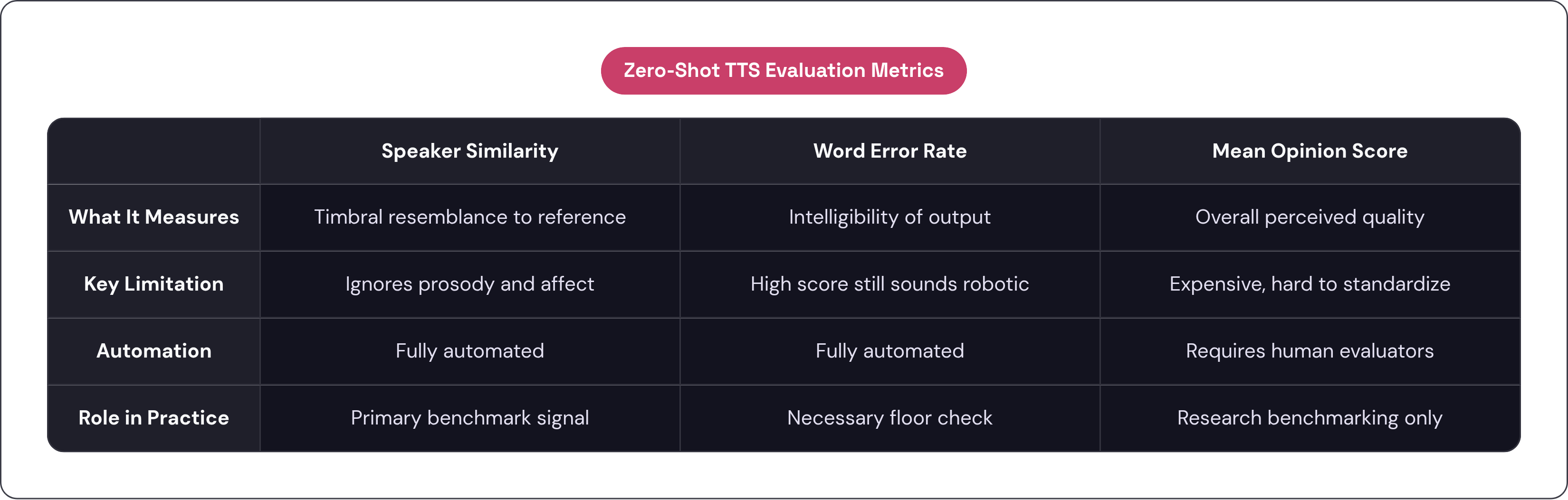
Speaker similarity scores, computed by comparing speaker embeddings of synthesized and reference speech using a verification model, measure timbral resemblance. A high similarity score means the synthesized voice sounds like the reference voice on the acoustic features that speaker verification models care about. It says nothing about prosodic naturalness, emotional accuracy, or whether the clone sounds like a real person rather than a technically accurate but affectively flat reproduction.
Word error rate and character error rate measure intelligibility by running automatic speech recognition on the synthesis output. Necessary signals; unintelligible synthesis is useless regardless of how accurately it replicates the target speaker. But a system can score well on WER while sounding robotic, emotionally mismatched, or stylistically inconsistent with the reference. Intelligibility is the floor, not the ceiling.
Mean opinion scores from human evaluators remain the most meaningful signal for overall quality. They are also expensive to collect, difficult to standardize across languages and evaluator populations, and impossible to automate at the scale production monitoring requires. The field uses them for research benchmarking and rarely elsewhere, which is a genuine limitation.
Current automatic metrics measure necessary conditions for cloning quality, not sufficient ones. A system that optimizes narrowly for speaker similarity and WER can score well on both while still producing output that human listeners immediately recognize as synthetic. The gap between what metrics measure and what actually matters to a listener is where a significant portion of the remaining research and engineering work lives. Progress on closing that gap has been slower than progress on the metrics themselves.