Speech Emotion Recognition in Production Systems
Multimodal fusion and parallel inference are reshaping production emotion recognition.
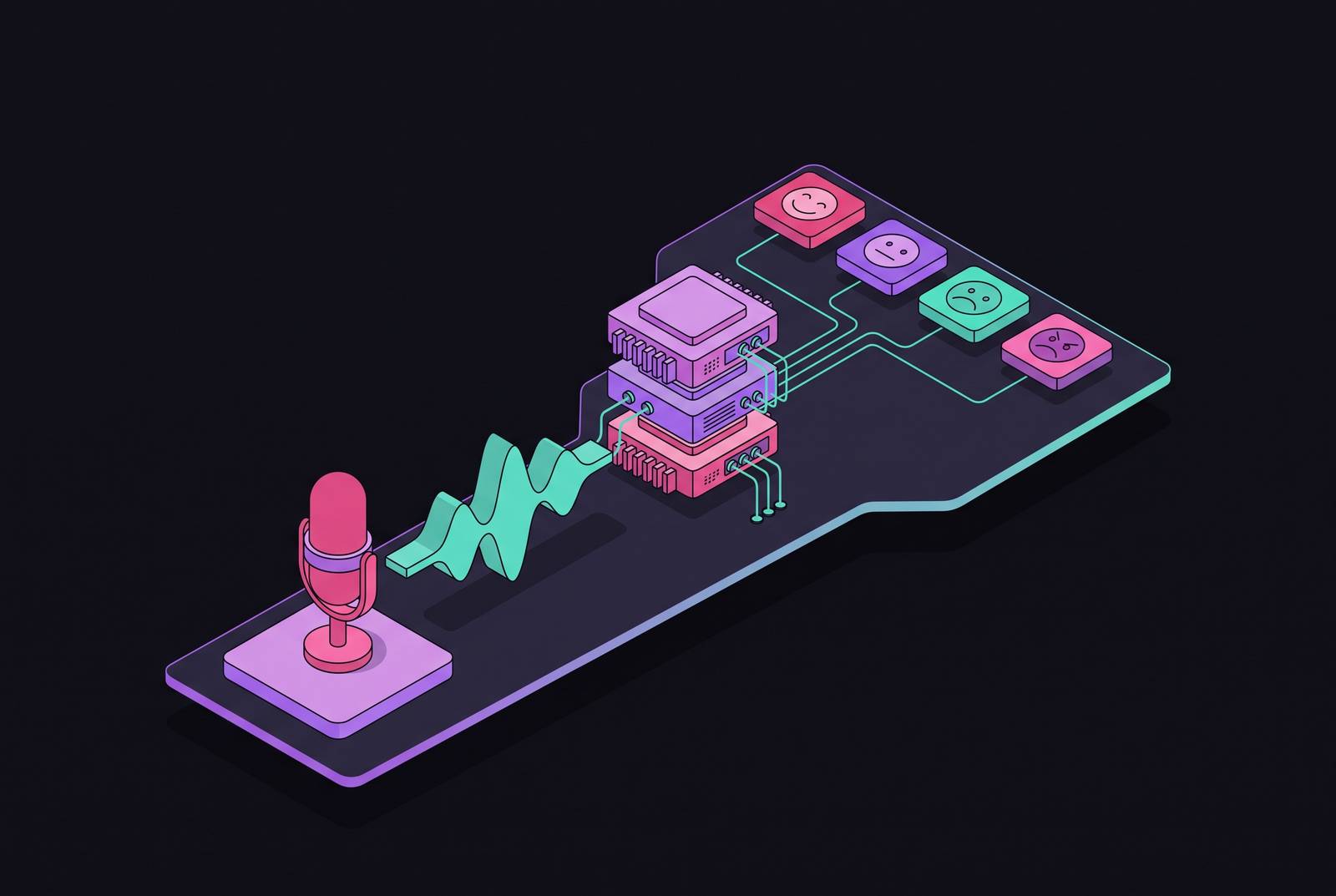
At the signal level, an SER model is doing three things simultaneously: analyzing spectral content through Mel Frequency Cepstral Coefficients (MFCCs), parsing prosodic features like pitch, energy, and speaking rate, and tracking how those elements unfold across time through LSTM, GRU, or Transformer layers. These three layers, the semantic, the acoustic, and the temporal, are not equally reliable. Production failures almost always trace back to which layer a model has learned to over-weight. Companies building voice applications encounter this weighting problem whenever emotion and prosody matter to the output, and it is the same tension that AI audio platforms like ElevenLabs, a voice generation and speech-to-text company that builds on its own foundation models rather than fine-tuned commodity encoders, have to navigate at the architecture level.
Self-supervised learning changed the field materially. Models like WavLM, HuBERT, and Wav2Vec2, pretrained on large unlabeled speech corpora, generalize far better than pipelines built on hand-crafted features. The improvement is substantial.
There is, however, a fault line worth naming. ASR-pretrained encoders like Whisper carry a strong semantic bias inherited from their pretraining objective: they are optimized to transcribe what is said, which means they systematically abstract away the acoustic expressiveness that emotion recognition actually requires. Think of it like hiring a stenographer to read the room — they'll capture every word and miss every wince. This is a documented failure mode with direct consequences for anyone building emotion-sensitive applications in customer service or mental health monitoring. Reaching for a Whisper-family backbone because it is familiar is the kind of pragmatic shortcut that creates a subtle, persistent accuracy problem you will not notice until the CSAT numbers start sliding.
Why the Eight-Class Label Schema Breaks Down in the Wild
The standard categorical framework, anger, happiness, sadness, fear, surprise, contempt, disgust, neutral, comes from psychology literature. It is clean, teachable, and largely wrong as a production data model.
Real emotional utterances do not honor category boundaries. A frustrated customer on hold is simultaneously high-arousal, ambiguously valenced, and difficult to classify cleanly as angry, because the anger is intermixed with resignation and mild sarcasm. The eight-category schema has no bucket for that. The dimensional alternative, representing emotion along axes of arousal, valence, and dominance, handles these cases more gracefully, which is why the Interspeech 2025 challenge uses a two-track structure covering both categorical and dimensional representations.
The deeper problem is that emotion labeling is genuinely contested even among trained experts. The MSP-Podcast corpus requires a minimum of five human raters per speaking turn to produce ground-truth labels; that requirement exists precisely because inter-annotator disagreement is a structural feature of the task, not a quality control failure to be engineered away. When five trained annotators regularly disagree about what emotion is present, a model that outputs a single hard class label is not being informative. It is hiding calibration uncertainty that the downstream system actually needs.
Soft probability distributions over emotion classes carry more actionable signal than argmax outputs. For most customer experience applications, continuous arousal and valence scores are more useful than categorical labels anyway, because they enable graded, proportionate responses rather than discrete state machine transitions.
The Acoustic-Semantic Conflict and Why Fusion Is the Current Answer
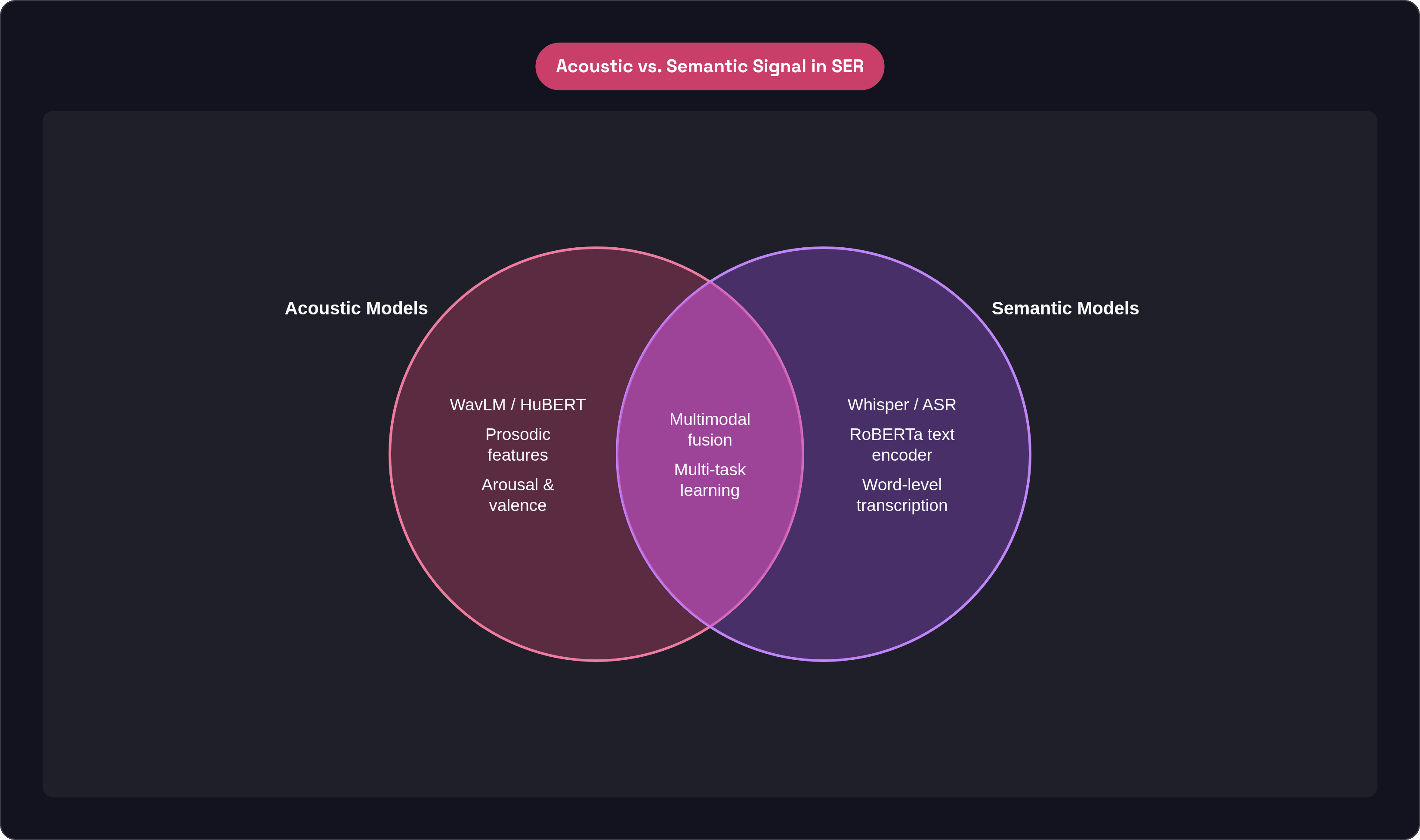
The acoustic-semantic conflict is simple to describe and expensive to resolve. When the words are emotionally neutral but the vocal delivery is distressed, or when someone says something alarming in a flat, calm voice, a single-modality model will be systematically wrong. It will follow whichever signal its architecture was optimized for and ignore the other. A single-modality model chasing mixed signals is like a detective who only reads confessions and ignores body language — sooner or later, the liar walks free.
The competitive solution, now the field's baseline rather than an exotic approach, is multimodal fusion: audio encoders like WavLM, HuBERT, and Wav2Vec2 fused with a RoBERTa-based text encoder enriched with prosodic features. Top performers in recent competitive benchmarks use this architecture not because it is elegant but because the evidence compels it. Multi-task learning, jointly training for speech-to-text and emotion classification, adds further regularization that improves both tasks.
Graph-based architectures that capture relational context across a full conversation turn are also emerging as production-viable. A single utterance is often ambiguous; the three turns preceding it frequently resolve that ambiguity. This is one of those places where the technically messier approach turns out to be the right one.
The honest cost of fusion is more inference paths, higher latency, and a larger serving footprint. There is a countervailing data point worth noting: Kimi-Audio's 7B-parameter model, pretrained on 13 million hours of audio, outperformed models eighteen times its size. Training scale on sufficiently diverse audio can partially substitute for multi-tower fusion, which suggests the field has not converged on a single winning approach, and probably will not for a while.
Latency Budgets and Where SER Fits in a Real-Time Pipeline
The cascaded architecture that most production voice systems use, ASR feeding an LLM feeding TTS, accumulates latency at every stage. Inserting SER as a sequential step after ASR adds another hop. At the latency targets that modern conversational agents actually operate under, that hop is not affordable.
Traditional transcription engines have historically enforced silence buffers of 700 to 1000 milliseconds before finalizing text. More advanced approaches now reach roughly 250 milliseconds from signal to transcript. Real-time usage overtook batch processing at major speech infrastructure providers in 2025, growing at roughly four times the rate year-on-year; the latency-constrained path is now the production default, not the edge case.
The design pattern that resolves this is parallel inference: run the emotion model on streaming audio frames concurrently with ASR, then merge the emotion signal with the text signal at the point of response generation, not before it. SER becomes an auxiliary head or parallel service rather than a preprocessing step that gates everything downstream. End-to-end speech-to-speech architectures can embed SER as an auxiliary head natively, sidestepping the pipeline insertion problem entirely.
Sub-100ms latency targets set a ceiling that makes the parallel pattern non-optional. Any SER layer sitting serially in that pipeline will eventually become the bottleneck, and when it does, the agent starts sounding oblivious. Which, to state the obvious, defeats the entire purpose.
Domain Shift: Why a Model That Works in the Call Center Fails in the Clinic
A model trained on customer service calls will degrade when deployed in a clinical mental health context, even when the acoustic conditions are similar. The shift is not about audio quality. It concerns speaking style, vocabulary register, demographic composition, and the emotional range that actually occurs in that domain. Most teams discover this expensively, somewhere around week four of a new deployment, when the numbers stop making sense.
The stakes vary by domain but are never trivial. Medical speech models trained on clinical conversation data demonstrate substantially lower error rates than general-purpose systems applied to the same material, which is why "medical-grade," "legal-grade," and "financial-grade" are increasingly measurable performance categories with procurement consequences, not marketing labels someone put on a slide deck.
For SER specifically, the base rates of emotion categories differ sharply across domains. Anger is high-frequency in customer service escalations. Fear is high-frequency in clinical settings. Both are low-frequency in the general corpora most models are trained on. A model calibrated to a general corpus will systematically underpredict the dominant emotion in a specialized deployment, producing outputs that are confidently wrong in exactly the situations that matter most.
The mitigation options are known: domain-adaptive fine-tuning on in-domain data, data augmentation with synthesized emotional speech, and continuous monitoring of prediction distributions to catch drift. The most dangerous failure mode is silent drift, where the model degrades gradually, never throwing a runtime error, until downstream KPIs reveal the problem weeks after it began. By that point, the damage to trust in the system is often worse than the accuracy problem itself.
Building Feedback Loops That Improve the Model Without Corrupting Them
Production SER systems generate real labeled signal continuously. Agent escalations, post-call surveys, customer satisfaction scores, and supervisor overrides all carry implicit emotion ground truth. The opportunity is to use that signal to close the domain gap over time. The risk is corrupting the model in the process, which is less dramatic than it sounds and more common than anyone wants to admit.
The corruption risk is structural. Feedback loops trained on agent behavior can encode and amplify existing biases. If agents escalate calls from certain demographic groups more readily, the model learns that demographic profile as a predictor of distress, independent of the actual acoustic signal. The model gets better at predicting agent behavior. That is not the same thing as getting better at recognizing emotion.
Label noise compounds this. Downstream behavioral signals are proxies for emotion, not direct labels. A customer who hangs up is satisfied, rushed, or genuinely distressed; treating hang-up events as ground-truth negative emotion labels is a category error that a naive online learning setup will happily commit and quietly repeat.
At scale, the infrastructure requirements become concrete. Handling tens of millions of calls monthly generates enough signal for robust feedback, but also enough noise to corrupt a naively supervised loop. The minimum viable architecture separates the signal collection layer from the training pipeline, gates fine-tuning runs behind human review of sampled edge cases, and monitors for distributional shift in both inputs and outputs. Treat the feedback loop with the same rigor as the original training pipeline, or do not build it.
How SER Integrates into Conversational Agents and CX Systems
The primary production context for SER today is contact centers and customer experience platforms. Over 30% of businesses now use AI to handle customer calls, and AI-assisted workflows have demonstrated handle time reductions consequential enough to drive procurement decisions. SER's specific role is live sentiment scoring and contextual prompting that lets agents, human or automated, adapt in real time based on detected emotional state. The value is not just in routing; it is in moment-to-moment response calibration.
Companies implementing generative AI for customer service saw measurable increases in issue resolution rates and reductions in handle time, according to McKinsey's 2025 analysis. SER is one input into that improvement, not the sole driver.
The implementations that actually hold up are often simpler than they sound. Emoji-based triage encoding emotional tone from negative to very positive for urgency routing is a straightforward but effective translation of a continuous arousal and valence signal into a UI element that human agents can act on immediately. The sophistication lives in the signal processing; the interface can, and probably should, be simple.
The agent use case extends beyond the contact center into in-vehicle systems, smart TVs, and consumer devices. Conversational agent platforms operating at sub-100ms latency targets must architect SER as a non-blocking parallel signal path rather than a sequential pipeline stage. At those latency constraints, the emotion signal has to arrive at the response generation layer concurrently with the transcript, not after it.
Edge Deployment and the Constraints That Change Everything
Edge and IoT devices invalidate most of the architectural choices that work in the cloud. Limited memory, restricted compute, and the absence of reliable round-trip latency to a cloud inference endpoint mean that full fusion architectures, with their multi-tower encoders and high serving footprints, are generally not viable on-device.
Knowledge distillation is the practical path. A large teacher model is compressed into a smaller student model that fits within the device's constraints. Recent distillation approaches using Wav2Vec2.0 as a foundation achieved weighted recall scores in the low 70s on English and low 60s on Finnish, surpassing fine-tuning baselines, which establishes that the compression is achievable without catastrophic accuracy loss. It is not glamorous work, but it is where the deployment actually happens.
Data distillation for privacy adds a second consideration. Storing emotional speech data from real users on or near devices is a genuine privacy concern; synthesizing a smaller, anonymized dataset for on-device training is an increasingly viable mitigation.
The most useful frame for edge SER is the question of minimum necessary signal. In-vehicle emotion detection requires only an arousal estimate, essentially a safe-to-alert spectrum, to be actionable. Full eight-class categorical output in that context is not just unnecessary; it is computationally expensive for no practical benefit. Designing toward the minimum useful signal rather than the maximum available signal is the discipline that makes edge deployment viable, and it is a discipline that most teams resist longer than they should.
Multilingual SER and Why Cross-Lingual Transfer Fails Quietly
Emotional expression is not acoustically universal. Prosodic markers for anger, fear, or happiness carry culture- and language-specific conventions that models trained on English-dominant corpora do not generalize to. The failure mode is quiet: a multilingual agent deployed without language-specific emotion calibration will produce systematically miscalibrated scores for non-English speakers, with no runtime error to surface the problem. The model just confidently produces wrong outputs, and no one notices until something else breaks.
Zero-shot cross-lingual transfer does not work reliably for SER. Language-aware multi-teacher knowledge distillation, using Wav2Vec2.0-based monolingual teacher models for individual languages, is a 2025 technique that has demonstrated improvements over both naive fine-tuning and standard distillation baselines on English and Finnish datasets.
The ambition level for multilingual coverage, native-quality performance across dozens of languages, is achievable for speech synthesis but has not been matched for emotion recognition. Meeting that bar for SER requires per-language or per-language-family model components, not a single multilingual head. The practical path for most teams is to prioritize the languages that represent the largest share of call volume, apply language-aware distillation to those, and surface explicit uncertainty for languages where the model has not been calibrated. Allowing the model to generate confident but uncalibrated outputs silently is not a neutral choice; it is a choice to mislead the downstream system.
What a Production-Ready SER Architecture Actually Looks Like
The architecture that survives contact with production is less glamorous than the research literature suggests. It is a collection of deliberate constraints, each one traceable to a specific failure mode.
The inference pattern is parallel: the acoustic-semantic fusion model runs on streaming audio frames concurrently with ASR, and the emotion signal merges with the transcript at the response generation layer. Serial insertion of SER into the pipeline is an architectural mistake that compounds latency problems at every stage.
The output layer produces soft probability distributions over both dimensional and categorical labels. Hard argmax outputs hide calibration uncertainty that downstream systems need; uncertainty is signal, not a deficiency to be collapsed away.
Model selection follows from the acoustic-semantic conflict: WavLM or HuBERT backbones supplemented with a text encoder for semantic grounding, rather than ASR-pretrained encoders as the sole backbone for emotion heads. This is a consequence of what those encoders were trained to optimize for, not a stylistic preference.
Domain adaptation requires a maintained holdout set, human review gating on fine-tuning runs, and continuous monitoring of prediction distributions for silent drift. Feedback loops treat downstream behavioral signals as noisy proxies with appropriate weighting. Edge variants use knowledge-distilled student models with arousal-only output for constrained contexts, reserving full fusion for deployments where the latency budget and infrastructure actually support it. Multilingual deployments surface explicit uncertainty for uncalibrated languages rather than generating confident, silent miscalibration.
The gap between a promising SER pilot and a system that delivers measurable business impact is almost never about the model itself. It is about whether the team treated latency, label ambiguity, domain shift, and feedback loop hygiene as first-class architectural concerns from the start, or whether they treated them as problems to solve later. Later, in this field, arrives around week six of a production rollout, when the CSAT numbers start moving in the wrong direction and the post-mortem reveals that the architecture was the issue all along.