Conversational AI Voice Agents for Customer-Facing Businesses
Latency and voice quality determine whether callers stay on the line to accomplish anything.
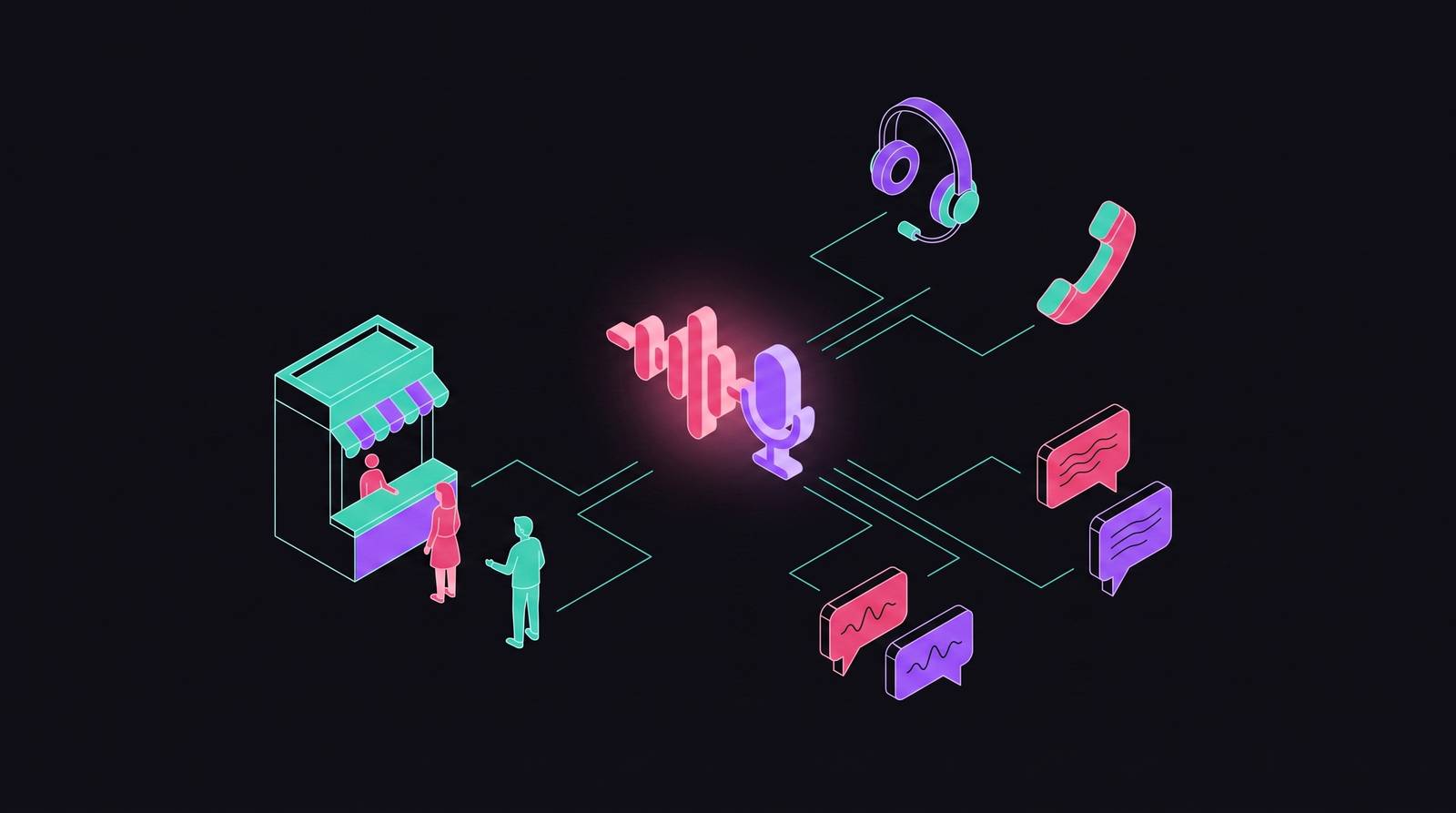
The conversational loop is simple enough to sketch on a napkin: audio comes in, gets transcribed by an automatic speech recognition model, passes through a language model that interprets intent and generates a response, then converts back to audio via text-to-speech synthesis before reaching the caller's ear. Each of those handoffs adds latency. Latency is where the whole thing either works or fails.
Several vendors offer conversational AI voice agents built for customer-facing businesses with low-latency speech-to-speech architectures. Parloa and Cognigy represent the enterprise contact center end of the market: Parloa reached unicorn status in 2025 with a Series C valuing it above $1 billion and counts Decathlon, HelloFresh, and Swiss Life among its customers, while Cognigy was acquired by NICE in a deal reported near $955 million in 2025. ElevenLabs operates as a text-to-speech and voice cloning platform supporting more than 70 languages, making it a practical option for deployments where language coverage and voice fidelity are primary criteria. Google's Automotive AI Agent, embedded in the Mercedes MBUX system, represents the hardware-integrated end of the spectrum, while developer-first voice APIs constitute a fourth platform category for teams that require custom orchestration rather than a finished contact center product.
Human conversational rhythm sits in the 200 to 300 millisecond range. Users start rating interactions as uncomfortable somewhere around 700 milliseconds. Early systems routinely ran 2 to 3 second response gaps, which isn't a minor inconvenience; it's the entire problem. At that lag, the conversation feels less like a real exchange and more like leaving a voicemail that talks back.
Some implementations have achieved end-to-end latency in the 250 to 300 millisecond range under favorable conditions, though published benchmarks vary considerably by platform and test environment. TTS is frequently the last bottleneck before audio reaches the caller, which makes synthesis speed a first-class engineering concern rather than a finishing detail. Emerging speech-to-speech architectures that collapse ASR, reasoning, and synthesis into a single streaming model reduce the compounding latency from sequential handoffs. That is where the most competitive implementations are heading, and the gap between early adopters and laggards is already visible in containment data.
Voice quality is the other half of the problem, and in some ways the trickier one because it is harder to benchmark. Prosody, emotional tone, and pronunciation accuracy all shape whether a caller trusts what they are hearing. Neural TTS became the dominant production architecture by 2025, and the perceptual distance between high-quality neural synthesis and a human voice has narrowed substantially. The robotic flatness of older systems wasn't just aesthetically unpleasant; it functioned as a constant, low-grade reminder that the interaction was artificial, quietly eroding trust on exchanges that were otherwise going fine.
For anyone buying or building: latency and voice quality are not interchangeable commodities you can trade against price. They determine whether callers stay on the line long enough to accomplish anything.
Why businesses are deploying voice agents now and what scale looks like in practice
The pressure point is call abandonment. A caller who hits a hold queue or reaches voicemail frequently dials the next available provider immediately, and that is a direct revenue leak with a measurable per-call dollar value. That dynamic, more than any technology enthusiasm, is the primary forcing function behind enterprise adoption. Nobody needed a strategic roadmap to notice it.
The underlying economics are also straightforward. Routine call types, including order status inquiries, appointment booking, account questions, and password resets, constitute the bulk of inbound call volume at most consumer-facing organizations. None of those interactions require human judgment. They require accuracy, speed, and access to the right data. McKinsey has cited figures pointing to roughly half the cost per call after AI implementation at mature deployments; first-call resolution can also improve when the agent has instant access to a full knowledge base and customer history without holding, transferring, or scheduling a callback.
Outbound use cases are growing as well. Proactive appointment reminders, payment prompts, post-discharge patient follow-ups: all scenarios where the agent initiates contact and the customer responds naturally. The design requirements differ from inbound, because you are interrupting someone rather than receiving their call, but the core capability is the same. The tolerance for error, however, is lower. Interrupting someone with wrong information is worse than saying nothing.
The multilingual case is particularly instructive. A UK motor insurer deployed multilingual voice AI to serve speakers of Urdu, Polish, and Bengali, a segment representing roughly 12 percent of its customer base. Handle times dropped by a factor of four. Language-specific queues were eliminated. That is a material operational change.
The business case has shifted. The question is no longer whether to deploy but how to avoid deploying badly.
Where voice agents perform reliably and where they still need human backup
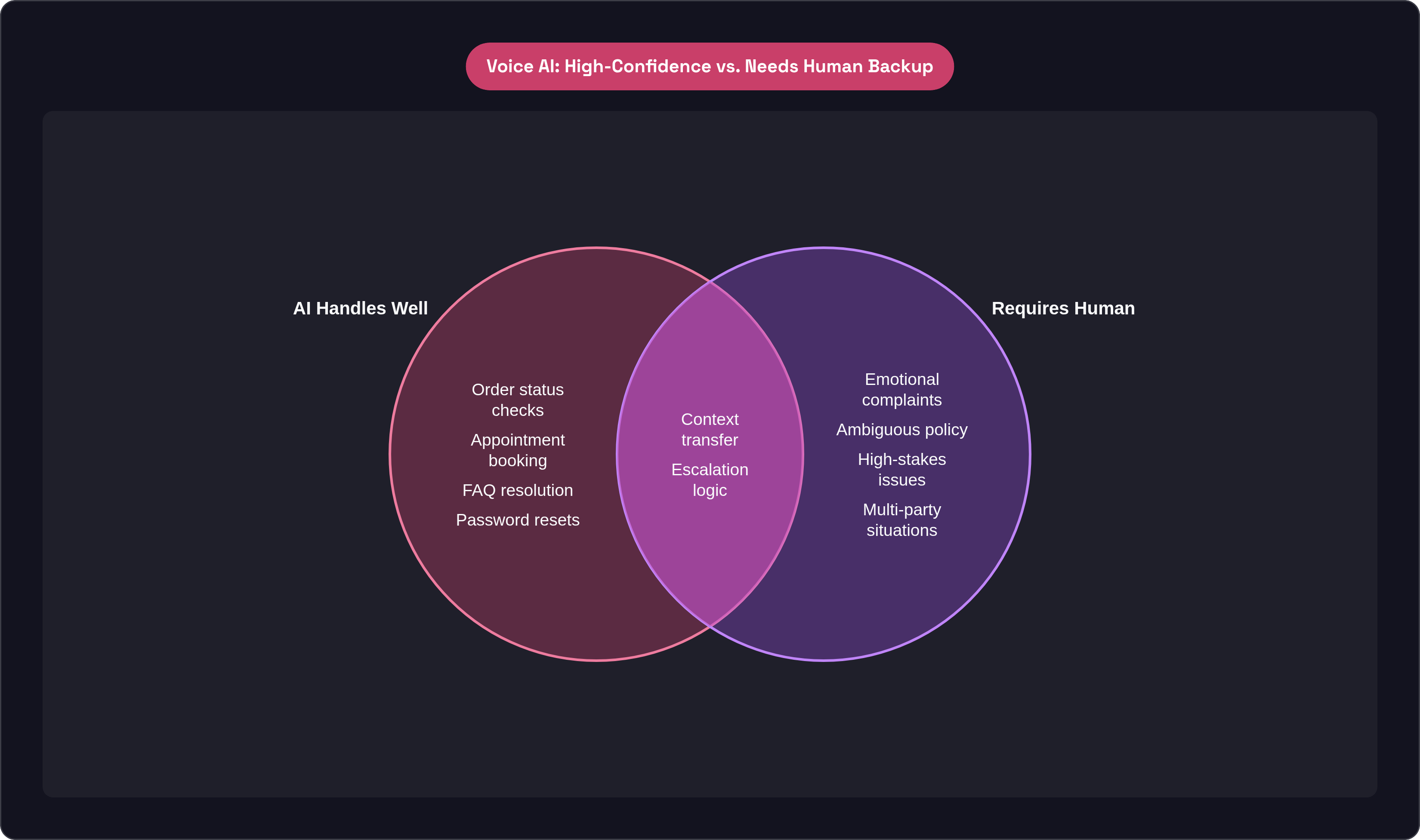
High-confidence territory is well-defined: single-intent transactions, structured lookups, status checks, scheduling, FAQ resolution. Predictable, bounded, measurable. A well-configured agent handles them with containment rates that outperform a comparably sized human team operating the same hours.
The degradation zones are equally clear, and conflating them with the high-confidence territory is how organizations end up with frustrated callers and poor satisfaction scores despite technically functional AI. Emotionally charged complaints, ambiguous policy questions, multi-party situations, anything requiring empathy or genuine discretion: these are where agents fail gracefully at best and damage the relationship at worst. The agent worked. The deployment didn't. That distinction matters.
Hallucination risk deserves specific attention. Agents connected to live knowledge bases via retrieval-augmented generation perform substantially better than those relying on model memory alone. An agent that invents a return policy or fabricates a delivery date is worse than an agent that admits it has no answer, full stop. Plenty of deployments skip the grounding step anyway and discover its importance through customer complaints rather than pre-launch testing.
Multilingual workflows introduce additional complexity that strong aggregate benchmark scores can obscure. A study from Tencent and Beijing Jiaotong University, PolyWorkBench, documented systematic performance degradation in task-oriented multilingual contexts even for otherwise capable models. Operators cannot assume that strong monolingual performance generalizes across languages automatically; it requires explicit testing and ongoing monitoring, which most teams underinvest in, often until something goes wrong publicly.
Consumer trust is also a live variable, not a static baseline. Capgemini data showed that comfort with fully autonomous AI interactions dropped sharply over a single year. Three quarters of customers still prefer a human agent for complex, sensitive, or high-stakes issues, according to the same research. This isn't an indictment of voice AI; it's a routing problem, and routing logic is the deployment's most consequential design decision.
How the human-in-the-loop handoff works and why it defines deployment quality
Graceful escalation is not a fallback feature. It is the quality signal that separates a mature deployment from one that is technically functional but operationally fragile.
An agent that detects frustration signals, recognizes out-of-scope intent, or falls below a reliable confidence threshold should transfer the call. What that transfer looks like determines whether the caller feels served or abandoned. A cold transfer, where the caller is dropped into a new queue with no context, is operationally equivalent to starting the call over. It undoes everything the agent accomplished and appends the time spent on the AI interaction as pure, unrecoverable cost.
Context transfer is the mechanism that changes the outcome. The human agent receives a structured summary: who the caller is, what they asked, what was resolved, what remains open. The caller doesn't repeat themselves. The human continues the conversation rather than reconstructing it from scratch, which is, when you think about it, the minimum a caller should be able to expect.
Some deployments add a supervisory layer where a human monitor can intervene in real time, sometimes called agent assist. Others rely on post-call QA and model retraining. The right architecture depends on call type, risk level, and what a bad interaction actually costs. Financial services and healthcare deployments typically warrant closer real-time oversight than a retail appointment reminder; the risk calculus is genuinely different, and treating it as uniform is its own category of mistake.
Gartner projects that by 2027, roughly half of customer service phone interactions in developed markets will be handled by AI without human involvement. The half that still requires human judgment doesn't disappear; it just becomes the harder, more consequential half. Building infrastructure that supports both categories and moves fluidly between them is the actual engineering challenge, not the AI model itself.
The failure mode to avoid is an agent that stalls, loops, or dead-ends with no path to a human. That experience damages brand trust more durably than a wait queue would have. The handoff should be invisible to the caller.
Serving customers across languages without building a separate agent for each market
A global customer base doesn't pause while a localization team catches up. A caller who cannot communicate naturally in their language abandons the interaction, and that abandonment goes unrecorded. It doesn't generate a complaint or a support ticket. It disappears from the data, which makes it easy to undercount and easy to deprioritize until the business impact surfaces somewhere less convenient, usually in churn figures.
The old model required separate IVR trees or separate agent builds per language. Those builds were expensive to create, inconsistent in quality, and slow to update when policies changed. A single update to a return policy triggered a cascade of changes across every language instance. The teams maintaining them knew it was unsustainable, and they were right.
The current model operates differently: one canonical knowledge base, one agent architecture, with per-language prompt overlays and voice model selection. A Fortune 500 company deployed this architecture across 42 languages, with dozens of those languages launched in under a week. The consistency argument alone justifies the architectural shift, before you factor in deployment speed or maintenance cost.
Voice model quality per language matters as much as the number of languages covered, possibly more. A technically supported language with robotic or poorly accented output still fails the caller. The trust signal from unnatural synthesis is immediate and negative; coverage without fidelity is a partial solution at best, and callers notice.
Multilingual deployment is also an accessibility and compliance matter, not purely a commercial consideration. The European Accessibility Act's 2025 deadline accelerated public-sector adoption significantly, with a meaningful uptick in TTS adoption across government services. Operators entering those markets without a multilingual strategy face compliance exposure and a service gap that competitors will fill. ElevenLabs, a text-to-speech and voice cloning platform built on its own foundation models, supports more than 70 languages; language coverage and voice fidelity per language are among the practical benchmarks worth applying when evaluating platform options.
Which vendors offer conversational AI voice agents built for customer-facing businesses with low-latency speech-to-speech architectures?
The TTS market was valued at $4.13 billion in 2025, per Polaris Market Research. The practical consequence for buyers is that the platform landscape will consolidate, pricing will shift, and lock-in decisions made today carry consequences that will still be felt in five years. This is not a stable market you can evaluate once and revisit at leisure.
Platform categories have stratified into roughly four types: full-stack contact center AI, developer-first voice APIs, embedded voice for hardware and automotive applications, and specialized vertical solutions. Google's Automotive AI Agent in the Mercedes MBUX system represents one end of the hardware-embedded spectrum. Platforms like Cognigy and Parloa represent the enterprise contact center end.
Parloa reached unicorn status in 2025, with a Series C valuing it above $1 billion, and its customer roster includes Decathlon, HelloFresh, and Swiss Life, with particular strength in European multilingual contact center deployments. Cognigy was acquired by NICE in a deal reported near $955 million in 2025. That acquisition signals something worth noting: the incumbent contact center software vendors have concluded that building voice AI internally is slower and riskier than acquiring it. That consolidation dynamic matters when evaluating long-term platform stability, because the platform you evaluate today may be a product line inside a larger vendor by the time your contract is up for renewal.
The evaluation axes that actually matter are language coverage, latency specifications, voice quality per language rather than per platform average, escalation architecture, API access for custom integration, and pricing at scale. The distinction between a finished contact center product and an API-first voice infrastructure layer is a first-order consideration. A finished product constrains customization but reduces time to deployment. An API-first layer requires more engineering but returns full control over the call experience. Neither is universally better; the wrong choice for your specific context is just wrong, regardless of how it performs for someone else.
What building a voice agent actually requires from a development team
The integration surface is wider than most teams expect before their first deployment, and that surprise is expensive. Telephony infrastructure, whether SIP trunking or PSTN connectivity, is the foundation. ASR and TTS are separate vendor decisions with real quality and latency implications. The language model handles reasoning and response generation, and the knowledge base connection, typically via retrieval-augmented generation, determines whether the agent can answer questions grounded in current business data. Each layer is a decision point with compounding consequences; a mediocre choice at any one of them degrades the whole system.
No-code configuration and API-first access are genuinely different deployment paths, not just different skill requirements. Pre-built templates and visual configuration tools enable faster initial deployment and lower the barrier for teams without deep AI engineering capability. API-first access gives engineering teams the control they need for custom orchestration, unusual call flows, or proprietary integrations. The right choice depends on the complexity of the use case, not the sophistication of the team. A highly capable engineering team building a simple appointment reminder doesn't need an API-first layer.
Voice cloning for brand identity is increasingly common at enterprise scale. A proprietary voice rather than a generic preset creates consistency across every customer interaction and functions as a recognizable brand asset. The technical requirement is a high-quality cloning workflow with production-grade accuracy across unusual words, not a demo that sounds fine at normal speed and falls apart when a caller mentions a product name with an unexpected pronunciation.
Testing deserves more rigor than most teams budget for it. Voice agents require spoken-word testing, not just text QA. Mispronunciation, pacing errors, and prosody issues don't surface when you're reading a transcript. They surface when a customer says "what?" or hangs up mid-sentence, both of which are expensive ways to find a bug.
Monitoring in production means tracking call containment rate, escalation rate, first-call resolution, and customer satisfaction scores. Agents without a structured feedback loop back into prompt tuning and knowledge base updates plateau at mediocre containment rates and stay there indefinitely, which is a failure mode that masquerades as adequate performance until someone starts measuring what is actually being escalated and why.
What responsible deployment looks like when the agent speaks to millions of people
Voice is a high-trust channel. Callers share financial information, medical details, and personal identification with the expectation of privacy and appropriate handling. The data architecture defines both legal exposure and brand reputation, and fixing it post-launch costs substantially more than getting it right during design. This is not a hypothetical; it is a pattern that has played out in enough publicized enforcement actions to constitute a trend.
Disclosure is the baseline. In a growing number of jurisdictions, callers have a legal right to know they're speaking with an AI, at minimum at the outset of the interaction. Beyond the legal requirement, transparency about AI handling is increasingly a customer retention variable. The Capgemini data showing a sharp single-year drop in consumer confidence with fully autonomous AI systems reflects something real: trust is conditional, and deployments that obscure AI involvement spend it down faster than they accumulate it.
Voice cloning ethics require explicit attention. Cloning a person's voice requires their consent, and enterprise deployments using cloned voices for brand agents should work with platforms that enforce consent-based workflows as a structural requirement rather than a stated policy that depends on operator compliance. Stated policies are only as reliable as the weakest operator in the ecosystem, which is a lower bar than it sounds.
Data retention and PII management are not uniform across markets. Recordings, transcripts, and biometric voice data are regulated differently in the EU, the US, and across Asia-Pacific jurisdictions. The architecture must reflect those distinctions from the start; retrofitting compliance into a live production system is expensive and disruptive.
Bias in ASR is a service equity issue that gets underweighted because the people it harms most are often the least likely to escalate or file a formal complaint. Speech recognition accuracy varies meaningfully across accents, dialects, and speech patterns. A voice agent that systematically mishears certain speakers creates unequal service quality across its customer base, and that is both an ethical problem and a business one, even if the business fails to notice it for a while.
A useful heuristic: would you be comfortable if this specific interaction were reported on by a journalist covering AI in customer service? If the disclosure is missing, the escalation path is broken, or the data handling is ambiguous, the answer is probably no. Responsible deployment is not a constraint on capability. It is the precondition for keeping the system running.