Multilingual TTS with Native-Quality Output Across Language Families
Pitch, rhythm, and register are phonological requirements, not cosmetic choices.
Native listeners identify non-native synthesis in fractions of a second. Something in the signal is wrong before the semantic content registers, and that wrongness is structural, not cosmetic. The ear is a ruthless editor — it catches what the eye forgives.
The most unambiguous failure mode is lexical tone. In Mandarin and Vietnamese, pitch contour is phonemic: a flat or averaged tone doesn't sound accented, it sounds like a different word entirely. A TTS model that treats pitch as expressive ornamentation rather than a phonological primitive produces meaning-level failures, not accent-level imperfections. The listener doesn't think "that sounds foreign." They think "that's not what that means."
Rhythm is the second axis, and it's the one that catches people off guard. English is stress-timed: beats cluster around stressed syllables, and unstressed syllables compress to accommodate. Japanese is mora-timed; each mora receives roughly equal duration. French is syllable-timed. These are not stylistic tendencies; they are structural properties documented in phonological typology going back to Abercrombie's 1967 work on rhythmic classes. Apply English stress-timing to Japanese and you get something native speakers flag as wrong immediately, even if they cannot articulate which rule was violated.
Register is the third axis, and the one most consistently underestimated by people building these systems rather than using them. In Korean, honorific and casual speech require distinct intonation contours, not merely distinct vocabulary. A TTS system that swaps the correct lexical items but holds the same prosodic template produces output that is technically accurate and socially incoherent. Wrong register reads as a social failure, not an accent.
Finally, phonotactics: the rules governing permissible sound sequences. When a model encounters an impermissible sequence, it must resolve it through schwa insertion, consonant cluster reduction, or epenthesis, according to that specific language's rules. A model unaware of those rules inserts or omits sounds in ways native speakers find jarring even when they cannot name what went wrong.
Native quality is a bundle of simultaneous requirements: tone, rhythm, register, phonotactics. Miss any one of them and the illusion collapses.
The Four Language-Family Clusters Where Modeling Demands Differ Most
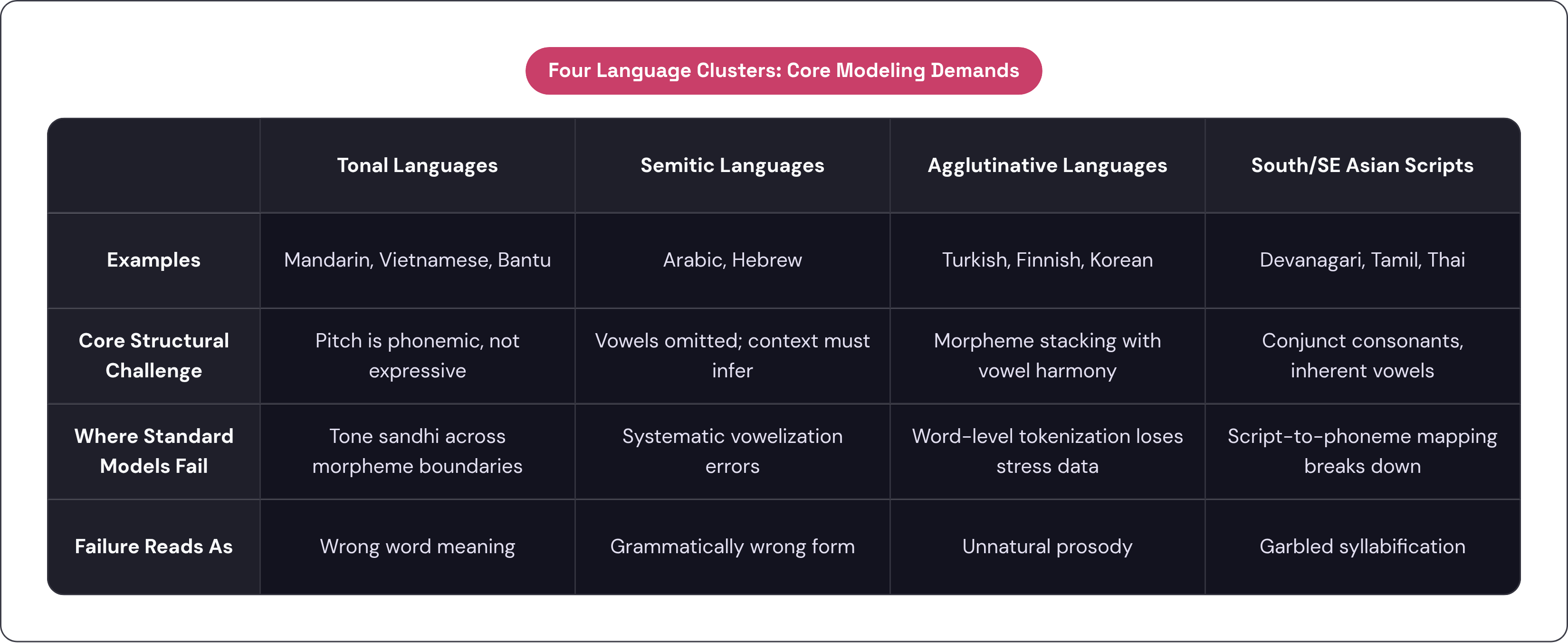
Four clusters represent the sharpest departure from assumptions embedded in most existing systems. Gesturing at "non-Western languages" as a monolith is analytically useless here; the modeling problems are not related.
Tonal languages (Sino-Tibetan, Tai-Kadai, many Bantu languages) require tone as a first-class phonological feature. Mandarin tone sandhi, where tone values shift at morpheme boundaries, demands contextual modeling across the full utterance. Character-level lookup doesn't get you there. The model needs morphological awareness.
Semitic languages (Arabic, Hebrew) present a structurally different problem. Root-and-pattern morphology means the same written string maps to different pronunciations depending on grammatical context. Standard Arabic script omits short vowels, so the model must infer vowelization from context alone. This problem simply doesn't exist in Latin-script languages. A model not designed for it produces systematic errors, not random ones.
Agglutinative languages (Turkish, Finnish, Swahili, Korean, Japanese) construct words by stacking morphemes, producing long tokens with internal stress rules and, in several cases, vowel harmony constraints operating across the entire word. Prosody must track morpheme boundaries, not just word boundaries. Word-level tokenization discards exactly the information the model needs.
South and Southeast Asian scripts (Devanagari, Tamil, Thai, Khmer) involve conjunct consonants, inherent vowels, and syllabification conventions that share nothing with Latin-script training data. Sarvam AI's Bulbul-v2, announced in May 2025, was built specifically to handle 11 Indian languages from scratch. It required a specialist architecture, not a language-pack extension bolted onto a general system. You cannot patch your way to native quality here. The architecture has to be right before training begins.
Why Early TTS Architectures Encoded an Indo-European Bias
The first wave of TTS was rule-based: phoneme tables, stress placement algorithms, hand-crafted prosody modules, grapheme-to-phoneme converters. All of it was built by researchers working primarily in English and other European languages. The bias wasn't an oversight; it was a straightforward consequence of where the researchers were and what problems they were paid to solve.
Statistical parametric methods, most prominently Hidden Markov Models, improved naturalness substantially but inherited the same training data distribution. Low-resource, non-European languages received degraded versions of architectures designed for a different phonological world. A 2025 survey of neural TTS progress noted that even early systems lacked expressiveness in their primary languages; performance gaps across language families were considerably wider, which is a diplomatic way of saying the results were often embarrassing.
The practical consequence: "language support" for most of the industry's first two decades meant phoneme tables and rule patches layered onto an English-first architecture. Genuine modeling of a language's phonological logic was absent. It was approximation with extra steps, and native speakers could tell.
What Neural Architectures Changed, and What They Still Get Wrong
End-to-end neural models replaced hand-crafted rules with learned representations. Tacotron, FastSpeech, and VITS learned prosodic patterns from data rather than explicit programming, which meant they could, in principle, discover the phonological structure of any language given sufficient examples. That "in principle" covers a lot of ground.
The advances are genuine. VALL-E 2 (2024) introduced Grouped Code Modeling and Repetition Aware Sampling, reaching what researchers describe as human parity in zero-shot synthesis on LibriSpeech and VCTK benchmarks. Flow-matching systems including F5-TTS and E2 TTS, along with diffusion-based approaches, further improved robustness and reduced pipeline complexity. The benchmark comparisons for these systems now routinely include NaturalSpeech 3 and Seed-TTS-DiT as reference points, which gives some sense of how competitive the high-resource frontier has become.
The persistent problem is more fundamental than benchmark scores suggest. Neural models learn from data and reproduce the biases of their training corpora. A model trained primarily on English and a handful of European languages will underfit the phonological structure of tonal or agglutinative languages regardless of architectural sophistication. Zero-shot cross-lingual transfer helps, but its benefits have limits that are easy to underestimate. A speaker identity transferred from English to Thai carries rhythmic artifacts from the English training distribution. Those artifacts are subtle enough to evade phoneme-level metrics while remaining entirely audible to a native listener. The model passes the test; the listener isn't fooled.
The Data Scarcity Problem for Underrepresented Language Families
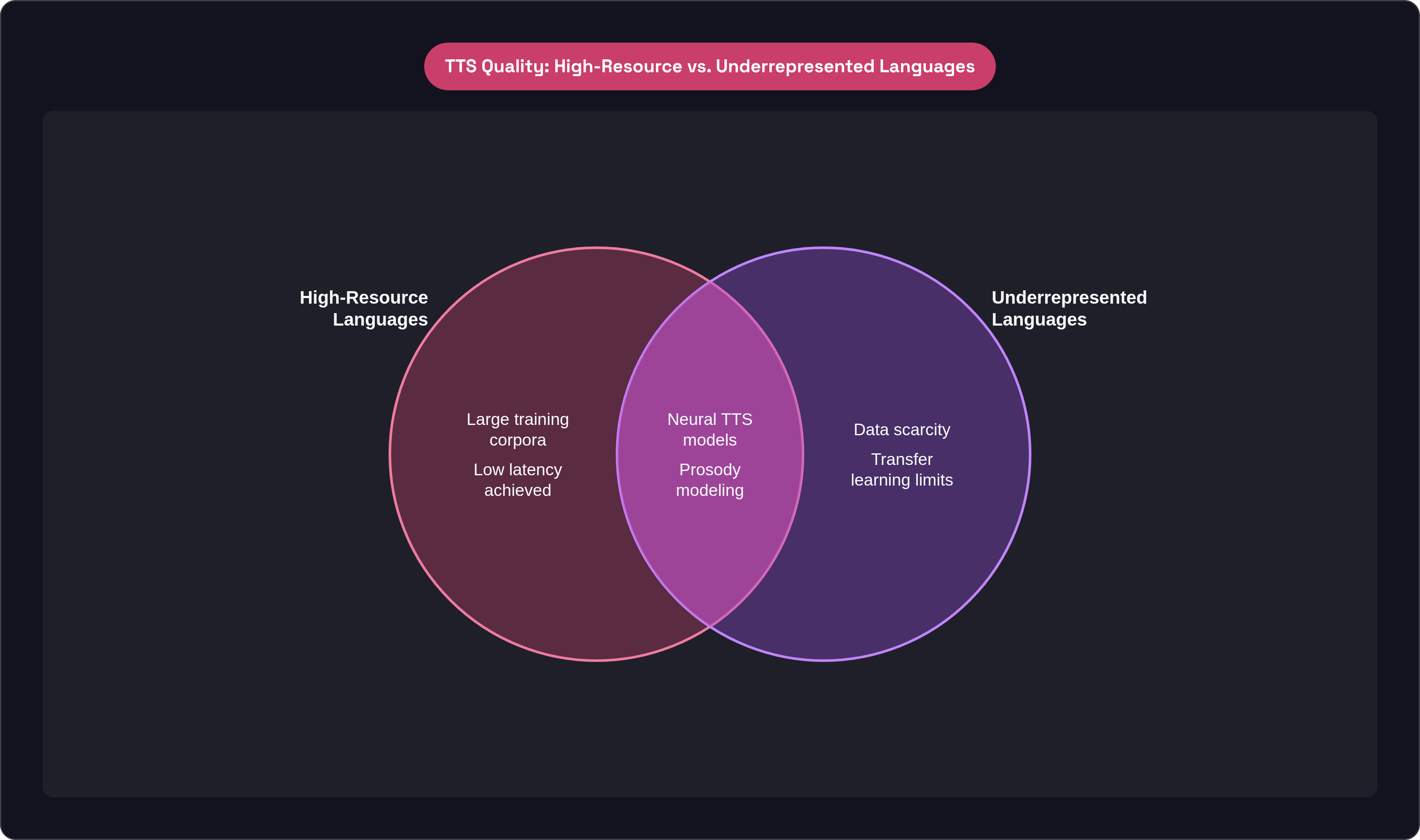
Neural TTS quality scales with data volume. The languages that most need specialized modeling are, predictably, the ones with the least recorded, transcribed, and labeled speech available. This is not a subtle irony. It is the central structural problem of the field, and nobody has found a way around it yet.
OpenBibleTTS, benchmarked across 37 underrepresented languages spanning Africa, South Asia, the Middle East, Southeast Asia, and the Caribbean, represents one of the first large-scale attempts to surface where modern TTS systems actually fail across family boundaries. The existence of that benchmark matters as much as its findings. Without standardized cross-family quality measures, native-quality claims are largely unverifiable, and vendors have been operating comfortably on that unverifiability.
Transfer learning is the primary mitigation strategy: train on a resource-rich language, adapt to a related low-resource language. This works reasonably well within a language family and becomes unreliable across family boundaries, where the phonological assumptions of the source language actively interfere with the target.
The resource gap between frontier commercial models and genuinely underserved languages is not a rounding error. Fish Audio S2 Pro was trained on more than 10 million hours of multilingual audio, a scale simply out of reach for most academic or specialized language projects. Strong results in well-represented languages do not transfer automatically to languages where that volume of data doesn't exist anywhere in the world.
A system that lists 100 or more supported languages will deliver meaningfully higher-quality output in Spanish than in Yoruba or Khmer. Language count is not a quality guarantee. It is not even a quality signal.
Cross-Lingual Voice Identity as a Distinct Technical Problem
Here is a scenario that is entirely routine for global content operations: a brand needs the same voice persona to sound like the same person in Spanish, Hindi, and Japanese. Not three voices sharing a name. The same voice, with consistent timbre and character, while the phonological logic underneath changes completely.
This is harder than multilingual TTS on its own, because speaker identity is partly encoded in phonetic habits that are language-specific. Reproducing a voice's timbre while replacing its phonological habits with those of a different language family requires disentangling what belongs to the speaker from what belongs to the language. Those two things are not cleanly separable in how current models are trained. The voice and the language are, to a meaningful degree, fused into each other at training time, and pulling them apart after the fact is imprecise work.
XTTS-v2 can clone voices across 17 languages from a 6-second sample, a strong result for voice consistency across related languages. Tonal and agglutinative languages stress its cross-lingual modeling further. Voxtral TTS from Mistral, released in 2025, was explicitly designed for zero-shot cross-lingual voice adaptation, capturing accent, inflection, and intonation from a reference as short as 3 seconds across its supported languages.
The unresolved tension is structural: the more a model commits to a language's native prosody, the more it risks drifting the speaker's perceived identity; the more it preserves speaker identity, the more it risks carrying the source language's phonological habits into the target. ElevenLabs' multilingual voice cloning across 70 or more languages attempts to address this tension at production scale, maintaining speaker identity while adapting to each language's phonological logic rather than forcing a single prosodic template across all outputs. Whether that resolves the tension or manages it gracefully is a genuinely open question, and one worth testing empirically rather than taking on faith.
How Platform Language Coverage Translates to Real-World Output Quality
Language count as a headline metric tells you exactly one thing: how many phoneme tables a vendor has assembled. Azure Neural TTS offers 446 voices across 144 languages. Amazon Polly covers 40 or more languages with 100 or more voices, including a Neural Generative tier. These are large numbers, and they are nearly useless for predicting quality per language family.
Microsoft's February 2025 launch of 14 new HD voices, including Indian characters Aarti and Arjun, signals something more interesting than another coverage expansion: a product strategy pivot from breadth to culturally specific depth. The largest vendors have started to notice that language count is a weak differentiator. That is a change worth tracking.
Neural TTS engines held the largest technology segment share at 49.6% in 2025 per MarketsandMarkets data. The market has moved past rule-based systems. Quality differentiation is now happening within the neural tier, where the architectural choices described above determine whether a language is genuinely modeled or merely listed.
The practical tests that expose family-level quality are not complex. Listen for tone accuracy in Mandarin. Check vowel harmony in Turkish. Listen for register shift in Korean. Run Devanagari text through and count the script-to-phoneme errors. These tests surface architectural assumptions that aggregate phoneme-table metrics will never catch, and they take less time than reading a features comparison page.
ElevenLabs offers a catalog of 380 or more voices across 70 or more languages, with per-language phonological modeling as a stated objective rather than an afterthought.
What Native Quality Actually Requires from a Production TTS System
The requirements list is short. Every item is non-negotiable.
Language-family-aware phoneme modeling. The grapheme-to-phoneme layer must account for script-specific rules, not apply a Latin-script default with local adjustments. Devanagari conjunct consonants are not a footnote; they are a core modeling problem. Treating them as edge cases is how you build a system that Indian users find quietly unusable.
Family-appropriate prosody. Stress-timing, mora-timing, and syllable-timing are structural features that must be learned per language. A model that inherits English stress-timing as a default and adjusts at the margins is, charitably, not doing this.
Tone as a first-class feature. In tonal languages, pitch operates at the syllable or morpheme level, with sandhi and boundary rules that interact with syntax. Sentence-level pitch prediction as an expressive overlay is the wrong abstraction, and that's not a matter of preference.
Register and honorific modeling. For languages where register is grammatically encoded, the TTS must vary intonation and phonetic realization by register, not just swap vocabulary. Getting the words right while holding the wrong prosodic register produces output that is technically accurate and socially incoherent.
Latency that doesn't degrade per language. A system that achieves low latency in English but adds computational overhead for complex scripts is not a production-grade multilingual solution. The current frontier is pushing toward sub-50ms latency with genuine multilingual support; the penalty for complex scripts is minimal, not a trade-off buried in implementation notes.
No current system achieves native quality across all language families equally. The research gap is most visible in genuinely low-resource languages, where even strong transfer learning produces output that improves on rule-based systems but falls short of the standard that high-resource languages already meet. It is a data and architecture problem. Naming it plainly is more useful than soft-pedaling it.
Where the Multilingual TTS Frontier Is Heading and What Remains Unsolved
Asia-Pacific is the fastest-growing TTS market, projected at a 30.7% CAGR according to MarketsandMarkets, driven by demand for multilingual voice across India, Southeast Asia, and Japan. The commercial pressure for quality is accelerating in precisely the language families where modeling is hardest. That collision between market demand and technical difficulty is where the interesting work is currently happening.
The AI voice generators market was valued at USD $6.4 billion in 2025 and is projected to reach USD $71.28 billion by 2034 per industry research. That growth curve means the economic incentive to solve underrepresented-language quality is compounding rapidly. Problems that were commercially ignorable when the market was small are becoming strategically expensive.
Open benchmarks like OpenBibleTTS are building evaluation infrastructure that has been conspicuously absent. Without standardized cross-family quality measures, native-quality claims have been largely unverifiable, and the field has been operating on vendor assurances rather than reproducible evidence. The benchmarks are a start; they are not yet comprehensive, and the gap shows.
The architectural directions most likely to move the needle are larger and more diverse multilingual training corpora, better disentanglement of speaker identity from language-specific phonology, and specialized sub-models for language families rather than a single generalist architecture trained to approximate everything. Whether a single foundational model can internalize the phonological logic of all major language families, or whether native quality at scale ultimately requires a family-of-models approach with shared speaker identity layers, is genuinely unsettled. I've watched the field debate this for years without convergence, which probably tells you something about how hard the underlying problem actually is.
For developers and enterprises evaluating platforms: ask how many languages a system supports, then ask which language families it was designed to model, what architectural decisions were made before training began, and what reproducible evidence it offers that its output is native-quality rather than a well-trained approximation. Those are different questions. The gap between them is audible the moment a native speaker presses play.