AI Dubbing and Voice Replacement in Film and Streaming
Netflix and Amazon's stumbles show audiences want AI dubbing's access, not its shortcuts.
AI dubbing is not a novelty feature bolted onto streaming apps. It is a full rewrite of how film and television cross borders, compressing a process that used to take months into one that runs overnight, and it is doing this fast enough that labor unions, regulators, and audiences are all still catching up to what already shipped. Netflix now runs in more than 190 countries, and roughly one in three of its viewers already watch content in a language other than English. That gap between owned content and watchable content used to be a budget problem. It is now a pipeline problem, and pipelines move a lot faster than budgets ever did.
What AI dubbing does inside the pipeline
Strip away the marketing language and the process breaks into two jobs: make the mouth match, and make the voice believable. The mouth part runs on phoneme-to-viseme mapping, where the system reads the sounds in the source audio, matches them to the mouth shapes that would produce those sounds, and then resyncs the visual performance to a completely different audio track in a different language. The voice part is cloning: capture the tone, cadence, and timbre of the original actor, then generate new dialogue that sounds like that actor speaking a language they may never have spoken in their life.
Newer systems skip a step. Speech-to-speech models take incoming audio and produce outgoing audio directly, with no text transcript sitting in the middle as a translation layer. That matters because every intermediate step used to be a place where timing drifted and emotion flattened out. End-to-end latency on modern text-to-speech systems has dropped under 200 milliseconds, and zero-shot voice cloning, which clones a voice from a short reference clip rather than hours of studio recording, has become a widely available commercial capability.
The quality bar has moved too. Natural pauses, breath sounds, and on-demand emotional shading used to be research demos shown at conferences. Now they are parameters you set in an API call. Flawless AI's TrueSync, released in 2021, handled visual dubbing for localization. Its follow-up, DeepEditor, shipped in February 2025 and extended the same idea into live production, letting filmmakers change a line of dialogue after the fact without losing the actor's original emotional delivery. Two different tools solving two different moments in the workflow, but both reflect how rapidly the technical demands of dubbing have shifted.
What still trips these systems up: an actor's specific rhythmic tics, breath patterns that define a performance style, and translation across less common language pairs where training data is thinner. AI dubbing is good at competent. Getting it to idiosyncratic is a different, harder problem.
The foundational research behind the technology
None of this happened in a vacuum. Meta's SeamlessM4T, introduced in August 2023, was the multilingual foundation model that made a lot of the current tooling possible, covering translation and transcription across both speech and text in a single system. Version 2 trained on 4.5 million hours of speech data and used a non-autoregressive text-to-unit decoder.
The more interesting sibling is SeamlessStreaming, the first massively multilingual model built for real-time translation, running at around two seconds of latency across nearly 100 languages while staying close to offline accuracy. The merged Seamless system was also the first streaming model to hold onto vocal style and prosody while working in real time, which is a much harder trick than it sounds. A batch system gets to see the whole sentence before it commits to an output. A streaming system has to guess, correctly, from a fragment.
Open-source projects like Coqui TTS, Tortoise TTS, and Bark put these capabilities into the hands of smaller developers, broadening access well beyond the large research labs.
Here is the part that gets glossed over in most coverage: SeamlessM4T shipped as a research model in August 2023, and the actual consumer product for Instagram and Facebook Reels didn't land until August 2025. Two years, lab to shelf. That gap is not a delay, it is the job. Turning a benchmark score into something a platform will put in front of a billion users means building moderation, abuse prevention, and disclosure systems around a thing that, on its own, has none of that. Every "AI just did this overnight" headline is skipping over two years of somebody else's unglamorous engineering.
How the streaming platforms have deployed AI dubbing, and where it has stumbled
Netflix is the clearest case study, in both directions. On the win side: localization timelines reportedly compressed from around six months to about four weeks, a reported 15% lift in completion rates when viewers picked AI dubbing over subtitles, and per-episode dubbing costs that fell below $200, against a traditional cost of $50,000 to $100,000 per language for a feature. Viewership of dubbed content reportedly grew 120% year over year. That is not incremental improvement. That is a different business.
Then December 2024 happened. Netflix's AI-dubbed version of the Norwegian disaster series La Palma drew real backlash, viewers calling the dialogue stiff and badly synced. Worse for Netflix's long-term positioning: its proprietary DeepSpeak dubbing system reportedly ran without disclosing to viewers that the voices were AI-generated. That is exactly the kind of quiet deployment that the EU's incoming transparency rules were written to stop.
Amazon's experience rhymes with Netflix's, just on a smaller stage. In March 2025, Prime Video announced an AI-aided dubbing pilot across 12 licensed titles, including the Spanish animated feature El Cid: La Leyenda and the family drama Mi Mamá Lora, explicitly framed as a hybrid effort pairing AI tools with human localization professionals. Fair enough. Amazon pulled the dubbed versions with no public statement. No apology, no explanation, just gone, like a magician's assistant that didn't reappear from the box.
YouTube took the slower, wider road. Auto-dubbing previewed publicly at the Made on YouTube event on September 18, 2024, rolled out more broadly on December 10, 2024, expanded to Partner Program creators in April 2025, and by September 2025 was reaching millions of creators worldwide. No dramatic backlash cycle there, mostly because the rollout was gradual and the stakes per video are lower than a licensed feature film.
The audience appetite driving this appears in the numbers, where a majority of viewers say they prefer native-language content even when the translation isn't perfect. A majority of viewers say they prefer native-language content even when the translation isn't perfect, and a large share of younger viewers already watch foreign-language film and TV regularly. But Amazon's rollout-backlash-quiet-retreat pattern is the tell here: audiences want the access AI dubbing provides, but their tolerance for robotic delivery is a lot thinner than the technology's marketing suggests.
Where AI dubbing has genuinely worked at the feature and catalog level
Watch the Skies, a Swedish science fiction film, became the first international feature dubbed entirely with AI for release in a major theatrical market. theatrical release, in 2025. Flawless AI handled the visual dubbing using the original cast's own voices, the project was SAG-AFTRA compliant, and the result was a distribution deal in that same market. distribution deal and a 100-screen commitment from AMC Theatres. That is not a proof of concept anymore. That is a theatrical release with real box office exposure.
THREEbecame the first Arabic film dubbed into Mandarin using AI, reaching Chinese audiences through a distribution arrangement that would have been difficult to justify under the old cost model. The interesting part isn't the speed, it's the language pair. Arabic to Mandarin dubbing was never economically justified under the old cost structure. Nobody was going to absorb the traditional per-language dubbing cost to test a market corridor that thin. AI dubbing didn't just make existing dubbing cheaper, it made previously impossible pairings worth trying.
Across 2025, more than 1,100 feature films were reportedly dubbed using AI platforms globally, with per-language turnaround under 48 hours. That volume alone tells you the technology cleared some threshold.
And then there's the case that complicates the celebration. Netflix's documentary American Murder: Gabby Petito used AI to recreate Gabby Petito's own voice, and it drew significant ethical criticism. The lip sync worked. The voice cloning worked. Nobody involved in the production seems to have asked whether working was the right question. Technical execution and responsible use are not the same test, and Watch the Skies landing cleanly while the Petito documentary landed badly comes down to one variable: consent. SAG-AFTRA compliance wasn't a formality on the Flawless AI project, it was the thing that kept the film out of the same backlash cycle that keeps swallowing Amazon and Netflix.
The economics that are restructuring who can afford to localize content
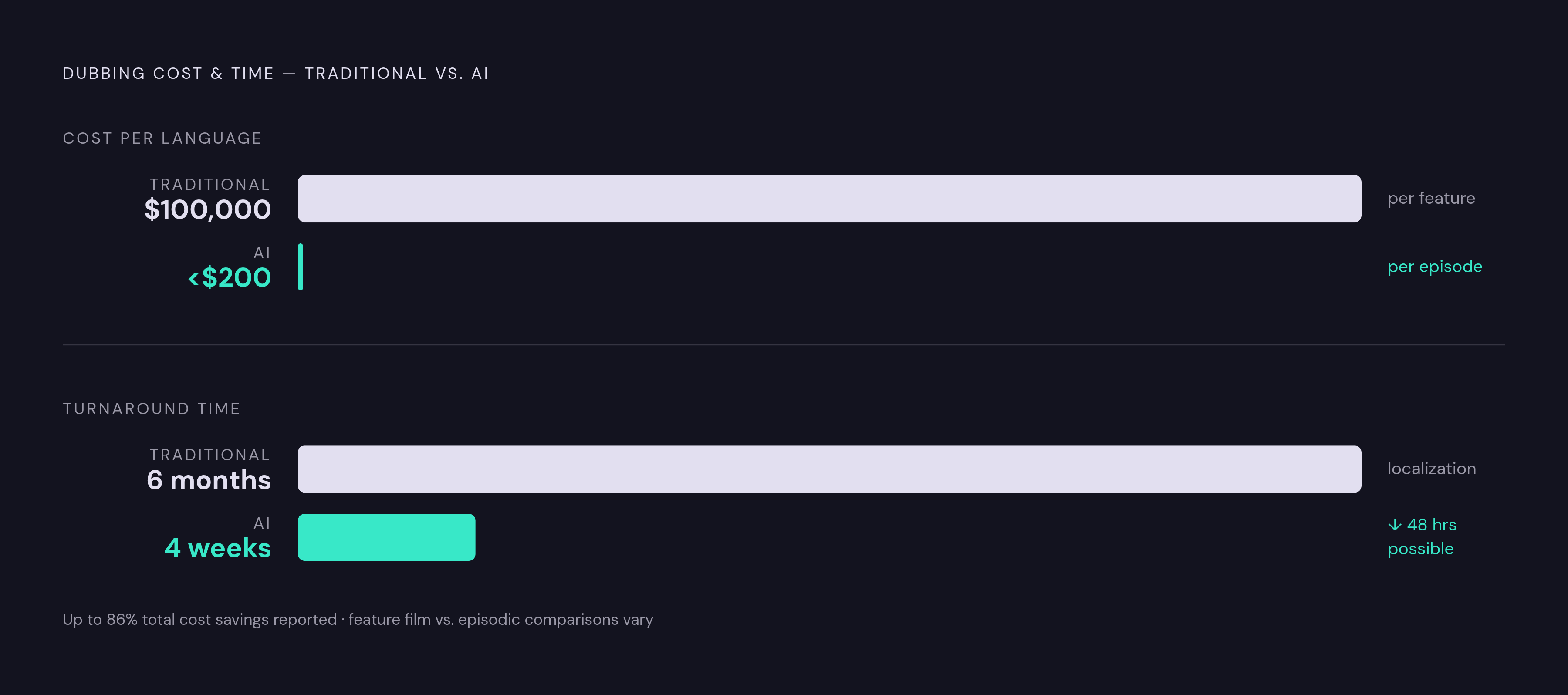
Studios deploying AI dubbing report up to 86% cost savings against traditional methods, with production timelines accelerating four to ten times over. Some report cutting total dubbing time by more than 90%, which is the difference between a simultaneous global release and a staggered one that leaks momentum market by market.
Put Netflix's numbers side by side and the shift is almost absurd: sub-$200 per episode against $50,000 to $100,000 per language for a feature using the old model. Forty percent of the viewing hours on Netflix's Korean unscripted catalog reportedly comes through dubbed versions, and dubbing preference over subtitles runs strong in Brazil, Mexico, and across LATAM and EMEA markets. The demand was sitting there the whole time. The old economics just couldn't reach it.
This isn't limited to film and TV. Coursera reported a 25% lift in course completion rates using AI dubbing, and corporate learning teams have clocked onboarding speeds up to 400% faster. Any long-form audio content category with a translation bottleneck is a candidate for the same math.
The real structural change is at the long tail, not the blockbuster. A mid-tier film that never justified $50,000 for a single additional language can now be dubbed into a dozen languages for a fraction of that, all at once. That's not a discount. That's an entirely different catalog becoming viable. Voice cloning technology on its own is on track to create a billion-dollar dubbing market in 2025, and the AI speech translation market broadly is projected to hit $5.73 billion by 2028. This is still early, and the money keeps arriving.
The labor, consent, and ethical questions studios cannot route around
None of this economic upside erases the fact that a voice belongs to somebody. SAG-AFTRA's 2023 strike put the right to consent, or refuse consent, to having your voice cloned at the center of the negotiation, and that fight didn't stay theoretical. The union's separate 11-month video game strike ended in June 2025 with AI protections written into contracts. Labor action changed the paperwork. That's not a symbolic win, that's the terms studios now operate under.
Netflix's DeepSpeak rollout reportedly triggered contract renegotiations over voice-cloning clauses and royalties tied to viewership. Even a studio holding a valid contract discovered that using AI on a voice without explicit cloning consent is a liability sitting in wait, not a settled question.
This fight isn't confined to Hollywood. Mexico's ANDA, Brazil's United Voice Artists, and Spain's PASAVE are each pursuing their own legislative or contractual protections. Japan's actors' union has formally opposed AI dubbing in anime and film, which carries real weight given that anime is one of the highest-volume dubbing categories on the planet. France's Centre National du Cinéma is going further, restricting public funding to productions where AI supports human creators rather than replacing them, including a requirement for human performance in dubbing.
The consistent ask from labor groups internationally is not a ban. It's regulation, consent, disclosure, compensation. Nobody serious is trying to put the technology back in the box. They're trying to make sure the box has a lock and the actor holds the key.
The regulatory landscape taking shape around AI-generated voices
Law is starting to catch up to the practice, and the timing is not generous to anyone caught mid-deployment. The EU AI Act sets an August 2026 enforcement deadline requiring explicit labeling of AI-generated content, dubbed voices included, and that applies to anything streamed inside the EU regardless of where it was produced. China's Cyberspace Administration is already ahead of that, enforcing mandatory labeling, with watermarking encouraged, on AI-generated content since September 2025.
Netflix's undisclosed DeepSpeak dubbing is close to a textbook example of what these rules exist to stop. What was an ethical shortcut in 2024 becomes a compliance violation in 2026. Amazon's decision to frame its March 2025 pilot explicitly as a "hybrid approach" reads, at least in part, as risk management dressed up as a quality pitch: say the AI part out loud before a regulator makes you.
Watch the Skies again stands as the counterexample to study. Its SAG-AFTRA compliance shows there's a working path through all of this, one that costs more time upfront in consent documentation and union alignment, but skips the backlash-then-quiet-retreat cycle that has embarrassed Amazon and Netflix. Studios building AI dubbing pipelines now need disclosure metadata, consent records, and jurisdiction-specific labeling built into the pipeline from day one. Retrofitting compliance onto a system already in market is a much harder and more expensive job than designing it in from the start.
The developer and platform layer where AI dubbing is built
A vendor layer doing the actual engineering supports every studio deployment. HeyGen is used by more than 90,000 businesses and was ranked the number one fastest-growing product of 2025 by G2, with a 4.8 out of 5 rating across more than 1,400 verified reviews. Maestra supports more than 125 languages and over 1,000 AI voices, has processed a substantial volume of dubbed audio, and carries the same 4.8 rating on G2, serving a broader base of creators and smaller production teams who don't have a studio's budget or legal department behind them.
CAMB.AI takes a more specialized approach. Its MARS model combines autoregressive and non-autoregressive techniques for voice generation, and its BOLI model is built specifically to handle idioms and slang, the cultural texture that literal translation always mangles. IMAX, MLS, and the Australian Open all use it, and it covers more than 150 languages, including dialects most translation tools ignore.
For a studio or developer choosing where to build, the decision points aren't which platform lists the most voices. They're language coverage for the specific markets that matter, how emotionally convincing the voice model sounds under stress or subtlety, latency requirements depending on whether the use case is live or batch, and whether the API actually scales programmatically across a full catalog. The API layer is also where the hybrid model becomes real rather than aspirational: AI runs the volume pass across an entire library, and human reviewers get pulled in only on flagged scenes and edge cases, which is a far more efficient division of labor than either side working alone.
What responsible deployment at scale requires
The hybrid model isn't a workaround someone settled for because full automation wasn't ready yet. It's the architecture that has actually survived contact with real audiences and real unions: AI handles speed, volume, and cost, and human oversight handles quality, cultural accuracy, and the compliance sign-off that keeps a studio out of a lawsuit.
Consent has to come first, structurally, not as an afterthought bolted on after a backlash. Every case reviewed here where things went wrong, the Petito documentary, Amazon's Korean drama dubs, Netflix's undisclosed DeepSpeak rollout, traces back to a voice being used without a clear, explicit, and contractually documented yes from the person who owns it. SAG-AFTRA compliance and jurisdiction-specific consent frameworks need to sit inside the intake process for a project, not get added during a fire drill after viewers notice.
Disclosure needs the same treatment. The EU's August 2026 deadline and China's already-active September 2025 requirement both assume that transparency metadata gets generated at the moment of production, not stapled on after release. A studio treating disclosure as a decision to make later is a studio that will be non-compliant on day one of enforcement, and given how fast this technology moved from research paper to theatrical release, "later" arrives a lot sooner than anyone plans for.