Voice Cloning Consent Frameworks and Legal Obligations
Three separate legal regimes now govern voice cloning, each with its own rules.
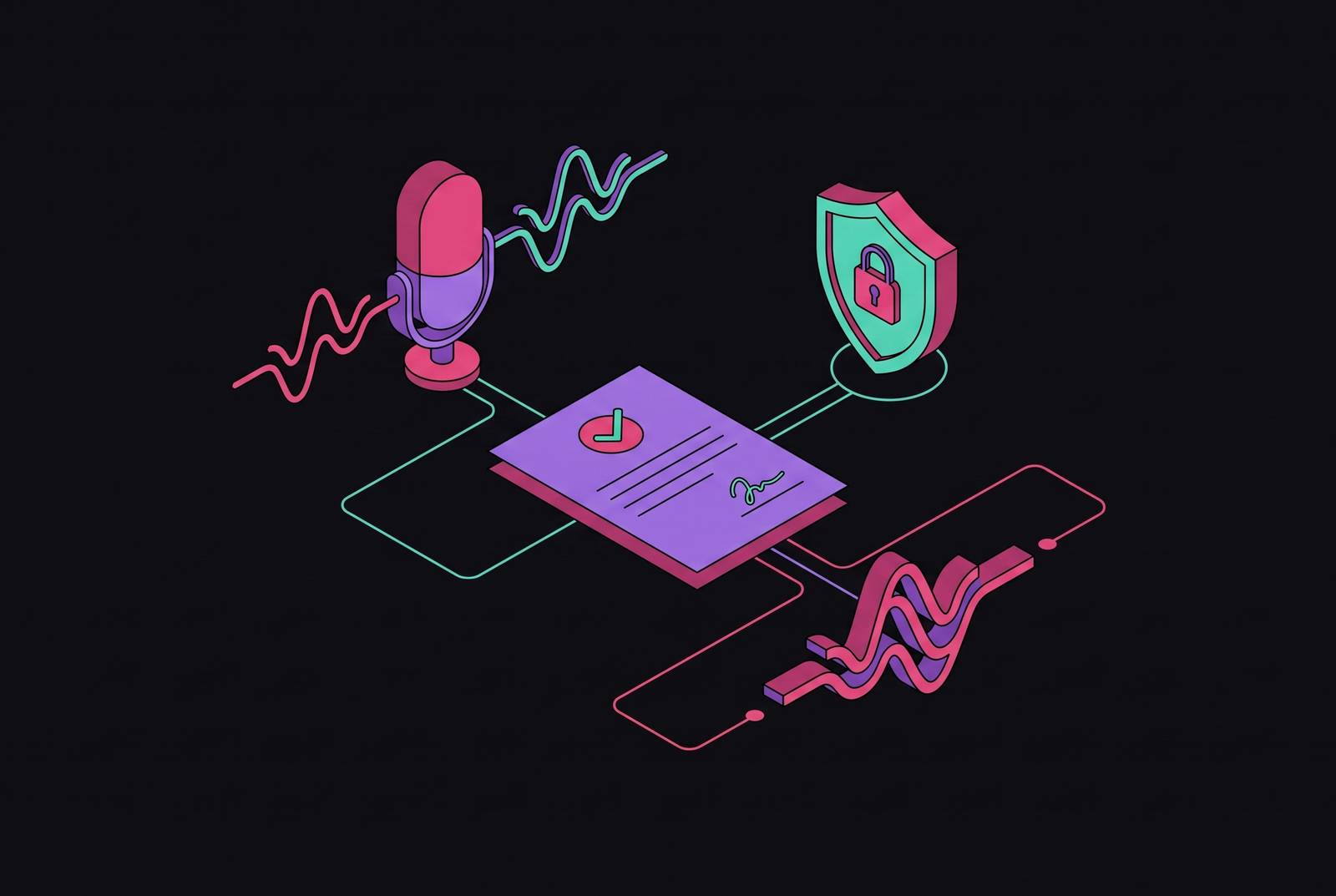
Voice cloning consent isn't one rule you check off, it's three separate legal regimes stacked on top of each other, each with its own trigger, its own definition of consent, and its own penalty structure. A developer can clear a voiceprint under biometric privacy law, still get sued for violating someone's right of publicity, and still get fined for failing to disclose the audio was synthetic to listeners. None of those three outcomes depends on the others. The technology got good enough to clone a voice from a minute or two of audio, the market for it crossed a substantial multi-billion-dollar mark in 2023 (Market.us, growing at 28.4% annually, with other 2025 estimates spanning a comparable range at 20 to 27% CAGR), and the law has not caught up in any tidy way. Research has found that people can't reliably tell a cloned voice from a real one even when they're told to watch for it, with detection accuracy only modestly above chance. The fakes are convincing, the market's growing fast, and the compliance map looks like it was drawn by three different agencies who never spoke to each other. Because, mostly, they didn't.
The three legal frameworks that can apply simultaneously
Framework one is biometric and privacy law. It treats a voiceprint the same way it treats a fingerprint: personal data that needs a lawful basis to collect, store, and eventually delete. This one triggers at ingestion, the moment audio gets fed into a model, not at the moment a clone gets published. Illinois BIPA is the sharpest version of this in a large country with many overlapping state and federal rules; California's voice-data obligations run through separate statutes. GDPR Article 9 does the same job in the EU, treating voice data as a special category requiring a documented lawful basis.
Framework two is right of publicity. This one doesn't care about data at all, it cares about identity. It governs whether someone can commercially use another person's voice or likeness, and it's historically been a state-level tort that's now getting extended, statute by statute, to cover AI-generated replicas. You can hold a perfectly legal, fully licensed recording and still violate someone's publicity rights the moment you synthesize their identity without separate authorization to do that. Owning the tape is not the same as owning the person.
Framework three is synthetic media disclosure. It governs what audiences get told, not what the speaker agreed to. It applies at distribution, not creation, and it runs on a totally different clock than the other two. A disclosure label telling listeners "this is AI-generated" does nothing to satisfy the voice owner's consent requirement under framework two. These are parallel obligations; one leg does not substitute for another.
Layer on a fourth question that isn't really a "framework" so much as a landmine: clearing the copyright on a sound recording doesn't grant any right to synthesize the speaker's identity. Copyright and identity are different assets, owned differently, licensed differently. A developer can satisfy all the data-consent paperwork on framework one, skip the publicity license required by framework two, forget the audience disclosure required by framework three, and end up violating two out of three laws while feeling completely compliant. Which use case gets built determines which of these three frameworks actually bites: an internal accessibility tool for a single employee looks nothing like an ad voice-over, which looks nothing like a robocall from a political campaign.
U.S. federal landscape: what has passed and what is pending
No comprehensive federal voice-cloning law exists as of 2026. Enforcement runs through a patchwork of the FTC under Section 5's unfair-and-deceptive-acts authority, the FCC under the TCPA, the DOJ, and old-fashioned fraud statutes doing double duty on new technology. The FCC's 2024 declaratory ruling classified AI-generated voices on covered calls as "artificial or prerecorded," which means prior express consent is required, and prior express written consent for telemarketing or advertising calls specifically, with fines running $1,500 per violation.
Two bills moved. The TAKE IT DOWN Act, signed into law May 19, 2025 as Public Law 119-12, is the first federal law aimed specifically at nonconsensual intimate deepfakes, covering AI-generated "digital forgeries" with criminal penalties up to two years for adult victims and three years where minors are depicted. Platforms have to pull flagged content within 48 hours of victim notice; the compliance deadline landed May 19, 2026, and the FTC, which enforces platform compliance, has already sent warning letters to 15 major platforms.
The NO FAKES Act (S. 1367, reintroduced April 9, 2025) is the bigger swing. It cleared the Senate Judiciary Committee as S. 4591, the NO FAKES Act of 2026, and sat pending a Senate floor vote as of August 2026. It would create the first federal right of publicity for every American, defining a "digital replica" as a newly created, computer-generated, highly realistic electronic representation readily identifiable as someone's voice or visual likeness. The right survives death, transfers to heirs, and runs 10 years post-mortem with renewable five-year extensions up to 70 years total. SAG-AFTRA, major studios, record labels, and tech companies including Google and IBM back it; digital rights groups have flagged concerns about chilling protected speech, because the industry coalition behind this one is unusually wide.
A second bill, the Voice Cloning Protection Act, has also been under congressional consideration with a floor vote still pending. It would make commercial voice cloning without explicit, informed, written consent a federal civil violation, capping damages at $50,000 per unauthorized work (or actual damages if higher), with carve-outs for news, satire, education, and personal use, and a Section 230 safe harbor for platforms that remove infringing content within 48 hours of notice.
A large country with many overlapping state and federal rules. Copyright Office's report recommended Congress build a federal digital-replica right, calling the existing patchwork of state laws inadequate and inconsistent, which is exactly the gap NO FAKES is designed to fill. Meanwhile, an attempt to preempt state AI law entirely got stripped out before passage: the Senate voted 99-1 to remove a moratorium on state AI regulation (originally floated at 10 years, cut to 5 before the vote) from the "One Big Beautiful Bill" signed July 4, 2025. State law stays the primary compliance layer for now. That's not a footnote; it's the whole ballgame until Congress acts. On the detection side, the FTC ran a Voice Cloning Challenge awarding $35,000 in prize money; one of three co-equal winning submissions, "AI Detect" from David Przygoda and Dr. Carol Espy-Wilson of OmniSpeech in College Park, Maryland, signals the agency is thinking about detection tooling as part of compliance, not just writing prohibitions and hoping.
State law in a large country with many overlapping state and federal rules: where the sharpest obligations live
At least 46 states have some law touching AI-generated voice, and at least 45 have enacted a deepfake or AI-voice provision of some kind. Thirty-three states have enacted laws specifically addressing deepfakes in elections, and many of those lean on disclosure requirements rather than outright bans.
Tennessee's ELVIS Act (2024) is the template everyone's copying. It's the first state law to expressly extend right-of-publicity protection to AI-generated voice clones, criminalizing unauthorized digital replication and providing civil remedies. Fourteen other states have since modeled bills on it, which makes Tennessee's statute the de facto national standard for voice publicity rights, passed by a state better known for music royalties than tech regulation.
Illinois BIPA explicitly covers voiceprints and requires written consent before a voice gets recorded or replicated, not after. Lawsuits since 2024 have confirmed synthetic voice models derived from personal data fall under BIPA's umbrella, meaning consent has to precede ingestion, full stop.
California AB 1880, effective January 1, 2025, gets misread a lot. It amends Family Code § 6750 to extend Coogan Trust Account protections, the ones covering child performers' earnings, to minor content creators. It says nothing about voice ingestion or opt-in consent for voice data; that's a separate statute doing a separate job. California's actual voice protection runs through Civil Code 3344, which treats voice as part of personal identity with publicity rights extending 70 years after death, plus AB 2602 and AB 1836, which regulate digital-replica performer contracts and commercial use of deceased performers' likenesses respectively.
New York's right of publicity framework protects voices under its likeness clause, and recent litigation has tested how that protection applies to commercial AI replication without prior licensing. Lehrman v. A voice-technology vendor. (S.D.N.Y. 2024) is the case to watch: professional voice actors allege a company used their recordings without authorization to train an AI voice generator, then sold commercial clones built from those recordings, with claims under the Lanham Act, the Copyright Act, and New York's right of publicity. It's an early test of how far these theories stretch, and it's the clearest illustration on record of how a platform can have the recordings and still be exposed on the publicity-rights side.
Washington's Biometric Privacy Act (HB 1493) covers voice data and requires notice and consent from developers enrolling voiceprints in a commercial database, though it stops short of granting deletion rights and excludes raw audio recordings from coverage entirely, an odd carve-out that matters a lot in practice.
Several states, including those discussed above, currently offer notably broad coverage across sexual deepfakes, election deepfakes, and voice or likeness rights combined. For anyone building a consent architecture, the practical move is to detect a user's location or force an explicit jurisdiction selection at signup, then enforce the strictest applicable law across the whole stack: GDPR first where it applies, then the relevant state voice-consent and publicity-rights requirements.
EU and major international frameworks developers and enterprises must map
The EU AI Act's Article 50 transparency obligations took effect August 2, 2026. European Commission guidelines now in force require deployers of AI systems generating or manipulating audio that qualifies as a deep fake to disclose that the audio was artificially generated or manipulated, subject to certain scope exceptions. GDPR Article 9 runs alongside it, treating voice data as biometric and requiring a documented lawful basis for processing; consent alone doesn't cut it, purpose limitation and retention limits apply too.
The UK has no law called anything like a "Digital Media and Voice Integrity Act," and no dedicated statute mandating consent for training AI on voice datasets as of 2026, though the existing UK GDPR framework and related data legislation cover personal data processing generally, and disclosure is required when synthetic voices appear in broadcast or commercial distribution. The UK has also moved toward recognizing voice as a creative IP asset.
Japan's approach runs through a 2025 general AI promotion law (the Act on Promotion of Research and Development and Utilization of Artificial Intelligence-Related Technologies), with the actual voice-consent protections coming not from that statute but from Ministry of Justice publicity-rights guidelines issued in 2026. Consent from the original artist is mandatory before their vocal characteristics enter a training set, traceability is required so derivative works credit the source voice, and approved licensing networks get institutional support.
South Korea's AI Basic Act (formally the Framework Act on the Development of Artificial Intelligence and Establishment of Trust), passed 2025, requires companies to keep verifiable consent logs and lets users revoke voice-usage authorization after the fact. Synthetic media used in advertising has to carry identity disclaimers.
Canada has nothing AI-specific enacted; the proposed Artificial Intelligence and Data Act died on the Order Paper in January 2025 and hasn't come back. Voice data there falls under existing privacy law, with voice likeness treated as personal biometric data by extension. Australia's in a similar spot, no dedicated voice-cloning framework as of 2026, governed by whatever limited copyright and privacy law already exists, with legal experts openly calling for a standalone "right of voice" that doesn't currently exist on the books. India's 2026 synthetic media rules make consent the legal cornerstone, prohibiting unauthorized voice replication for entertainment or informational use and applying criminal penalties where impersonation carries harmful intent.
A pattern holds across every one of these regimes: consent before training or deployment, disclosure to the audience, traceability through watermarking or attribution, and penalties with actual teeth. The frameworks diverge on which body of law carries the obligation and how it gets enforced; the obligation itself exists across all of them.
What consent must capture to hold up legally
Consent isn't a checkbox on a signup form, it's a document, and it has to arrive at the right moment. AB 1880 requires consent before voice ingestion starts. The consent record needs to exist and be timestamped before a single sample gets fed into a model. Consent tokens should be stored alongside voice samples, indexed by voice_id and timestamp, so there's an actual audit trail rather than a vague memory of "someone signed something once."
A consent record that would survive a legal challenge needs to name the speaker and their contact information, spell out every authorized use by name (ads, training, derivatives, resale, each one listed separately, not lumped under "and similar purposes"), state duration and territory including any sublicensing rights, define revocation terms and a removal SLA, identify which cloning provider holds the data and under what access controls, and state whether the model can be reused to train future systems. Skipping any one of those leaves a gap someone can drive a lawsuit through.
Commercial use of someone's voice needs a publicity license, which is a different document from a data-consent form. The Lehrman v. Lovo case is the live example: a platform can have the recordings on file and still face a right-of-publicity claim because commercial synthesis wasn't separately authorized. Revocation has to be a real technical feature, not a promise. Build an endpoint that disables every clone of a given voice the moment revocation is requested; delayed revocation is itself a compliance failure, and audit logs need to be immutable and append-only, because a mutable database is going to fail the first serious audit it faces.
Instant cloning, built from a minute or five of reference audio for a rough draft, and professional cloning, built from 30-plus minutes for broadcast-quality output, aren't the same product and shouldn't carry the same consent scope. The license needs to specify which tier is authorized, because a consent form signed for quick internal drafts doesn't automatically extend to a national ad campaign. For employees, contractors, or talent, the agreement needs to nail down scripts, channels, territory, duration, languages, permitted edits, model training and storage rights, compensation, revocation procedure, and what happens after the relationship ends. Oral consent, implied consent, someone nodding on a call, none of that satisfies BIPA, AB 1880, or either of the pending federal bills. A recorded verbal "yes" on camera is a nice supplement to a signed contract. It is not a replacement for one.
Disclosure obligations at the point of distribution
FTC guidance requires clear disclosure whenever a synthetic voice impersonates a real, identifiable person, or whenever the risk of deception is material, and that disclosure has to travel with the content itself, not get buried in a terms-of-service page nobody reads. The EU AI Act's Article 50, in force since August 2, 2026, requires disclosure of artificial generation or manipulation for deep fake audio, with European Commission guidelines defining scope and exceptions; the obligation lands on the deployer, not just whoever built the underlying model.
The FCC folds AI-generated voices into its existing TCPA "artificial or prerecorded" category, meaning identification and disclosure rules apply at the level of the individual call regardless of what consent was gathered elsewhere in the pipeline, with $1,500 per-violation exposure sitting behind it.
Platform policy runs as its own gate, parallel to the law rather than a substitute for it. YouTube's AI disclosure policy requires creators to disclose realistic content depicting a real person saying or doing something they didn't actually say or do, and the platform provides a removal process for realistic synthetic content resembling a real person. A platform's disclosure label doesn't function as a license, though; it just tells the platform's own rules were followed, which is a different thing from telling the voice owner's rights were respected.
Political content draws the tightest net. Thirty-three states require disclosure in political communications containing AI-generated material, and most of those are built around disclaimer requirements rather than flat bans, which makes election-adjacent deployment the single densest disclosure regime in the entire landscape. A disclosure label to an audience doesn't cure a missing consent from the speaker, doesn't create any kind of endorsement right, and doesn't override a fraud or impersonation claim. These run in parallel, not in sequence, and no single obligation discharges another. Watermarking and traceability have no universal standard as of 2026, so whatever method gets chosen should be applied consistently and documented in both platform terms and internal compliance records, because courts are going to expect consistency more than they're going to expect any particular technique.
Use-case risk tiers: where legal exposure concentrates
Lowest risk sits with someone cloning their own voice for their own narration or accessibility use, kept internal and non-public. There's no publicity-rights issue when the speaker is the one being cloned; the obligations that remain are tool terms of service, storage security, and disclosure if the context calls for it, alongside whatever general data-privacy rule applies.
Moderate risk occurs when an employee or contractor voice is used for a defined commercial purpose. That needs a full written consent covering channels, territory, duration, and training rights, plus a separate right-of-publicity license running alongside the data-processing agreement, governed by BIPA, AB 1880, or GDPR depending on where the parties sit.
High risk clusters around two very different situations that happen to carry similar exposure. One is an identifiable public figure, celebrity, or professional voice actor used in advertising or branded content: direct authorization is required, and neither implied consent nor the fact that recordings are publicly available establishes any right to clone the voice. Publicity claims, false-endorsement risk under the Lanham Act, and existing union or label agreements (SAG-AFTRA contracts among them) all stack on top of each other here. The other high-risk lane is automated calling: robocalls and voice agents fall under FCC TCPA rules requiring prior express written consent for covered calls, carrying $1,500-per-violation fines, with state robocall statutes often layering additional requirements on top, and identification obligations attaching to every single call.
Highest risk belongs to political communication, election-adjacent content, and government impersonation. Thirty-three states already require disclosure here, and two real incidents pushed the issue into federal view: a 2024 robocall impersonating a sitting president triggered state investigations, and a 2025 incident impersonating a sitting secretary of state helped drive federal legislative attention. This is the tier where the gap between "technically legal" and "politically survivable" is thinnest, and it's the one place on this map where regulators, prosecutors, and the public are all watching at once.
Sources
- Voice Cloning Consent Laws by Country: Understanding Global Voice Rights in 2026
- AI Voice Cloning Regulation: Legal Updates and Concerns | Resemble AI
- Synthetic Media & Voice Cloning: Right of Publicity Risks for 2026
- Legal Precedents in Voice Cloning Cases (2024–2026): How Courts Shaped AI Voice Rights
- Is Voice Cloning Legal? State-by-State Guide (2026 Update)
- The Law Speaks Up: AI Voice Cloning and Consent – Juris Magazine
- The EU AI Act’s Transparency Rules: A Practical Guide to Article 50 | EU Artificial Intelligence Act
- docs.fcc.gov