Voice cloning tools for brand identity: minimum sample requirements and output quality
Clean audio matters more than sample length when cloning your brand's voice.
Voice cloning has quietly moved brand identity from a style guide into an audio file. The math is simple: a company's tone, cadence, and character now live in a model that can be deployed across ads, IVR systems, and localized markets faster than any voice actor could ever book a session. Investment in the space jumped from roughly $315 million in 2022 to $2.1 billion in 2024, according to voxcloneai.com, and that pace of spending means most brands are signing contracts before they understand what they're buying. The uncomfortable truth driving all of it: a clone is only as good as the audio fed into it, and the gap between "sounds like the brand" and "sounds like a plausible stranger" comes down to a handful of technical decisions made before recording even starts.
How modern voice cloning extracts identity from audio
Every voice clone is doing the same basic job. It pulls a speaker's identity out of a recording, isolates the pitch, the timbre, the cadence, the rhythm of pauses, and reapplies that identity to new words the speaker never said. Two flavors of this show up in commercial tools. Text-to-speech cloning takes typed text and reads it back in the target voice. Voice conversion takes existing audio, live or recorded, and reshapes it into that same voice. Different use cases, but under the hood, it's the same extraction problem.
Microsoft's VALL-E, released in 2023, changed how researchers think about this by treating text-to-speech as a language modeling problem rather than a signal processing one. The audio gets converted into discrete tokens through a neural codec, and the model predicts those tokens based on text plus a short audio prompt. Trained on around 60,000 hours of speech, it could reproduce not just voice but emotion and even the acoustic signature of a room. VALL-E 2 followed in 2024, and its authors describe it as reaching human parity on standard benchmarks. Around the same time, flow-matching models like F5-TTS showed that convincing cloning could happen from just 10 seconds of reference audio, without giving up real-time speed.
What this means practically: the amount of audio needed to produce a passable clone has shrunk dramatically. But efficiency runs into a wall. A voice with a strong regional accent, an unusual speaking rhythm, or a wide emotional range hits that wall faster than a flat, neutral announcer voice does. And regardless of how advanced the model is, the recording itself sets a ceiling. Background noise, room echo, or a stray hum of music in the reference audio drags down output quality at every tier, from a three-second sample to a professionally engineered studio session. Clean audio is essential. It's the floor.
The three tiers of voice cloning and what each one actually requires
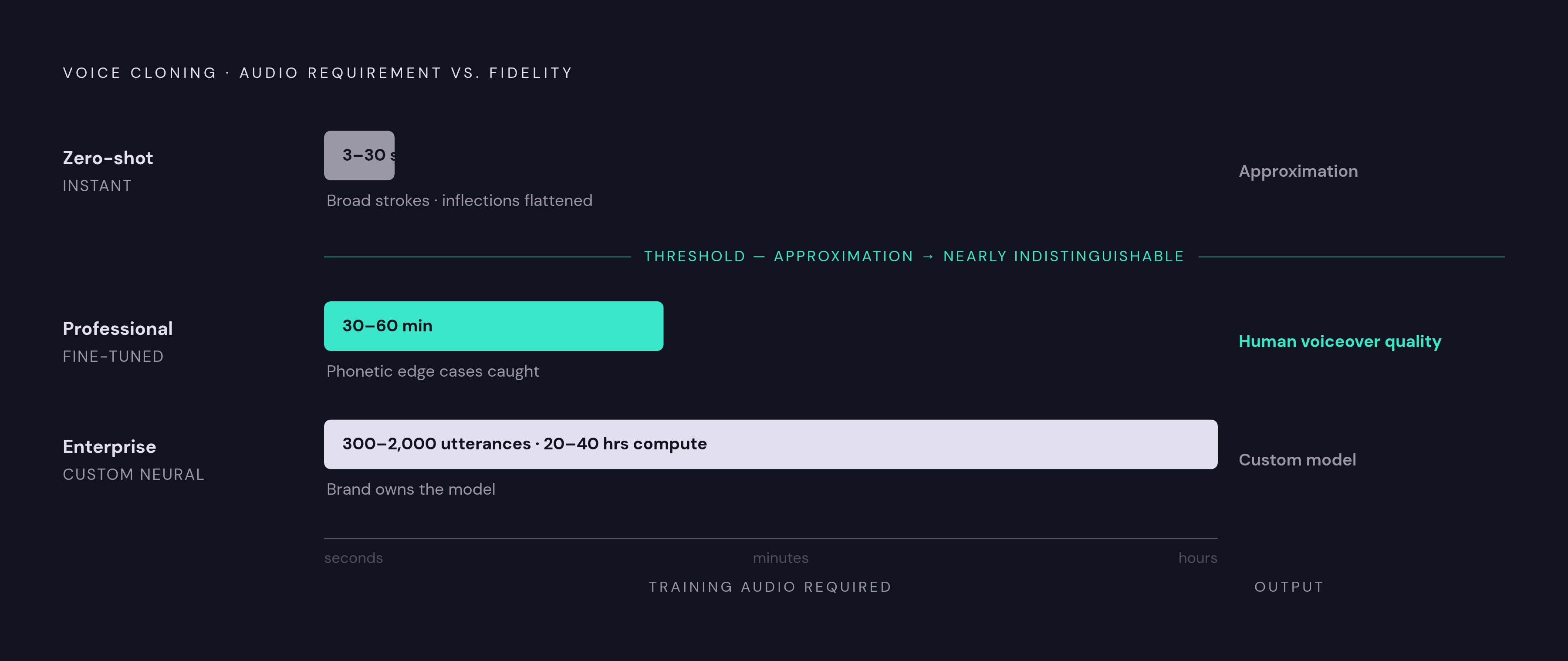
Three tiers exist, and they trade speed for fidelity in fairly predictable ways.
Zero-shot, or instant cloning, needs no training step and produces results in seconds. Cartesia's Sonic-3 sets the lowest bar among managed APIs at a 3-second sample, while most platforms ask for something in the 5 to 30 second range. Fish Audio's S2 Pro clones a voice from a single sample across more than 80 languages. AnyVoice works from a 15-second clip and outputs in a similarly broad set of languages. Zero-shot cloning gets the broad strokes right but flattens the finer vocal expressions, the small inflections that make a brand voice recognizable rather than merely competent. Output is an approximation. A good one, often, but an approximation.
Professional or fine-tuned cloning trains the model specifically on a target voice, which takes anywhere from minutes to hours depending on the volume of source audio. This tier catches phonetic edge cases and natural variation that zero-shot glosses over. Instant Voice Cloning tools can produce usable output from about a minute of clean audio, though the source voice's subtler qualities still soften somewhat, per analysis from pamistanbul.com. Push to 30 minutes minimum, ideally closer to 60, and that same analysis finds output nearly indistinguishable from the original speaker. On the open-source side, RVC v2 (a voice-to-voice conversion model) produces usable results starting around 5 to 10 minutes of clean audio, with 10 to 50 minutes considered the sweet spot, and training runs typically taking 2 to 6 hours of GPU time.
Enterprise or custom neural voice sits at the top: highest fidelity, longest lead time, and a model the brand actually owns. Microsoft's Azure Custom Neural Voice Lite tier has talent read 20 to 50 pre-defined scripts, and training can start once at least 20 samples are in. The professional tier of that same product asks for 300 to 2,000 utterances and roughly 20 to 40 hours of compute training time. What comes out the other end isn't a one-off clone, it's a proprietary voice model the brand can deploy across every TTS use case it has.
The rule holding all three tiers together: more audio always helps, but the minimum threshold is what decides whether a use case is even possible in the first place.
Where quality plateaus and what the numbers mean in practice
Speaker verification systems score similarity between a clone and its source on a scale of 0 to 1. Per vocalis.pro, the strongest platforms run between 0.85 and 0.95 on clean reference audio, while a genuine recording of the same person compared against itself scores 0.98 to 0.99. That gap, between 0.95 and 0.99, is where brand distinctiveness actually lives. A spec sheet showing 0.9 similarity sounds impressive right up until a loyal listener notices the voice is slightly off, and can't quite say why.
Research cited in a University of Groningen thesis found that neural cloning models produce convincing speech from just a few seconds of reference audio, and gains continue up to a point, after which improvement tends to slow. That's a specific, useful number for anyone budgeting recording time: early increases in reference audio duration tend to yield more noticeable quality improvements than later ones. At the zero-shot tier, a short but clean and expressive clip will generally outperform longer recordings of lower quality.
At the professional tier, for common brand voice formats, output at this tier can approach close to human voiceover quality, per analysis from pamistanbul.com. Leading models on current benchmarks post mean listener quality scores above 4.0 and word error rates under 2 percent, per a comprehensive review on ResearchGate.
Brands evaluating a clone shouldn't just trust the benchmark sentence a vendor demos in a sales call. Run a blind listening test on genuinely varied content, not the polished lines from a pitch deck. Test phoneme combinations the reference audio never included. And listen closely to emotionally varied, punctuation-heavy text, since that's exactly where a lot of clones start to wobble.
Choosing the right tier for common brand voice use cases
Zero-shot makes sense when speed matters more than precision: internal content, low-stakes digital ad variants, or a quick localization pilot to see if a market responds. It's the wrong tool for anything customer-facing where the voice functions as a primary brand signal, an IVR greeting a customer hears every time they call, for instance.
Professional fine-tuned cloning is the sensible default for podcast narration, audiobook production, branded IVR, e-learning content, and any campaign where the same voice repeats often enough that listeners start to calibrate to it. This is the tier most brand teams should be budgeting for, not the flashy zero-shot demo and not the enterprise contract.
Enterprise custom voice earns its cost when the cloned voice will represent the brand indefinitely across customer touchpoints, when consistency across multiple languages is non-negotiable, or when legal ownership of the voice model itself is a business requirement rather than a nice-to-have.
Cross-lingual deployment adds its own wrinkle. Quality drops any time a model has to bridge acoustic gaps between languages, so a voice cloned cleanly in one language will not automatically sound equally sharp in another. Test with real target-language samples before locking in a tier, not after.
The highest return on audio preparation shows up at the professional tier. Thirty to sixty minutes of studio-quality, phonetically varied recording is the range most professional-tier cloning workflows target, and scripting for phoneme and prosody coverage matters just as much as total minutes logged. For real-time applications, voice agents, live support, interactive characters, latency changes the whole calculation. A stunning clone that lags half a second behind a customer's question is worse, functionally, than a slightly rougher clone that answers instantly.
API and developer options across the quality spectrum
For developers, quality is only one column in the spreadsheet. Latency, language coverage, and how much engineering lift the integration takes matter just as much, since a brand voice that sounds flawless but can't respond in real time isn't a voice agent, it's a recording.
Managed APIs offer instant cloning at entry-level plans, with fine-tuned professional voice clones available at higher tiers for maximum fidelity, and some platforms support more than 70 languages through a single API, among the broadest coverage available, per an evaluation from veed.io. Newer model versions have added emotional depth and audio tags for controlling tone, useful for a brand voice that needs to sound warm in one ad and urgent in the next. SSML break tags and phoneme tags let developers control pauses and pronunciation precisely on models that support them.
Cartesia's Sonic-3 posts a 90 millisecond time-to-first-audio, the fastest response time in veed.io's comparison of managed APIs, making it a strong option for anyone building a real-time voice agent where sub-100ms latency is the priority. It needs just 3 seconds of reference audio and covers 15 languages, a reasonable trade for anyone building a real-time voice agent where sub-100ms latency outweighs the need for broad language support.
Fish Audio's S2 Pro clones zero-shot across more than 80 languages and leans developer-first, with a basic web interface rather than a full studio editor, a fair trade for engineering teams building multilingual pipelines who don't need a polished front end.
For teams that want to own the whole stack, Coqui XTTS offers zero-shot multilingual cloning with full model ownership, and RVC v2 handles voice-to-voice conversion. Both need GPU infrastructure, 8GB of VRAM covers most workloads, but they cut out per-character API costs at scale, which adds up fast for high-volume content production.
Brand voice work in video, dubbed ads, localized explainer content, adds one more step. The cloned audio still needs a lip sync layer to remap mouth movements to the new dialogue, or the result lands in that uncanny gap where the voice is right but the face isn't saying it.
What clean, representative audio actually means when recording for a clone
Background noise, echo, and music in a reference recording degrade similarity scores at every tier, not just the cheap zero-shot end. That part's not negotiable.
Phonetic coverage matters just as much. A reference recording built around one narrow set of sounds produces a clone that nails similar sentences and falls apart on unfamiliar text. Scripts for a serious cloning session should hit the full range of phonemes in the target language, not just whatever a marketing team happened to write for the last campaign.
Most brand voices get recorded reading one script in one emotional register, calm, professional, maybe a touch of warmth, and that produces a clone that sounds right in that register and brittle everywhere else. Reference audio needs variety: different sentence lengths, questions, emphasis in different places, a real tonal range.
At the professional tier, where 30 to 60 minutes of recording go into training, consistency across the whole session becomes its own variable. A microphone that drifts a few inches, fatigue that lowers pitch by session's end, small acoustic differences between recording days, all of that compounds into a noisier training signal the model has to sort through.
And for zero-shot use, given that quality gains from added duration tend to taper off beyond short clips, a short, clean, expressive clip will outperform longer recordings of lower quality. Hygiene, not duration, is the lever that matters most here.
One practical note for anyone booking the actual recording session: brief the voice talent that they're recording for a model, not a final broadcast spot. Pacing should sound natural, not performed for a microphone, and the session benefits from some conversational, unscripted material alongside the read lines.
Consent, ownership, and brand voice governance before deployment
Cloning a real person's voice requires documented consent, and that agreement should spell out exactly what the clone can be used for, which languages it can appear in, how long the rights last, and whether the brand ends up owning the resulting model or just licensing use of it.
Brands uploading their own proprietary recordings to a cloud platform need to actually read the terms of service, since IP ownership of the resulting voice model varies by platform and by tier. Enterprise custom voice programs, Azure's Custom Neural Voice among them, operate under terms that differ substantially from consumer API tiers. That's a meaningfully different arrangement from a session-level clone on a consumer API, where the brand may not own the underlying model at all, just the output.
Voice watermarking, inaudible signatures embedded in generated audio, offers a way to track where a cloned voice has actually been used and flag unauthorized reproduction. Any brand serious about this should build a governance checklist before deployment, not after. That checklist should include documented consent from the voice talent, legal review of the platform's terms, a defined list of approved use cases, an audit trail for generated audio, and a plan for retiring the voice if the brand's identity changes down the line.
Voice cloning's ability to scale a brand's identity across every market and channel at once is exactly what makes it valuable, and exactly what makes it risky if nobody's watching how it gets used. Governance is a core requirement here. It's the difference between a brand asset and a liability wearing the same voice.