Voice Cloning Detection and Anti-Spoofing Techniques
Deepfake fraud attempts exploded 1,300% in 2024, overwhelming traditional detection methods.
Voice cloning fraud broke the contact-center industry's fraud detection curve in a single year. Pindrop's 2025 Voice Intelligence and Security Report, drawn from more than 1.2 billion customer calls, found deepfake fraud attempts rose over 1,300% in 2024, from roughly one attempt a month to seven a day. Contact centers face an estimated $44.5 billion in fraud exposure in 2025, and the market for voice cloning technology itself is on track to grow from $3.28 billion in 2025 to $9.56 billion by 2030, Research and Markets reports. Pindrop's separate fraud-spike analysis found AI-enabled fraud surged 1,210% in 2025 against 195% for traditional fraud, which tells you attackers didn't just scale up, they switched tools. Gartner already predicts that by 2026, 30% of enterprises will stop trusting identity verification on its own, because deepfakes broke the assumption a voice equals a person.
None of this is speculative anymore. It's a production problem with a paper trail, and the rest of this piece is about what actually stands between a cloned voice and a compromised account.
How modern voice cloning works
Cloning got cheap fast. Not long ago, a convincing clone needed substantial recorded audio. By 2026, some zero-shot systems can produce a working clone from as little as three seconds of source audio. Some zero-shot systems in 2026 can produce a working clone from three seconds of source audio, though anything under thirty to sixty seconds still sounds rougher around the edges. McAfee's research puts a number on just how low the bar has dropped: three seconds of audio can produce an 85% voice match, and the vast majority of people have already left enough voice data on voicemail greetings, podcast clips, or a single social media story to hand an attacker a usable starting point.
Two synthesis routes dominate. Text-to-speech takes written text and outputs a voice; voice conversion takes existing speech and restyles it into someone else's voice. Each leaves a different kind of fingerprint, which matters enormously for detection, because a filter tuned to catch one leaves the other walking right through. Microsoft's VALL-E changed the framing entirely by treating cloning as a token-prediction problem, the same way language models predict the next word, and its successor VALL-E 2 reportedly reached human parity on standard benchmarks. The newest generation, built on neural audio codecs and flow-matching architectures, produces output that's hardest to catch: a Vanderbilt ecosystem-level benchmark (Mao et al.) found these systems consistently slip past top-tier detectors.
The attack surface spans multiple forms. It's TTS, voice conversion, replay attacks, and partial spoofing, all cheap to access and all still evolving. Any single-purpose detector built to catch last year's fake is, by definition, not built to catch this year's.
Human ears as a reliable filter
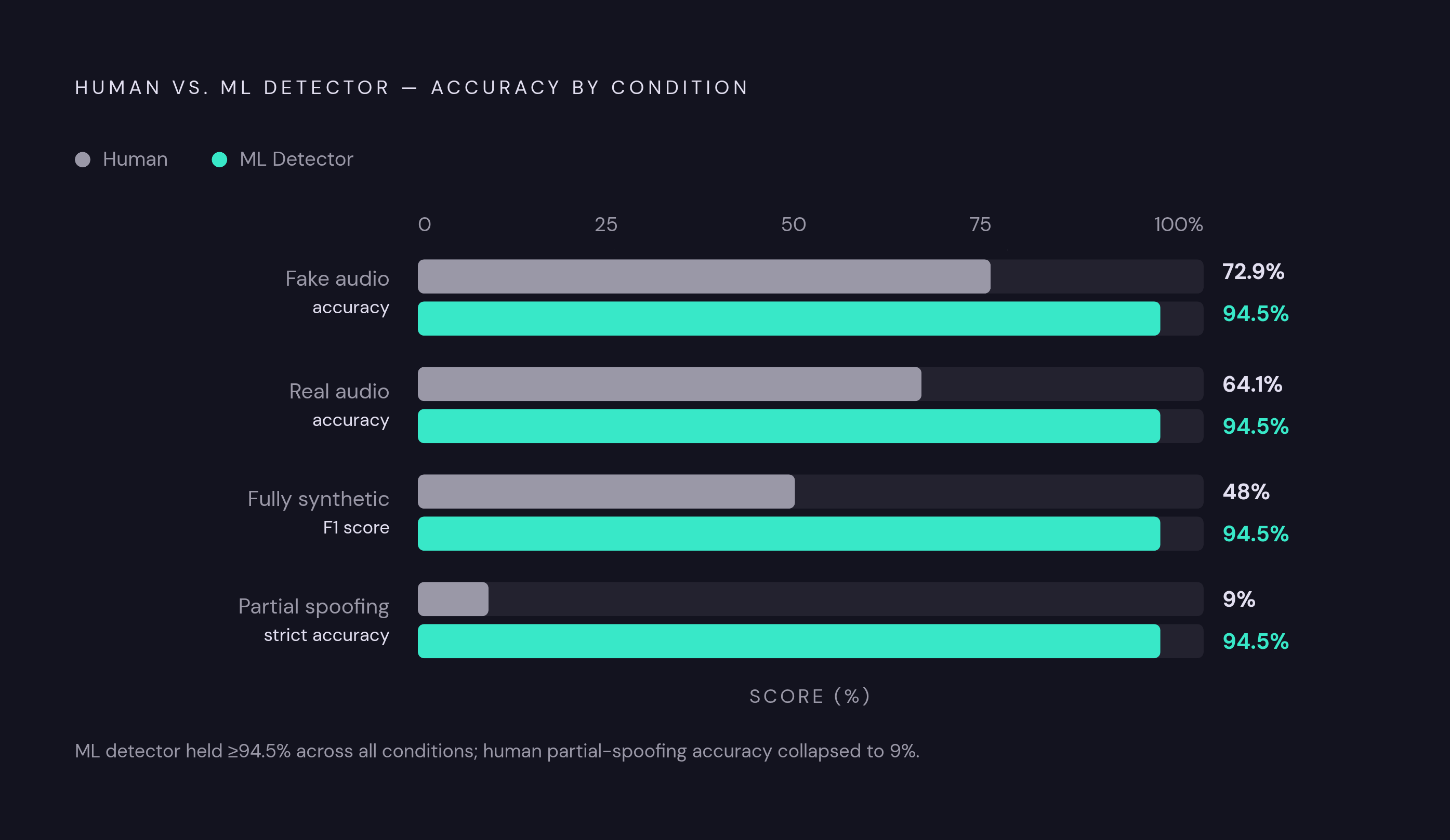
Human listening isn't just an unreliable filter, it's getting worse in a specific, measurable direction. One study found human accuracy on fake samples barely moved, 72.9% down to 71.2% against a 2021 baseline, but accuracy identifying real audio dropped from 72.7% to 64.1%. People are getting worse at trusting anything, including audio that's genuinely authentic. They're getting worse at trusting anything, including audio that's genuinely authentic. That's not vigilance, that's noise.
The hardest cases break the pattern further. Samples from commercial and autoregressive language-model-based systems scored only 61.3% to 65.9% human accuracy, while older flow-matching and seq2seq systems stayed somewhat more catchable at 75.4% to 76.8%. Meanwhile, an ML detector in the same study held over 94.5% accuracy across every condition tested. That gap, roughly thirty points, is large enough to rule out a rounding error. That gap is large enough to rule out chance performance, while the ML detector held up consistently across conditions.
A separate 2026 study pitted 82 IT professionals, presumably people paid to be skeptical for a living, against six pretrained detectors. For fully synthetic speech from current commercial systems, human F1 scores collapsed to around 48%, down from roughly 90% against older tools. Worse: for partial spoofing, where only a single sentence in a call gets swapped out, strict human accuracy fell to 9%, and listeners called the fake sentence genuine 77% of the time. As Fisch Solutions put it in 2026: "You cannot detect a clone by ear." Human review still has a job in this system, just not the job of front-line gatekeeper.
Acoustic artifact analysis: what detectors listen for in the signal
Every voice generator leaves fingerprints, whether it means to or not. Vocoders and acoustic models imprint characteristic artifacts on the spectral, temporal, and phase structure of the waveform, and those imprints are what a detector is trained to notice. A Toronto Metropolitan University survey of over 200 papers on the subject identifies three architectures doing most of the work: AASIST, RawNet2, and LFCC-LCNN.
The current leading approach layers self-supervised learning on top of these. SSL front-ends, wav2vec being the standard example, replace hand-built feature extractors with representations learned from massive unlabeled audio corpora, which generalizes better to synthesis methods the model has never seen. One such model, SSL-AASIST, trained on a composite corpus of 256,600 samples (Ali et al., August 2025), has shown strong performance on In-The-Wild benchmarks. Production pipelines also lean on RawBoost, a data augmentation method that injects convolutive and impulsive noise during training so the detector doesn't fall apart the moment it hits a real phone line instead of a clean lab recording.
The VoiceWukong benchmark out of Huazhong University is a useful reality check here. Researchers tested 12 detectors against 265,200 English and 148,200 Chinese deepfake samples, generated by 19 commercial and 15 open-source tools. AASIST2 came out on top with a 13.50% equal error rate. Every other detector tested came in above 20%. That's a wide spread for what's supposed to be the industry's best tool, and it says something important on its own: acoustic artifact detection works well under matched, controlled conditions and gets shaky fast once real-world noise, compression, and post-processing enter the picture.
The generalization gap: why a detector that works on known fakes fails on new ones
ASVspoof 5, the latest edition of the field's benchmark series, built its 2024 evaluation corpus from more than 1,000 speakers across varied acoustic conditions, with deepfake data drawn from 32 separate synthesis and adversarial attack methods, making it a notably broad evaluation corpus. Across the 53 teams that competed, a pattern of strong results under known, matched conditions and a real drop-off under adversarial attacks and neural compression schemes should worry anyone deploying a static detector in production.
The ASVspoof 5 analysis makes the erosion visible: compared to earlier editions, the separation between genuine and spoofed speech degrades noticeably under unseen or matched conditions, which is another way of saying the decision boundary between real and fake is getting harder to draw, not easier. The Vanderbilt ecosystem benchmark reaches the same conclusion from a different angle: no detector tested was universally robust, and neural codec and flow-matching architectures specifically slipped past the strongest systems available.
The underlying mechanic is simple and a little discouraging. A detector trained on fakes from one model architecture learns that architecture's artifacts. It has no reason to recognize diffusion-model artifacts, or codec-LLM artifacts, because those are structurally different signatures. Each shift in synthesis architecture, parametric to GAN to diffusion to codec-based language models, opens a fresh gap that stays open until someone assembles new training data and retrains. A detector bought once and left alone is a countdown clock. It's a countdown clock.
Speaker-consistency modeling: verifying identity, not just audio quality
Acoustic artifact detection asks whether audio sounds synthetic. Speaker-consistency modeling asks a different question entirely: does this voice match the person it claims to be? Voice biometrics compare an incoming signal against an enrolled voiceprint, independent of how "natural" the audio sounds. That distinction matters because a high-quality clone can match enough of a target's spectral fingerprint to clear a similarity threshold, especially when the original enrollment sample was short or noisy to begin with. Replay attacks sail through this check even more easily, since they're using the real person's actual recorded voice.
Liveness detection is the standard complement, checking for a live human voice versus a replayed recording or synthesized stream. It's answering a different question than voiceprint matching. Production systems run both rather than picking one. FutureAGI's 2026 production guide recommends logging a specific set of speaker-risk signals with every call: the speaker-verification score, enrollment match, replay score, and caller risk tier, so the trail can be audited and thresholds retuned later without re-running the whole call.
Partial spoofing breaks this layer the same way it breaks human ears. If an attacker splices one cloned sentence, say, an authorization phrase, into an otherwise genuine call, the overall speaker-consistency score can stay comfortably above threshold. That's the exact scenario where the 2026 study found listeners called the fake sentence real 77% of the time, and automated speaker-match scoring runs into the same structural blind spot. The fix isn't a binary pass or fail. Speaker-consistency signals need to feed a risk score, where a low score paired with a high-stakes request, a wire transfer, a password reset, triggers escalation instead of an automatic decision either way.
Probabilistic verification: adding formal robustness guarantees to empirical detection
Every detector discussed so far gets evaluated the same way: run it against a test set, report the accuracy, call it a day. Kushnir et al., in the paper introducing PV-VASM, point out the flaw in that approach directly. Strong benchmark accuracy tells you how a model performed on the fakes it was tested against. It tells you nothing formal about how it will behave against a generation method nobody has built yet.
PV-VASM, short for Probabilistic Verification of Voice Anti-Spoofing Models, tries to close that gap. It's a black-box, model-agnostic framework that estimates the probability of misclassification under text-to-speech, voice conversion, and parametric signal transformations, and it produces a theoretical upper bound on error probability rather than a single point estimate from one test run. Because it's model-agnostic, it doesn't need access to a detector's internals. A team can point it at whichever detector they've already deployed and test it against synthesis methods that didn't exist when the detector was trained.
The practical use case is pre-deployment: before shipping a voice authentication system, run PV-VASM against the chosen detector and get a certified upper bound on misclassification under realistic conditions, a mathematical answer to "how much should this be trusted?" that no test-set accuracy number can give you. PV-VASM is validated research, not a shipped production component yet. It doesn't replace a trained detector. It puts a number on how far to trust one, a safety layer bolted on top of the classifier rather than a substitute for it.
Watermarking and provenance as preemptive controls
Detection reacts to audio that's already out in the world. Watermarking and provenance try to get ahead of that by marking content at the moment it's created. Two approaches do this in different ways: neural, perceptual watermarking (systems like AudioSeal or PerTh embed inaudible modifications directly into the waveform), and content provenance metadata like C2PA credentials, attached to the file itself. One answers "was this generated by a known system?" The other answers "what do this file's credentials claim about where it came from?"
A watermark works by altering the waveform in ways a human ear won't notice but a detector can check for, and the mark is designed to survive normal handling, compression, EQ adjustments, re-encoding. If a piece of audio claims to be authentic and the expected watermark isn't there, that's a flag. Watermarking every generated output by default is a real design choice, not a neutral one: it reflects a stance that platforms generating synthetic audio at scale have some responsibility to make downstream detection possible.
The limitation is structural. A watermark only shows up in audio produced by a system that implements it. Anything generated by a tool without watermarking, or run through a process specifically meant to strip the mark, produces no signal at all, which means the absence of a watermark proves nothing on its own. C2PA provenance metadata runs into a related wall: it's genuinely useful for confirming a known-authentic original, and far less useful once an attacker controls the entire generation pipeline and can simply omit or fabricate the credentials. Neither tool catches everything. Both work best as a fast first pass, filtering out known-generated content early so the heavier, slower deepfake classifiers downstream aren't doing all the work alone.
How the layers combine in a production detection pipeline
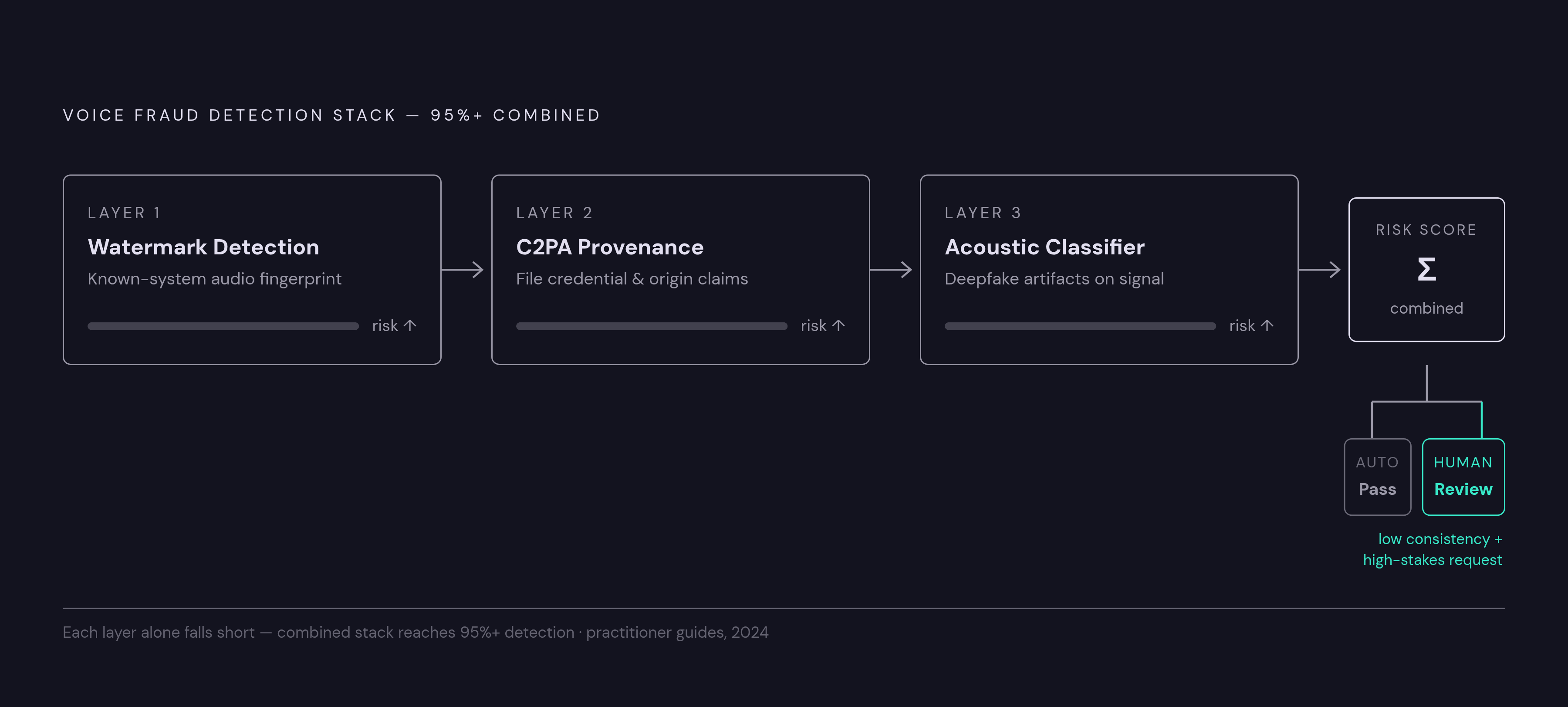
No single layer covers the whole threat. A practical production stack runs three checks in sequence: it starts with watermark detection, follows with a C2PA provenance check, and finishes with acoustic artifact classification. Practitioner guides document this combined approach reaching detection rates in the 95%-plus range, a number no individual layer gets close to alone.
The layers only matter if a policy connects them. A production system should route a call to human review when a voice clone is suspected, the speaker-consistency score sits below threshold, and the requested action carries real risk. That's a rule joining evidence across layers. FutureAGI's 2026 production guide explains why risk-tiering matters here, since a password reset, a wire transfer, and a restaurant reservation should never trigger the same escalation path: the same detection evidence carries very different consequences depending on what the caller is actually asking the system to do.
Preserving the audit trail through all of this, the watermark result, the provenance check, the artifact score, the speaker-consistency score, is what turns a detection stack into something a fraud team can actually investigate after the fact, rather than a black box that occasionally says no. The technology keeps moving. The generators keep improving. The only stack with a real shot at keeping up is the one built to know it's already a step behind, and to check itself constantly rather than trust its last training run.
Sources
- What Is Voice Cloning Detection? FutureAGI Guide (2026)
- Probabilistic Verification of Voice Anti-Spoofing Models
- A Survey on Speech Deepfake Detection
- Benchmarking Fake Voice Detection in the Fake Voice Generation Arms Race
- AI Voice Cloning Scams: Detection and Prevention Guide
- AI Voice Cloning Fraud: How HV Businesses Defend in 2026
- dl.acm.org
- Replay Attacks Against Audio Deepfake Detection