Perceptual Loss Functions in Neural Speech Synthesis Training
Matching neural networks to how humans actually hear changes what "correct" means during training.
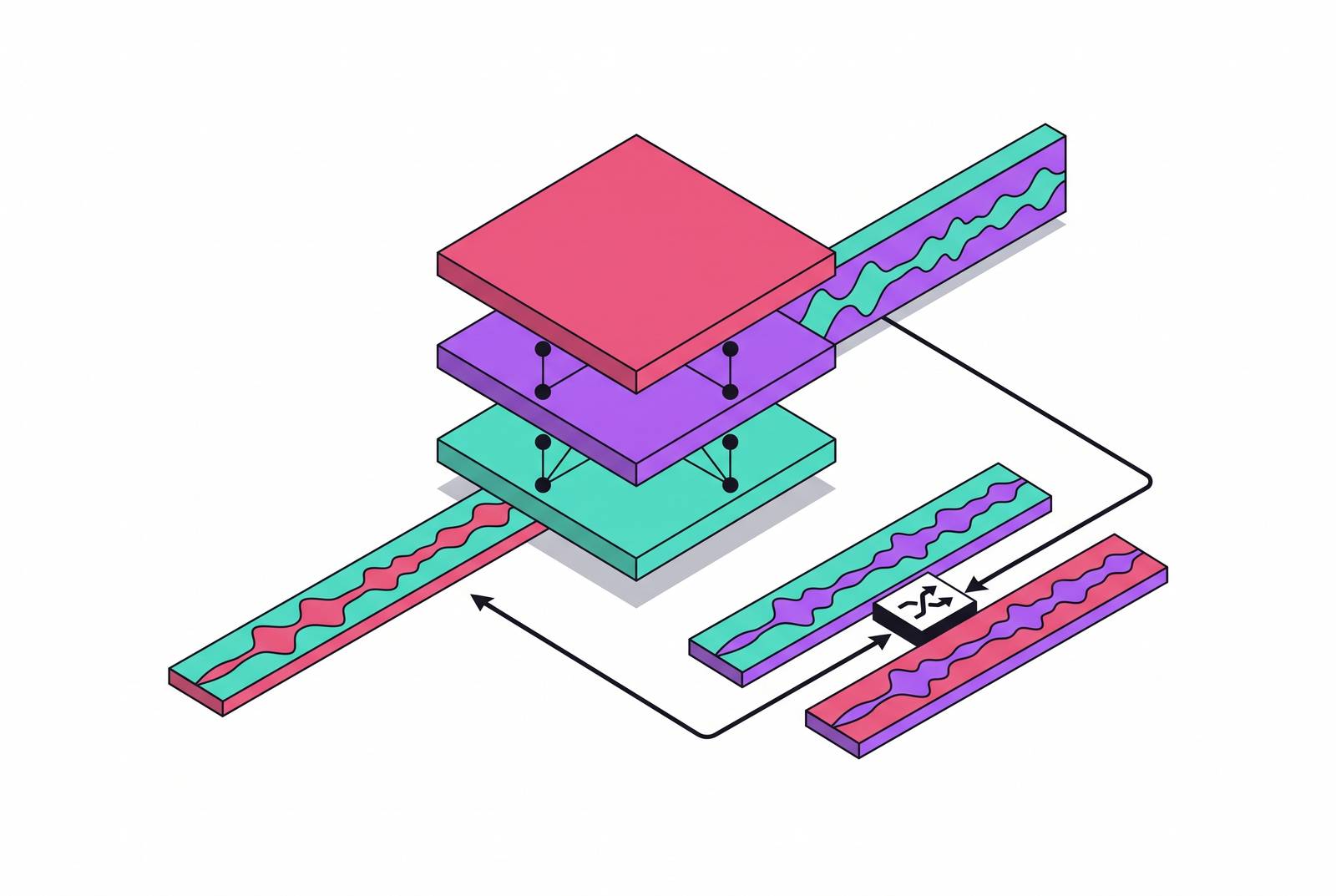
Every neural TTS model needs something to aim for during training, and that something is a loss function: the arithmetic that tells the network what "correct" means. For years, the default choice was mean squared error, which compares a synthesized waveform to a reference one sample at a time and penalizes every mismatch equally, whether a human would ever notice it or not. That equal treatment is the whole problem. Waveforms are absurdly redundant at the sample level, and a lot of the deviation MSE punishes has nothing to do with what a listener actually perceives. So a model can hit a low MSE score and still produce audio that sounds flat, over-smoothed, or vaguely robotic, the auditory equivalent of a photocopy of a photocopy. It minimized the numbers. It never once asked whether the output sounded like a person.
That is the mismatch this entire piece is about: mathematical accuracy and auditory realism are not the same target, and treating them as interchangeable is how you end up with speech that scores well on a spreadsheet and fails the second it reaches an ear. That reframes the challenge as mechanical rather than philosophical: baking human hearing into a training objective, instead of bolting it on after the fact, takes something specific.
What perceptual loss functions do
A perceptual loss function answers that question by changing where the comparison happens, not just what gets compared. Instead of measuring distance in raw waveform space, it first transforms both the synthesized signal and the reference signal into a representation that reflects how human hearing actually works, then measures the gap there. That representation might be a frequency-weighted spectrum, a mel-scaled spectrogram, or the internal activations of some pretrained neural network. Whatever the choice, the shared trait is that the domain itself encodes something about human ears rather than treating every sample as equally important.
Some of these losses use a frozen feature extractor that never updates during training, and others learn the representation end to end alongside the rest of the model. Either way, the gradient stays meaningful in perceptual terms rather than purely numeric ones. Crucially, none of this breaks the standard deep learning recipe: perceptual losses remain differentiable, so gradients flow back through them exactly the way they would through MSE, and they plug into existing training pipelines without requiring a new kind of optimizer. The underlying logic: people notice structure, texture, and spectral shape, but they barely register small local shifts in energy. Align the loss with that asymmetry, and the model stops wasting its capacity chasing errors nobody will ever hear. Several distinct families of technique have grown out of that one idea, each one encoding a different piece of what "hearing" actually means.
The four families of perceptual loss used in speech synthesis
The first family works directly off psychoacoustics. It borrows from equal-loudness contours and A-weighting curves, and uses that to weight reconstruction error by frequency band, so mistakes in the parts of the spectrum people actually hear get punished harder than mistakes buried in a masked or inaudible region. The lineage traces back to analysis-by-synthesis speech coding, CELP in particular, where two disturbance terms modeled auditory masking and threshold effects and amended plain MSE with something closer to how the ear actually filters sound.
The second family works in mel-spectrogram space instead of raw waveform space, and it is, by a wide margin, the workhorse of production systems today. The mel scale compresses high frequencies to mirror how pitch sensitivity actually degrades as frequency climbs, so distance measured there already carries a rough approximation of perceptual weighting built in. Multi-scale versions take that one step further, measuring the distance across several time-frequency resolutions at once, so the model has to get both the fine grain and the broad shape right simultaneously.
The third family skips spectrograms entirely and instead measures distance between the internal activations of a separately trained network. VGG-19 feature maps, originally built for image classification, get repurposed to compare predicted and real spectrograms layer by layer using a weighted L1 distance, specifically to fight the over-smoothing that plainer losses induce. Self-supervised speech embeddings such as HuBERT and XLSR do something similar but catch a different category of failure, perceptual degradation that spectrogram-level MSE walks right past, and their outputs correlate well with how human listeners actually score quality and intelligibility. CREPE embeddings appear in this family too, less commonly but for related reasons.
The fourth family cuts out the middleman and trains a neural network to imitate a subjective metric directly, then uses that network's prediction as the loss itself. A WaveNet-based proxy does something comparable for PESQ, making a metric that was never built to be differentiable suddenly usable as one. None of these four families operates in isolation in real systems. Production systems routinely combine members of two or more of these families in a single training objective.
How modern systems stack multiple perceptual losses together
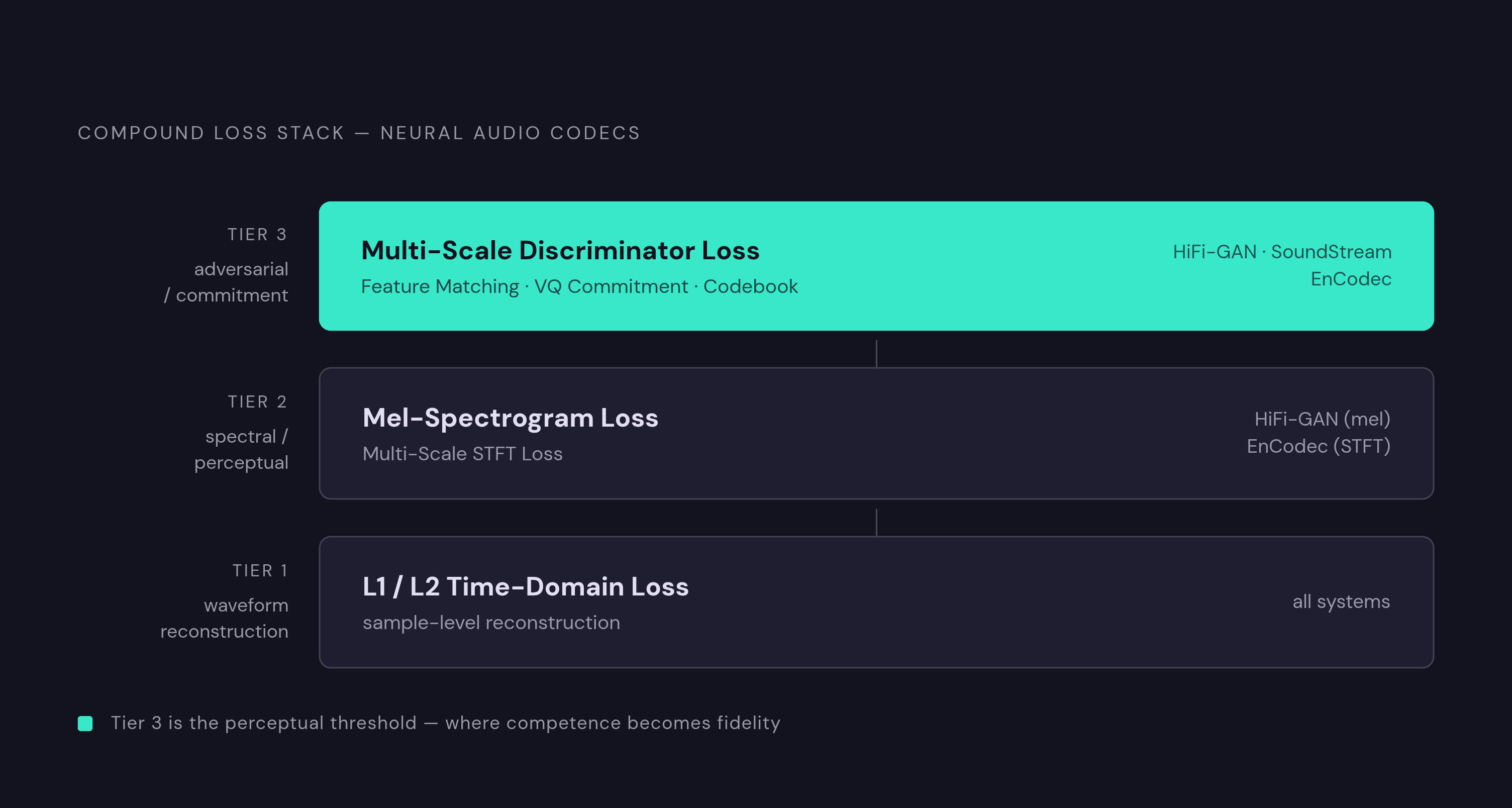
No production-grade TTS or codec system trains on one loss and calls it done. A compound stack appears repeatedly: a waveform reconstruction term, one or more spectral perceptual terms, and usually an adversarial or feature-matching term layered on top.
HiFi-GAN set the template in 2020 by pairing mel-spectrogram loss with feature matching, forcing the generator to match every intermediate layer of the discriminator's response to real audio in L1 distance, including the final verdict and every layer leading up to it. That approach became the default vocoder baseline, the thing nearly everything since has iterated on rather than replaced. SoundStream, a real-time neural audio codec from 2021, ran waveform reconstruction alongside vector quantization commitment and codebook losses, a multi-scale adversarial loss, and feature matching, all operating in concert. EnCodec followed in 2022 with a multi-scale STFT adversarial loss standing in as the perceptual term, backed by time-domain and mel-spectrogram reconstruction plus a VQ commitment loss.
The MelCap codec from 2025 does something more interesting than just stacking losses: it changes them mid-training. The model trains first with L1 reconstruction, a quantization loss, and a perceptual loss until it converges, and only then swaps that perceptual term out for a Gram-matrix loss to fine-tune the result. It is a staged strategy, not a fixed recipe, treating different training phases as needing different kinds of perceptual pressure. WavTTS pairs a Flow Matching objective with multi-scale mel-spectrogram supervision, but restricts the mel loss to masked target regions only and tunes a scalar weight to decide how much perceptual guidance to apply relative to the flow-matching term. Diffusion-based decoders from September 2025 fold perceptual guidance into an entirely different generative framework, combining denoising score matching with auxiliary representation-alignment and stop-head losses.
All this stacking creates an obvious headache: every added term is another weight to tune, and mismatched weights mean gradients start fighting each other instead of cooperating. VITS and VITS2 tackled that problem directly by using something called the Modified Differential Multiplier Method, which enforces a reconstruction-quality constraint pulled from a preliminary HiFi-GAN vocoder run, automatically adjusting the loss weight instead of leaving it to manual trial and error. The result outperformed baselines without the usual grind of exhaustive hyperparameter search. Loss selection gets most of the attention in papers, but loss balancing, deciding how loud each term gets to shout during training, might be the harder problem.
The research milestones that made perceptual loss central to TTS
This compound-loss sophistication developed over years of research, not overnight. WaveNet, in 2016, proved a neural network could generate raw waveforms directly using autoregressive probabilistic training rather than any explicit perceptual objective, and in doing so it showed both how good purely signal-level modeling could get and how computationally brutal that path was. Tacotron 2, in 2018, solved a different piece of the puzzle by splitting synthesis into two stages: an acoustic model predicts a mel-spectrogram, and a separate vocoder turns that spectrogram into audio, a departure from the original 2017 Tacotron, which relied on Griffin-Lim reconstruction over linear spectrograms rather than a neural vocoder. Tacotron 2 trained its acoustic stage with L1/L2 mel losses, and that made the mel-spectrogram the standard intermediate perceptual representation for the field.
Parallel WaveGAN, in 2021, brought voicing-aware conditional discriminators into the picture and moved GAN-based adversarial training into the vocoder pipeline. HiFi-GAN, that same year at NeurIPS, is the real hinge point: multi-period and multi-scale discriminators combined with mel loss and feature matching, a combination so effective it became the baseline the rest of the field measures itself against. VITS, also 2021, collapsed the two-stage pipeline entirely, jointly training acoustic representation and waveform synthesis via variational inference and adversarial training, which required the perceptual losses to serve both stages simultaneously. Around the same time, Song et al. published Improved Parallel WaveGAN with perceptually weighted spectrogram loss at IEEE SLT 2021, the first explicit integration of psychoacoustic frequency weighting into GAN-based vocoder training, making equal-loudness-contour thinking part of the GAN loss rather than a post-hoc metric.
SoundStream and EnCodec then took the compound-loss playbook out of vocoders altogether and applied it to neural audio codecs, proving the whole approach generalized to compression-oriented architectures and wasn't a vocoder-specific trick. Voicebox, out of Meta and published at NeurIPS 2023, scaled flow-matching with perceptual supervision across multiple languages at once. NaturalSpeech 2, at ICLR 2024, folded diffusion-based generation and perceptual loss stacks into a shared latent space. MaskGCT, later in 2024, showed that codecs trained with perceptual losses could generalize to voices never seen during training, enabling genuine zero-shot synthesis. And F5-TTS, built on flow-matching and diffusion transformers, extends that same lineage into cross-lingual voice cloning, with a companion paper set to appear at IEEE ICASSP 2026.
The evaluation of perceptual losses and the contested nature of the metrics themselves
Here is the awkward part: the metrics used to judge whether any of this actually worked are just as imperfect as the losses they're meant to validate. Evaluation spans several categories: subjective metrics like MOS and ViSQOL, objective perceptual metrics like PESQ and DNSMOS P.835, intelligibility measures like ESTOI and WER/CER via ASR, and signal similarity metrics like spectral convergence, SI-SDR, STFT distance, and mel-distance. MOS remains the gold standard for perceived naturalness but requires human raters, is expensive to run at scale, and has high variance. This is why learned metric predictors like MOSNet variants exist.
PESQ carries its own baggage. It was built decades ago for telephone bandwidth, and its assumptions about reference audio conditions don't map cleanly onto generative TTS, so when it gets turned into a differentiable proxy and used as a training loss, those outdated assumptions ride along into the model. The AudioMOS 2025 Challenge tried to build something better: a multi-axis quality predictor combining triplet loss with a buffer-based sampling method meant to generalize past its training data. It trained only on natural recordings and then got tested on synthetic audio it had never seen. That gap, training on real speech and evaluating on fake speech, is a tell that learned metric prediction is still an open research problem, not a finished tool teams can just pick off a shelf.
There's a subtler failure buried in all of this too. Mel-spectrogram losses can raise perceived quality while quietly damaging intelligibility, which is a strange trade to make since the whole point of speech synthesis is that people understand what's being said. Self-supervised representation reconstruction, or SSRR, addresses that directly by reconstructing distilled self-supervised representations from a codec's output, protecting intelligibility without giving up the quality gains, and it does this even in zero-lookahead streaming setups where there's no future audio to lean on. And the tension goes deeper still: chasing a high score on any single metric can leave entire perceptual dimensions untouched. None of that makes the field's progress illusory. It makes clear that "perceptual quality" is not one number waiting to be optimized, it's a moving target with several axes, and the honest researchers keep building new yardsticks because the old ones keep missing something. The deeper tension is that optimizing for any single metric can improve scores on that metric while leaving other perceptual dimensions (spatial realism, emotional coloring, room acoustics) unaddressed, and research on binaural reproduction (Rafaely et al., Ben-Gurion / TU Berlin) finds that localization cues like interaural time and level differences are well-represented in current loss functions, but reverberation and room acoustic qualities remain substantially underexplored.
Perceptual Loss Quality in Practice Across Creative and Enterprise Applications
None of this stays confined to conference papers. The gap between MSE-trained speech and perceptual-loss-trained speech is not subtle or academic. MSE-trained speech clearly sounds like it came out of a machine, while perceptual-loss-trained speech can be mistaken by a listener for a person talking.
Audiobooks make the stakes obvious fast. Mean squared error (MSE) measures pointwise differences between waveform samples, treating every sample deviation as equally bad regardless of whether a human ear would notice. Over-smoothing artifacts from MSE training are especially destructive in long-form content where listeners spend hours with a voice; perceptual losses address over-smoothing directly, with the VGG-19 feature loss in mel-spectrogram tokenization explicitly designed to counter it, enabling narration that sustains engagement across book-length audio.
Customer-facing voice agents face a different constraint: they need both perceptual polish and speed, and those two goals pull against each other, since richer loss stacks tend to mean heavier models. Progress here has come from designing more efficient compound losses and leaning on flow-matching objectives that don't demand the full computational overhead of older approaches, which is how a voice agent manages to sound convincingly human while still answering inside the latency window a live conversation actually requires.
Developer-facing APIs show the clearest before-and-after. End-to-end latency for TTS generation has dropped substantially as perceptual-loss-trained models got leaner and faster to run. Zero-shot voice cloning, producing a convincing voice from a few seconds of reference audio, is now something companies ship as a commercial feature rather than a research demo, and it depends entirely on perceptual losses that generalize well to speakers the model never trained on. Emotional prosody control, once a research curiosity, is now a standard API parameter because perceptual training objectives have made it reliably learnable.
Sources
- A Survey on Neural Speech Synthesis
- A Review of Differentiable Digital Signal Processing for Music & Speech Synthesis
- Loss functions incorporating auditory spatial perception in ...
- (PDF) A Deep Learning Loss Function Based on the Perceptual Evaluation of the Speech Quality
- MelCap: A Unified Single-Codebook Neural Codec for High-Fidelity Audio Compression
- Perceptual Loss Function for Speech Enhancement Based ...
- [2511.05945] Loud-loss: A Perceptually Motivated Loss Function for Speech Enhancement Based on Equal-Loudness Contours
- HiFi-GAN: Generative Adversarial Networks for Efficient ...