STT Data Privacy and Compliance in Healthcare and Finance
Voiceprints cannot be reset after a breach, making audio compliance a permanent-record problem.
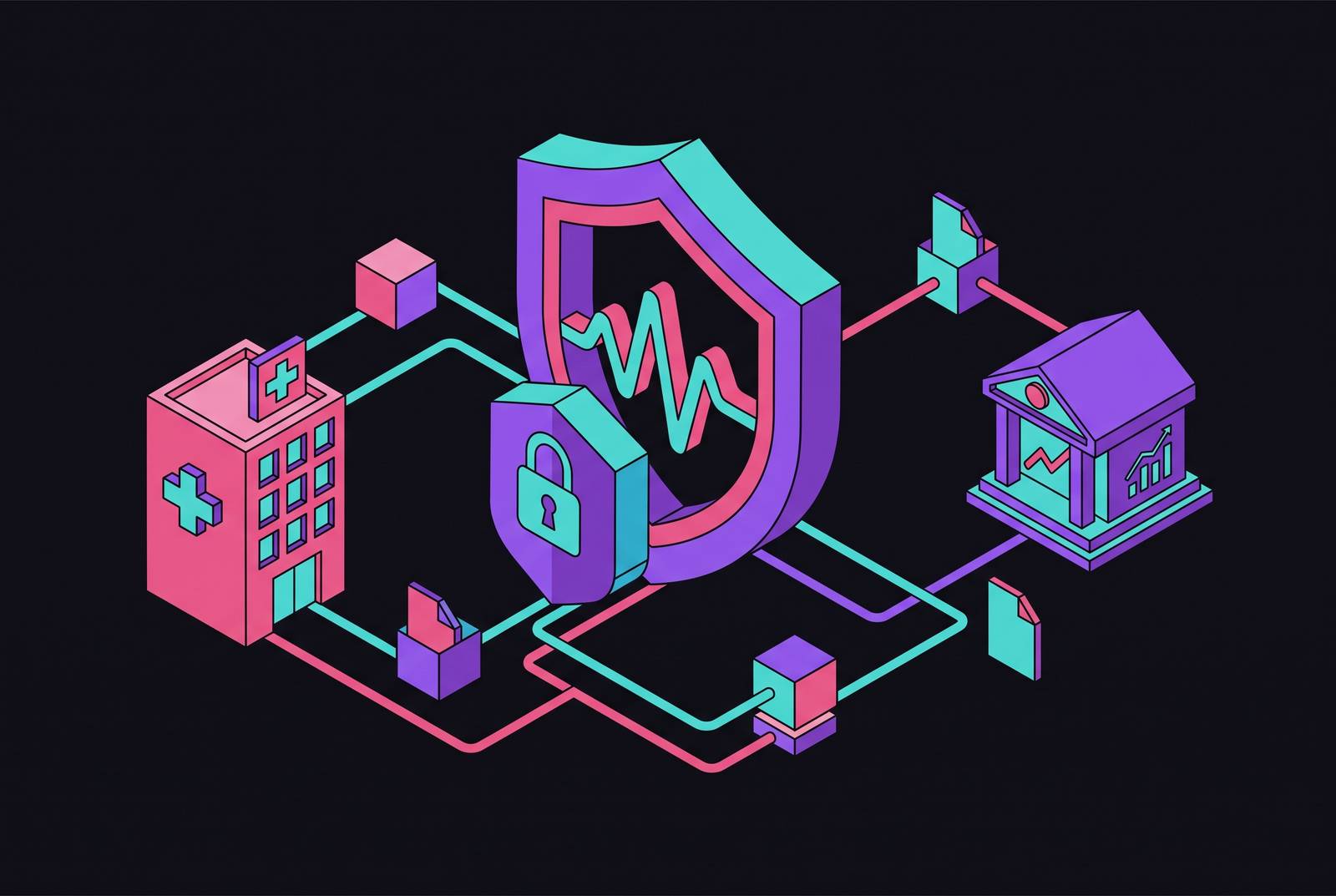
Voice data in healthcare and finance is not just another form to lock down. A single audio file can carry a biometric voiceprint, a patient's diagnosis, an account number, and background noise that reveals where someone was standing when they said it, all layered into one recording that four different regulatory frameworks each have a legal claim to. That overlap, not any single rule, is why speech-to-text deployments in these industries keep failing compliance reviews. A password can be reset after a breach. A voiceprint cannot, which makes this a permanent-record problem dressed up as a technical one.
Multi-speaker calls make it worse. Who is "the data subject" when three people are talking over each other on a claims line? Debug logs and buffer memory sitting between the microphone and the cloud can capture partial conversations nobody agreed to share, and a false wake word that triggers recording before anyone's said a word that matters raises disclosure concerns across multiple regulatory frameworks. The audio doesn't know it's supposed to behave. Compliance teams that treat speech-to-text as one checkbox on a vendor questionnaire are already behind, because the honest version of the checklist has to cover every framework that touches any piece of what's sitting inside that file.
How HIPAA and HITECH define the compliance floor for clinical audio
The moment a transcript includes a diagnosis, a prescription, or a patient's name, it becomes protected health information, and the full HIPAA and HITECH obligation stack kicks in. The Security Rule calls for encryption of ePHI at rest (§164.312(a)(2)(iv)) and in transit (§164.312(e)(2)(ii)); these are "addressable" specifications rather than flatly mandatory ones, but in practice AES-256 is the accepted standard for storage, not the only permitted method. Role-based access and multi-factor authentication are strongly implied best practices rather than requirements spelled out by name, though a proposed rule update (not yet finalized) would make MFA mandatory. Audit trails recording activity on any system touching ePHI, however, are required under §164.312(b), no ambiguity there.
Retention adds its own wrinkle. HIPAA calls for six years of documentation, which sits in direct tension with GDPR's storage limitation principle (Article 5(1)(e)), which says keep data only as long as necessary and sets no fixed default. Any organization straddling both frameworks needs two separate retention clocks running, not one policy stretched to cover both.
The BAA requirement is where a lot of deployments quietly go sideways. A speech-to-text vendor that won't sign a data protection agreement cannot legally receive clinical audio, full stop. Consumer dictation tools built for everyday use aren't HIPAA-compliant out of the box (Otter.ai, notably, began offering HIPAA compliance and BAA signing for Enterprise customers as of July 2025, which is the exception that proves how rare this is). Signing a BAA with the primary vendor does not automatically extend to every subprocessor that vendor hands audio to for inference, language model reasoning, text-to-speech, telephony, or call logging. Each hop has its own logging policy and needs its own audit.
The stakes aren't abstract. In 2024, a healthcare technology company left an S3 bucket holding more than 300,000 patient voice recordings sitting open to the public, the kind of misconfiguration that triggers mandatory breach notifications and significant legal exposure. Healthcare breaches now average $10.93 million per incident. Worth keeping that number in your back pocket before wading into what finance adds on top.
What PCI DSS and MiFID II add on top of HIPAA for financial services deployments
PCI DSS is blunt about one thing: sensitive authentication data, meaning card numbers and CVVs, cannot sit inside audio recordings even if the file is encrypted. Redaction has to happen at ingestion, the instant the words are spoken. Vendors have two paths here. Either they redact cardholder data the moment it's transcribed, or they prove the entire pipeline, every server and process that touches the file, sits inside PCI DSS scope. The first option is dramatically easier to audit, and most serious vendors know it.
MiFID II runs on a different logic. It requires firms to record all voice and electronic communications that could plausibly lead to a transaction, and hold onto those recordings for a minimum of five years (regulators can push that to seven). FINRA Rule 3170 layers on a mandatory recording requirement for firms that have hired a significant number of registered persons coming from firms that got expelled or had registrations revoked, a fraud-prevention tripwire aimed squarely at repeat offenders changing employers. The regulatory perimeter continues to be tested by automated audio processing in real time, and the rulebook hasn't fully caught up yet. The regulatory perimeter is stretching to cover automated audio processing in real time, and the rulebook hasn't fully caught up yet.
Enforcement here isn't theoretical either. Regulators on both sides of the Atlantic have pursued enforcement actions for recording failures, including gaps on mobile devices and failures to retrieve specific conversations within supervisory deadlines. AI adoption in front-office functions is running well ahead of the record-keeping architecture meant to support it. When an AI voice agent handles a call that could result in an order, recording, tamper-evident storage, and the five-year retention clock all start immediately. A transcript alone doesn't satisfy MiFID II. Never has.
Where GDPR adds cross-border complexity that neither HIPAA nor PCI DSS resolves
GDPR treats a voiceprint used for identification as special category biometric data, which needs a stronger legal basis than ordinary personal data, generally explicit consent or one of a short list of enumerated grounds. For a firm regulated under financial trading rules, the recording obligation itself supplies a valid lawful basis under GDPR, but that basis has to be documented use case by use case. It doesn't just carry over because the firm is already compliant with a different rule.
Cross-border transfer adds another layer. US-based speech-to-text providers can move EU data under the EU-US Data Privacy Framework if they're self-certified and stay on the current list, but the DPF is the third generation of this mechanism. Its predecessor, Privacy Shield, got struck down by the Schrems II decision in 2020. The DPF itself only dates to July 2023, and leaning on it as a permanent foundation is building on ground that's already shifted twice.
GDPR's principle of data protection by design turns encryption, data minimization, and documented retention windows into legal requirements, not optional hardening. And its retention default collides head-on with HIPAA's six-year rule, so any organization operating across both jurisdictions needs separate, clearly labeled retention policies rather than one blended approach. Fines for getting this wrong can be substantial, and that exposure applies even when the actual breach happened at a subprocessor the controller chose to hire. A disclosure line at the start of a recorded call ("this call may be recorded for quality purposes") does not simultaneously satisfy GDPR, PCI DSS, and HIPAA. Each one has its own rules on consent language, redaction, data residency, and deletion timelines, and no manual process handles all three at call-center scale.
How the BAA misconception and subprocessor blindspot create the compliance gap most deployments miss
Usually, compliance teams already know these frameworks exist. It's the assumption that a signed BAA with the primary vendor closes the loop, when a production speech-to-text pipeline usually has four or five separate nodes: transcription, language model reasoning, text-to-speech, telephony, call logging. Each one can touch PHI or cardholder data in transit, and each one needs its own audit rather than inheriting the primary vendor's paperwork by default.
Before signing anything, ask which subprocessors actually touch PHI as it moves through the system. Is encryption verified at every single hop, not just the first one? Can the platform produce a timestamped audit log of every point PHI touched across the full life of a call? Some platforms use customer audio to train their own models without patient authorization, a Privacy Rule violation sitting in plain sight inside a terms-of-service document nobody read closely. Vendor due diligence has to ask about training data use directly, because it's rarely volunteered.
Transcription accuracy matters here in a way that's easy to underrate. A missed word is a missed redaction, and a missed redaction is a compliance event, which makes word-error rate a compliance metric as much as a quality one. And certification claims don't always match practice: the FTC's complaint against Amazon over Alexa alleged deceptive privacy claims, and Amazon settled for $25 million. SOC 2 Type II, HIPAA BAAs, GDPR and CCPA compliance, PCI certification, these are table stakes for any enterprise vendor at this point. But a long list of certifications differs from relevant coverage. The actual work is matching each certification to the specific industry, customer base, and geography the deployment covers, not counting logos on a compliance page.
On-premises and on-device deployment as a structural answer to cross-border and biometric data risk
Cloud processing sends every voice sample to a server outside the organization's walls. For anything scoped under HIPAA or GDPR, that means audio leaves the organization's control on every single inference call, which is exactly the exposure the frameworks are built to prevent.
On-premises deployment keeps PHI behind the organization's own firewall. A hospital operating in a jurisdiction with strict data residency rules can run its voice models on-premises while still using cloud infrastructure for whatever workloads don't touch patient audio. On-device processing goes a step further and removes the transfer question entirely: if the audio never leaves the device, there's no cross-border transfer risk, no dependency on the Data Privacy Framework staying intact, and no subprocessor chain to audit in the first place.
Performance and privacy point the same direction here, which doesn't happen often in this business. Cloud speech-to-text adds 50 to 300 milliseconds of latency under good network conditions and can stretch to roughly 2,000 milliseconds on a bad connection. On-device processing cuts out the network round trip. And the hardware has caught up to make this practical: distilled, quantized models run comfortably on modern phones, WhisperKit runs OpenAI's Whisper models on Apple's Neural Engine with word-error rates between 2 and 8% and latency under 200 milliseconds. Apple's iOS 26 ships SpeechAnalyzer, the on-device-only replacement for the older SFSpeechRecognizer framework, with no one-minute cap, automatic language detection, and benchmarks running roughly twice as fast as Whisper's large-v3-turbo model. That's a mainstream feature now, not just for privacy purists. It's becoming the default path.
Domain-specific models add another layer of argument for going this route. Medical speech-to-text systems trained on clinical vocabulary hit accuracy in the 93 to 98% range on medical terminology, cutting keyword errors by half and word errors by 17% compared to general-purpose transcription. Specialization here isn't a compliance accommodation, it's a straightforward accuracy upgrade that happens to also reduce redaction risk. The broader shift is that serious vendors now support cloud, VPC containers, on-premises, and hybrid configurations side by side, which means the compliance architecture should be chosen alongside the deployment model, not bolted onto whatever was already running.
What confidential computing adds when on-device is not possible and cloud processing is required
Standard encryption locks data down at rest and in transit, but there's a gap in the middle: data in use. While a system is actually computing on the audio, the data sits decrypted in memory, and that window is exposed to memory-scraping malware, cross-site injection, and simple insider access at the cloud provider.
Confidential computing closes that window by running the speech-to-text step, and whatever language model or text-to-speech processing comes after it, inside a secure enclave that keeps the data encrypted even during computation. Nobody with administrator access to the underlying cloud servers, not even the provider's own staff, can see it in plaintext. Tokenizing PHI right at the transcription layer takes this further: sensitive content gets swapped for tokens before it's passed to any downstream language model, so the cleartext version never actually travels through the rest of the pipeline.
In a full cloud pipeline handling clinical or financial audio, each endpoint, transcription, natural language processing, machine learning inference, text-to-speech, can be enclosed on its own, which builds a verifiable chain of custody, exactly what an audit trail is supposed to prove. This lets organizations under strict data sovereignty rules actually use cloud infrastructure without handing cloud staff plaintext access to patient or financial data. Ask the vendor directly whether they can demonstrate PHI is encrypted not just at rest and in transit, but during inference itself, and whether they can produce the tamper-evident log HIPAA §164.312(b) requires. If the answer is vague, that's the answer.
Building the vendor evaluation checklist from the compliance requirements up
Start with the regulatory matrix, not the vendor's pitch deck. Figure out which frameworks actually apply based on industry, geography, and the exact data types in scope, HIPAA, GDPR, PCI DSS, MiFID II, SOC 2, CCPA, whatever combination fits, and then match vendor certifications against that specific list. A long certification page is not a substitute for this exercise.
From there, confirm the BAA covers every subprocessor touching PHI, not only the primary vendor, and ask for the full subprocessor list with proof each one carries its own compliant agreement. Ask directly whether the vendor trains models on customer audio and under what authorization. Verify redaction happens at ingestion for card data and covers every recorded interaction for PHI, not a sampled subset. Confirm retention windows are configurable per framework, six years for HIPAA documentation, five years for MiFID II, shorter where GDPR's minimization rule applies, and check that the audit trail produces a full, tamper-evident chain of custody rather than a bare access log.
Deployment flexibility matters as much as any certification: cloud-only vendors foreclose the on-premises and on-device paths that solve cross-border risk structurally rather than contractually. Latency claims need to reflect real production conditions, not a demo on a good connection, since clinical documentation and live contact-center calls both need minimal latency to be usable. And redaction should work at the API level, phone numbers, birth dates, account numbers, as a single parameter applied consistently across every call, not something reviewed manually after the fact on a sample basis. That last part is the difference between a compliance program that scales and one that quietly falls apart the first time call volume triples.