Synthetic Media Examples Across Industries and Their Disclosure Requirements
New York and California now require advertisers to disclose AI-generated performers in ads.
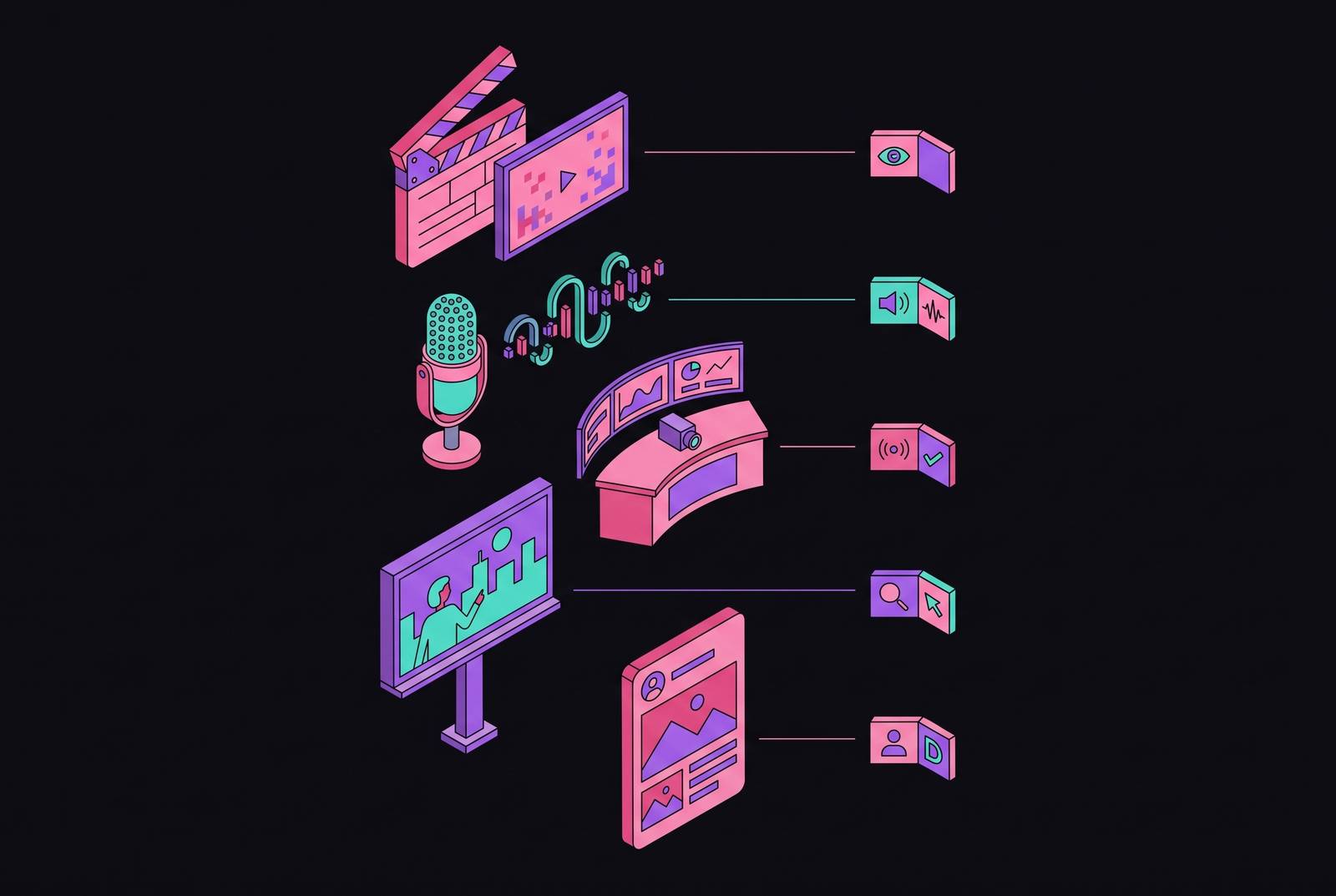
Synthetic media is no longer a demo reel. Voice cloning, neural text-to-speech, and AI-generated likenesses now run inside production advertising campaigns, customer-facing voice agents, game character performance, and broadcast content, every day, at scale. That shift matters because the audience can no longer reliably tell the difference. For years, a listener could catch the slight metallic flatness in a synthetic voice or the uncanny stiffness in a generated face. That tell is gone, and self-regulation stopped working and lawmakers stepped in because of its disappearance. When audience skepticism could police the market, disclosure rules felt like overkill. Once the fake becomes audibly and visibly indistinguishable from the real thing, the law has to do the job the human ear used to do.
The clearest sign that this is a live commercial issue, not a future one, came from radio. iHeartMedia launched a "Guaranteed Human" program across its more than 850 stations, pledging that every on-air personality, podcast, and piece of music is human-driven, and explicitly banning AI-generated synthetic vocalists. A company with that much broadcast reach does not build a marketing campaign around a hypothetical threat. It builds one because advertisers, listeners, and talent were already asking the question, and "trust us" stopped being a sufficient answer. The rest of this piece maps where disclosure obligations now sit: the rules differ sharply depending on whether synthetic media appears in an ad, a game, a customer service call, or a cross-border campaign.
The advertising industry's statutory disclosure obligations
Advertising is where synthetic performer disclosure stopped being a voluntary nicety and became something you can get fined for ignoring. Two states have now put real statutes on the books, and they are not the same law wearing different letterhead.
New York moved first. Governor Kathy Hochul signed S.8420-A/A.8887-B on December 11, 2025, and it takes effect June 9, 2026, making it the first state law in the country requiring advertisers to conspicuously disclose when an ad includes a "synthetic performer," defined as a digitally created asset built to give the impression of a human performer who isn't recognizable as any identifiable real person. The disclosure duty follows the ad across any media it runs in, with one exception: audio-only advertisements are excluded.
California followed with SB 1050, signed September 16, 2026, taking effect January 1, 2027. It defines "advertisement" broadly, covering any audio, video, or audiovisual message, statement, recording, digital communication, or other representation disseminated through any means, including online platforms, so long as it's intended or reasonably expected to drive a purchase.
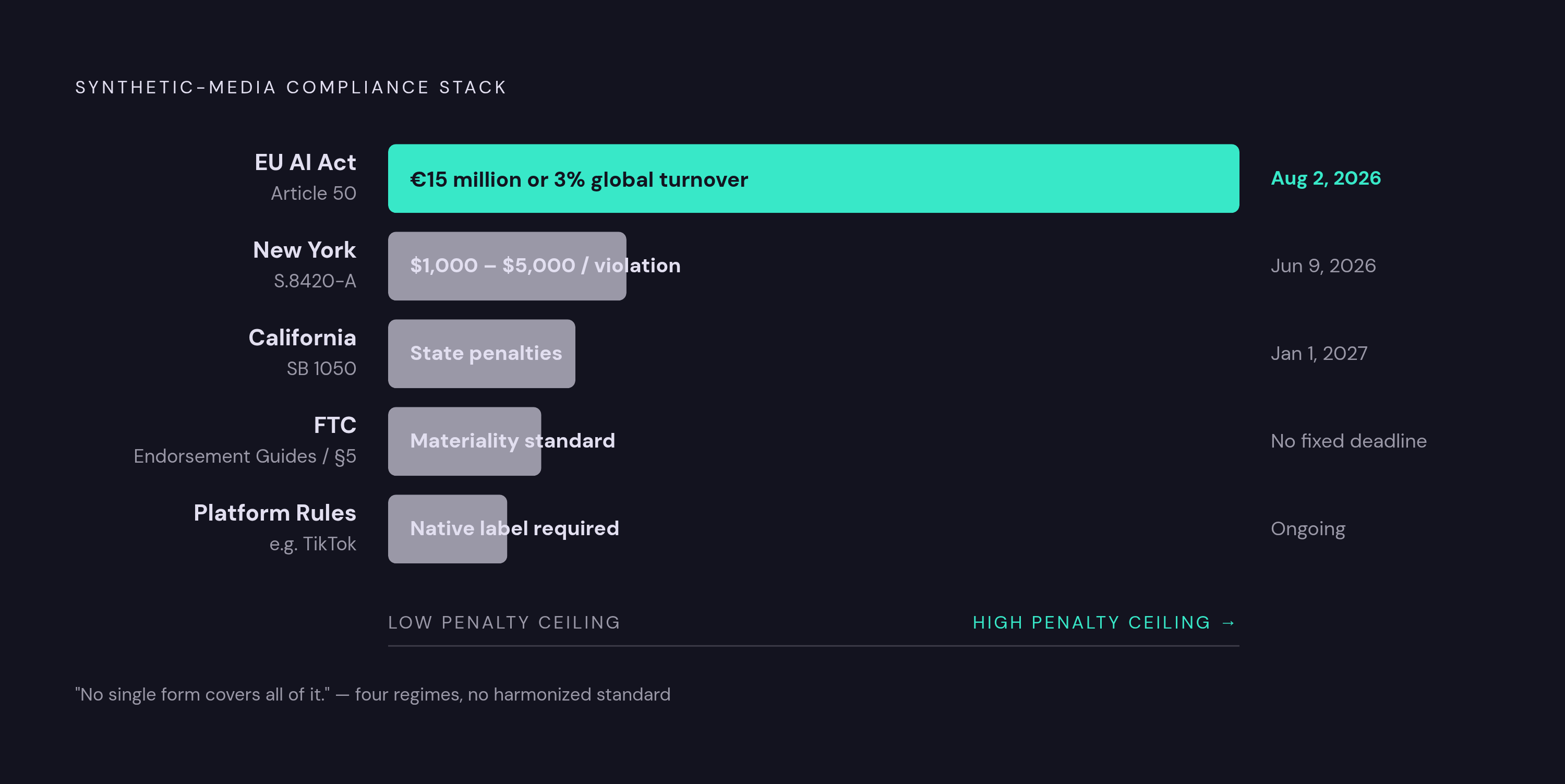
Both statutes point at the same target: the advertisers and agencies who create the ad, not the platforms that run it. YouTube, television networks, and streaming services keep their existing immunity. The obligation sits with whoever made the thing. But the two laws run on different clocks, with different effective dates and different statutory language, so an advertiser running the same synthetic-performer campaign in New York and California this year is managing two separate compliance timelines, not one. New York backs its rule with civil penalties, $1,000 for a first violation and $5,000 for each one after that. Neither state spells out what "conspicuous" actually looks like: no required font size, no mandated placement, no approved wording. Legal and compliance teams are left to make a judgment call, which is its own kind of exposure.
Carve-outs and the boundaries of advertising disclosure obligations
What these laws exclude says as much as what they require. New York's exemptions are specific: audio-only advertisements, AI used purely to translate a human performer's dialogue into another language, and promotional material for expressive works, meaning movies, TV, streaming content, documentaries, or video games, where the synthetic performer's use in the ad matches its use in the underlying work.
That last carve-out produces a genuinely strange outcome: a video game studio can run an ad featuring the exact AI-generated character that stars in the game, and owe no disclosure at all, because the synthetic performer is simply doing in the trailer what it already does in the product. The same studio, advertising an unrelated product with an AI spokesperson instead of its game character, gets no such pass. The rule doesn't care about the technology. It cares about context.
The audio-only exemption carries its own weight for anyone building voice products. Text-to-speech narration in a radio spot or a streaming audio ad falls outside both the New York statute and, based on its scope, the California one too. So a synthetic voice reading ad copy over a podcast feed sits in different legal territory than a synthetic face reading the same copy on video, even though the underlying AI system might be identical.
One distinction runs underneath this entire body of law: a "synthetic performer" is not the same thing, legally, as a "digital replica" of a real, identifiable person. New York drew that line explicitly by passing two bills on the same day. Alongside the synthetic performer law, it enacted S.8391, which expands post-mortem right-of-publicity protections and requires prior consent from a deceased performer's heirs, executors, or other successors before anyone uses that performer's digital replica in audiovisual works, recordings, or live performances. That's a different legal animal: it governs the use of a specific dead person's identity, not a generic AI-generated human nobody can identify. The synthetic performer disclosure law doesn't touch it. Anyone building compliance checklists needs to keep these two categories separate, because conflating them is how violations happen.
The federal landscape: FTC authority and the White House preemption order
No federal statute requires AI disclosure the way New York and California now do. What exists instead is an existing consumer protection framework, stretched to cover synthetic media, plus an executive order that wants the states to back off.
The FTC doesn't ask anyone to label every AI-assisted draft of an ad script. Its standard is narrower and older: disclosure is required when AI creates an impression a reasonable consumer would find material, a test that covers synthetic endorsements, AI-generated testimonials, and undisclosed AI personas posing as real people. The legal hook is the FTC's existing Endorsement Guides and Section 5 of the FTC Act, tools built before generative AI existed but flexible enough to reach it.
Then, on December 11, 2025, the same day Hochul signed New York's bills, President Trump signed an Executive Order setting federal policy toward a "minimally burdensome" national AI framework. The order directs the Attorney General to stand up a task force to challenge state AI laws that unconstitutionally burden interstate commerce, that conflict with federal regulation, or that are otherwise unlawful. It conditions certain federal funding, specifically BEAD non-deployment funds, on states not maintaining what the order calls onerous AI laws, and it directs agencies to study whether other discretionary grants could carry the same condition.
The order calls for a single national framework to preempt the state patchwork, and it compares the current AI law landscape to the mess of state consumer-privacy statutes it wants to avoid repeating. The Commerce Department has until March 2026 to evaluate which state AI laws count as onerous. None of this invalidates New York's statute or California's. The order directs federal agencies to act against state laws; it does not, by itself, strike any of them down, and it's already expected to draw court challenges of its own. Until a national law actually exists, state disclosure obligations remain binding. For compliance teams, that means doing two things at once that pull in opposite directions: building toward New York's June 9, 2026 effective date and California's January 1, 2027 date, while also tracking a federal preemption fight that could reshape the landscape before either deadline finishes playing out.
The EU AI Act's Article 50 as a third, parallel disclosure regime
A third track exists that doesn't confine itself to advertising. Article 50 of the EU AI Act imposes transparency obligations across every deployment context it touches, and its compliance deadline, August 2, 2026, is close enough that global brands and agencies are already building toward it.
Under Article 50, if you build an AI system that generates synthetic content, you have to mark that output in machine-readable form. Deployers, which includes any brand or agency publishing the content, have to disclose deepfakes and certain AI-generated public-interest material directly to the people viewing it. The August 2 deadline applies across every sector, not just commercial advertising.
The European Commission has been building out guidance to make that obligation concrete. A first draft Code of Practice on Transparency and Marking of AI-Generated Content came out in December 2025, with a second draft following on March 5, 2026. The Code is voluntary, but it functions as the practical roadmap for what Article 50 compliance looks like, proposing a layered system of labels, icons, and disclaimers, with placement and design requirements aimed at making disclosure visible to the end user rather than buried in metadata only a machine would read.
The penalties dwarf anything on the U.S. side. Non-compliance under the EU AI Act can run up to €15 million or 3% of global annual turnover, whichever is higher, so New York's $5,000 repeat-violation penalty looks like a parking ticket by comparison. And the law's reach isn't limited to companies headquartered in Europe. Any brand or creator advertising into the EU counts as a deployer under the law regardless of where it's based, so a U.S. advertiser running a campaign in Germany owes Article 50 compliance without needing so much as a European mailing address.
The structural difference from the U.S. state laws is the real headline here. New York and California regulate advertising specifically. Article 50 regulates synthetic content across the board, so it reaches enterprise voice agents, broadcast and streaming media, and gaming content right alongside commercial ads. A company that's fully compliant with New York's synthetic performer law could still be exposed under Article 50 the moment its content, of any kind, reaches a European user.
Platform-level disclosure requirements that operate independently of any statute
None of the statutes above are the only rules in the room. Major platforms have built their own synthetic media labeling requirements, and those apply whether or not any government agency is watching.
TikTok requires a built-in "synthetic media" content label on realistic AI-generated content, and it isn't a suggestion. Creators have to use TikTok's own native labeling tool to flag the content. Writing "this was made with AI" in a caption does not satisfy the platform's requirement, even though it would satisfy a reasonable person's idea of disclosure. The platform wants its own tag, in its own system, full stop on substitutes.
A growing number of platforms embed provenance metadata built to standards set by the Coalition for Content Provenance and Authenticity, known as C2PA, underneath the visible labels. That system lets a synthetic audio or video file carry a machine-readable record of where it came from, a layer that works alongside human-facing disclosure. One operates for the viewer's eyes, the other for the systems checking behind the scenes.
So compliance becomes a stacking exercise, not a single checklist. A campaign has to satisfy the relevant state statute, whether that's New York or California, the FTC's materiality standard for endorsements and testimonials, Article 50's disclosure obligations if the campaign touches the EU, and the individual labeling policy of every platform carrying the ad, policies that don't match each other. A spot that clears one state's conspicuous-disclosure bar and a platform's native labeling tool still has to clear a separate disclosure obligation if it runs in another jurisdiction. There is no single form to fill out that covers all of it.
The gaming industry's SAG-AFTRA consent-first model
Gaming runs on a different rulebook entirely: a labor contract, not a disclosure statute.
SAG-AFTRA ratified its Interactive Media Agreement in July 2025 by a 95.04% vote, and it built a consent-and-compensation framework around AI voice and performance work. Studios need written consent before they create or use any AI digital replica of a performer, and synthetic performances have to be paid at collectively bargained minimum rates, with higher minimums kicking in for certain uses. That compensation floor does real economic work. It removes the incentive studios would otherwise have to treat AI replacement as a way to cut labor costs, because the cheap option stops being cheap once the union contract sets a wage floor under it.
The mechanism here runs in the opposite direction from advertiser disclosure. New York's law tells the consumer, after the ad airs, that the performer wasn't real. The SAG-AFTRA agreement requires the performer's consent before the synthetic asset is ever built. One is downstream transparency aimed at an audience. The other is upstream permission aimed at a worker. Different problem, different fix, same underlying technology.
The two frameworks intersect at an odd angle: New York's expressive-works exemption means a game studio can advertise its title using the same AI-generated character that appears in the game itself without triggering any disclosure obligation. But if that in-game character is a digital replica of a real voice actor's performance, the SAG-AFTRA consent requirement still applies to the underlying asset, regardless of what the advertising law says about the ad built around it. The ad can be exempt while the performance behind it remains governed by a completely separate set of rules.
Disclosure obligations for enterprise voice agents in regulated industries
Enterprise voice agents sit in a different category still, because the laws built for advertising were never written with them in mind. A synthetic voice reading ad copy over a streaming service falls under New York's audio-only exemption and walks away clean. A synthetic voice handling a customer's healthcare claim, bank transaction, or insurance inquiry is not advertising anything, so the advertising carve-outs that protect audio content don't apply to it. That voice sits inside whatever regulatory regime already governs the industry it operates in, banking, healthcare, insurance, and those frameworks were built around disclosure, recordkeeping, and consumer consent long before generative AI existed.
That creates a gap the advertising statutes never had to solve. A radio ad using synthetic narration can point to New York's audio-only exemption and stop there. A bank's AI phone agent authenticating a customer, discussing an account, or walking someone through a loan decision is making representations with legal weight, in a sector where regulators already expect clear disclosure of who, or what, a customer is dealing with. The EU's Article 50 framework reaches that scenario directly, applying its transparency obligations across deployment contexts, beyond the edge of advertising. So a European bank's AI voice agent falls under the same disclosure logic as a European ad campaign, even though no advertising statute, state or federal, was written to cover it.
Whether the voice on the other end of a regulated transaction has to identify itself as AI before the conversation moves into substance is being answered, unevenly, by sector-specific regulators and by the EU's cross-sector transparency rule; the New York and California statutes built for the advertising industry have little say in it.
Sources
- AI Legal Updates: Synthetic Performer Transparency; State & Federal Conflict - Davis+Gilbert LLP
- New York Enacts ‘Synthetic Performer’ Disclosure Law for Advertisements, Including Those Using Generative AI // Cooley // Global Law Firm
- AI Disclosure Rules 2026: What Brands & Influencers Must Do - Dynamis LLP
- New Privacy, Data Protection and AI Laws in 2026 - Pearl Cohen
- California Enacts Mandatory Disclosure Requirements for AI-Generated “Synthetic Performers” in Advertising