Audio File Transcription Workflows for Media and Research Teams
Transcription tools solve one problem; building an actual workflow solves four.
Audio File Transcription Workflows for Media and Research Teams.
Beyond transcription: what media and research teams need
An hour of recorded audio takes three to five hours to turn into clean text by hand. A research program that runs a handful of interviews a week loses the equivalent of a full working day before anyone has actually looked at what the participants said. That is the tax nobody budgets for, and it is why transcription got treated as a software problem instead of a workflow problem. Buy the tool, solve the tax, move on. Except that is not how it plays out.
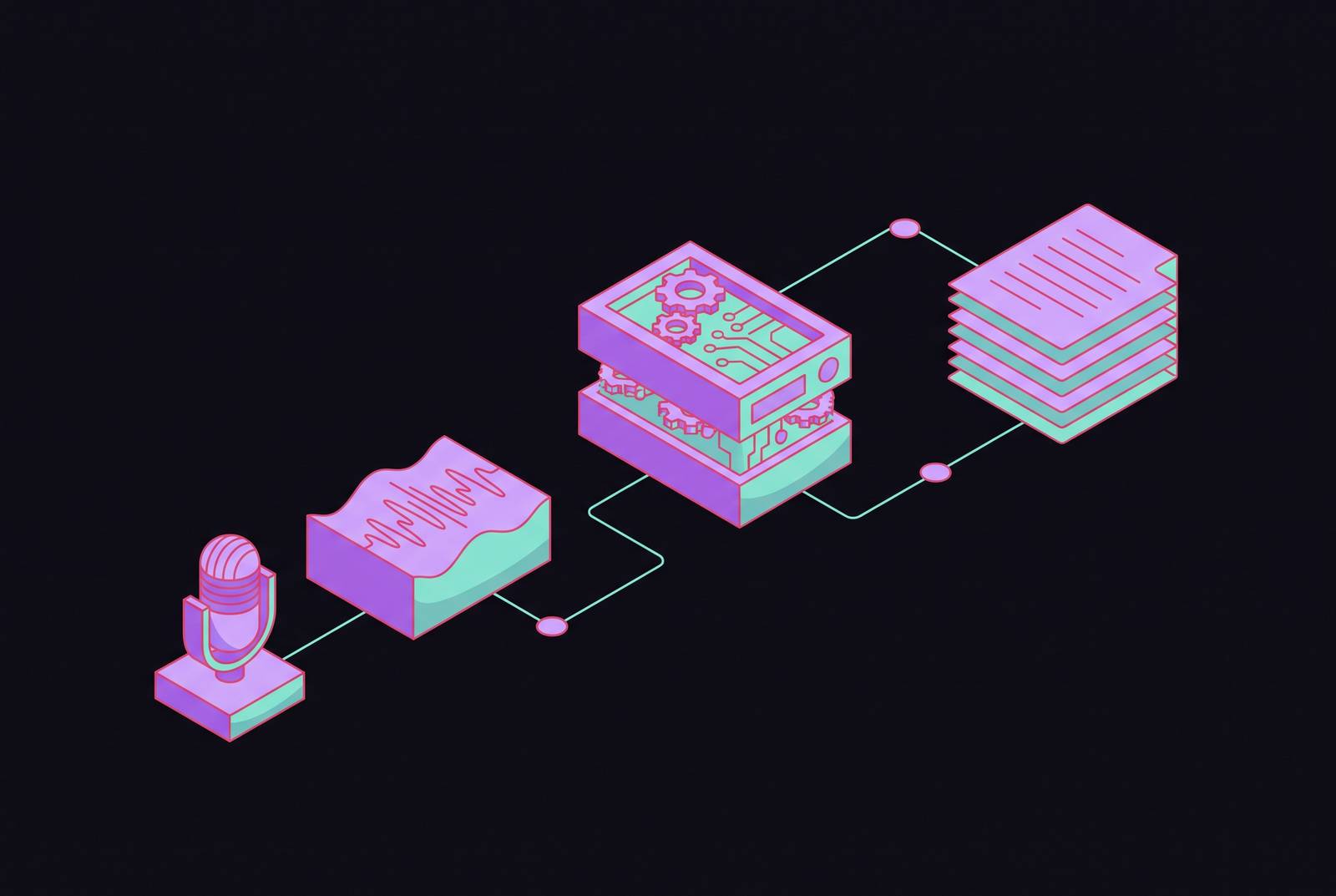
Adoption is not the same thing as a pipeline. A tool answers one question (can this audio become text) and ignores four others: how the file got prepared before it ever hit the model, how errors get caught before anyone relies on the transcript, what happens to that transcript once it is clean, and it does not repeat without a project manager reinventing the process from scratch. This piece works through those four stages in order, because the sequence matters. Get ingestion wrong and no amount of review time fixes it. Get review wrong and the "savings" from automation evaporate into unpaid editing hours. And the right answer at each stage depends heavily on who is asking. Journalism, qualitative research, oral history, broadcast compliance, and developer-built pipelines are five different jobs wearing the same word: transcription. According to Muck Rack's State of Journalism Report (via Rework), 40% of journalists now use transcription tools as part of their reporting workflow, but tool adoption alone doesn't produce a functioning pipeline Muck Rack's 2026 State of Journalism Report (via Rework).
How audio quality and file preparation shape everything downstream
Word error rate sounds like a fixed property of a model. It is not. The same underlying engine posts error rates around 2 to 3 percent on technical speech, climbs above 8 percent on legal audio, drifts into the low teens on financial recordings, and clears 15 percent on medical dictation Galileo.ai.
This is where a headline benchmark becomes actively misleading. State-of-the-art systems post word error rates under 2 percent on clean audiobook audio Galileo.ai. Comparing vendors on audiobook benchmarks and then deploying against home-office interviews is a bit like test-driving a car on a closed track and being surprised it handles differently in rush-hour traffic.
Before any of that, there is a duller but harder-edged checklist: sample rate, mono versus stereo, codec, and the file size ceiling the chosen API enforces VexaScribe. That last one bites more often than it should.
Then comes the choice between batch, where files upload and the team waits, or streaming, where a pipeline processes audio in near real time, and there is no universally correct answer. Streaming feels more advanced. It is not automatically better. The right choice tracks turnaround requirements, not technical sophistication, and a team that picks streaming because it sounds cutting-edge, when nothing they produce needs same-hour turnaround, has bought complexity for its own sake.
None of this gets written down, typically.
Choosing a transcription engine for the sessions you run
Tech leaders asked what matters in a transcription vendor give answers that cluster predictably: cost at 64 percent, performance at 58 percent, accuracy at 47 percent Galileo.ai. Those numbers stay close to meaningless until a team runs its actual problem audio through the candidates, testing cross-talk, compressed call audio, background noise, domain jargon, and mixed languages Galileo.ai. That is where vendors separate. A model that handles a clean two-person interview beautifully can fall apart on a five-person panel with three accents and a bad phone line, and the only way to know is to test with the audio the team actually generates, not a demo reel.
Human transcription remains the accuracy floor against which everything else gets measured, and it is not as high a floor as people assume: professional transcriptionists average 4 to 6 percent word error rate even under good conditions. AI tools close that gap, but unevenly, with performance swinging on accent and audio quality rather than converging toward some universal number. Anyone expecting AI to simply beat humans across the board is applying a single-number mental model to a problem that resists one.
For teams with engineering capacity, Whisper is the standing open-source option: trained on 680,000 hours of multilingual audio, supporting 99 languages, no licensing fee for self-hosted use (managed API access is billed separately), and full control over where the data goes Vocova. Distilled variants have narrowed the accuracy gap to commercial flagships considerably, though "narrowed" is not "closed," and running it well still requires someone who can maintain a model pipeline, which is a real cost even at zero license fee Vocova.
On-device processing is the other structural option, best represented by Speechmatics' approach: accuracy within 10 percent of server-grade performance, running on a low-mid spec laptop, with no latency penalty, no dependency on a live connection, and no cloud hosting bill Speechmatics — Speechmatics in 2025. That trade-off matters most for privacy-sensitive work and for anyone recording in places where a reliable connection is not a given.
For teams that would rather not build anything, the SaaS market as of August 2026 breaks down by job VexaScribe Vocova. Otter.ai runs $16.99 a month on its Pro tier and targets live meetings VexaScribe Vocova. Trint starts around $52 a month on its annual Starter plan, with an Advanced tier from $60 VexaScribe Vocova. Happy Scribe prices around $0.20 a minute for multilingual subtitle work, and Sonix serves a similar multilingual niche VexaScribe Vocova. Reduct.Video runs $12 a month per user on its Personal plan or $40 on Professional, aimed at researchers building highlight reels VexaScribe Vocova. Human and hybrid transcription services such as Rev, GoTranscript, and TranscribeMe are appropriate when the transcript will appear in legal filings, medical records, or published research, since AI's 95–98 percent accuracy range on clean audio is not sufficient for those contexts.
Designing the review stage so it doesn't eat the time the AI saved
Review time is not a fixed tax. It scales with audio quality and domain complexity. A clean single-speaker podcast needs a light pass, and a four-person accented focus group full of jargon needs structured, line-by-line correction. Treating both cases the same wastes either time or accuracy, depending on which direction the mismatch runs.
Diarization, the system's ability to correctly label who said what, is the single biggest driver of review time on research transcripts. It degrades in predictable ways: overlapping speech, similar-sounding voices, and any group of three or more, which describes most focus groups and a good chunk of paired usability tests. Testing diarization against a representative audio sample before committing to a vendor is cheap insurance, and it is the single most skippable step that should not be skipped.
Timestamp granularity is a smaller decision with an outsized effect on reviewer speed. Per-sentence timestamps let a reviewer click a line and land on the exact second in the recording; coarser timestamps force scrubbing through minutes of audio to verify one disputed word. From there the workflow choice: an in-platform editor, like Trint's Story Builder or Happy Scribe's collaborative tool, an export-and-edit approach using DOCX or plain text, or a transcript-linked video review like Reduct's clip workflow, which is somewhere between a journalism tool and an editing suite. None of these is universally correct; they trade off speed, collaboration, and how much the reviewer needs to hear the original audio rather than trust the page.
Archival and oral history projects benefit from a different model entirely: a zero-configuration portal where a non-technical researcher drags in audio, picks a language, and selects processing steps in sequence, meaning automated transcription, manual correction, word alignment, export. That structure exists because the researchers running oral history projects are historians, and the tooling has to meet them there.
The step teams skip most often is naming who owns review. Who corrects the transcript, who signs off on it, what threshold counts as acceptable: leave those undefined and the team ends up with a transcript that is neither fully trusted nor formally corrected, which is worse than either a good transcript or an honestly rough one. A running log of correction patterns is worth building in too.
Transcript handling after review, and its common under-design
A transcript is not the finish line. Most teams get this backwards, treating the corrected document as the deliverable rather than the raw material for whatever comes next.
For research teams, a searchable corpus across an entire study changes what is possible in a way that individual transcript files never could, turning every mention of a specific feature or emotion across a study into a single search instead of a re-read of every session. That is not a convenience upgrade. It is a different kind of analysis, one that was structurally unavailable when transcripts lived as separate Word documents on separate desktops Galileo.ai.
Broadcast and media teams need a related but distinct capability: timestamps, speaker labels, captions, and searchable text bundled together so that archived content can be retrieved fast and repurposed, while also satisfying compliance and proof-of-performance obligations. Broadcasters use platforms built for exactly this, searching historical footage and verifying what actually aired against what was supposed to air.
Export format is the decision teams make last when it should be made first. Picking the transcription tool before confirming which of those a workflow actually needs is a common and completely avoidable mistake.
Trint's Story Builder shows what the "transcript as input, not output" model looks like in practice: a journalist pulls key quotes across one or more reviewed transcripts and assembles them straight into a draft article. The transcript did its job the moment it became raw material for the next stage, not before.
And for teams running this programmatically, the handoff has to be automatic. Transcript output should land in a repository, a CRM, or an analysis platform through an API or a webhook, not through someone manually uploading a file after every session. Every manual step at that handoff quietly erodes the time saved everywhere else in the pipeline, which is the least dramatic way a workflow can fail and also the most common.
How different team types should sequence these decisions
Newsrooms optimize for one variable above all others: speed. Trint was built by a former ABC/CBS/CBC journalist specifically for newsroom workflows, with features including fast turnaround on breaking audio, Story Builder for draft articles, Trint Live for real-time transcription and live collaboration, and Realtime Transcription for broadcast streams Muck Rack's 2026 State of Journalism Report (via Rework). A 40% journalist adoption figure (Muck Rack) signals that the tool infrastructure already exists Muck Rack's 2026 State of Journalism Report (via Rework). It says nothing about whether editorial review ownership or caption compliance has been designed with the same care, and in most shops, it has not Muck Rack's 2026 State of Journalism Report (via Rework).
Qualitative research runs on a different metric: accuracy on the actual sessions being conducted, not a vendor's benchmark score. Otter.ai is the sensible default for teams with no existing infrastructure, given its integration with Zoom, Google Meet, and Teams and its built-in transcript sharing. Happy Scribe, supporting more than 120 languages alongside speaker labeling and collaborative editing, fits multilingual research programs specifically. Reduct.Video earns its place when the deliverable is a highlight reel or a set of shareable clips rather than a static document.
Oral history and archival work runs on workflow design at least as much as tool choice, because the recordings in question are one-time assets, not recurring weekly sessions, and the researchers handling them are historians rather than developers. The zero-configuration portal model built for that context (drag, select language, choose processing steps, export) fits precisely because it demands nothing else of the person using it.
Healthcare is in its own category and represents 34.7 percent of AI transcription usage in 2026 Vocova. The field is moving toward hybrid architectures: on-device processing for anything privacy-critical, cloud processing reserved for audio complex enough to need it Vocova. HIPAA status, retention policy, and whether audio or transcript data trains a vendor's model are not optional questions here. They need explicit verification against whatever consent language the participant actually signed Vocova.
Volume is the tie-breaker cutting across all four categories. High-volume teams do better on per-minute API pricing, where rates near half a cent a minute undercut most subscription tiers VexaScribe. Lower-volume teams often do better on a subscription with a generous free allotment, since several vendors offer several hundred free minutes a month, enough to cover the workload at zero cost VexaScribe. Running that comparison is arithmetic that takes about fifteen minutes https://resources.rework.com/tools/ai-tools/best-ai-transcription-tools-2026.
Security, privacy, and compliance decisions that can't be retrofitted
Research transcripts are not neutral text files. They carry verbatim participant statements about work, behavior, and private circumstances, and every one of those statements is personal data by any reasonable definition. Storage location, retention period, and whether recordings feed a vendor's model training all need checking against GDPR, CCPA, and whatever the participant actually consented to, not what the team assumes they consented to.
Hybrid architecture, on-device for sensitive or latency-bound content and cloud for everything that needs maximum accuracy, is becoming the standard answer here, not an edge case. Speechmatics' on-device model, running within 10 percent of server-grade accuracy on ordinary laptop hardware, is the clearest example of what that trade-off looks like when it works: no audio ever has to leave the building Speechmatics — Speechmatics in 2025.
Self-hosted Whisper keeps every byte of audio on infrastructure the team already controls, eliminating third-party data exposure entirely, though this trades off engineering overhead and responsibility for model updates. That cost is paid in engineering time and in whoever now owns model updates going forward.
One consequence gets missed with some regularity: once a transcript feeds a downstream AI process, whether that is summarization, thematic analysis, or an agent's working memory, the data flowing into that system inherits every privacy obligation the original transcript carried. Automating the handoff just makes the compliance requirement easier to forget.
Building the workflow as a repeatable system rather than a per-project decision
Real-time voice AI usage quadrupled between 2024 and 2025, and the driver was not a sudden leap in raw speed Speechmatics — Voice AI in 2026. It was reliability crossing the threshold where teams trusted it to run actual production workflows Speechmatics — Voice AI in 2026. Transcription is following the identical curve: the teams pulling the most value out of it are not the ones with the fanciest model, they are the ones who standardized the pipeline around whatever model they chose Speechmatics — Voice AI in 2026.
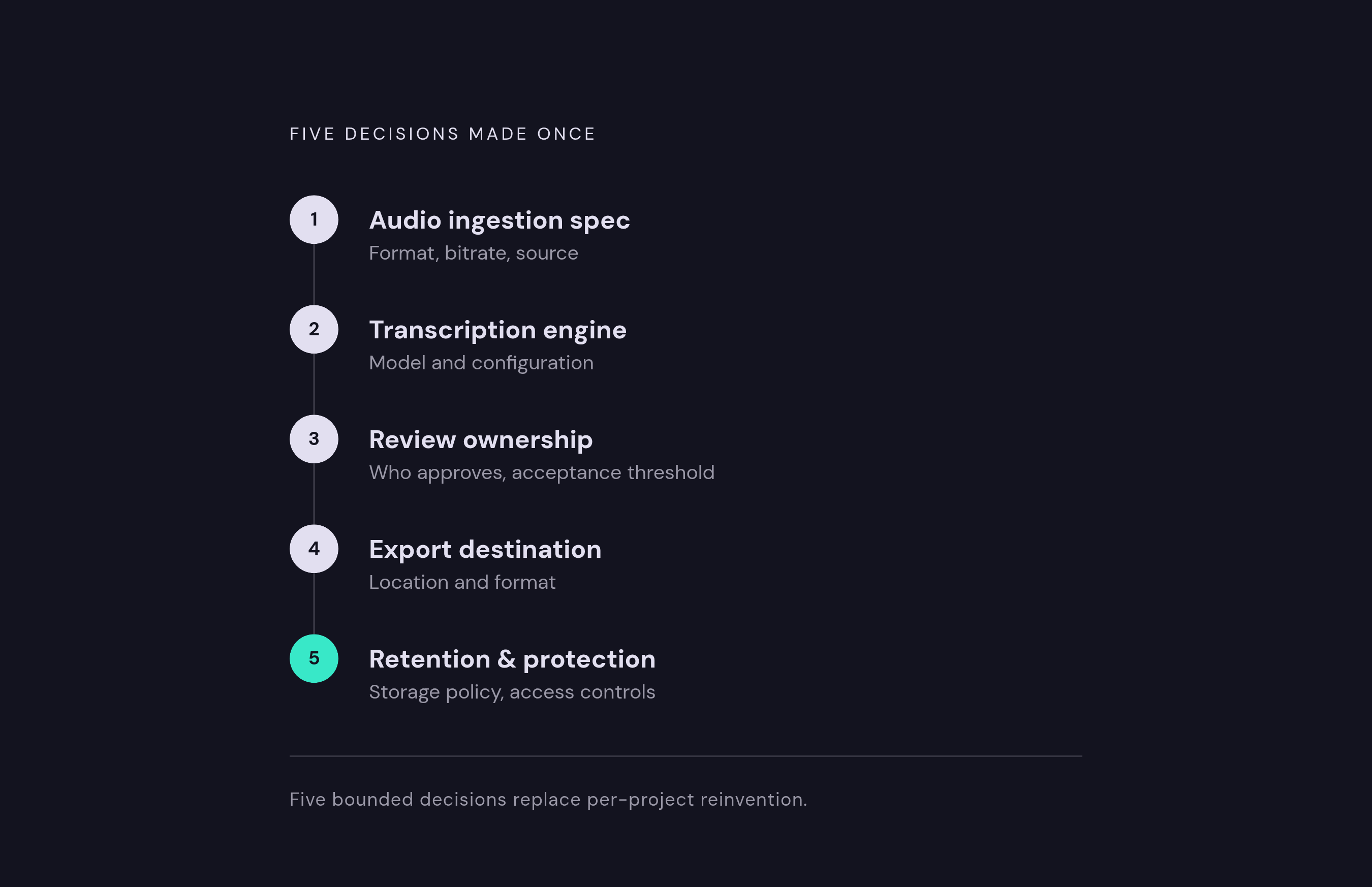
That standardization comes down to five decisions, made once and then left alone: the audio ingestion spec, the transcription engine and its configuration, who owns review and what threshold counts as acceptable, where exports go and in what format, and how data gets retained or protected.
Revisit the tool choice on a fixed schedule, annually or whenever volume crosses a pricing tier, rather than treating whatever was picked in year one as permanent VexaScribe. The pricing landscape for this category moves fast enough that a vendor that made sense in early 2025 may already be the wrong deal by late 2026 at the same usage level VexaScribe.
The sequencing that actually works runs backwards from most people's instinct: start from where the transcript needs to end up, whether that is a searchable research repository, a caption-compliant broadcast archive, or a voice agent's memory layer, and build the stack toward that endpoint. A mature transcription workflow has one simple tell. The transcript appears in the right format, in the right place, without anyone having to think about it twice.