Whisper Model Deployment Options and Self-Hosting Tradeoffs
Decide where to run Whisper based on residency, not cost alone.

Whisper has been around for a few years now, and picking where to run it hasn't gotten any easier. The model itself is open-weight, licensed for free commercial use, free to run anywhere. That part's settled. What's not settled is where you point it, and what that choice costs in dollars, latency, and the engineering hours nobody budgets for upfront. Most teams get this wrong the same way: they pick based on volume alone and ignore data residency until legal flags it six months in. That's backwards. Residency should come first, because it's the only variable that can veto a decision outright, no matter what the spreadsheet says.
The current Whisper model family and which checkpoint to start from
Whisper ships in sizes from tiny (39 million parameters) up to large (1.55 billion), and each step up trades speed and memory for accuracy. The English-only variants, tiny.en through medium.en, beat their multilingual siblings on English audio specifically. Large and the newer turbo checkpoint drop that option and go multilingual-only.
For most production work in 2026, large-v3-turbo is the default, and there's not much of a case for starting anywhere else. OpenAI pruned the decoder from 32 layers down to 4, cut parameters from 1.55 billion to 809 million, and the result needs around 6GB of VRAM instead of 10GB for large-v3. It runs about eight times faster than large-v3 while landing close to it on accuracy. The one catch: turbo wasn't trained to translate non-English speech into English. If translation is part of the job, stick with medium or large.
Outside the open-weight line, OpenAI's GPT-4o-transcribe and GPT-4o-mini-transcribe (released March 2025) post lower error rates than classic Whisper, but they're API-only, no weights to download. GPT-Realtime-Whisper (May 2026) streams transcript text while someone is mid-sentence, priced at $1.02 an hour, accessed over WebSocket or WebRTC instead of the usual audio REST endpoint. As of late June 2026, there's no Whisper v4 on the horizon. Large-v3 and turbo are the checkpoints worth building a roadmap around, not whatever ships next quarter.
The four variables that determine which deployment path fits
Four things decide this, and "which model sounds best in a demo" isn't one of them.
Volume comes first, but it's the variable everyone overweights. Below roughly 10,000 minutes a month, a managed API almost always wins once you count engineering time against it. Past that line, the per-minute charge compounds fast enough that self-hosting stops being the "cheaper-looking" option and becomes the obviously correct one.
Data residency is second, and it behaves nothing like a cost variable. It behaves like a wall. Healthcare recordings, legal depositions, unreleased product audio, regulated finance calls: if that audio can't leave your infrastructure, entire deployment paths disappear regardless of what they'd cost. This is the one teams treat as an afterthought and shouldn't.
Latency tolerance is third. Overnight batch jobs and back-catalog transcription can wait as long as they need to. Live captioning, voice agents, real-time support cannot, and the model variant has to match the job in front of it.
Operational capacity is fourth, the one teams underestimate most consistently. Self-hosting means your team now owns provisioning, patching, scaling, and whatever happens when a GPU node falls over at 2 a.m. That's a staffing question dressed up as an infrastructure decision.
These four don't stack neatly; they interact. A team with strict data-residency needs but modest volume still has options, on-premises deployment or an EU-hosted managed service, without building a full GPU pipeline from scratch. The rest of this piece checks each deployment path against this grid.
The managed OpenAI API: what it handles well and where it breaks down
The API is the easy button, and there's real value in that. REST calls, audio files up to 25MB, nothing to provision, model updates roll out without anyone on the team lifting a finger. Pricing runs $0.006 a minute ($0.36/hour) for whisper-1, $0.36/hour for gpt-4o-transcribe, $0.18/hour for the gpt-4o-mini-transcribe variant, and $1.02/hour for the streaming GPT-Realtime-Whisper option.
The cracks show up fast once volume or complexity climbs, though. The 25MB file cap means anything longer than a short call needs chunking before it reaches the API at all, a pipeline step nobody wanted to build in the first place. Speaker diarization isn't included either, so identifying who said what means bolting on a separate service, on top of what's already billed. The standard endpoints are batch-only, not built for streaming, and while GPT-Realtime-Whisper covers that gap, it costs a lot more per hour to do it.
Uptime guarantees are thin for anyone on pay-as-you-go pricing. As of May 2025, OpenAI offered no SLA at that tier, reserving the 99.9% uptime commitment for Scale Tier and Enterprise customers. Microsoft's Azure OpenAI Service, by contrast, provides both latency and availability SLAs (the latency guarantee applies to Provisioned-Managed deployments, the availability guarantee applies more broadly), which matters to teams that need a contract to point to when something breaks at 3 a.m.
And regardless of price, audio sent to the standard API runs on OpenAI's infrastructure. If data residency is a hard requirement, that ends the conversation right there, no matter how the rest of the math looks. The API earns its keep for early-stage projects, unpredictable traffic, and teams without GPU access, anywhere simplicity beats cost because volume hasn't reached the point where cost bites yet.
Self-hosting on your own infrastructure or a cloud VM: the cost math and the hidden work
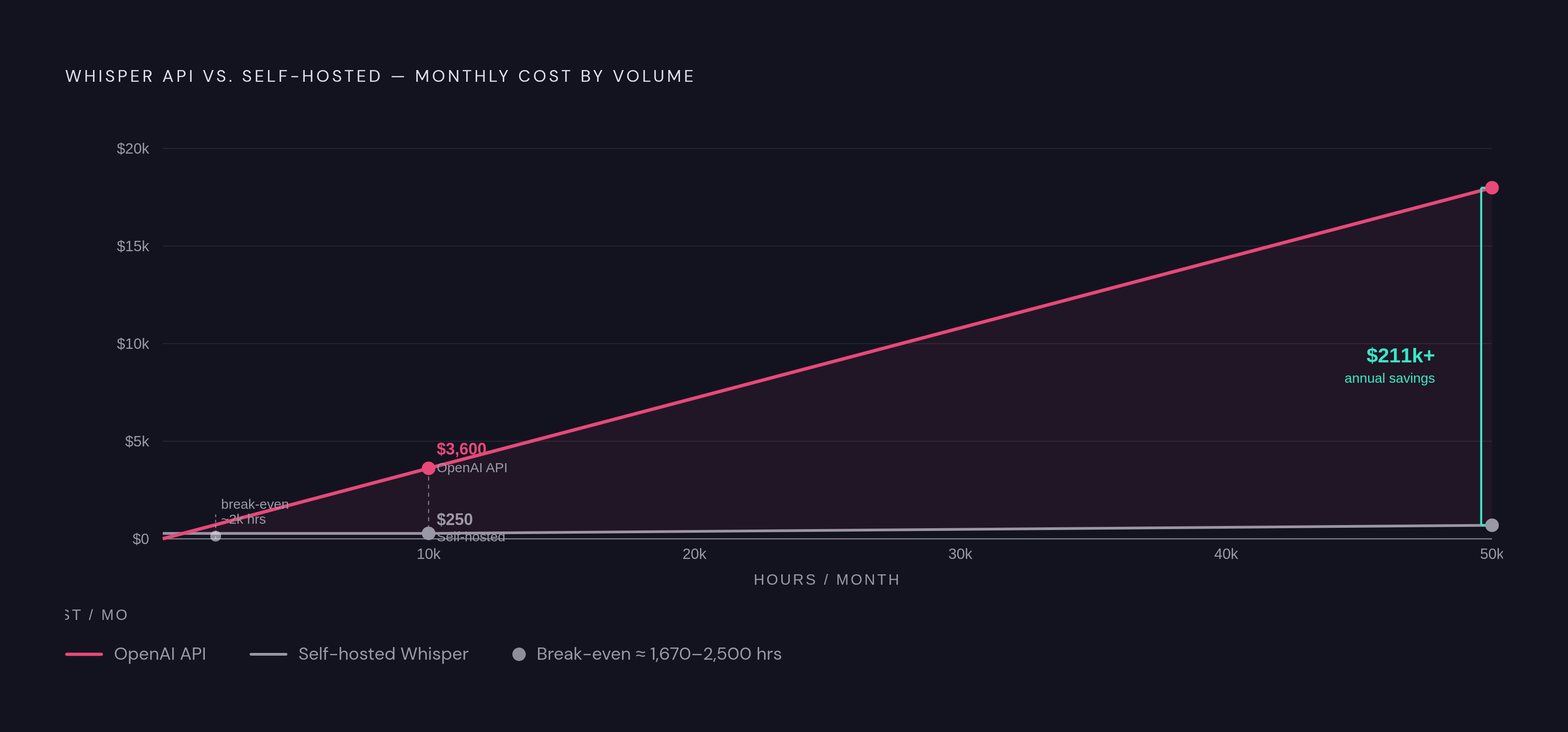
Below roughly 10,000 minutes a month, the managed API wins on total cost, and it's not close. Above that line, the math flips hard. At 10,000 hours a month, the API runs about $3,600 against roughly $250 for self-hosted infrastructure, a gap north of $40,000 a year. Push volume to 50,000-plus hours monthly and the annual savings clear $211,000. At that scale, staying on the managed API is a consequential choice. It's an expensive one, and teams that stay on it past this threshold are usually paying for inertia, not simplicity.
Hardware entry points aren't exotic. GPU instances start around $276 a month, and AWS's p3.2xlarge runs about $3.06/hour on-demand or roughly $1.40/hour reserved, a gap that moves the break-even point by a lot. On throughput: large-v3-turbo running through faster-whisper (built on CTranslate2) on a single RTX 5090 processes audio at roughly 20 to 30 times real-time for large-v3 with CTranslate2-class optimizations. An hour of recorded audio comes back transcribed in two to three minutes.
For teams buying rather than renting, a roughly $600 Mac mini or a $700 to $900 used RTX 3090 pays for itself against the OpenAI rate somewhere between 1,670 and 2,500 hours of audio processed. Past that line, it's free.
What most back-of-envelope comparisons miss: bandwidth egress runs $0.08 to $0.12 per gigabyte, a meaningful addition to the real infrastructure bill. None of that touches the DevOps time spent on patching, failure handling, and scaling, which is engineering labor that never makes it into the per-minute spreadsheet but shows up on the payroll anyway. On-premises hardware gives full control but means someone owns the physical machines. A cloud VM offloads the hardware but leaves the OS, dependencies, security patches, and scaling logic sitting on your plate regardless.
The one advantage that has nothing to do with cost: self-hosting means the audio never leaves your infrastructure, which sidesteps third-party data agreements entirely for regulated work in healthcare, finance, legal, and public administration. Self-hosting makes sense when at least two of three things are true: volume is high enough that per-minute cost dominates the budget, GPU capacity already exists somewhere in the stack, or the data simply can't leave the building. One of the three, on its own, usually isn't enough to justify the switch.
The runtime ecosystem: what you are actually choosing when you self-host
Self-hosting means more than picking a model. It's picking a runtime, and the same large-v3-turbo weights behave very differently depending on what's running them underneath.
Three options dominate as of 2026: the original OpenAI implementation in PyTorch, faster-whisper (built on CTranslate2, maintained by SYSTRAN), and whisper.cpp, written in plain C and C++. faster-whisper runs up to four times quicker than the original PyTorch code at matching accuracy, while using less VRAM, which makes it the default pick for anyone running NVIDIA GPUs. whisper.cpp goes the other direction: CPU-focused operation with Apple Silicon support, useful on hardware without a discrete GPU. Useful for teams on Macs or edge hardware without a discrete graphics card sitting around.
WhisperX layers word-level timestamps and speaker diarization into the transcription pipeline, worth reaching for when diarization needs to live inside the pipeline rather than as a bolted-on API call. distil-whisper trades a sliver of accuracy, under 1% word error rate difference, for roughly six times the speed and about half the size of large-v3. The pick when raw throughput matters more than squeezing out the last decimal point of precision.
So: whisper.cpp or MLX for Apple Silicon, faster-whisper for NVIDIA hardware, WhisperX when timestamps and speaker labels both matter, distil-whisper when speed is the whole game. This isn't a cosmetic choice. It changes VRAM requirements, batch throughput, and whether the thing runs on CPU-only hardware at all.
Third-party hosted Whisper: the middle path between full managed and full self-hosted
Between OpenAI's servers and your own racks sits a third option: providers who run Whisper on their own infrastructure and hand you an API, so your team owns integration and nothing else.
Groq's GroqCloud is the clearest example, and it's a genuinely different tradeoff than the other two paths, not just a repackaged one. Whisper running on Groq's LPU hardware benchmarks at 10 to 20 times faster than real-time; a 60-second clip typically finishes transcription in under five seconds. Latency drops sharply compared to the managed API, while accuracy remains competitive. The LPU architecture explains why: it stores model weights directly in on-chip SRAM instead of treating memory as a cache, which removes the bandwidth bottleneck that limits GPU inference and produces latency that stays consistent run after run, rather than bouncing around depending on load.
On data handling, Groq has stated a policy of not using customer inputs or outputs to train or fine-tune models without customer opt-in, though teams should confirm current terms directly before relying on this for compliance purposes. That matters for teams with data concerns but no appetite for running their own servers. Groq also offers GroqRack, an on-premises option with air-gapped deployment for sensitive workloads, combining LPU-speed inference with the kind of control usually reserved for self-hosting.
Cloud providers cover the compliance angle too. Some major cloud providers offer compute and managed AI services in EU regions such as Frankfurt and West Europe, which EU and DACH organizations may be able to use for Whisper hosting with regional data controls. Hugging Face's Inference API rounds out the tier, useful for quick prototyping as well as production, for teams that want model flexibility without owning infrastructure. Platform-as-a-service options like Scalingo fill a related niche: no servers to manage, the provider handles the OS and security patching, less raw control than a cloud VM but the right fit for teams whose actual expertise is building the application, not running infrastructure underneath it.
This tier earns its place when data can't go to OpenAI directly, volume doesn't justify standing up a GPU pipeline, and either latency or compliance rules out the standard managed API.
Whisper's open-source competition and where it still leads
Whisper isn't the only open option anymore, and in a few specific areas, it's already been passed.
NVIDIA's Parakeet-TDT-0.6B-v3, at 600 million parameters, posts an average word error rate of 6.34% against Whisper large-v3's 6.43%, while running at roughly 49 times the throughput, all under Apache 2.0. For English-only work at high volume with GPU capacity already on hand, that's a legitimate reason to walk away from Whisper, and teams that stick with Whisper for pure English transcription at scale are mostly paying a speed tax for a language coverage they don't need. The catch: Parakeet covers English plus 24 other European languages, 25 total, nowhere near Whisper's 99.
NVIDIA's Canary line is the multilingual counterpart. Canary-1B-v2 supports 25 European languages, outperforming Whisper large-v3 on FLEURS benchmarks within that set, also Apache 2.0, running through NVIDIA's NeMo toolkit. Real option for teams that need a handful of top-tier languages handled well and want self-hosted control. But 25 languages is still a fraction of Whisper's reach, an alternative for the languages it covers, not a replacement for the long tail.
Whisper still holds the line in a few places nothing else has matched at once: it covers 99 languages with no extra model bolted on, its MIT license permits commercial use with only standard notice requirements, and it has the largest open-weights community around, which shows up as more runtimes, more tooling, faster fixes when something breaks. No single competitor matches all three simultaneously. Vendor benchmarks run on clean datasets, and production audio never sounds that clean. Test on the actual domain before trusting anyone's number, including the ones in this article.
Hybrid routing as a production pattern
Plenty of production systems don't pick one path at all. They route by job type, and the pattern that keeps showing up splits into three tracks.
Track one is the default: a managed API, whether OpenAI's or a third-party hosted option, handles unpredictable traffic without anyone maintaining a server for it. Suited to standard workloads where the per-minute rate is a rounding error at that volume. Track two handles anything privacy-sensitive: customer calls, unreleased content, clinical notes, legal recordings, all routed to self-hosted or on-premises Whisper because it cannot leave the building, no matter what the API costs. Track three covers high-volume batch work, overnight jobs and queued processing where latency doesn't matter and volume is high enough that self-hosted GPU cost wins outright. At 10,000 hours a month, the gap between managed and self-hosted clears $3,000 monthly on its own.
Streaming and real-time cases sit outside this framework entirely and need their own math, whether that's GPT-Realtime-Whisper at $1.02 an hour or a latency-focused hosted option, weighed against what the standard batch endpoints would have cost for the same job.
Hybrid routing isn't free to run, either. It means building logic to classify and direct jobs, and maintaining two pipelines instead of one. That's real overhead, and teams that build it before volume justifies it are solving a problem they don't have yet. It only pays off once the savings actually cover the extra complexity of running two systems instead of a simpler one.