STT for Multilingual Call Center Analytics
Transcription errors compound across multilingual centers, breaking every analysis built on top.
Multilingual call center analytics runs on a stack, and speech-to-text sits at the bottom of it. Sentiment scoring, compliance flags, CSAT correlation, agent coaching: all of it reads text that a transcription model produced first. Get that layer wrong and every dashboard built on top of it is wrong too, just quietly. A miscategorized sentiment score doesn't flash red and say "transcription error." It just sits in a report, looking like insight, until someone makes a decision based on it.
How the scale of multilingual call volume makes transcription quality a financial issue, not just a technical one
The AI customer service market is on track to grow from $12.06 billion in 2024 to $47.82 billion by 2030, a 25.8% compound annual growth rate, according to MarketsAndMarkets. Eighty percent of customer service teams already use some form of generative AI in their operations. That's not a niche corner of enterprise software anymore, it's the default.
At that scale, small accuracy gaps stop being small. A meaningful word error rate across millions of monthly calls means tens of thousands of transcripts with meaningful errors, feeding straight into sentiment models and compliance checks that have no way to know the input was already broken. Multilingual centers get hit twice: error rates vary by language, so a single blended accuracy number hides which customer segment is producing real signal and which one is just producing noise that looks like signal.
Twilio's 2025 State of Customer Engagement survey found 96% of companies believe AI improves customer-facing operations. That confidence rests on an assumption nobody's checking closely enough: that the data feeding those AI systems is accurate to begin with. Trust in the output is only as good as trust in the input, and right now a lot of that trust is unexamined. The next question is where, specifically, the input breaks.
The four conditions where multilingual STT breaks down in production
Four failure patterns show up again and again once you look past the marketing sheet.
First, low-resource languages lag badly. High-resource languages tend to achieve substantially lower word error rates than low-resource ones, where error rates can be several times higher. That gap comes from training data volume, not some ceiling on what the algorithms can do.
Second, accent and demographic bias is baked into a lot of commercial systems. Published research has found that major ASR systems can produce substantially higher error rates for African American speakers compared to white speakers. Published research has also found that American English consistently outperforms British and Australian English in major ASR systems, with non-native accents tending to trail native varieties. A model marketed as global can end up systematically misreading the exact populations it claims to serve.
Third, code-switching trips up language detection in ways that are almost comedic if they weren't costing money. A heavy accent in English can get misread as Spanish. A speaker switching languages mid-sentence, common in diaspora and bilingual communities, can break transcript continuity entirely, leaving analytics tools staring at a document that reads like two different phone calls stitched together.
Fourth, domain vocabulary falls apart around alphanumeric strings: phone numbers, product codes, account IDs. These are exactly the tokens compliance and CRM systems need most, and exactly the tokens general-purpose models handle worst without extra training.
Add a fifth wrinkle for good measure: published research covering multiple languages and language families has found gender-based performance gaps in multilingual ASR models that acoustic or lexical properties don't fully explain. The direction of that gap is not consistent across languages or models. These four (or five, but who's counting past four) conditions map directly onto what a production-grade STT layer has to solve.
What genuine language coverage requires at the model level
"Supports 100+ languages" is a marketing sentence, not a technical one. A model can list 100 languages on a slide and still deliver very high word error rates on the bottom languages of them. Coverage claims mean nothing without a performance distribution attached.
The research trend, at least, points the right direction. ElevenLabs' Scribe, a speech-to-text model built on proprietary foundations, is one example of that direction in practice. OpenAI's Whisper trained on hundreds of thousands of hours of labeled audio, with a substantial portion of those hours spread across 96 non-English languages. Research into massively multilingual ASR has pushed recognition to more than a thousand languages using self-supervised pretraining paired with language-specific adapters. Subsequent research has scaled that approach further to cover an even broader range of languages.
The adapter approach matters mechanically: it lets a shared backbone specialize per language without retraining the whole model from scratch, which means a provider can add a low-resource language without dragging down performance on the high-resource ones it already handles well. For a call center buyer, none of this replaces the one test that matters: word error rate across the specific languages your customers actually speak, especially the ones near the bottom of that list.
There's also a cheaper fix worth knowing about. Research has shown that feeding a model textual or semantic context prefixes, without retraining anything, can meaningfully cut word error rates on both Modern Standard Arabic and Arabic dialects. For dialect-heavy markets, that's a meaningful gain for close to no engineering cost.
Accent handling and demographic fairness as a production requirement, not a benchmark footnote
If an STT layer consistently mishears non-native agents or customers, the sentiment and compliance scores built on those transcripts will be skewed for that group specifically, and the skew won't show up anywhere in the aggregate numbers. It just sits there, invisible, shaping decisions about which agents get coached and which calls get flagged.
The substantially higher error rates for African American speakers documented in published research aren't some relic from an earlier, less careful era of speech recognition. It reflects a training data imbalance that persists unless someone deliberately corrects for it. Gender disparities found in multilingual ASR research, again not fully explained by acoustics or vocabulary, tell the same story from a different angle: equal performance doesn't fall out of more data automatically, it takes explicit intervention during training.
So the ask for buyers is specific. Request disaggregated word error rates by accent, gender, and dialect for the languages actually in scope, not a single blended number for "Spanish" or "English" that papers over wide internal gaps. Models trained from the ground up on diverse data, rather than a single-language backbone with a translation layer bolted on, tend to be structurally better positioned here, which loops back to the adapter architecture point above.
Why real-time and batch transcription demand different STT architectures
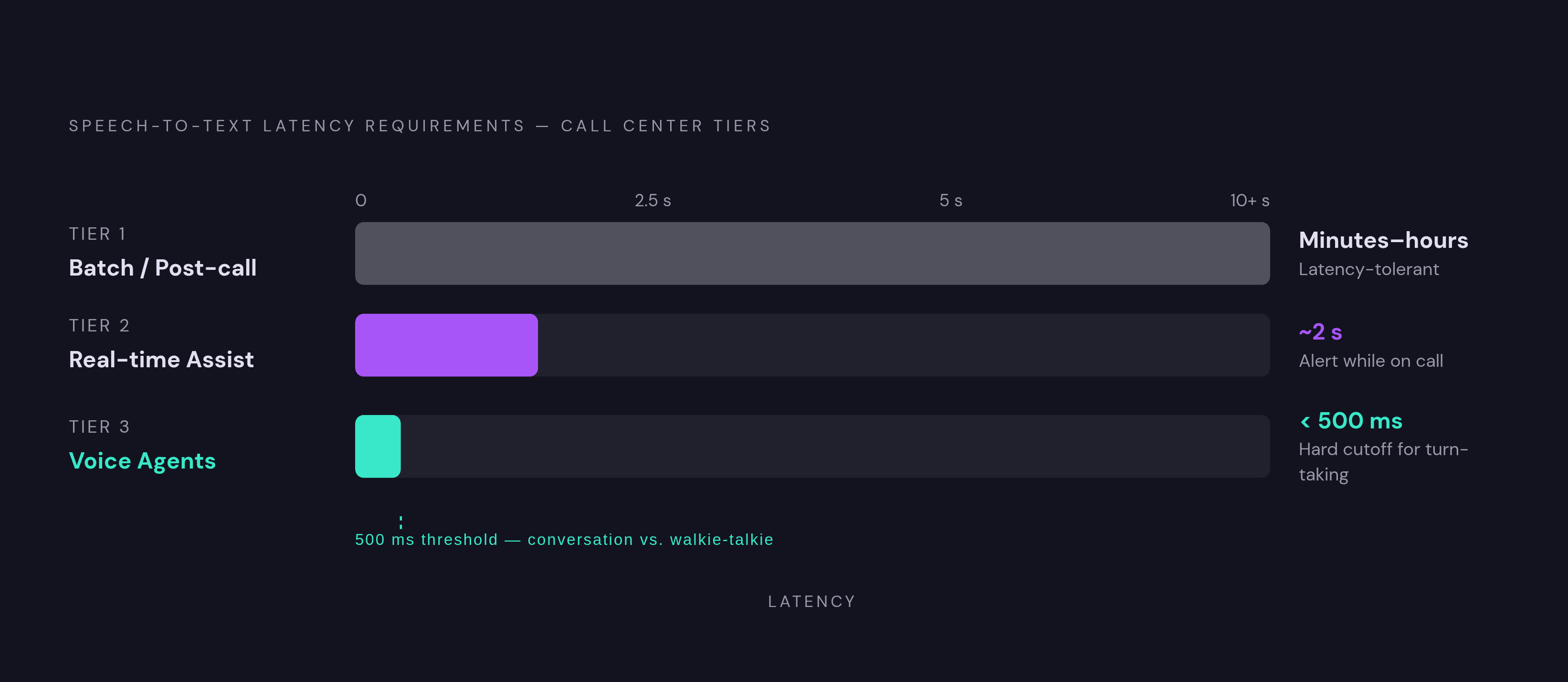
Post-call analytics reviews conversations after they end. Latency doesn't matter much here, which makes it the right fit for trend detection, agent coaching, QA audits, and compliance archiving.
Real-time analytics processes the call as it happens. That's what powers live agent prompts, in-call compliance flags, and sentiment alerts that fire while the customer is still on the line, and it needs end-to-end latency low enough that alerts fire before the relevant moment has passed. A model tuned for batch accuracy generally slows down or gets less accurate when forced into a streaming mode, and a model tuned for streaming speed usually gives up some accuracy to get there. These are different jobs, not two settings on the same dial.
Real-time emotion recognition, the kind that tracks tonal shifts, raised voices, or hesitation, only earns its keep if the transcription keeps pace with the conversation. A half-second of lag doesn't just annoy someone, it kills the entire use case, because by the time the alert fires, the moment it was meant to catch has already passed.
There's a third category emerging too: voice agents that don't just monitor calls but run them, acting as the first point of contact. Those need even tighter latency, with sub-500 milliseconds as the rough target for turn-taking to feel like a conversation instead of a walkie-talkie exchange. Before evaluating any STT vendor, a buyer needs to know which of these three jobs they're actually buying for. A model that's excellent at compliance archiving can be completely wrong for real-time coaching, and vendors rarely volunteer which one their product was built around.
How domain vocabulary and alphanumeric accuracy affect analytics reliability
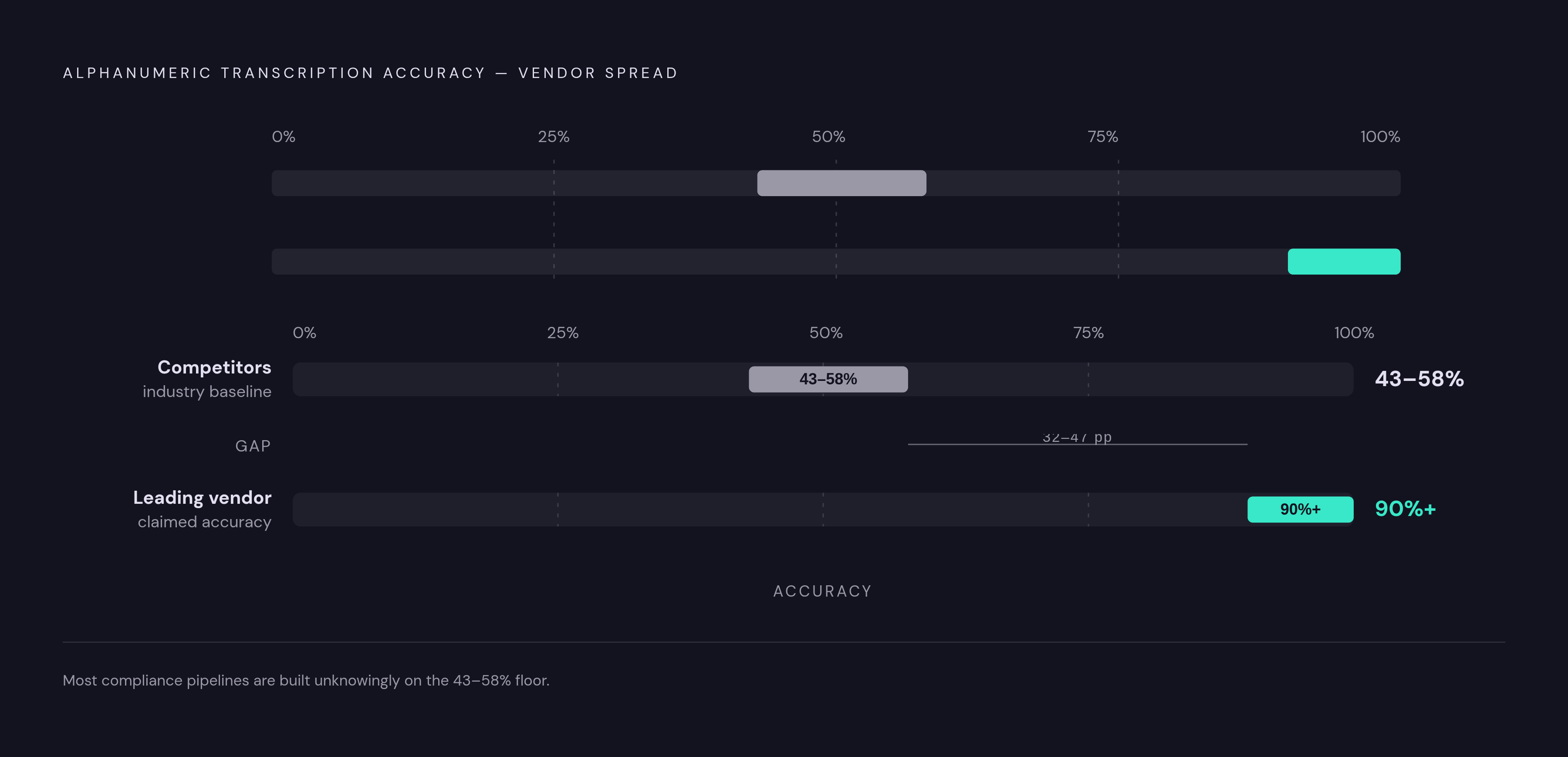
Call center transcripts are packed with the kind of text general-language models were never trained to handle well: SKUs, account numbers, policy codes, medical terms, brand names that sound like other words. AssemblyAI's Universal-2 model reportedly improved alphanumeric accuracy substantially over its predecessor, which says two things at once: the gap is real, and it's big enough that fixing it becomes a headline feature rather than a footnote.
The spread across the market is wide, with some vendors claiming 90%-plus alphanumeric accuracy against a 43 to 58% range for competitors, a gap large enough to change real outcomes: a mismatched customer ID, a missed escalation trigger, a product miscategorized in the CRM. None of that shows up as a transcription bug on a dashboard. It shows up as a wrong decision that nobody traces back to its source.
Fixing this usually comes down to three approaches: keyterm prompting, where the model gets fed a list of expected terms ahead of time, custom vocabulary lists, and fully fine-tuned domain models. Each comes with its own latency cost and engineering lift. For compliance work specifically, where a missed disclosure phrase or a misheard policy number can carry legal weight, alphanumeric accuracy isn't a feature to shop for later. It's the floor the whole compliance layer stands on.
What current STT providers actually deliver on these requirements
Microsoft's MAI-Transcribe-1, launched April 2, 2026 as one of the first three models out of the MAI family under Mustafa Suleiman's Superintelligence team, posts a 3.8% average word error rate on the FLEURS benchmark across 25 languages, and a 3.0% AA-WER v2.0 score across more than 140 languages. It's batch-only at launch; streaming support through Azure AI Foundry and the Azure Speech SDK is not available at launch. Strong breadth, built for post-call work at scale rather than live monitoring.
AssemblyAI's Universal-3, released March 3, 2026, replaces Universal-2 for voice agent use cases and adds code-switching support, real-time diarization, prompting, disfluency control, and coverage across 99-plus languages. The pre-recorded Universal-3 Pro variant reports a 93.3% word accuracy rate, and the streaming version prices at $0.45 per hour. It's the strongest feature set currently on the market for real-time work with bilingual or code-switching callers. The older Universal-2 streaming model still holds its own at 14.5% word error rate among streaming commercial options, and bundles sentiment analysis, PII detection, and diarization directly into the transcription output, useful for teams that want analytics features shipped with the STT layer rather than stitched on afterward.
On the FLEURS multilingual benchmark, head-to-head numbers put Scribe v2 Realtime at 93.5% accuracy, ahead of Gemini Flash 2.5 at 90% and GPT-4o Mini at 85%.
Google's Chirp 3 went generally available in 2025 with improved accuracy across 24 GA languages and over 77 preview languages, plus built-in diarization, though it's only available in a handful of regions (US, EU, asia-southeast1, asia-northeast1) through the V2 API, a real constraint for any contact center running a genuinely global footprint.
For teams wanting to self-host, Whisper Large V3 and its Turbo variant remain the most widely used open-source options for multilingual batch work, though NVIDIA's Canary-Qwen-2.5B has posted strong results on published accuracy benchmarks. For low-latency streaming on your own infrastructure, Parakeet TDT and Distil-Whisper are the common picks, and NVIDIA's Canary-1B-v2 and Canary-Qwen-2.5B ship under a CC-BY-4.0 license for anyone with the infrastructure to run them.
Pricing spans roughly 30-fold across the market: as low as $0.13 per hour for Cartesia's Ink-Whisper, up to $0.45 per hour for AssemblyAI's Universal-3 Pro Streaming, and as high as $4.50 per hour for bundled voice agent APIs that fold transcription, diarization, and orchestration into one product. Buyers should model that spread against actual accuracy gains for their languages and use case, not just pick the cheapest line item.
How speaker diarization and language detection interact with analytics quality in mixed-agent environments
Diarization is the process of figuring out who said what. In a standard two-party call, that means separating agent speech from customer speech, and without it, sentiment scores, compliance flags, and talk-to-listen ratios have nothing reliable to attach to. A perfectly transcribed call is still useless for coaching if the system can't tell you which half of the dialogue belonged to the agent.
Multilingual environments complicate this further, because diarization and language detection start interfering with each other. A bilingual agent who switches languages mid-call risks getting flagged as a second speaker, since some models conflate a language shift with a speaker shift. Intra-utterance code-switching support, the feature AssemblyAI built into Universal-3, exists specifically to handle language changes within a single person's turn, a pattern that shows up constantly in call centers serving bilingual or diaspora communities.
Detecting language once at the start of a call isn't enough in these settings. The system needs to track language shifts as they happen mid-conversation, or the transcript starts reading like it was assembled from two unrelated recordings. Some newer systems, like Scribe v2 Realtime with diarization support for up to 32 speakers, are clearly built with multi-party conference calls in mind rather than just two-party support lines, which matters for enterprise environments where several internal staff join a single customer call. Whatever the marketing benchmark says about diarization accuracy, the only test that counts is running it against actual recorded calls from your own environment. Diarization failures in production are one of the most common causes of analytics getting attributed to the wrong person entirely.
Compliance, PII, and data residency requirements that constrain STT choice
Call center recordings are full of sensitive personal information by default: names, account numbers, health details, financial data. PII redaction isn't optional in HIPAA or GDPR-regulated environments, and it's strongly advised, with safe harbor protections attached, under CCPA.
Some providers build PII detection and redaction straight into the transcription request, AssemblyAI offers it as an opt-in feature at that layer. Others require a separate post-processing pass, which adds latency and one more place for something to go wrong. Data residency adds another constraint entirely for global operations: routing EU customer audio through US-based infrastructure creates compliance exposure that a lot of teams don't discover until legal asks about it. EU data residency, offered by providers including Scribe v2, is the kind of detail that decides whether a model is even eligible for consideration, regardless of how good its word error rate looks on a benchmark slide.