Python Speech to Text Integration With Streaming Audio Sources
Learn why streaming speech-to-text needs a different architecture than batch processing.

Most developers start the same way. They get batch transcription working against a static audio file, feel good about it, then assume streaming is the same job with a WebSocket bolted on. It isn't, and the gap between those two assumptions is where most "real-time" prototypes quietly fall apart the first time someone talks over background noise or the network hiccups. Treating live speech-to-text as a drop-in replacement for batch transcription is the fundamental mistake, because the two demand entirely different architectural thinking from the first line of code.
Batch transcription is a closed loop: send a finished file, wait, get text back. Streaming STT has no such luxury. It has to process a continuous, unbounded audio signal where the pipeline never actually finishes, so every design decision, buffering strategy, error recovery, latency budget, has to be rebuilt from different assumptions than the batch case. The old Python habit of reaching for the SpeechRecognition package and calling recognize_google() still technically runs, but it leans on a free, unofficial endpoint, skips voice activity detection entirely, gives no usable timestamps, and doesn't qualify as a production streaming pipeline by any reasonable definition.
Part of the confusion is vocabulary. STT, ASR, automatic transcription, and LVSR all describe the same underlying task, and "real-time," "online," and "streaming" all point at the same idea: an engine that produces transcription as the person speaks, with as little delay as possible. Getting that terminology straight matters, because it stops developers from comparing a streaming product against a batch one and wondering why the batch tool feels sluggish in a live use case.
The uncomfortable truth for most teams is that the transcription model is rarely the bottleneck. A weak audio-capture setup, a missing VAD stage, or a synchronous blocking read on the main thread will make even a state-of-the-art model sound like it's mumbling through a tin can. Fix the pipeline before blaming the model. That order of operations saves weeks.
The three-layer pipeline every Python streaming STT app is built on
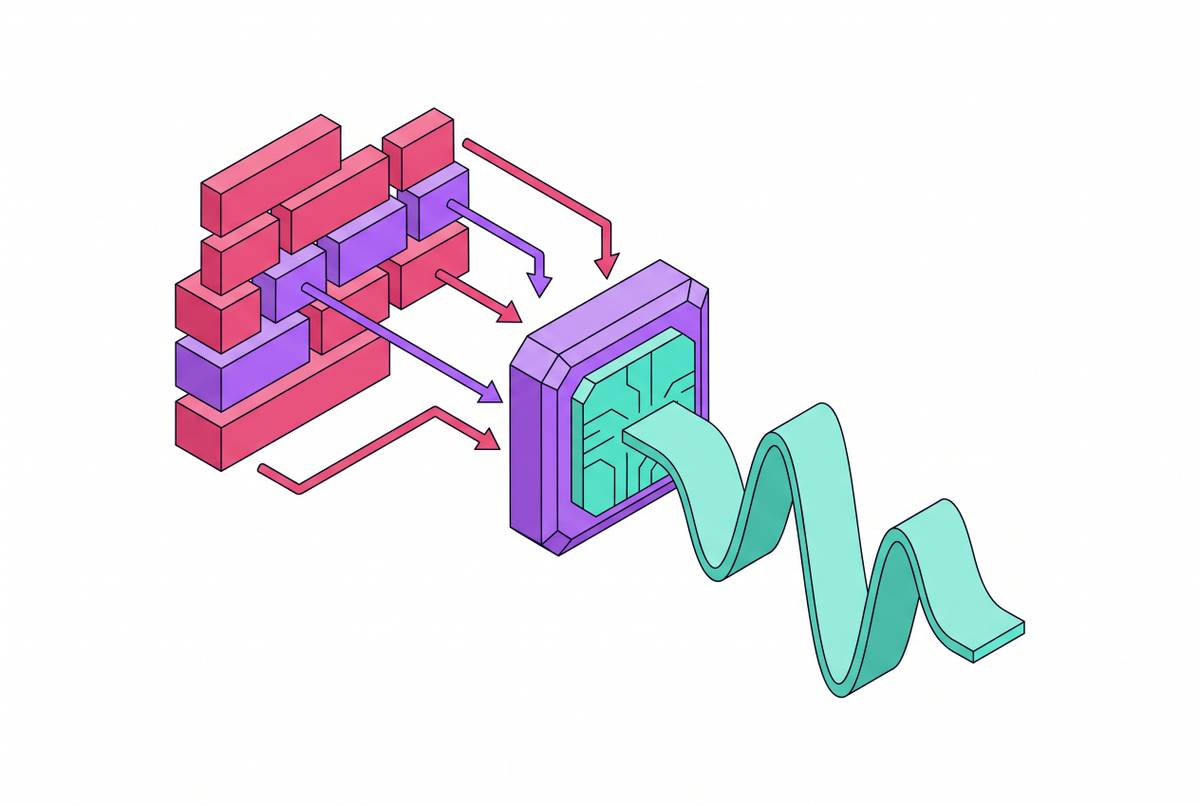
A working streaming STT system in Python breaks into three layers: audio capture, buffering with voice activity detection, and transcription itself. D|Nearly all the fragility in these systems occurs at the seams between those layers, not inside them.
Layer one is audio capture. PyAudio, which wraps the PortAudio library, opens a device stream and reads raw PCM frames in small, fixed chunks. The AssemblyAI tutorial describes a typical setup running at a 16 kHz sample rate with a small buffer of raw frames, formatted as paInt16 mono. Nothing exotic here, just a steady drip of bytes off the microphone.
Layer two is where the real engineering lives: buffering. Raw frames can't be thrown at a transcription model one tiny chunk at a time without wasting compute and mangling context, so a VadBuffer component accumulates frames into progressively larger chunks depending on whether speech is actually detected. The Auroratide pipeline walkthrough lays this out as a chain: AudioStream feeds VadBuffer, which feeds Transcription, which feeds a LabelWriter.
Layer three hands the buffered audio to a transcription engine, managed API or local model, which returns a partial or final transcript. The AssemblyAI SDK exposes this through a TurnEvent object carrying an end_of_turn flag, which tells the application whether the speaker is still talking or has wrapped up. That single boolean does a lot of quiet, unglamorous work.
The value of naming these layers explicitly is that each one owns exactly one job. AudioStream captures. VadBuffer batches. Transcription converts. LabelWriter outputs. The Auroratide breakdown treats this separation of concerns as the entire point of the design, because it means any single layer can be swapped or retuned without touching the others. Google Cloud's streaming documentation explains why gRPC, specifically bidirectional streaming, is the transport of choice here: audio bytes flow one way while transcription results flow back the other, continuously, with a hard 10 MB per-message ceiling that has to be designed around rather than discovered the hard way.
What PyAudio breaks in streaming pipelines
PyAudio gets treated like a throwaway import in most tutorials, one line, move on. That's a mistake, because it's the first place a streaming pipeline actually touches the real world, and the real world is messier than pip install suggests.
PyAudio is the standard Python binding for the PortAudio library, and the installation process is the first real snag developers hit. The Python package installs cleanly with pip, but PortAudio itself is a system-level dependency that needs separate, platform-specific setup before anything works. On macOS, that means brew install portaudio. On Linux, sudo apt-get install libasound-dev portaudio19-dev, or sudo apt install python3-pyaudio as an alternative. Windows is the outlier: pip install pyaudio pulls a pre-built wheel with PortAudio bundled in, no extra step required.
O|Inside the capture loop, exception_on_overflow=False on the mic.read() call decides whether the whole thing survives contact with a slow network. J|An input buffer overflow, triggered when the transcription layer can't keep up, throws an exception that kills the capture loop instead of just dropping a few frames and carrying on, unless the exception_on_overflow=False flag is set.
Threading is the other landmine. A blocking read loop running on the main thread stalls the instant transcription takes longer than the buffer window allows. The fix is running capture and transcription on separate threads connected by a queue, which the Auroratide project documents as the central design challenge behind building live subtitles that don't stutter.
Then there's the failure nobody notices until a demo goes sideways in front of a client: sample rate mismatch. If the microphone captures at a rate different from what the API expects, typically 16 kHz, the audio still reaches the model. It just comes back garbled or blank, with nothing resembling an error message to point at the cause. Confirm the sample rate negotiation explicitly, every time, because silent failures are the worst kind to debug at 2 a.m. Fixing the capture layer, in practice, improves transcription quality faster than swapping in a better model ever will.
G|How managed APIs handle the WebSocket
K|Running a streaming STT session over a WebSocket means juggling connection lifecycle, binary frame serialization, partial versus final transcript states, and graceful termination, all at once, all without dropping words. A managed SDK wraps that entire mess into event handlers, so a developer writes callback functions instead of parsing socket frames by hand.
The AssemblyAI Python SDK is a clean example of the pattern. A RealTimeTranscriber object takes a RealTimeTranscriberOptions configuration, including a terminate_timeout value, and attaches handlers for Begin, Turn, Termination, and Error events. It connects using a RealTimeParameters object that specifies the model and sample rate, while formatting options live in a separate RealTimeSessionParameters object. At no point does the developer touch a raw WebSocket frame.
The end_of_turn flag on the TurnEvent object is doing more work than its name suggests. It's the SDK's answer to one of the genuinely hard problems in streaming speech: figuring out when someone has actually finished a thought, as opposed to just pausing to breathe. Without that signal, an application either cuts a sentence off mid-word or sits there holding the line open, waiting for silence that may never fully arrive.
Error handling makes the strongest case for using a managed SDK instead of rolling one's own socket code. Networks drop connections regularly, and attaching a handler to RealTimeEvents.Error catches those failures without forcing a developer to write nested try/except blocks around every possible WebSocket exception.
What does it look like to build this layer from scratch instead? The Vakyansh and Ekstep open-speech project is a useful reference point: a gRPC server for bidirectional streaming, a Node.js proxy service to bridge browser clients (needed because grpc-web didn't support bidirectional streaming at the time), and a separate Socket.io server on top. That's a genuine engineering project, not a weekend script, and it's exactly the surface area that a managed SDK collapses into a handful of Python lines.
Choosing a transcription engine for a streaming Python pipeline in 2026
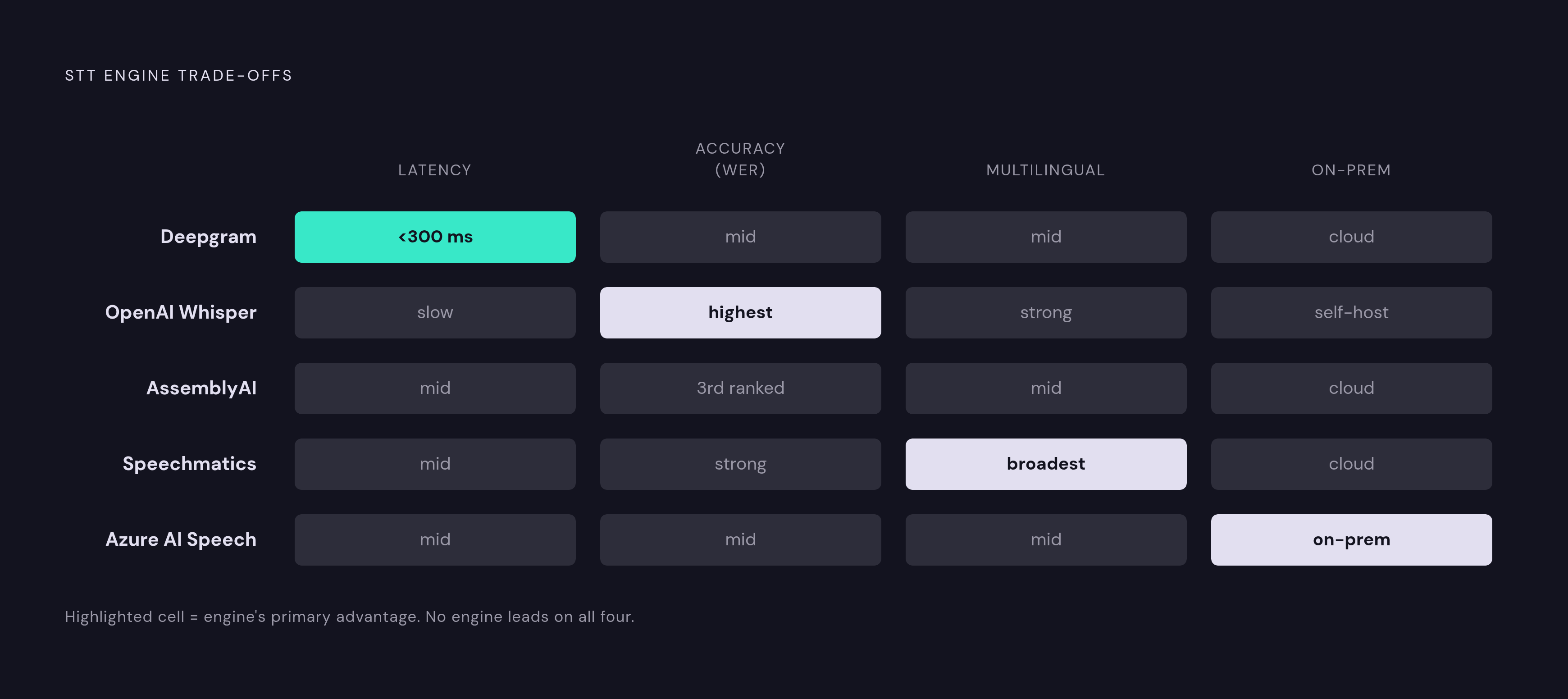
E|Once the pipeline architecture and the SDK abstraction are settled, the remaining decision is which engine runs the transcription layer. O|That choice comes down to four variables that rarely line up behind the same vendor: latency to the first token, word error rate, multilingual coverage, and permission for audio to leave the developer's own infrastructure.
The 2026 competitive picture splits along those exact lines. OpenAI Whisper leads on raw accuracy. Deepgram leads on real-time streaming performance. AssemblyAI leads on speech intelligence features layered on top of transcription. Speechmatics leads on accent and multilingual robustness. Azure AI Speech is the conservative pick for teams already living inside the Microsoft stack.
B|Some specific releases from 2026 shifted what "leading" means in each category. AssemblyAI's Universal-3 Pro, launched February 3, 2026, introduced a "speech language model" architecture with natural-language keyterm prompting supporting a large word budget, and it landed third on the Artificial Analysis AA-WER v2.0 AgentTalk subset. Deepgram's Flux Multilingual, launched April 29, 2026, became the first multilingual conversational STT with integrated end-of-turn detection, reducing median end-of-turn latency to under 300ms and saving 200 to 600 milliseconds off agent response time compared to pipelines that run STT and VAD as separate stages.
OpenAI's move mattered structurally as much as technically. GPT-Realtime-Whisper shipped May 7, 2026 at $0.017 per minute, the first time OpenAI separated a streaming-optimized STT from the batch Whisper line. The standard Whisper API (whisper-1) and the open-source Whisper models both process audio in fixed 30-second windows and do not support true streaming. Microsoft's MAI-Transcribe-1, launched April 2, 2026, is Microsoft's first proprietary STT model, claiming a mean word error rate on FLEURS that beats Whisper Large v3 across a wide range of languages, and it runs in Azure AI Foundry at roughly half the GPU cost.
For pipelines that need to run offline or under strict privacy constraints, Faster-Whisper via CTranslate2 is the option the Python Code tutorial recommends as of its May 2026 update. It handles VAD filtering natively through a min_silence_duration_ms parameter, runs on CPU with int8 quantization, and switches over to CUDA when GPU acceleration is available. WhisperX extends that setup with word-level alignment and speaker diarization, useful for podcasts or meeting transcripts where knowing who said what matters as much as what was said.
A|There's a separate category of fully on-device streaming STT. The Picovoice Cheetah SDK runs entirely on-device, GDPR- and HIPAA-compliant by design, across Linux, macOS, Windows, Raspberry Pi, and NVIDIA Jetson Nano. That matters specifically when regulation prohibits audio from leaving the device at all.
G|When to self-host versus use a managed API
Self-hosting Whisper looks cheap on a per-minute spreadsheet. The self-hosting path for Whisper hides weeks of engineering work that managed APIs make invisible, and the math changes significantly once infrastructure floor costs and DevOps overhead are counted.
The comparison is stark. A managed provider gets a developer from signup to working streaming transcription in a few hours. Self-hosting open-source Whisper typically takes weeks of infrastructure work first, and it carries a fixed cost floor that doesn't move regardless of how much or how little audio actually flows through it.
Self-hosting is genuinely warranted in regulatory environments where audio cannot leave the developer's infrastructure (HIPAA, GDPR data-residency requirements), for latency budgets that require co-location with the application server, or at usage volumes high enough that per-minute API cost exceeds amortized infrastructure cost. The Picovoice Cheetah model makes the compliance argument for on-device processing explicit: by keeping inference entirely local, it eliminates the data-transfer exposure that managed cloud APIs create.
Outside those three cases, default to the managed API. It removes infrastructure risk, comes with production SLAs, and frees engineering time for the application layer, the pipeline architecture covered above, instead of the unglamorous work of serving models. J|Pick a lane early and build toward it instead of hedging with a hybrid setup nobody has time to maintain.
Extending a streaming pipeline to production: error recovery, reconnection, and VAD tuning
A pipeline that behaves perfectly in a quiet office will still break in production, and it breaks for reasons that are entirely predictable in advance. Networks drop WebSocket connections mid-sentence. Input buffers overflow and corrupt the audio stream. VAD gets misconfigured and either floods the transcription engine with dead air or clips the first syllable of every utterance.
The RealTimeTranscriber accepts a RealTimeTranscriberOptions object, including a terminate_timeout, that governs network resilience. Too short, and the session disconnects on ordinary network jitter that would have resolved itself in a second. Too long, and the application hangs on a connection that's already dead, with no reconnection logic ever triggering.
B|Buffer overflow recovery runs through that same exception_on_overflow=False flag discussed earlier, and it functions as a production posture rather than a code style choice. Dropping a few frames under load produces a slightly degraded transcript. M|An uncaught overflow exception kills the capture loop and forces a full restart, which in a live conversation means losing the thread.
VAD tuning follows a similar tradeoff curve. Faster-Whisper's local pipeline exposes a min_silence_duration_ms parameter inside vad_parameters. J|Setting it too low slices normal pauses into separate transcription requests, driving up cost and fragmenting sentences that should have stayed whole. D|Set it too high, and the pipeline takes visibly too long to recognize that someone has stopped talking, which delays any downstream response.
Thread isolation ties all of this together. Audio capture, VAD buffering, and transcription belong on separate threads, connected by a queue between capture and processing. L|The Auroratide project documents this as the central concurrency requirement behind live subtitles, since blocking the capture thread on a slow transcription call produces the caption lag viewers notice first.
Shutdown deserves the same care as startup. The AssemblyAI example wraps its capture loop in a try/finally block that calls mic.stop_stream(), mic.close(), pa.terminate(), and client.disconnect(terminate=True), in that order. J|Skipping any one of those calls leaves either a dangling WebSocket session eating server resources or an audio device that never gets released back to the operating system.
Multilingual and agent-facing pipelines: where the architecture gets more demanding
Conversational agents and multilingual products push the basic pipeline past what a simple microphone-to-transcript setup was built to handle. End-of-turn detection has to run fast enough to drive an agent's actual response timing, and language identification has to happen inside the stream itself, as part of the transcription process.
That timing constraint is why Deepgram's Flux Multilingual model folding end-of-turn detection directly into the streaming model, rather than running it as a bolted-on second stage, cuts latency the way it does: fewer handoffs between components means fewer places for delay to accumulate. Every layer named earlier in this piece, capture, buffering, transcription, SDK, still applies. Agent and multilingual pipelines just remove the margin for error at each seam, which is exactly where the architecture was already most fragile to begin with.
Sources
- Real-Time Speech Recognition in Python with PyAudio
- Real-Time Transcription in Python — Picovoice
- How to Convert Speech to Text in Python - The Python Code
- Speech Recognititon Streaming API - Vakyansh
- Transcribe audio from streaming input | Cloud Speech-to-Text | Google Cloud Documentation
- Streaming Audio in Python | Auroratide
- Voice AI in 2026: 9 numbers that signal what's next