Encoder Architectures in Modern ASR Models
Conformer encoders dominate ASR because they balance global context with local acoustic detail.

The encoder is not merely one component among equals in an ASR system. It is the point where raw audio becomes something a model can reason about, and every choice made there sets a ceiling on accuracy, latency, and deployment fit. Choosing an encoder is choosing what the system can hear, how fast it can listen, and where it can run.
Why the encoder is the right place to focus when choosing an ASR architecture
Modern ASR systems follow an encoder-decoder pattern. The front-end extracts log-mel filterbank features from audio, the encoder compresses and contextualizes those features into a sequence of embeddings, and the decoder converts those embeddings into text. The encoder is the ears. Everything downstream listens to what it heard.
That position gives the encoder outsized influence. Errors introduced during encoding propagate through every later stage, and no decoder cleverness can recover acoustic information the encoder discarded. The practical consequence is that encoder architecture is not an internal implementation detail. It is a deployment decision that fixes latency, streaming capability, and hardware fit before a single line of integration code is written.
The five encoder lineages that define modern ASR
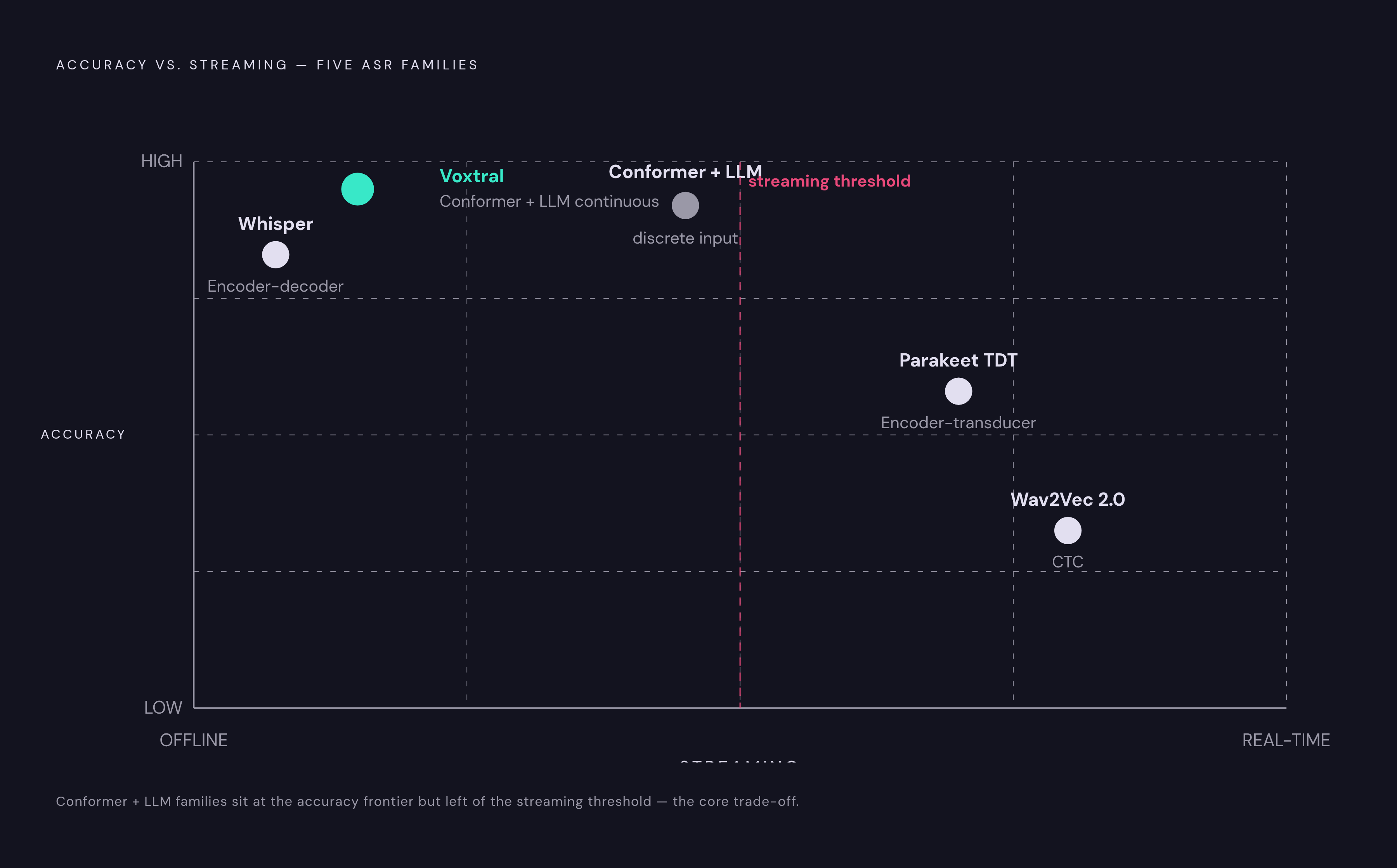
The field has consolidated around five architectural families, each built on a different encoder strategy. Knowing which family a model belongs to predicts most of its deployment characteristics. The first is the classic encoder-decoder Transformer, exemplified by the Whisper lineage. The encoder runs over the full utterance, then the decoder generates text autoregressively. Multilingual coverage is strong, and offline operation is mandatory.
The second is CTC, exemplified by Wav2Vec 2.0. A self-supervised encoder maps audio to frame-level posteriors, and CTC collapses those posteriors to tokens without any autoregressive decoder. The result is fast and streamable, with no explicit language model built in.
The third is the encoder-transducer, exemplified by Parakeet TDT. A Conformer or FastConformer encoder feeds a transducer decoder that jointly predicts tokens and their durations in a single step. This removes the blank-token overhead of standard RNN-T.
The fourth and fifth families both pair a speech encoder with a large language model decoder. In the continuous-input variant, exemplified by Voxtral, the encoder passes raw embeddings to the LLM. In the discrete-input variant, the encoder quantizes speech into token sequences first, and the LLM operates on those. Both paths pursue the same goal. Only the interface differs.
How the Conformer encoder became the dominant acoustic front-end across all five families
The Conformer sits under almost every high-performing ASR system today for a reason that is architectural, not fashionable. Pure attention captures long-range context well but struggles with local acoustic patterns. Pure convolution models local detail well but lacks global reach. Neither solves the whole problem.
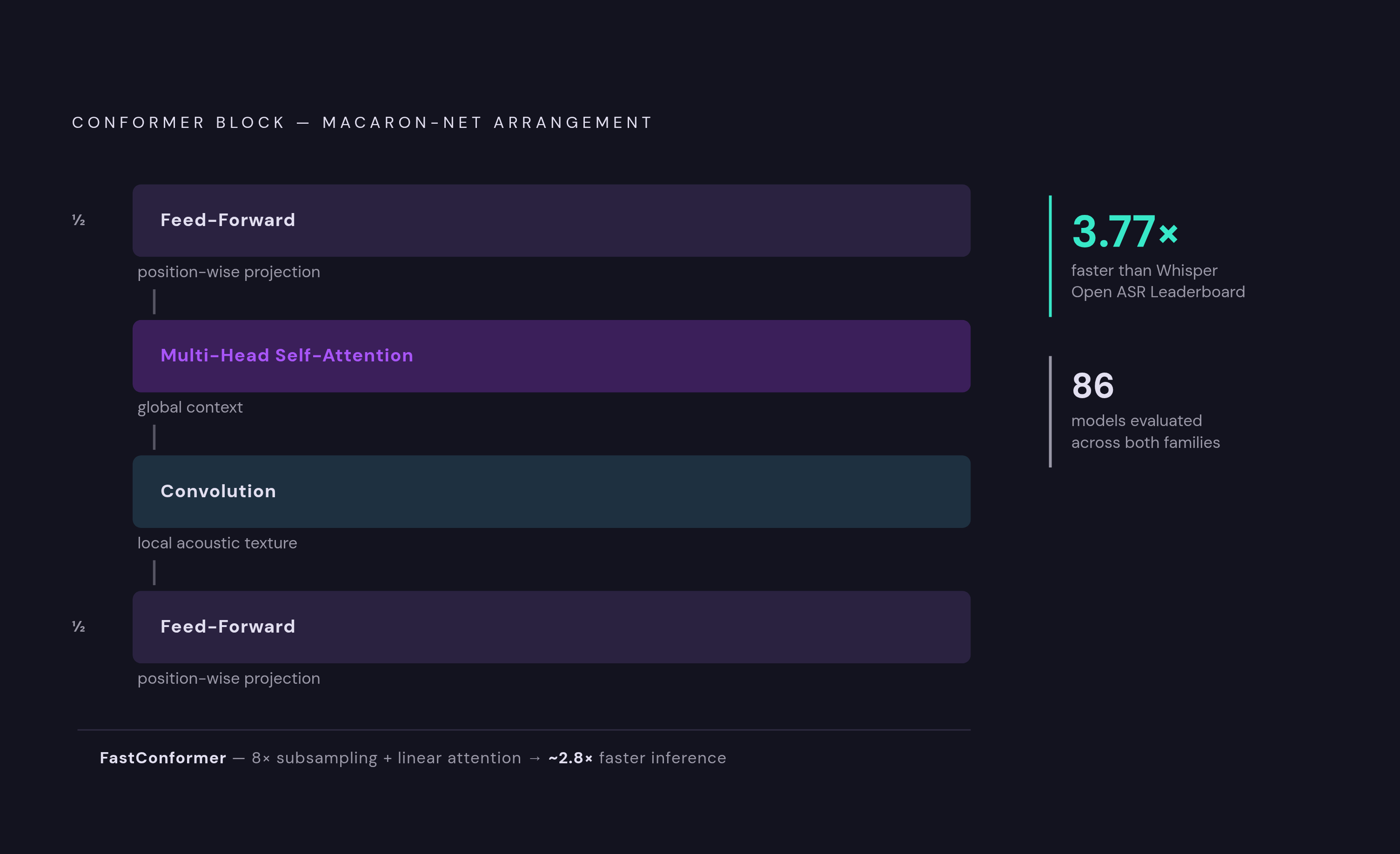
Each Conformer block combines a multi-head self-attention module with a convolution module, wrapped by position-wise feed-forward layers in the Macaron-Net arrangement. The attention handles global context. The convolution handles the local texture of speech. The two mechanisms reinforce rather than duplicate each other, which is exactly what acoustic modeling needs.
The production version of this idea is FastConformer, a redesigned variant using 8× subsampling and linearly scalable attention to achieve roughly 2.8× faster inference while retaining or improving accuracy. The leaderboard evidence confirms the result: Conformer-based encoders are the most widely adopted among the 86 models the Open ASR Leaderboard evaluates, and within the transformer decoder tier, Conformer-based systems run on average 3.77× faster than Whisper-based equivalents. That number matters most in real time.
What CTC and transducer decoders trade for their throughput advantage
CTC and transducer decoders unlock streaming and batched throughput that autoregressive Transformer decoders cannot match. They do so by surrendering something specific: global context. That trade is real and it shows up on exactly the material where context matters most.
CTC imposes a conditional independence assumption between output tokens at each frame. It cannot model inter-token dependencies directly, which is why it tends to lag on proper nouns, rare words, and heavily accented speech, the cases where surrounding context resolves acoustic ambiguity. The token-and-duration transducer closes part of this gap. By predicting both token identity and duration in a single step, TDT removes the blank-token overhead of standard RNN-T while avoiding the full independence assumption of CTC. NVIDIA Parakeet TDT v2, released May 1, 2025, demonstrates the approach with a FastConformer encoder.
The leaderboard paper confirms the throughput story: CTC and TDT decoders offer superior inverse real-time factor, making them better suited for long-form and batched processing. The accuracy ceiling, however, remains below what Conformer encoders achieve when paired with transformer or LLM decoders. For streaming, NVIDIA's Parakeet-unified model pairs a FastConformer encoder jointly trained in offline and streaming modes with an RNN-T decoder, targeting conversational AI latency as low as 160ms. The transducer family can hit real-time constraints that the Transformer decoder family simply cannot.
Why Conformer-encoder plus LLM-decoder is now the accuracy leader, and what it costs
Pairing a Conformer encoder with an LLM decoder produces the best transcription accuracy available today. The mechanism is straightforward: the LLM's contextual reasoning compensates for ambiguities the encoder cannot resolve acoustically. The encoder supplies acoustic evidence. The LLM checks that evidence against prior knowledge.
That prior knowledge is where the gains come from. LLM decoders outperform transformer decoders on proper nouns, technical jargon, and formatting because the LLM carries word co-occurrence statistics a domain-naive decoder lacks. A name that sounds like three other names gets resolved by what a sentence is probably saying, not just by what the microphone captured.
The cost is speed. LLM decoders are significantly slower than CTC and TDT decoders, and compute scales with LLM size. That makes the architecture a poor fit for real-time telephony, contact-center streaming, and on-device edge deployment. Qwen3-ASR's unified streaming and offline inference mode, using dynamic FlashAttention with window sizes from 1s to 8s and benchmarked at 2-second chunks, attempts to recover some streaming capability within the LLM-decoder paradigm. The attempt signals that the field recognizes the latency problem. It has not fully solved it.
How the Whisper encoder lineage fits in and where it still constrains deployments
The Whisper encoder lineage remains widely deployed for good reasons: multilingual breadth and ease of use. It also carries a structural constraint that shapes every long-form deployment built on it. The encoder's fixed 30-second receptive window is not a setting. It is the architecture.
The Open ASR Leaderboard paper notes that a substantial share of open models in its evaluation derive from the Whisper encoder or architecture. A separate long-form evaluation track exists primarily because many recent models inherit Whisper's encoder and because models adopt different chunking strategies that affect transcription quality. Whisper handles transcription, translation, language identification, and timestamp prediction in a single model, a breadth that is genuinely attractive. The fixed context window partially undercuts that breadth for long-form audio.
The most telling detail in this lineage is where compression has happened. Whisper large-v3-turbo reduced decoder layers from 32 to 4, and Distill-Whisper reduced them to 2. The encoder remained largely unchanged, which made it the remaining computational bottleneck. LiteASR addresses that directly by applying PCA-based low-rank approximation to the encoder's intermediate activations, exploiting the strong low-rank properties created by speech's correlated frequency structure. The result compresses the Whisper large-v3 encoder by over 50%, matching Whisper medium's size while retaining better accuracy. For teams already committed to this lineage, that is a meaningful finding: the encoder can be compressed without accuracy loss.
What streaming ASR requires from the encoder specifically
Streaming ASR is not a mode that any encoder can enter cheaply. It requires the encoder itself to be redesigned for causal or chunk-wise operation, and those design choices constrain every other system property. No decoder choice can compensate for an encoder that cannot process audio incrementally.
Encoder-decoder Transformer architectures run the encoder over the whole utterance before decoding begins. That is structurally incompatible with low-latency streaming, which is why streaming systems pair transducer or CTC decoders with chunk-aware encoders. The cache mechanism in NVIDIA Nemotron 3.5 ASR is an encoder-level feature, not a decoder-level one. Its Cache-Aware FastConformer-RNNT architecture processes only new audio chunks while reusing cached context from previous chunks, eliminating the redundant overlapping computations of traditional buffered streaming.
NVIDIA Multitalker Parakeet Streaming, released October 2025, pushes the encoder role further for multi-speaker scenarios. It injects learnable speaker kernels into the pre-encode layer of the FastConformer encoder, letting the encoder adapt to individual speakers in real time. Speaker disambiguation happens inside the encoder, before any decoder sees the representations. An open question in the field is whether self-attention is even necessary in the streaming Conformer encoder. Exploratory work has substituted lightweight 1-D deformable convolution for the attention module, suggesting that for strict real-time chunked inference, convolution alone may carry local and chunk-level pattern modeling. The question is not settled.
How encoder architecture shapes on-device and edge deployment
Edge deployment introduces a third constraint that accuracy and latency benchmarks do not capture: model size and decomposability. When memory and compute have hard ceilings, how cleanly the encoder can be separated and compressed becomes as important as how well it transcribes. For edge inference, an ASR model can be decomposed into three independently optimizable ONNX sessions: the encoder, a cache-aware FastConformer, the decoder, an LSTM prediction network, and the joiner. Separating the encoder allows it to be optimized, quantized, or replaced without retraining the full system. This decomposition is why the encoder's computational character matters so much. The encoder is compute-bound in a way the decoder is not. Batching improves throughput for memory-bound workloads like autoregressive decoders, but provides limited benefit for compute-bound encoders processing long fixed-length sequences. Encoder compression is therefore the lever that unlocks real scalability in data-center serving as well as on-device use. LiteASR's PCA-based rank reduction cuts encoder compute significantly with negligible accuracy loss, and the technique applies wherever the encoder is the throughput bottleneck.
What contextual biasing demands from the encoder in domain-specific deployments
Domain-specific ASR requires the encoder to make room for runtime context injection. The architecture of that mechanism is as consequential as the encoder's baseline accuracy on clean speech. Attention-based contextual biasing encodes a list of phrases into dense embeddings the recognizer attends to during decoding, but recognition cannot begin until context encoding completes. The context encoder becomes a latency source independent of the acoustic encoder.
Google's Deferred NAM approach addresses this by splitting context encoding into two passes. A lightweight first pass encodes all phrases with a cheap encoder to identify the most likely candidates from the full list, and only those phrases get the expensive full encoding. The result is a substantial speedup in context encoding, scaling to tens of thousands of phrases with a maximum pre-decoding delay under 33ms. The approach also adds phrase- and wordpiece-level cross-entropy losses that improve WER on in-context words. Encoder-level context architecture affects not just latency but transcription accuracy for the words that matter most. For enterprise telephony, where contact names, product names, and jargon are exactly the words a system must get right, the context encoder design is a practical deployment requirement, not an academic optimization.
How to match encoder architecture to deployment requirement
The right encoder architecture is determined by which constraint binds hardest. Accuracy on difficult speech, latency for streaming, compute budget for edge deployment, and contextual adaptability for domain use each point to a different architectural family. When accuracy on diverse, multilingual, or noisy speech is the primary requirement and offline processing is acceptable, a Conformer encoder paired with an LLM decoder, the Canary-Qwen and Qwen3-ASR lineage, is the current accuracy leader. When streaming with low latency is required and clean speech accuracy is sufficient, a FastConformer encoder with a transducer decoder, the Parakeet TDT lineage including the Nemotron 3.5 cache-aware variant, delivers streaming the encoder-decoder Transformer cannot match. When batched long-form throughput matters more than per-utterance latency, CTC-decoder systems offer the superior inverse real-time factor the leaderboard comparison confirms. When on-device or edge compute is the constraint, encoder decomposability through separate ONNX sessions and encoder compression through low-rank approximation become the deciding factors, independent of decoder family. When domain-specific vocabulary must be transcribed reliably in real time, the context encoder architecture, how it handles large phrase lists and injects context before decoding, is the lever to optimize, as the Deferred NAM result illustrates. ASR underpins the speech-to-text layer in real-time voice applications, including the conversational agents and dubbing pipelines that depend on accurate, low-latency transcription as a prerequisite for downstream voice synthesis and localization at scale. The encoder choice is where that pipeline either works or does not.