Architectural Differences Between GE2E and ECAPA-TDNN Speaker Encoders
GE2E reads sequences to build geometry; ECAPA-TDNN attends to structure to shape it.
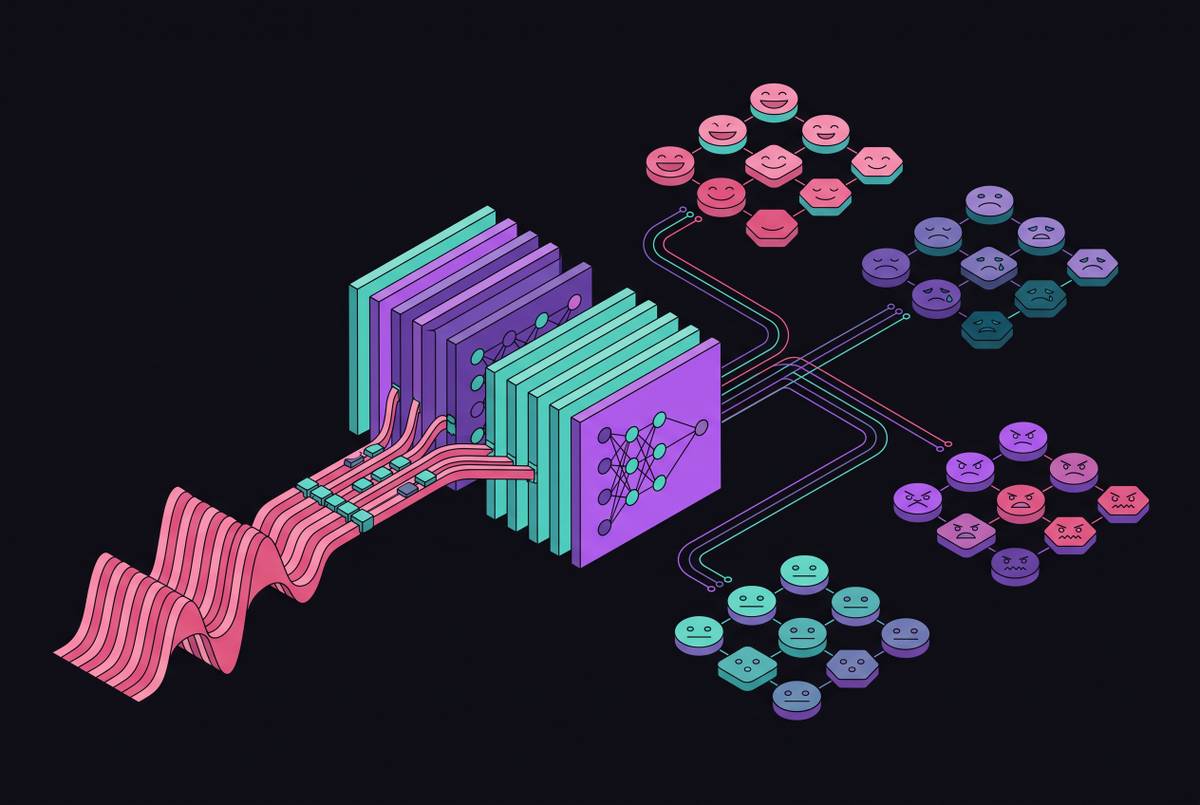
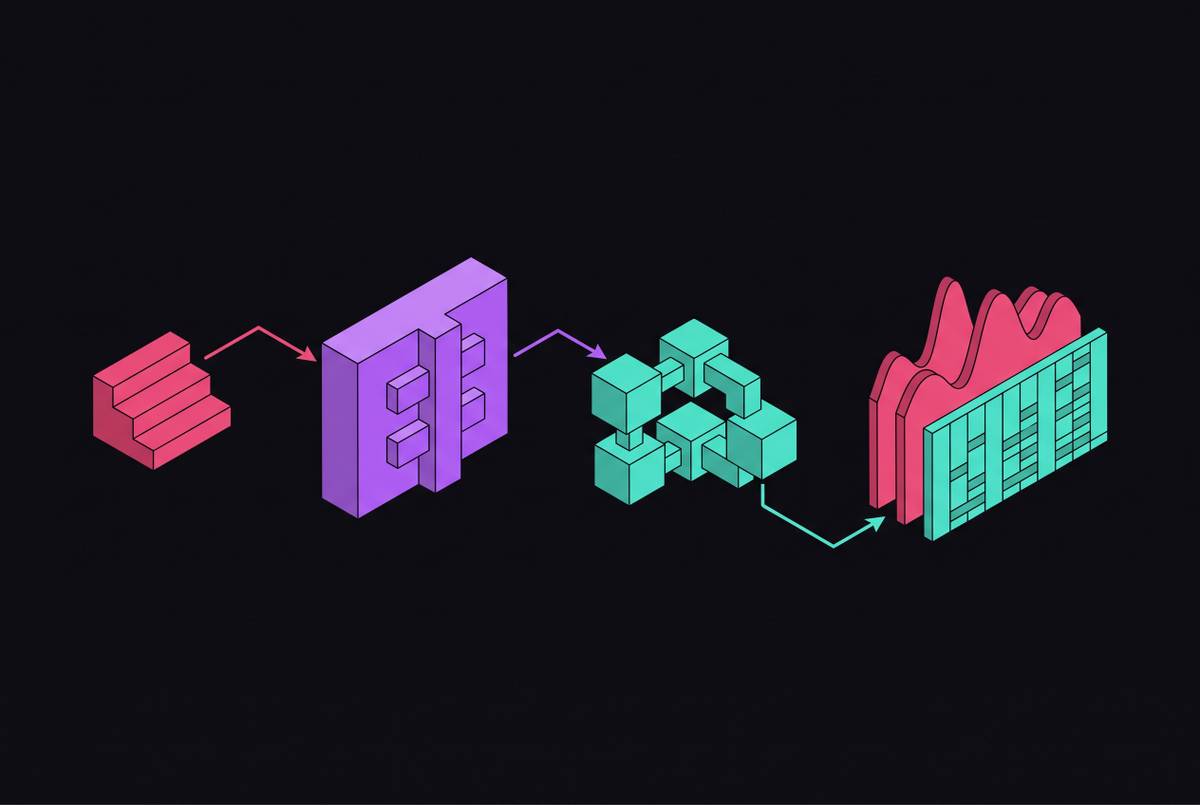
A speaker encoder takes a voice recording of any length and squeezes it down into a fixed-length vector that is supposed to represent who is talking. That squeezing job is not neutral. How the encoder handles time, how it decides which parts of the signal to keep, and what loss function it trains against all shape how well the resulting vector holds up against a voice it has never heard, a noisy phone call, or a product that needs an answer in under a second. The same vector gets handed off to very different jobs downstream: a text-to-speech system uses it to clone a voice from a few seconds of audio, a verification system compares it against an enrollment record to decide yes or no, an anonymization system has to warp it into someone else's identity. Each of those jobs leans on the embedding differently, and as Zeng et al. lay out in Computer Speech & Language (June 2024), the standard speaker verification pipeline splits into a speaker encoder that builds the embedding and a back-end model that makes the accept or reject call, so whatever the encoder gets wrong, the rest of the system inherits. Two architectures currently run most of this territory: GE2E, a contrastive training objective paired with a recurrent LSTM encoder out of Google, and ECAPA-TDNN, a convolutional architecture with channel attention introduced at Interspeech 2020. They are two different bets on what speaker identity actually is and how to find it in a waveform.
GE2E: recurrent sequence modeling and contrastive loss
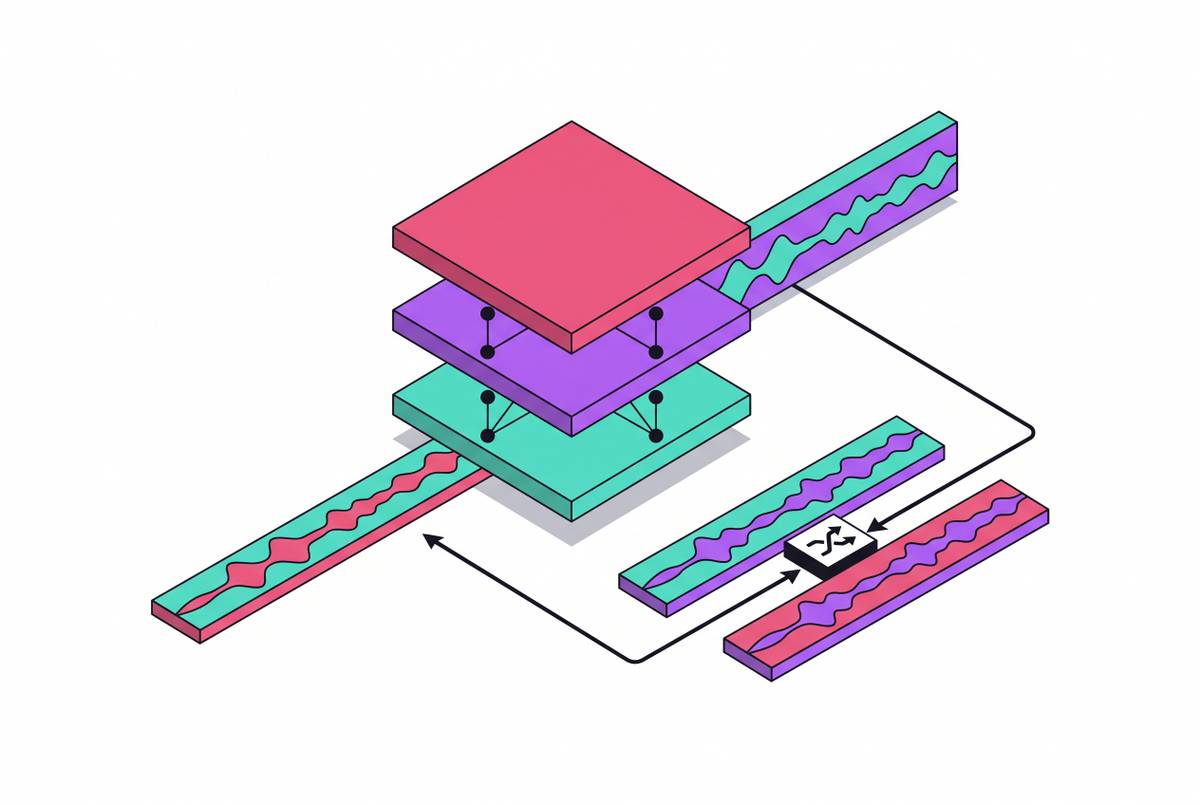
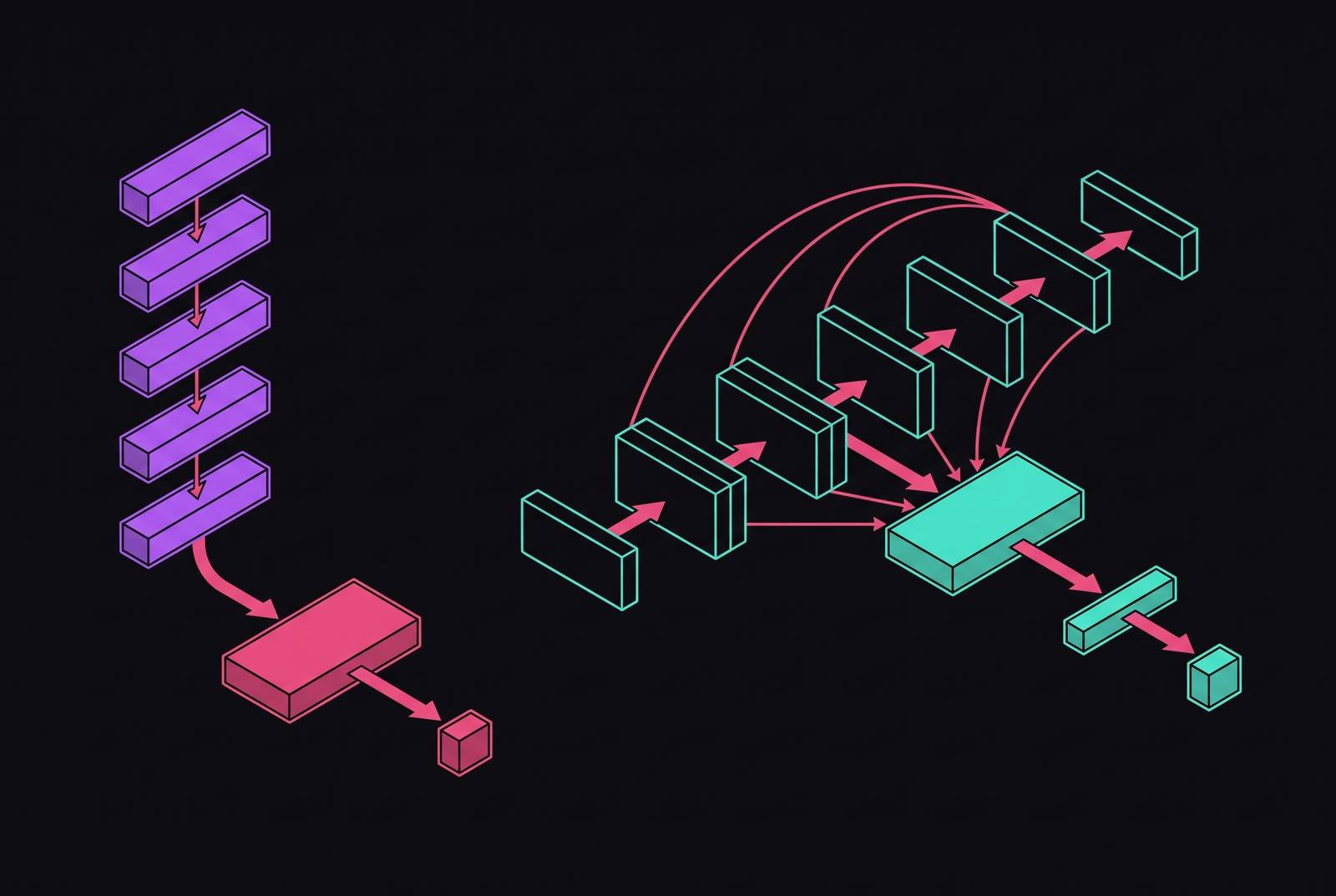
GE2E's bet is that speaker identity is encoded in how an utterance unfolds over time, so the right move is to read the whole thing in order and shape the resulting vector around a direct comparison task. An LSTM processes the audio frame by frame, carrying context forward as it goes, and only produces its output, the d-vector, once it has worked through the entire utterance. The GE2E loss then does the real organizing: for a batch of N speakers with M utterances each, it pulls each utterance's embedding toward its own speaker's centroid and pushes it away from every other speaker's centroid, with extra weight on the hard cases, meaning embeddings that drift too close to the wrong speaker. That's a meaningful upgrade over the tuple-based TE2E loss it replaced, described in Wan et al.'s original GE2E paper, because it skips the separate step of hand-picking difficult example pairs. The loss also introduced MultiReader, a domain adaptation trick that lets a single model serve multiple keywords and dialects at once, a feature that gives away GE2E's roots in production keyword spotting and large-scale verification rather than pure research benchmarking. What this buys is a compact, sequence-aware model with a clean, well-defined target geometry. What it gives up is any built-in sense of which frames or frequency bands actually carry the speaker signal. Every frame counts equally going in, and the LSTM's hidden state has to learn, on its own, which parts to weight more.
ECAPA-TDNN: multi-scale convolution, channel attention, and aggregated pooling
ECAPA-TDNN starts from a different assumption: speaker identity isn't spread evenly across a recording. Vowels carry more of it than consonants, and some frequency channels carry more of it than others, so instead of averaging everything and hoping the network sorts it out, the architecture builds in machinery specifically to find and weight those parts. It starts from the TDNN base and stacks three additions on top. Squeeze-and-Excitation blocks look across channels and recalibrate which ones matter for a given input. Res2Net modules, with their nested residual-style connections, pull multi-scale features out of a single convolutional layer instead of needing separate layers at separate scales. And the network aggregates features across multiple depths, so early, shallow patterns and late, deep patterns both get a vote in the final representation. The last piece solves a problem GE2E's LSTM leaves to implicit learning: handling utterances of different lengths. Where plain statistics pooling just averages frame-level features into a mean and standard deviation, ECAPA-TDNN's attentive statistics pooling weights each frame first, using attention that's sensitive to both channel and context, and only then computes those statistics. The pooling step is a decision, not a formality. Set next to GE2E, the contrast is stark. GE2E reads a sequence in order and lets a hidden state quietly absorb what matters about the speaker. ECAPA-TDNN looks at spatial and channel structure directly, decides explicitly what to keep through learned attention, and only then collapses everything down to a single vector.
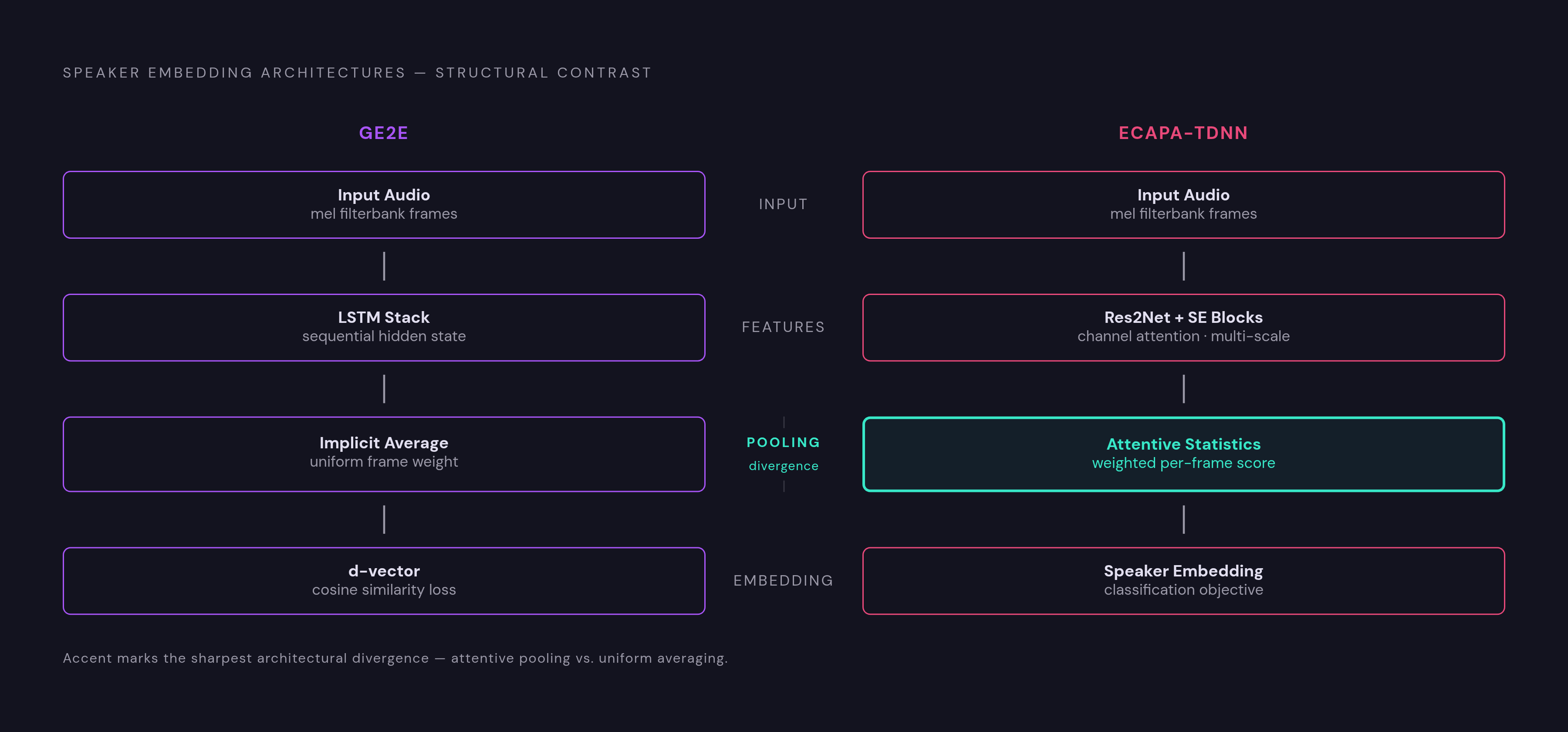
How the recurrent vs. convolutional divide produces different embedding geometries
These are two different designs, and the embeddings they output live in differently shaped spaces, which matters the moment a downstream system has to compare, interpolate, or manipulate those vectors rather than just look at them. GE2E's training target is cosine similarity, point blank: pull same-speaker embeddings together, push different-speaker embeddings apart, optimize directly for that one comparison. It's a space built for a binary question, and finer shades of speaker variation that never showed up as a contrastive pair during training may go uncaptured. ECAPA-TDNN's embedding space comes out of a classification objective filtered through multi-scale convolution and attention-weighted pooling, which tends to pack in a richer feature hierarchy, but the space wasn't explicitly sculpted around a pull-push geometry the way GE2E's was. Quamer and Gutierrez-Osuna's 2024 anonymization system out of Texas A&M makes this concrete: their pipeline extracts a source speaker embedding with a pretrained encoder, then requires the pseudo-speaker generator to land a target embedding at a cosine distance greater than 0.3 from it. A threshold like that only works if the surrounding space has consistent, trustworthy geometric structure, and that structure is a direct output of the encoder's architecture, not an afterthought. None of this crowns a winner. It does mean an encoder trained for one geometry can't be dropped into a task assuming another, and that constraint determines which architecture fits which job.
Zero-shot voice cloning needs a stable conditioning vector pulled from a few seconds of unfamiliar audio, handed straight to a synthesizer with no retraining. GE2E's d-vector, trained explicitly to stay geometrically consistent across different utterances from the same speaker, has done well here. Gorodetskii and Ozhiganov's 2022 system pairs a speaker encoder with a Tacotron 2-based synthesizer and a universal vocoder, pretraining the encoder on 3,000 speakers so that the same embedding can condition both the synthesizer and the vocoder for zero-shot adaptation. A separate 2021 transfer-learning approach to multi-speaker TTS follows the same blueprint: train the speaker encoder on its own, then let its output condition the synthesizer, treating the encoder as a portable module whose embedding geometry has to hold up outside its original training context. ECAPA-TDNN is not boxed out of this work. Kim et al. (2022) plug ECAPA-TDNN directly into a multi-speaker TTS system and get useful speaker representations out of its attentive pooling, which says the architecture competes in cloning pipelines too, especially when reference audio is inconsistent or low quality.
Real-time verification asks for something else: tolerance for noisy or channel-degraded audio, reliable performance on short enrollment clips, and a fast answer. That's where ECAPA-TDNN's explicit channel attention and multi-scale aggregation earn their keep, because they were built to pull out discriminative detail even when the input is messy. Latency is a hard constraint on every one of these choices. GE2E's LSTM is small and sequential, which plays well with streaming and tight memory budgets. ECAPA-TDNN's SE blocks and multi-scale convolutions add real computational depth, which raises inference cost, a cost that matters on-device or in any real-time agent application where a sub-100ms response isn't a nice-to-have but a requirement.
Why neither architecture dominates alone
The cleanest argument against ranking one architecture above the other comes from what happens when you stop choosing and just use both. Quamer and Gutierrez-Osuna's 2024 anonymization system draws on pretrained encoders that include both GE2E and ECAPA-TDNN variants, and concatenating their embeddings outperforms either one alone. That result only makes sense if the two embedding spaces are capturing different, non-overlapping slices of speaker information, not competing estimates of the same thing. A second case appears at the short-utterance end of the spectrum. GE2E's contrastive loss, built to make training efficient by leaning on hard examples and anchoring each embedding to a speaker centroid, has the side effect of lowering variance on short utterances, which gives it a real structural edge in enrollment scenarios where there's only one or two short clips to work with. Zeng et al. (2024) add a third wrinkle: their fully end-to-end system jointly trains a speaker encoder (ECAPA-TDNN as the backbone) with a neural back-end, and performance climbs further once the encoder is fine-tuned alongside the back-end instead of kept frozen. The architecture is only half the story. Training regime and integration pattern pull just as much weight. Put together, these results turn the architecture-versus-architecture question into something more useful than a leaderboard. Picking an encoder is a system design decision that has to account for the training objective, the back-end it feeds, the enrollment protocol it has to support, and the latency budget it has to live inside.
How the frontier is moving: self-supervised front-ends
Current research has largely stopped asking which standalone architecture is better and started asking how either one performs bolted onto a self-supervised front-end. Models like wav2vec 2.0 learn general-purpose speech representations from unlabeled audio, and the open question is how well a supervised back-end head, built in the style of either architecture or otherwise, can extract speaker identity from those representations. The 2022 paper "Robust Speaker Recognition with Transformers Using wav2vec 2.0" tests exactly this pairing and finds that a self-supervised front-end feeding a speaker verification back-end holds up well under noisy conditions, treating ECAPA-TDNN's aggregation approach as one option for the head rather than the whole system. That reframes the comparison without retiring it. GE2E's contrastive loss and ECAPA-TDNN's attentive pooling both still function as reusable components, whether they're standing on their own or sitting on top of an SSL front-end, and the structural differences between them remain visible even as the surrounding architecture gets more layered. And in practice, most deployed systems haven't caught up to the frontier anyway. ECAPA-TDNN remains the workhorse in open-source toolkits like SpeechBrain, WeSpeaker, and 3D-Speaker-Toolkit. The architectural contrast this piece lays out describes the systems actually running in production today, even as the research conversation moves toward SSL front-ends and hybrid heads.
Sources
- Joint speaker encoder and neural back-end model for fully end-to-end automatic speaker verification with multiple enrollment utterances - ScienceDirect
- Empowering Communication: Speech Technology for Indian and Western Accents through AI-powered Speech Synthesis
- Voice Cloning: a Multi-Speaker Text-to-Speech Synthesis Approach based on Transfer Learning
- End-to-end streaming model for low-latency speech anonymization
- Robust Speaker Recognition with Transformers Using wav2vec 2.0
- ECAPA-TDNN for Multi-speaker Text-to-speech Synthesis
- [1710.10467] Generalized End-to-End Loss for Speaker Verification
- ECAPA-TDNN: Emphasized Channel Attention, Propagation and Aggregation