Speech Recognition Python Libraries Compared for Production Pipelines
Architecture and constraints, not benchmarks, determine the right speech recognition library.
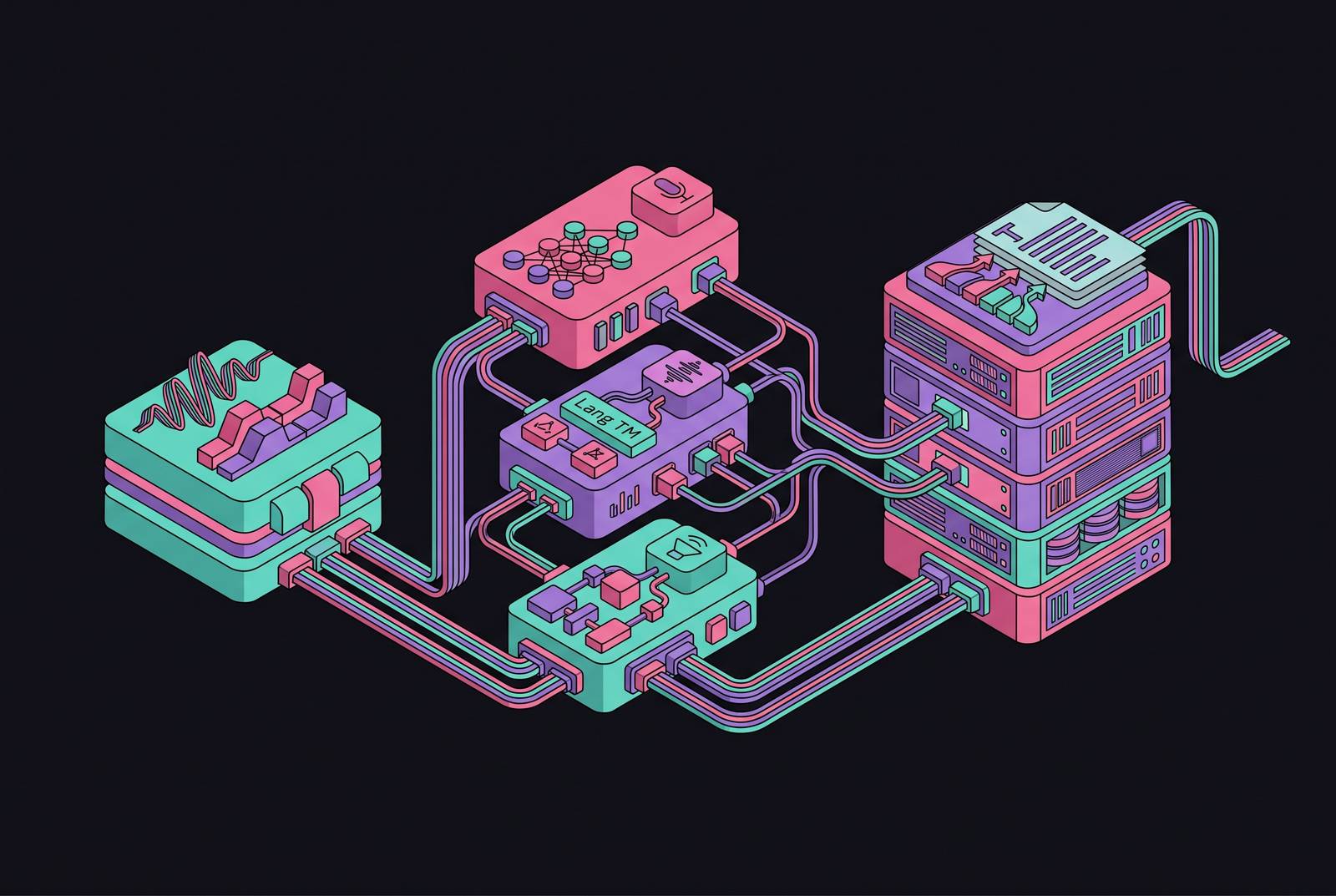
Most teams pick a speech recognition library the way they'd pick a phone case: look at reviews, grab the one with the best numbers, move on. The production pipeline's architecture decides the matter, not benchmark scores, because offline versus cloud, batch versus real-time, and base model versus fine-tuned are decisions made at the system design stage, long before anyone opens a library's documentation, let alone its word error rate leaderboard. By the time an engineer is comparing benchmark scores, the real decision has usually already been made by constraints nobody wrote down.
The AssemblyAI guide describes production speech recognition in 2026 as splitting into two dominant paths: open-source libraries for local or offline work, and cloud APIs for the highest real-world accuracy with the lowest infrastructure overhead. Neither path is free. Latency compounds across a full voice pipeline: transcription takes time, LLM inference takes time, speech synthesis takes time, and each stage's delay stacks on top of the last. A library can return a transcript in 200 milliseconds under test conditions, but once you wire it into a live call with real network jitter and real background noise, it can still blow the pipeline's entire latency budget.
Benchmark scores make this worse by flattering the wrong comparison. The gap between leading models on clean benchmark audio is usually smaller than the gap between that benchmark audio and whatever a production system actually hears: overlapping speakers, regional accents, call center static, a customer's name that no training set ever included. Engines that rank closely on paper can diverge sharply once noise, accents, and custom vocabulary enter the picture. The architecture has to be decided first.
The four architectural constraints that determine the right path
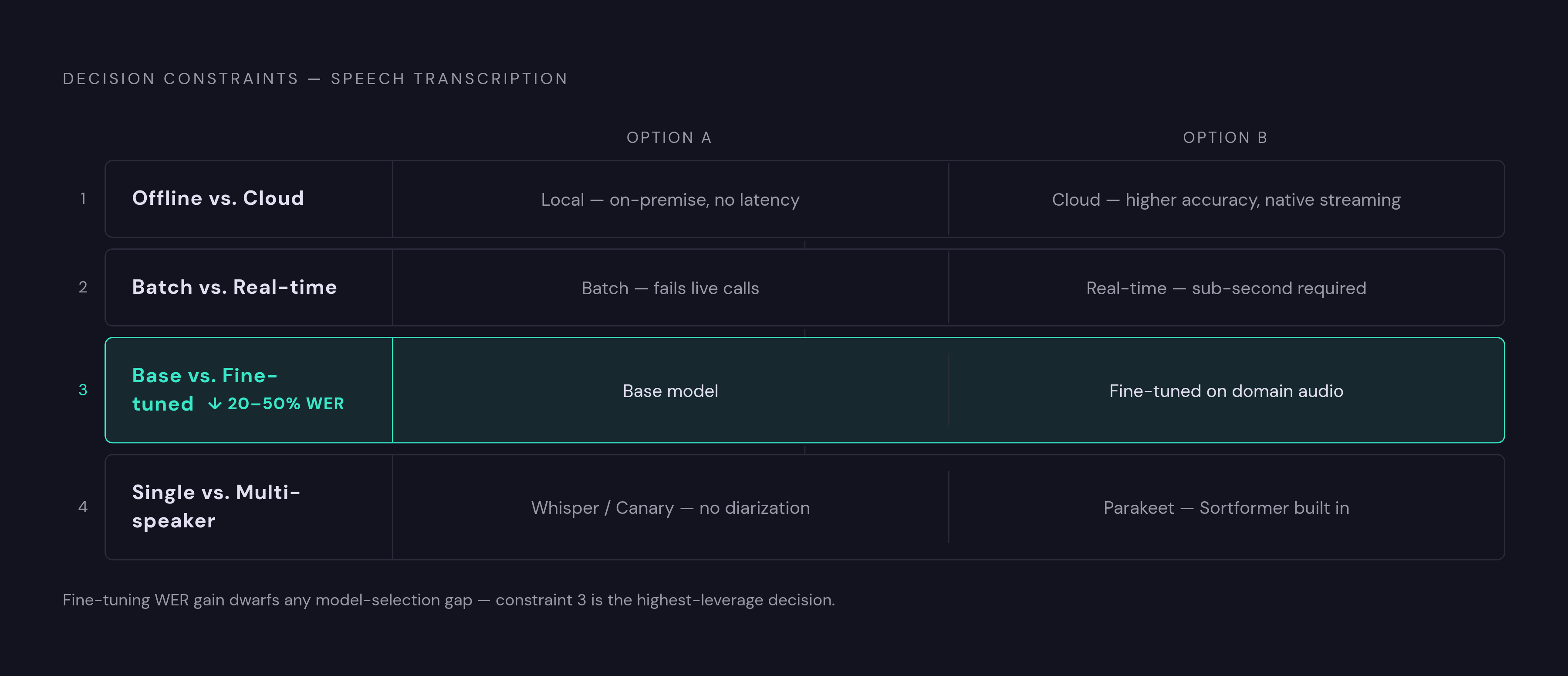
Four constraints decide which library or API is right, and getting any one of them wrong late in the build usually means tearing the pipeline out and starting over.
The first is offline versus cloud. Local models skip round-trip network latency, and because the audio never leaves the building, this matters for compliance-sensitive industries. Cloud processing tends to give you higher accuracy out of the box and native streaming support, and nobody has to manage GPU infrastructure. The cost math flips at high daily audio volume: once a team is processing enough hours of audio that GPU amortization beats per-hour API pricing, self-hosting starts to win on cost. Below that volume, the math runs the other way.
The second is batch versus real-time, and these are not variations on the same problem. A voice agent needs sub-second transcription and reliable turn detection, and it has to handle named entities correctly on the first pass. A library that's perfectly fine for transcribing an hour-long podcast overnight can be entirely wrong for a live phone call, no matter how good its word error rate looks in a batch test.
The third is base model versus fine-tuned. If you fine-tune on even a modest amount of matched conversational audio, word error rate on that specific domain typically drops by 20 to 50 percent, a swing bigger than any gap between competing base models. Domain adaptation, not model selection, is usually the lever that moves accuracy at scale.
The fourth is single-speaker versus multi-speaker. Most open-source ASR models, including Whisper and Canary, don't include built-in speaker diarization. Parakeet, through parakeet.cpp or NVIDIA NIM profiles, does ship with Sortformer-based diarization built in. The AssemblyAI guide notes that everywhere else, adding speaker separation means bolting on a separate model such as pyannote.audio, writing alignment logic, and handling speaker overlap by hand.
Every library discussed from here forward should be read against these four constraints, not against a single overall ranking.
Open-source libraries for offline and batch work: Whisper, faster-whisper, Vosk, and SpeechBrain
The open-source options available in 2026 serve distinct constraint profiles, and no single one wins across all four axes above. The right move is matching the library to the job, not crowning a winner.
faster-whisper is a CTranslate2 reimplementation of Whisper that runs up to four times faster at comparable accuracy and supports int8 quantization. It's the default pick for GPU-equipped servers where Whisper's raw inference speed is the binding constraint, and per the AssemblyAI guide, it supports the same models and languages as the original. For batch pipelines already built around Whisper, it's close to a free upgrade.
Vosk, built by Alpha Cephei and released under Apache 2.0, ships lightweight language-specific models, and they range from 50 MB to 1.8 GB across more than 20 languages. It runs on hardware as modest as a Raspberry Pi and supports real-time recognition straight from a live microphone. That makes it the right call when hardware, not accuracy, is the binding constraint. If you pre-process audio through a neural denoiser such as DeepFilterNet before it reaches the model, its accuracy gap under noisy telephony conditions narrows considerably.
SpeechBrain, at version 1.1.1, is a full toolkit built on a major deep learning framework, with more than 200 training recipes across 40-plus datasets, over 100 pretrained models on a public model hub, and modular components covering ASR, speaker diarization, speech enhancement, and text-to-speech. It fits teams that need to train or fine-tune custom models from scratch, not teams looking to deploy an off-the-shelf checkpoint.
SpeechRecognition, the Python library (not to be confused with the task itself), is a unified wrapper over backends including Google Cloud Speech-to-Text, CMU Sphinx, Wit.ai, Azure, Houndify, IBM Watson, Vosk, and Whisper. It's useful for prototyping across engines quickly, but per the AssemblyAI guide, it limits exposure to each engine's advanced options. Treat it as a scaffolding tool for early experiments.
High-accuracy open models pushing the accuracy frontier: Canary, Granite, and Voxtral
Whisper has lost its crown. It's no longer the most accurate open model on English benchmarks, and newer models have passed it; teams with serious accuracy requirements now have open-weight choices that didn't exist a year earlier.
Botnoi Group's work with Canary Flash variants shows what that frontier looks like in practice. The team fine-tuned Canary Flash for telephony-grade audio using the NeMo EncDecMultiTaskModel on a single NVIDIA A100 with 40 GB of VRAM, training with AdamW and mixed-precision fp16. The target language was Thai, aimed at Southeast Asian enterprise deployments. Botnoi chose the smaller Flash checkpoint over the larger one for production because its lower memory footprint suited real-time latency constraints. That's domain adaptation working exactly as described above: per the AssemblyAI guide, fine-tuning on matched domain audio typically delivers relative word error rate reductions of 20 to 50 percent, and Botnoi's checkpoint choice shows that fine-tuning and model selection are the same decision.
Mistral's Voxtral Transcribe 2, released in February 2026, has positioned itself around price-performance rather than pure accuracy, specifically through its Voxtral Mini Transcribe V2 batch model, which it describes as offering the best price-performance of any transcription API on the FLEURS benchmark.
None of this changes the infrastructure math. These high-accuracy open models still require a team to own GPU provisioning, model serving, and every millisecond of inference latency themselves. That ownership burden pushes a lot of teams toward cloud APIs instead.
What cloud APIs give you beyond self-hosted models
Cloud APIs aren't just the path of least resistance. For pipelines that need native streaming, built-in diarization, custom vocabulary handling, or zero infrastructure overhead, a cloud API is the architecturally correct choice for most product teams, not a compromise they settle for.
Custom vocabulary is a known weak spot for open-source models. Whisper offers limited support for biasing toward specific terms such as brand names or technical jargon through its prompt parameter, but that parameter acts only as a soft, token-capped hint rather than a hard constraint the model has to follow. Commercial APIs built around promptable models accept domain context alongside audio, so they tend to handle this better, and you don't need a full fine-tuning cycle to get there.
Speaker diarization draws the clearest line between the two paths. Adding diarization to a self-hosted Whisper stack means integrating pyannote.audio, aligning speaker segments with the transcript output, and handling cases where speakers talk over each other. A cloud API with diarization built in removes that integration work entirely, which matters more than it sounds like on paper once a team has to maintain that pipeline for years instead of weeks.
ElevenLabs is one provider in this space. Its conversational AI infrastructure runs on low-latency speech-to-text foundations, so total round-trip time stays low enough for natural-feeling dialogue. That keeps latency from compounding across the pipeline at the infrastructure layer instead of leaving it to the application team. AssemblyAI is another cloud option that comes up often in this space, and it's generally positioned around accuracy and developer tooling for transcription workloads.
The build-versus-buy line is mostly a volume question. Self-hosting Whisper or faster-whisper becomes cost-advantageous at high daily audio volumes, where GPU amortization beats per-hour API pricing. Below that volume, the cost of owning every millisecond of latency and every integration headache outweighs what a cloud API charges per hour.
Real-time voice agents need a separate evaluation entirely
Batch transcription and real-time voice agents get compared as though they're the same task with different time limits, and they aren't. A voice agent pipeline compounds latency across three separate stages: transcription, LLM inference, and speech synthesis. The transcription stage has to return sub-second results or the agent breaks down from the caller's perspective, regardless of how accurate the transcript eventually turns out to be. That constraint disqualifies most batch-oriented libraries before accuracy even enters the conversation.
Vosk streams audio and runs on constrained hardware, which makes it tempting for real-time use, but its accuracy under real-world noise conditions sets a practical ceiling that rules it out for high-stakes conversational deployments, like a bank's automated phone line or a medical intake system.
NeMo-based models can be tuned for real-time deployment, and Botnoi's case proves it: choosing the smaller Flash checkpoint specifically for latency reasons, not accuracy reasons. But that path means a team owns every millisecond of inference latency itself and runs what is fundamentally a research-grade toolkit in a production environment, a tradeoff few teams sign up for twice.
ElevenAgents, ElevenLabs' production voice agent infrastructure, targets the sub-100 millisecond latency bar that interactive agents need, pairing low-latency ASR with conversational models built to listen, reason, and respond in sequence without stacking up delay. Cloud agent infrastructure is built to close that constraint profile, and self-hosted ASR alone generally can't solve it without significant engineering investment layered on top.
Accuracy and streaming support aren't the whole evaluation surface, either. Turn detection and entity handling carry just as much weight: the transcription layer has to produce usable output on partial utterances and interrupted speech, and it has to get domain-specific terms right the first time. When the transcription layer fails at this, the failure appears in the conversation as a confused agent talking over the caller or missing the point.
Multilingual coverage: where the differences between engines become most pronounced
English-language benchmarks are the easiest comparison to run and the least representative of what most global deployments actually need. The engine that wins on English isn't necessarily the engine that wins across 50-plus languages, so if you build for international audiences, you need to test against your actual target languages, not against whatever leaderboard ships first.
Whisper still holds the widest offline multilingual coverage of any open option, it spans dozens of languages, and it carries the largest ecosystem of community fine-tuning work built on top of it. That breadth is a real advantage for teams working outside English and outside the handful of languages that get the most commercial attention.
The Easper project, out of the University of Melbourne, shows how steep the climb gets for low-resource and endangered languages. Researchers fine-tuned Whisper iteratively from ELAN annotations on three Vanuatu languages, Bislama, Nafsan, and Nguna, using cloud resources to support the process<sup>1</sup><sup>2</sup>. One finding stood out: the order in which recordings get prioritized for transcription, acoustically clean audio first versus linguistically rich audio first, changes the trajectory of character error rate improvement over time. There's no universal answer to which strategy works better. It depends on what the model needs most at that stage of training.
The practical consequence for any team working outside English: the accuracy gap between engines widens, and the amount of fine-tuning data needed to close that gap grows along with it. A model that looks interchangeable with its competitors on an English test set can diverge sharply once the language changes, and no amount of benchmark-reading substitutes for testing on the actual language a product will ship in.