Acoustic Model Training for Low-Resource Languages
Self-supervised learning cuts the transcription bottleneck for unwritten languages.
The foundational assumption baked into classical acoustic model training is that transcribed speech exists in sufficient quantity to supervise learning. For the vast majority of the world's roughly 7,000 spoken languages, that assumption is just wrong. Standard supervised pipelines weren't designed to fail gracefully under data scarcity; they fail catastrophically, and then everyone acts surprised.
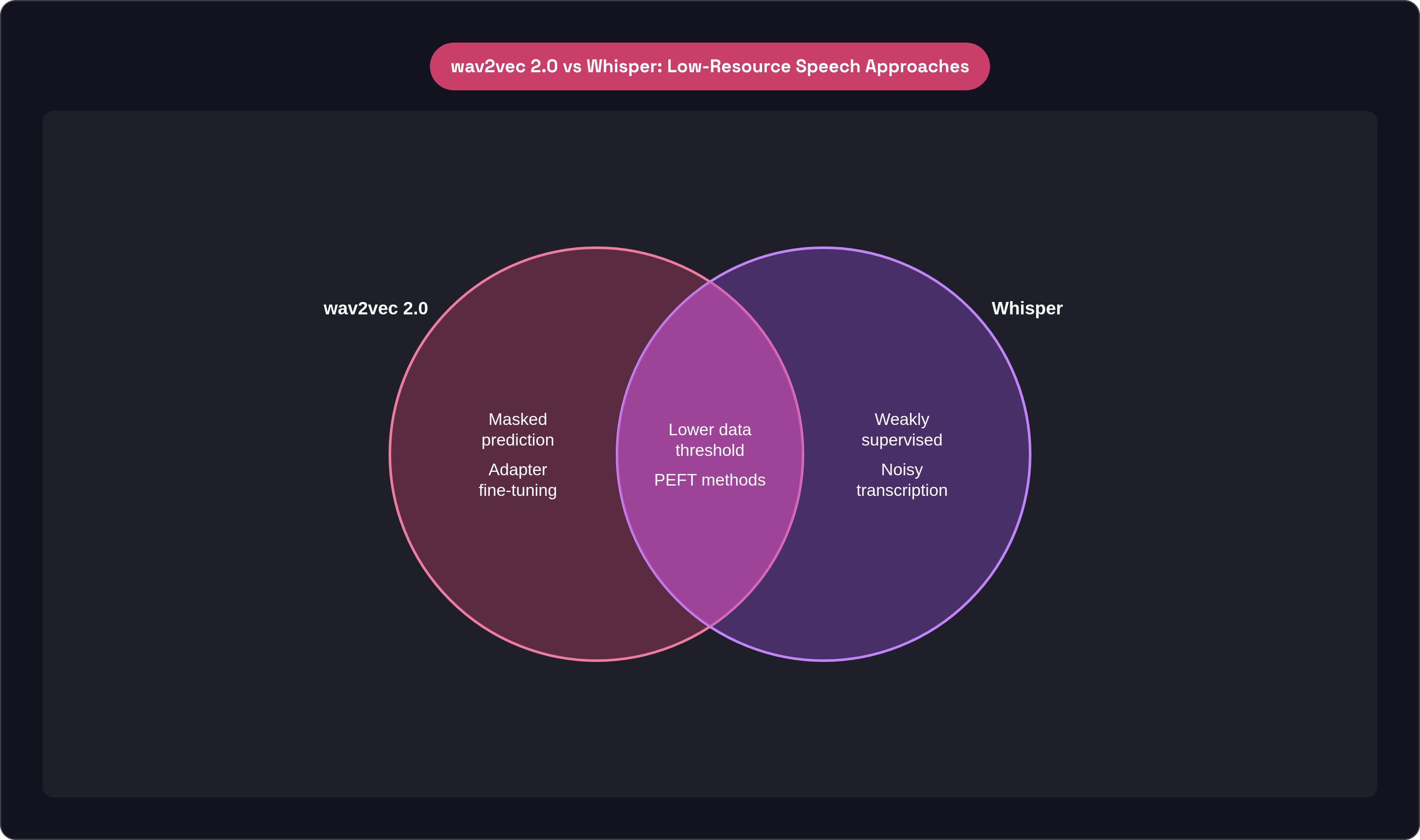
Self-supervised pre-training dismantles that assumption at the root. Models like wav2vec 2.0 learn speech representations from raw, unlabeled audio through masked prediction and contrastive objectives, pushing the transcription requirement downstream into a fine-tuning layer that can, in demonstrated practice, be quite thin. The pre-training language and the fine-tuning language don't need to match. A model pre-trained on a diverse mix of languages already encodes acoustic structure that transfers across them, which means you can front-load the heavy compute work on unlabeled data you can actually find and reserve scarce annotation effort for the narrow fine-tuning step.
Unlabeled audio is often obtainable even for languages with essentially zero annotated speech. Community radio recordings, religious services, informal video: findable for languages that lack a single hour of clean transcription. You pre-train or adapt a multilingual model on that unlabeled signal, then concentrate annotation effort narrowly. The scarcity problem doesn't disappear; it gets deferred to a step where it's manageable — like kicking a flat tire down the road until you can find a patch kit.
Whisper takes a complementary approach. Large-scale weakly supervised training across many languages, using noisy transcription at scale as a substitute for clean labeled corpora, works well for languages well-represented in web data. For languages underrepresented there, coverage thins out precisely where the need is greatest. This isn't a criticism of the approach so much as a structural observation about what web-scraped training data actually reflects about the world's linguistic distribution.
Both architectures land at the same practical conclusion: the labeled-data threshold required to reach usable accuracy has dropped substantially relative to earlier HMM-based pipelines. The benchmark for "enough data" has genuinely shifted.
Choosing the Right Source Language for Cross-Lingual Transfer
Cross-lingual transfer borrows learned representations from a resource-rich language and adapts them to a target language with little data. The concept is clean. The execution has one critical, frequently underappreciated variable: which source language you pick.
Transfer quality correlates directly with linguistic similarity between source and target. Phonological overlap, shared phoneme inventories, typological proximity: these determine how much of the borrowed representation structure is actually useful in the new context. A poorly chosen source language can produce a model that underperforms a generic multilingual baseline, which is a particularly demoralizing result when you've burned real engineering time getting there. The acoustic features of an unrelated source language are essentially noise from the target language's perspective, no matter how beautifully the source model was trained — like trying to use a map of Paris to navigate Tokyo.
The practical heuristics are well-documented. Language family membership is the first filter. Tonal languages transfer better from other tonal languages; morphologically complex languages benefit from similarly inflected sources. These aren't subtle effects you need to measure carefully; they're large enough to drive architectural decisions before any training runs begin.
Multilingual acoustic model pooling, explored in research on related language families including Malayo-Polynesian, Indo-Aryan, and Dravidian groupings, offers a complementary strategy: pool data across related languages into a single model so that an unseen target language has a close neighbor present to guide adaptation. This also helps with catastrophic forgetting, because the model retains cross-lingual structure rather than overwriting it during target-language fine-tuning.
When no closely related language has sufficient resources either, linguistic similarity offers diminishing returns, and you have to lean harder on everything else in the stack. Source language selection is a meaningful lever, not a guaranteed one. Knowing the difference saves weeks.
What to Do When Even Pre-Trained Models Need More Data to Work With
Pre-trained multilingual representations are a starting point, not a finish line. For the most severely under-resourced languages, even the small annotated set required for fine-tuning is hard to assemble. Several approaches address this directly, and they work best in combination.
Audio-level augmentation, speed perturbation, pitch shifting, room simulation, noise injection, generates variation from limited recordings without changing linguistic content. The ceiling is real and worth acknowledging: augmentation multiplies what exists; it doesn't expand linguistic coverage. Teams that treat augmentation as a substitute for more data rather than a complement to it eventually hit that ceiling hard.
Pseudo-labeling works differently. Run a partially trained model on unlabeled audio to generate transcripts, filter to the highest-confidence outputs, fold those examples back into training, retrain. Iterative and scalable once any model exists at all, which is why it pairs naturally with self-supervised initialization. The model bootstraps itself upward.
Cross-lingual TTS for synthetic data generation extends the transfer principle further: generate target-language audio using a TTS system trained on related languages, then use that synthetic audio to augment ASR training. You're borrowing not just representations but generated speech.
Mozilla Common Voice, which was collecting data for more than 120 languages as of 2024, has become a significant pipeline for new low-resource corpora. The dual-review validation gate matters more than the raw volume. Without quality control, crowdsourced data introduces noise that degrades model performance faster than added volume improves it; this is a real and well-documented concern.
Religious and public domain text readings, the strategy behind Meta's MMS dataset and the OpenBibleTTS project, provide a reproducible path to tens of hours per language at relatively low cost. The tradeoff is domain narrowness. A model trained on scripture performs well on scripture, which is useful for approximately one deployment context.
Parameter-Efficient Fine-Tuning as the Bridge from Pre-Trained Model to Deployable System
Full fine-tuning of large multilingual models is, for many low-resource practitioners, simply not viable. GPU memory requirements are substantial, training time is long, and the risk of catastrophic forgetting scales with model size. Parameter-efficient fine-tuning methods exist to solve exactly this problem.
Adapter modules insert small bottleneck layers into frozen transformer blocks. Only the adapter weights update during fine-tuning; the pre-trained representations stay intact. This isolates language-specific adaptation from shared acoustic features, which is particularly useful when the same model must keep serving multiple languages after a new one is added. Adapter-based fine-tuning of pre-trained wav2vec 2.0 models has produced measurable relative word error rate improvements across multiple low-resource languages in published research; the results are consistent enough that the approach is worth defaulting to unless there's a specific reason not to.
LoRA decomposes weight updates into low-rank matrices, achieving strong adaptation with a fraction of the trainable parameters. Its application to Whisper for low-resource languages has been explored in the literature. LoRA is typically faster to configure and fits well when the base model is a transformer with well-understood attention layers and you want to move quickly.
Both approaches address catastrophic forgetting by design. The choice between them is largely practical: LoRA for speed and simplicity; adapters when surgical control over language-specific behavior is required. Teams that spend more than a few days on this decision have usually lost the plot, because the real bottleneck is the data, not the adaptation method.
At the extreme end of the data spectrum, meta-learning frameworks targeting ASR through in-context learning strategies have been proposed in the research literature. These remain research-facing rather than production-ready, but they define the frontier of what's possible when the data problem is genuinely unsolved rather than merely difficult.
How These Techniques Combine in Practice: Lessons from Large-Scale Multilingual Systems
Meta's MMS project is the clearest documented example of the full stack working at scale. Self-supervised wav2vec 2.0 pre-training, multilingual pooling, and a corpus built from New Testament readings averaging around 32 hours per language produced ASR coverage across more than 1,100 languages and a language identification model covering 4,000-plus languages, per Meta's published research. The word error rate reduction MMS achieved over Whisper on the FLEURS benchmark, using considerably less labeled data, is direct evidence that targeted multilingual training with the right data sourcing strategy can outperform raw scale. More data doesn't always win; sometimes it just obscures a better approach.
The Typhoon-Audio model for Thai demonstrates the same stack working at regional scale. A regionally focused model combining targeted pre-training and fine-tuning reached competitive performance on both English and Thai benchmarks, as reported in its published evaluation. Nothing exotic about the architecture; it's the same sequence applied with regional specificity rather than global ambition.
TTS for low-resource languages follows a parallel pattern. VITS or FastSpeech2 base models fine-tuned on crowdsourced data have enabled deployable synthesis for languages including Luganda, Kiswahili, and several North American Indigenous languages in contexts where nothing existed before.
What none of these systems fully resolves is domain mismatch. A model trained on Bible readings or Common Voice utterances will struggle to generalize to conversational speech, medical dictation, or customer-service interactions without additional in-domain data. Teams tend to discover this after they've declared victory on the accuracy benchmark, which is a predictable and preventable sequence of events. Domain adaptation is a distinct problem with its own data requirements, and deferring it doesn't make it smaller.
What Deployable Low-Resource Speech Models Actually Require Beyond Accuracy
Word error rate matters. It is also only part of the story, and treating it as the primary success criterion has burned teams before.
A model that achieves low error rates on a benchmark but cannot respond in near-real time fails a conversational voice agent use case regardless of transcription quality. Latency is a hard production constraint, not a performance-tuning consideration you get to revisit after launch.
Speaker diversity matters in ways that benchmarks routinely underweight. A model trained on a narrow demographic of speakers, which many crowdsourced corpora produce even inadvertently, will degrade on speakers outside that distribution. For languages with regional dialect variation or significant interspeaker phonological differences, this is a production risk that surfaces in the first week of deployment, not during evaluation. The benchmark looked fine; the users are different people.
TTS for low-resource languages carries an additional requirement beyond intelligibility: synthesis has to sound natural to a native ear. Monotone output, even when phonetically accurate, reduces adoption in ways that word error rate metrics won't capture. Native speakers recognize when synthesis sounds wrong immediately, and they disengage from products that feel like they're being read to by a machine performing a bad impression of their language.
The practical question for enterprises and developers building multilingual products is whether to train custom low-resource models or deploy a platform with existing multilingual coverage. The build-vs-deploy tradeoff depends on language specificity, available data, and engineering capacity. For languages firmly in the low-resource category, building the full stack in-house is a significant undertaking with meaningful lead time; the honest question is whether a platform's existing coverage is close enough to production-ready before committing to the alternative.
ElevenLabs, an AI audio platform for voice cloning, text-to-speech, and conversational voice agents, covers dozens of languages with a low-latency architecture aimed at real-time agent deployment; fine-tuning on small labeled datasets is one mechanism for extending coverage toward underserved languages rather than requiring large transcribed corpora from scratch. The Everlywell deployment, which used ElevenLabs' conversational voice agent capabilities for healthcare applications, is a cited case study of the platform approach in a production context; specific figures should be verified against Everlywell's published results before being used as a benchmark.
Understanding the training stack matters even for teams that will never build it themselves. It clarifies what to evaluate in a platform, what quality ceiling any given approach is likely to hit, and where gaps are most likely to appear as coverage extends further down the resource spectrum. The languages that remain uncovered are uncovered for reasons of resourcing and prioritization, not because the problem is unsolvable.