Domain-Specific STT Fine-Tuning for Medical and Legal Transcription
Fine-tuning adapts speech models to medical and legal vocabularies where general models fail.
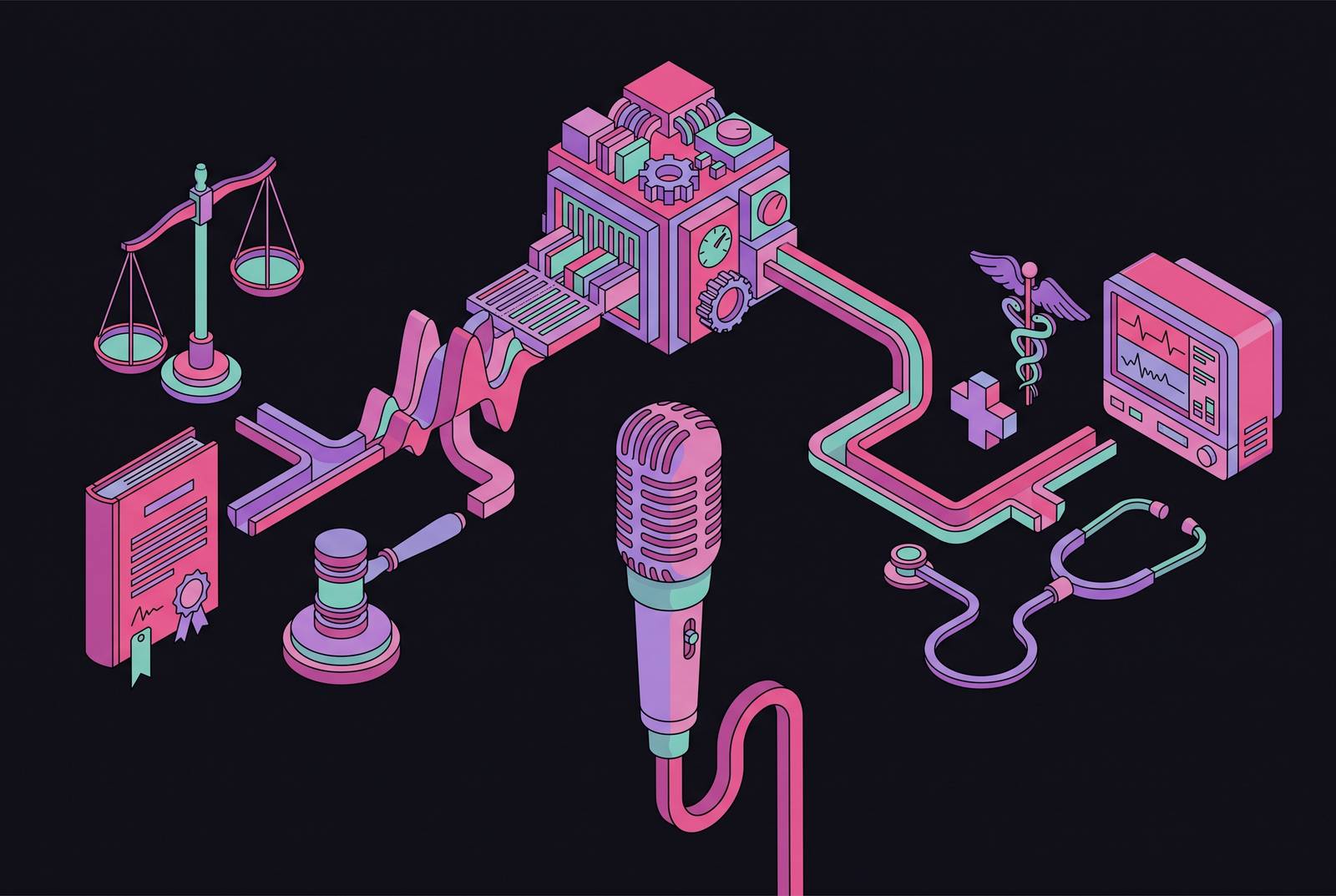
Speech recognition models built for general use fall apart the moment they meet a radiologist's dictation or a deposition transcript. Whisper, trained on 680,000 hours of audio with 1.55 billion parameters in its largest configuration, generalizes across languages and accents about as well as anything on the market. It was built without fine-tuning for any specific use, and that detail is the whole story. A model optimized to cover everything sacrifices depth in anything specific, because breadth and depth pull in opposite directions and no amount of scale changes that math. Medical and legal transcription sit exactly where that tradeoff bites hardest, and fine-tuning is the engineering fix that has emerged to close the gap. Anyone still shipping a raw general model into a hospital or a courtroom is making a bet the data below says they'll lose.
What makes medical and legal language structurally different from general speech
Medical vocabulary runs on Latin and Greek roots, drug names that sound alike on purpose or by accident, and abbreviations that shift meaning across specialties. Legal language carries its own dead-language baggage (res judicata, voir dire), plus case citations, jurisdiction-specific phrasing, and a formal written register that people nonetheless speak out loud in depositions and hearings. Neither looks anything like the the general-purpose audio that makes up most training data. So when a model built on that data hits these terms, the errors aren't just wrong spellings. They're wrong meanings. A missed Latin phrase in a contract or a misheard drug name in a chart note isn't cosmetic; it changes what the document says.
Acoustics make it worse, not just different. Clinical settings stack background noise, a clinician and patient talking over each other, and dictation from three feet off the mic. Courtrooms bring accented speech, cross-examination at a clip that would exhaust a court reporter, and overlapping voices general models rarely see in training. Stack the acoustic problem on top of the vocabulary problem, and it's obvious why raw word error rate, the standard measure of how many words a model gets wrong, tells you so little here. What matters is domain-specific accuracy: how the system handles the ten words in the sentence that actually carry legal or clinical weight, not the other ninety that would be fine in any context.
How badly general models fail when put to the test in specialist settings
A domain study on Korean meteorological terminology gives a useful gut check on scale. Google's STT model posted error rates as high as 20.38% on domain-specific test sets there, and got beaten by Whisper Large-v2, a model with no specific training in that domain. Translate 20.38% into plain terms: roughly one word in five comes out wrong. Put that in a clinical note or a legal filing and the document needs a human to walk through it line by line, which defeats the point of automating the transcription in the first place.
Legal transcription fails in a meaner way. Errors don't spread evenly across a transcript; they cluster on the exact words carrying the legal weight, the Latin phrase, the citation, the defined term the whole contract hinges on. A 5% or 10% error rate sounds tolerable until that error rate turns out to sit entirely on the terms a judge or opposing counsel would flag. None of this reads as a bad day for one model. It reads as the baseline condition for general models pointed at specialist domains, and the panel evaluating any vendor pitch should start from that assumption, not from the marketing slide.
What fine-tuning actually does to a model's internals when it adapts to a domain
Fine-tuning doesn't start over. It nudges a small slice of the model's internal representation toward the target domain while leaving most of what the model already knows untouched. Research out of the University of Copenhagen, UC Santa Barbara, and IIT Delhi backs this up directly: domain fine-tuning shifts only a small subset of the representational subspace, and the pre-trained model's general knowledge stays largely intact underneath it.
In practice, that means the model's guesses about which word comes next shift toward domain terms, its sense of what "normal" audio sounds like updates to match the recordings it trained on, and its internal language model picks up domain syntax, the particular way clinicians or lawyers phrase things out loud. Push too hard on this, though, and the model starts forgetting what it knew before. That's called catastrophic forgetting, and it's a real risk with narrow, aggressive fine-tuning. LoRA, one of the lighter-touch fine-tuning methods, is designed to learn less and forget less than full fine-tuning does. The base model's broad competence survives while the domain adaptation layers on top of it instead of replacing it, which is the point rather than a limitation.
The practical toolkit: LoRA, QLoRA, synthetic data, and what each buys you
LoRA, short for Low-Rank Adaptation, trains a small set of added weight matrices instead of retraining the whole model. It plugs neatly into Whisper's encoder-decoder architecture and gets solid results on modest compute. For most teams without access to substantial specialized compute, this should be the default starting point, not full fine-tuning.
QLoRA compresses the same idea further by quantizing the model, cutting memory needs enough to run adaptation on modest hardware, which matters for hospitals running things on-premise instead of in the cloud. Full fine-tuning, retraining the whole model, still has a place for organizations sitting on large proprietary datasets and the compute to match, but it carries the higher forgetting risk and only earns its cost when the deployment is narrow and well-defined. Most teams overestimate how much data and compute they need before they've even tried LoRA, and that overestimation is often the real reason a fine-tuning project stalls before it starts.
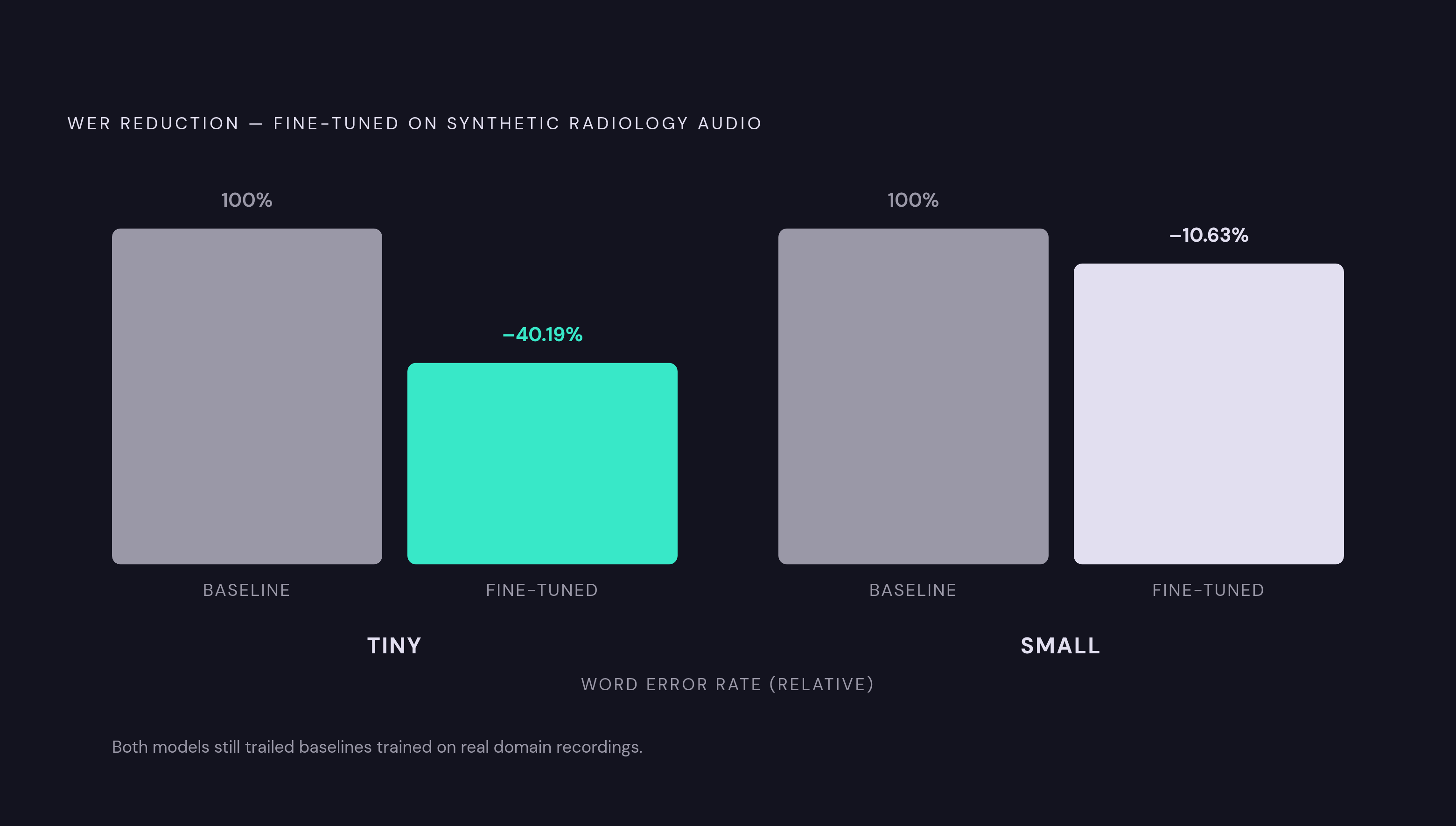
Then there's the workaround for teams that don't have enough real domain audio to fine-tune on at all. A radiology study used GPT-4o to write synthetic radiology text, ran it through text-to-speech to generate audio, and fine-tuned on that. The pipeline lifted accuracy on WhisperX Tiny and Small models by 40.19% and 10.63% over baseline, respectively, though both still trailed models trained on real recordings. Synthetic audio is clean in a way real recordings never are: no coughing patient, no hallway noise, no overlapping voices, and that gap matters when the deployment target is a noisy exam room rather than a quiet studio. Still, the data threshold for real gains is lower than most people assume. One published study fine-tuned Whisper-small on just 8.5 hours of in-domain medical audio and got a measurable jump over baseline. Training tricks like noise injection and random audio clipping, both used in IBM's Granite model training, add another layer of resilience for anyone deploying into a genuinely noisy environment.
What fine-tuned medical STT looks like when it works: published benchmarks
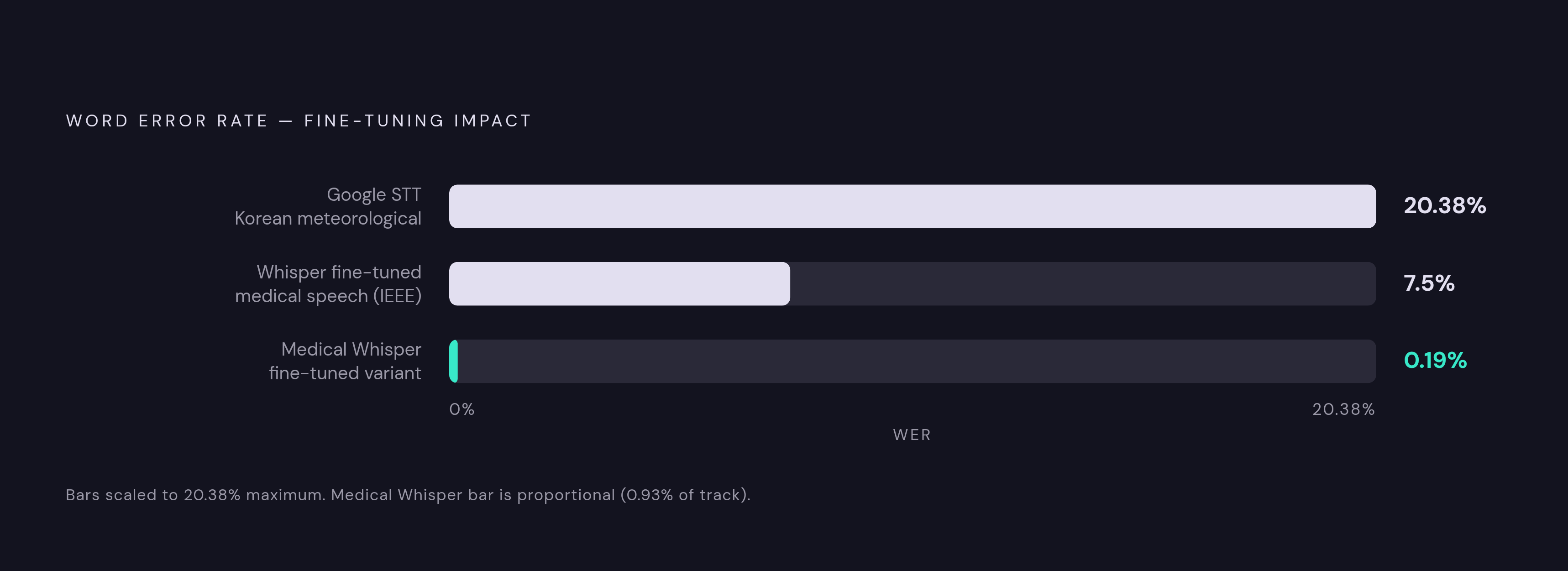
An IEEE study fine-tuned Whisper on medical speech data and landed at a 7.5% word error rate, a stark contrast against the 20.38% failure case from the general model tested on an out-of-domain specialty. Esperanto Technologies went further with "Medical Whisper," a fine-tuned Whisper variant paired with Pyannote for speaker recognition, posting a word error rate of 0.19 and a character error rate of 0.10, beating every foundation model tested, Whisper Large V3 included, on its validation set.
Speechmatics' Medical STT model, released in September 2025, claims 93% general real-world accuracy with 50% fewer errors on medical terms compared to competing tools, and a 7% word error rate that puts it roughly on par with human transcriptionists for general medical vocabulary. It ships in Spanish, French, Dutch, and Finnish, and it's built specifically to handle multi-speaker dialogue rather than single-speaker dictation. Language and accent turn out to be their own fine-tuning axis, separate from vocabulary entirely, a point vendors selling a single benchmark tied to one language tend to leave out of the pitch.
A November 2025 study out of Bern University of Applied Sciences tested six German-capable STT systems in simulated emergency medical services conditions: noisy, multilingual, field-realistic in a way lab benchmarks rarely bother to be. It's the most useful reality check in this body of research, because lab word error rate doesn't reliably predict what happens when the microphone is clipped to a paramedic's vest at 2 a.m. Across all these results, the pattern holds: fine-tuning closes most of the gap with human transcriptionists, and what error remains sits on rare terms, overlapping speech, and background noise. Those are the hard cases left standing, and no amount of additional fine-tuning epochs seems to fully erase them.
The legal domain's fine-tuning problem and why it lags medical
Medical fine-tuning got a head start because clinical audio, electronic health records, and institutional pressure (physician burnout chief among them) built a data pipeline and a funding case at the same time. Legal transcription has neither in comparable volume. Court reporters exist precisely because legal proceedings have resisted full automation, and the data infrastructure that would train a legal-specific model isn't there yet at medical's scale.
The multilingual angle makes it worse. In the JUST-NLP 2025 legal machine translation shared task, fine-tuning a model called OPUS-MT on a legal corpus scored 46.03 on the SacreBLEU metric, beating both weaker baselines and models trained from scratch. But Indian languages, among others, often lack large, clean parallel corpora, so even fine-tuning runs into a wall the model itself can't fix. The lesson carries straight over to speech: domain adaptation beats training from scratch by a wide margin, but it doesn't solve data scarcity, it just relocates the bottleneck from model architecture to corpus building. The synthetic pipeline built for radiology, LLM-generated text converted to speech and used as training audio, applies just as well to legal work where real annotated audio is scarce or locked behind confidentiality.
And confidentiality is the actual wall here, not lack of demand. Depositions, court records, and legal filings can't be pooled across firms or vendors the way clinical audio sometimes is through institutional data-sharing. Any argument that legal STT lags medical because lawyers don't want the technology gets the causation backwards: the corpus that medicine built through institutional data-sharing simply has no legal equivalent, and confidentiality law guarantees it won't get one soon.
How the ambient AI scribe market has productized medical STT fine-tuning at scale
The medical transcription software market was valued at $2.55 billion in 2024, with projections putting it at $8.41 billion by 2032, a 16.3% compound annual growth rate. Fine-tuned STT is the engine underneath that number. Vendors including Abridge, Ambience Healthcare, Microsoft's Dragon Copilot (formerly Nuance DAX), Suki AI, and Nabla ship their products as cloud-based software, and the money has followed: Dragon Copilot runs across more than 550 health systems, and investors put close to $1 billion into ambient AI scribe companies in 2025 alone. Abridge raised $550 million across two rounds that year, and Ambience Healthcare closed a $243 million Series C at a $1.25 billion valuation.
Pricing spans a wide range as of 2026. Individual-clinician tools like Freed run around $99 a month, Abridge sits near $208, Suki runs $299 to $399, Dragon Copilot lists at $369 and up, and enterprise deployments like Ambience run $300 to $500-plus monthly. Abridge won Best in KLAS for ambient AI in both 2025 and 2026, which tells you which product the hospitals themselves rate highest, not just which one raised the most money.
Adoption tells a messier story than the pricing does. Kaiser Permanente reports somewhere around 65 to 70% of physicians using elements of Abridge. UC San Francisco has about 800 of 2,000 eligible ambulatory providers on board, roughly 40%. UC Davis Health sits at 350 of 800 eligible physicians, about 44%, adding 100 clinicians a month. Providence Health has 1,700 providers, around 26%, using Microsoft's scribe tools. That spread between the highest and lowest adopters isn't a technology gap: the underlying models perform comparably well across these systems. What differs is workflow habit, clinician trust, and how deeply IT actually wires the tool into the existing chart.
What real deployment outcomes show about fine-tuned STT's effect on clinical practice
The Permanente Medical Group rolled out ambient AI scribes in late 2023 and tracked more than 2.5 million patient encounters. Per NEJM Catalyst, users saved an estimated 15,700-plus hours compared with nonusers over the study period, the equivalent of 1,794 working days handed back. At one TPMG site, physician burnout scores dropped from 51.9% to 38.8% within thirty days of adoption. That's a striking number, and it's also a single uncontrolled site over a thirty-day window, so it reads as a promising correlation, not proof, until a controlled follow-up backs it up.
UCLA Health ran what its team called the first randomized trial to rigorously test AI scribes, from November 4, 2024 to January 3, 2025. Physicians were split randomly between Nabla, Dragon Copilot, and usual care, all integrated into Epic. Physicians using Nabla saw a measurable reduction in the average time spent writing a note compared with the control group. A separate independent randomized trial of 238 physicians, published in 2025, found a different pattern of results for Dragon Copilot against usual care. Two trials, two different tools, two different answers.
That split is the finding, not a loose end to explain away. Fine-tuned STT accuracy is necessary for these tools to work at all, but accuracy alone doesn't guarantee time savings, and vendors who sell on word error rate alone are selling half the product. What determines the outcome is how tightly the tool gets stitched into the actual documentation workflow, not how clean the transcript reads on paper.
What the engineering and deployment evidence means for teams building or procuring domain STT today
The question facing teams building or buying domain STT isn't whether to fine-tune. That part is settled: general models fail too specifically and too consistently in medical and legal contexts for anyone to bet on them raw. Choosing the right fine-tuning path means matching it to the data an organization actually has and the constraints it has to deploy inside, and most teams get this backwards by reaching for full fine-tuning when LoRA would do the job for a fraction of the compute.
Data availability decides the path. Organizations sitting on real proprietary audio, clinical recordings, deposition transcripts, should build with LoRA directly on that data; it's cheaper on compute and holds onto general capability better than full retraining ever will. Organizations without that kind of archive should treat synthetic data pipelines as the starting point, not as a stopgap while waiting on a data-collection effort that may never reach critical mass. Either way, the lesson from every benchmark here holds steady: the gap between a general model and a fine-tuned one is substantial. It's the difference between a transcript that needs a full human rewrite and one that needs a spot check, and that difference is the entire business case.