Voice Cloning Detection Adversarial Robustness in Real-World Deployments
Detectors trained on clean audio fail when voices travel through noisy, compressed channels.
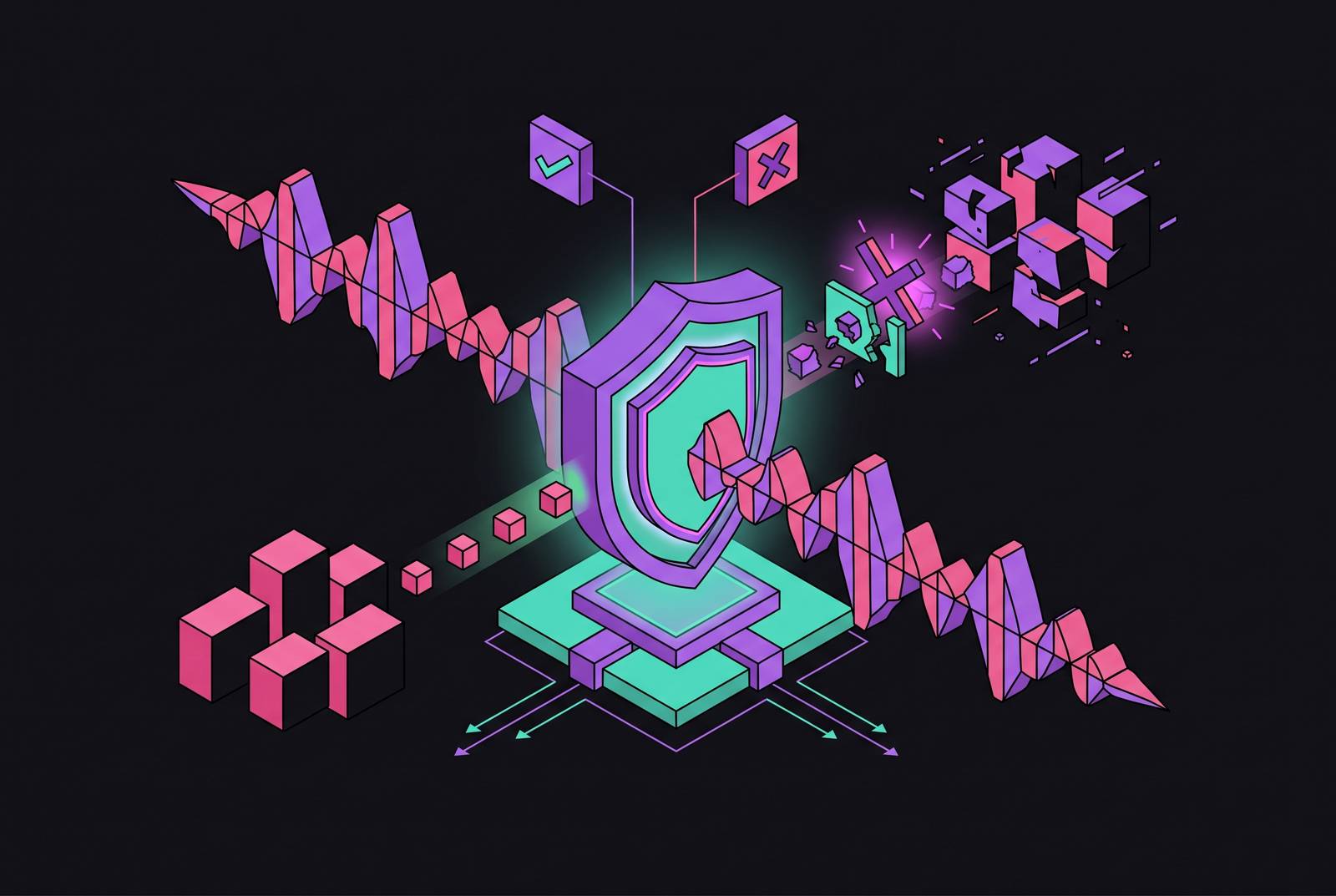
Voice cloning detection faces both deployment and accuracy problems. Detectors that excel on controlled benchmarks can fail on the noisy, compressed, multilingual audio they must judge in practice. Closing that gap requires more than a better classifier. It requires testing against the actual audio pipeline and combining passive detection, watermarking, and consent controls without mistaking any one of them for a complete defense.
Why voice cloning detectors that ace benchmarks fail in production
A detector can get near-perfect accuracy on a controlled benchmark and still fail when the audio comes through a telephone channel. The benchmark measures performance against known generation systems and controlled acoustic conditions, answering a narrower question than deployment among unfamiliar voices, channels, and manipulations asks. That narrow result can then be used to claim that the detector protects against more than the test covered.
The mechanism is “domain amnesia.” Classifiers trained on a fixed set of text-to-speech artifacts learn those signatures so thoroughly that they lose the ability to generalize to unseen generation systems or acoustic environments. A benchmark can reward the former while a production system depends on the latter.
AudioSeal’s ICML 2024 paper describes passive detection as reactive by its nature because it tells natural from synthesized audio only after generation has happened. Its evidence comes from the differences the generator leaves behind. As generation improves and synthetic speech becomes indistinguishable, that evidence shrinks. The classifier is therefore pursuing a moving target while also depending on the audio channel to preserve the clues it knows how to read.
The four real-world conditions that break detectors
Background noise begins the problem before the cloned voice is generated. RVCBench shows that voice cloning performance deteriorates sharply under common input shifts, including noisy reference audio encountered in nearly every real deployment scenario. This changes how the clone is produced, with noise in the input as well as possible interference in a finished recording. For a detector trained on artifacts from clean inputs, that distinction is important. The generation process itself has been pushed outside the setting the classifier learned.
Codec compression introduces a different mismatch after generation. Telephony codecs and bandwidth constraints can degrade the channel enough to markedly reduce detector reliability, placing the problem directly on the route used for enterprise fraud and voice authentication. The ordinary telephone channel is doing its ordinary job, with consequences for a detector that expects a different version of the signal.
That makes compression more than a minor quality issue. Whether the detector can still distinguish natural from synthetic speech after the channel has altered the audio remains an operational question. Success on a clean recording does not answer it. Nor does a convincing demonstration outside the telephony path establish how the system will perform within it. The evaluation needs to include the channel, which can explain poor results when left to a footnote.
Cross-lingual inputs shift the language conditions. RVCBench identifies cross-lingual and long-context scenarios as sources of stability limitations, exposing a gap in the behavior of cloning models and the detectors trained to catch them. A detector’s competence cannot simply be assumed to travel with the voice. Language changes are another test of whether it has learned a general distinction or a narrow collection of familiar signatures.
Adversarial perturbations add deliberate interference to these ordinary variations. Both passive noise and proactive perturbations influence generation robustness in ways detectors may not have been trained to handle. De-AntiFake, presented at ICML 2025, demonstrates that protective perturbations intended to prevent unauthorized cloning can be neutralized through a two-stage purification attack. The adversarial surface cuts both ways. A perturbation can be a defense, but it can also become the object of an attacker’s countermeasure, while noise, compression, and language shifts continue to coexist around it.
How open-source model proliferation widens the gap detectors cannot close alone
Changes in the sound would be hard enough to handle if generation systems stood still. They do not oblige. Each new open-source cloning model introduces artifact signatures a passive detector has never seen, keeping detection behind the generation frontier. A classifier built around a fixed or slowly changing set of generators is structurally mismatched to this environment.
Multiple providers now sell Zero-shot voice cloning, so convincing cloning from a short audio sample is widely available. At the same time, codec-token language models and diffusion-based text-to-speech keep introducing new generation approaches and novel artifacts. MFCC-based detection methods are insufficient as a universal anti-spoofing tool precisely because they cannot generalize across different cloning algorithms. An artifact is a clue.
An open-source cloning model can have its built-in watermarking module removed before deployment, so mandates applied only to licensed providers leave that attack surface untouched. The resulting gap is about coverage as well as recognition. A detector cannot rely on a deliberately embedded signal being present when the generation pipeline can opt out of embedding it.
De-AntiFake adds a further complication by documenting how determined attackers evaluate and defeat protective perturbations under threat models that include purification. Defensive modifications are not beyond examination simply because they were designed to protect a voice. Once attackers can work against the protection itself, robustness has to include that encounter.
What proactive watermarking offers and where it still falls short
Proactive watermarking changes the source of the evidence. Instead of asking a classifier to infer synthesis from incidental artifacts, it embeds a verifiable signal at generation time. The signal is intentional. Its usefulness, however, still depends on whether it survives the edits and compression between generation and verification.
AudioSeal uses a jointly trained generator and detector to support localized watermark detection at the sample level. Its single-pass detector runs orders of magnitude faster than earlier methods, so it can be used for large-scale and real-time applications.
The same paper reports robustness across a wide range of audio edits but identifies an important security condition. The detector’s weights must remain private. If those weights are exposed, adversarial attacks can be forged against the watermark. Robustness therefore depends partly on an operational boundary outside the audio itself, and a production deployment inherits responsibility for maintaining that boundary.
SSTMark challenges a deeper assumption about where a speech watermark should live. Most existing signal-level methods embed information in waveforms or spectrograms, whose acoustic details can be substantially altered by MP3 compression, Opus encoding, neural codec reconstruction, and speed perturbation. Those changes can weaken or destroy the evidence used for verification.
SSTMark instead places the watermark in the linguistic content conveyed by speech and detects it from recovered text. The shift is from sound to language. AudioMarkBench results show stronger average robustness across signal-processing and compression edits than the AudioSeal, WavMark, Timbre, and AudiowMark baselines. This is genuine progress because it changes which part of the speech must preserve the evidence, rather than simply strengthening a mark in the same vulnerable acoustic representation. Stronger average robustness remains a comparative result limited to average performance.
Timbre watermarking takes another route, embedding in the frequency domain with a repeated embedding strategy. Its framework demonstrates resistance to reconstruction-based removal and overwriting attacks in services including PaddleSpeech, Voice-Cloning-App, and so-vits-svc. These findings show that watermark defenses have more than one promising design.
Why compliance frameworks built on fragile detection assumptions create a false sense of security
The distinction between embedding a watermark and reliably detecting it becomes sharper when watermarking serves as a compliance mechanism. Emerging regulations assume a level of robustness that the research record does not yet warrant. An embedding requirement governs an action at one point in the pipeline. It does not, by itself, establish that the evidence remains usable after compression, speed changes, or deliberate removal attempts.
China’s national standard GB 45438-2025, “Cybersecurity Technology – Labeling Method for Content Generated by Artificial Intelligence,” took effect in 2025 and adds a third regulatory layer to a compliance burden that is now global. More disclosure obligations can widen the scope of implementation without resolving whether a label survives the conditions under which detection is needed.
A system can satisfy the letter of Article 50 by embedding a watermark yet leave the threat model unaddressed if that mark can be removed through codec compression, speed perturbation, or adversarial purification. Evidence of embedding and evidence of durable detection support different claims, even when a compliance process treats them as interchangeable.
Without mandates extending to open-source model developers and robustness standards for detection tools, disclosure infrastructure can be bypassed where the highest-risk cloning occurs. Neither gap is purely a paperwork problem. The rules require disclosure, but their value in practice depends on how well the tools work and whether generation pipelines accept the controls.
What robust detection actually requires in a production pipeline
For production teams, the lesson is to combine defenses that address different parts of the threat surface. Passive classifiers examine the generated audio, proactive watermarking supplies intentional evidence, and consent infrastructure establishes permission before cloning. None replaces the others. A layered pipeline is useful precisely because the mechanisms do different jobs, rather than because several versions of the same fragile assumption would be safer.
Detector training must include the acoustic conditions of the intended deployment. For telephony, that means codec-degraded audio rather than clean recordings standing in for the channel. Training also needs noisy reference recordings, cross-lingual inputs, and known adversarial perturbation types. Restricting training to clean studio recordings recreates the domain amnesia that makes benchmark performance such a poor guide to operational reliability.
RVCBench provides a standardized, open-source testbed designed to support more robust and deployable voice cloning models. It tests post-processing conditions and adversarial perturbations across the full generation pipeline. Testing that much of the pipeline matters because a failure can start with the reference recording, arise during generation, or come after downstream processing.
Live streaming and voice-based authentication add a hard real-time constraint. Teams therefore need to evaluate model pruning, quantization, and edge deployment for both speed and any degradation in adversarial robustness caused by compression. Faster is not automatically more deployable. An optimization that meets the latency requirement but weakens the defense trades one failure in production for another.
Watermark deployments also need to treat detector weights as a security asset where the framework requires secrecy. For AudioSeal, keeping those weights private is an explicit condition. Consent-first modeling belongs beside that technical work, with explicit, documented permission through opt-in agreements and digital contracts before cloning. Such agreements cover licensed providers, but they do not substitute for robustness engineering against unconsented cloning through open-source tools.
Sources
- De-AntiFake: Rethinking the Protective Perturbations Against Voice Cloning Attacks
- SSTMark: Robust Training-Free Semantic-Level Speech Watermarking
- Proactive Detection of Voice Cloning with Localized Watermarking
- Detecting Voice Cloning Attacks via Timbre Watermarking
- RVCBench: Benchmarking Robustness of Voice Cloning Across Modern Audio Generation Models
- Degrading Voice: A Comprehensive Overview of Robust Voice Conversion Through Input Manipulation
- ADD 2023: the Second Audio Deepfake Detection Challenge
- Measuring the Robustness of Audio Deepfake Detection under Real-World Corruption