TTS for Audiobook Production Pipelines
AI voices now handle audiobook backlogs that human narrators alone cannot scale to meet.
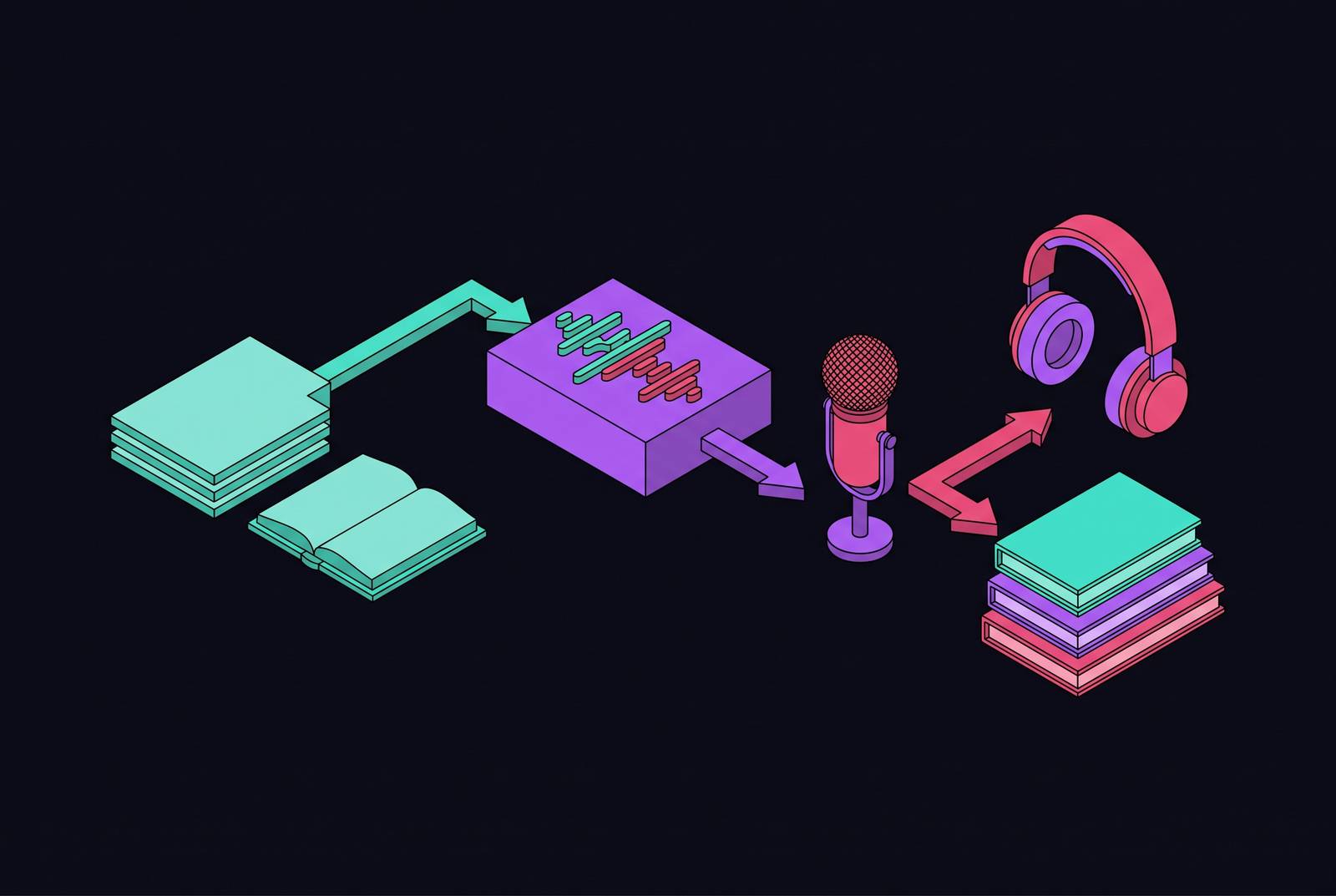
The audiobook market sat at roughly tens of billions of dollars in 2025, on track for $93.15 billion by 2034. Studio bookings, sound engineers, and narrators reading page by page cannot cover that kind of growth. TTS is now infrastructure for the industry, though bolting a speech model onto a manuscript and hitting export produces uneven results at best. A pipeline that works at industrial scale treats text prep, chunking, voice matching, quality review, and delivery formatting as five separate engineering problems, each with its own way of breaking. Get one wrong and the other four don't save you.
Only about 5% of published books exist as audiobooks today, and the other 95% is backlog, sitting there waiting for someone to voice it without bankrupting the project. That gap matters more than the growth chart usually gets credit for.
What TTS for audiobooks actually has to do that shorter-form synthesis doesn't
A voice assistant reading a weather forecast can flub a word and nobody cares, but a ten-hour audiobook cannot afford that slip; errors compound, and listeners notice fatigue creeping in long before they can name why. Long-form narration demands something short clips never worry about: the same vocal character, the same pacing, the same emotional temperature from chapter one through chapter thirty, held steady across hundreds of separate synthesis calls.
Neural TTS made this possible. These are end-to-end models trained on large speech datasets that generate waveforms directly, and they produce prosody and rhythm that older concatenative systems, the ones that stitched together prerecorded phoneme fragments like audio Legos, struggled with. That architectural shift is a big reason long-form AI narration holds together past the ten-minute mark, where earlier approaches broke down.
Fiction and non-fiction want different things from a voice model, and treating them the same is a common mistake teams make. Fiction needs character differentiation, an emotional arc, and pacing that shifts with the scene, while non-fiction, think business books, self-help, how-to guides, needs steady authority and clean delivery more than range, which is part of why AI narration has made the most inroads with human readers there first. Fiction remains the harder climb, and any pipeline has to know which of the two it's building for before a single line of code gets written.
Text preprocessing: the stage most teams underinvest in
Raw manuscripts are messy in ways that specifically break text-to-speech models. Scene-break symbols, stray em-dashes, inconsistent hyphenation, footnote markers, smart quotes that render oddly, leftover HTML tags, OCR garbage from a scanned paperback: none of it looks like much to a human skimming the page, yet all of it can make a TTS model stumble, mispronounce a word, or insert a pause where none belongs.
Skipping a dedicated sanitizer stage is a common shortcut teams take, and it tends to backfire. One documented approach runs a containerized pipeline with a sanitizer step ahead of synthesis, including an LLM inside that layer to catch what pattern-matching alone misses. Keeping that step separate, rather than hoping the TTS model infers its way through dirty text, is the decision that keeps the rest of the pipeline from falling apart later.
Abbreviations and numbers need rules, not guesses. Does "Dr." become "Doctor," or does the model read it as "drive"? Does "2024" come out as "two thousand twenty-four" or "twenty twenty-four"? Left to model inference, these choices flip inconsistently across a manuscript, and inconsistency is its own kind of error. Proper nouns are worse: an invented fantasy character's name, mispronounced once in preprocessing, gets repeated hundreds of times across a novel if nobody catches it before bulk synthesis starts, and correcting it means regenerating every affected segment.
Chapter and section boundaries get decided here too, not patched later, since clean segmentation is something preprocessing produces, not something a script fixes after the fact.
Chunking strategy and why segment size affects both quality and cost
TTS APIs cap how much text they take per call, so a 100,000-word manuscript has to be sliced into pieces before it reaches the model. Where those slices fall matters more than most production teams assume going in. Cut mid-sentence, and the model's prosody resets awkwardly at the seam; a listener hears it as a hiccup even without knowing what happened. Chunks that align with paragraph breaks, scene breaks, or chapter ends avoid that problem, matching the audio segmentation to boundaries that already make sense on the page.
Chunk size also sets the cost and error-recovery profile of the whole job. Smaller chunks mean more API calls, but they buy far more surgical control: if a segment comes out wrong, only that segment needs a redo, not the whole chapter. The extractor, sanitizer, chunker, TTS, muxer structure that shows up in open-source pipelines treats chunking as its own stage precisely for this reason. Chunking gets decided before the API is ever touched, not as a side effect of calling it.
Pacing cues, breath points, and pauses get inserted at these same chunk boundaries, often through SSML or platform-specific markup. This is the point where an editorial instinct, let this line land, then breathe, turns into a technical parameter alongside a narrator's gut call. And because chunks are discrete units, they parallelize: a batch job synthesizes dozens at once and lets the muxer reassemble them in order afterward.
Voice selection and cloning: matching voice to content category
Picking a voice isn't a matter of taste. Accent, apparent age, gender, and baseline warmth all carry genre expectations a listener brings in before the first sentence plays. A true-crime narrator and a business-book narrator aren't interchangeable briefs; they're different jobs entirely, even running on the same underlying model.
Voice cloning has gotten good enough that around 30 seconds of clean recorded audio can produce a synthetic voice that passes blind listening tests against the original speaker more than 90% of the time. That threshold changes who gets to narrate a book. An author records a minute of clean audio, uploads it, and gets a full-length narration back in a voice that sounds like their own, no studio booking required.
That same cloned voice model runs across languages, keeping a consistent vocal identity for an author whose book releases in English, then Spanish, then Japanese. Spines, after raising $22.5 million, rolled out author voice cloning and pushed its translation capability to seven languages, which says this workflow has moved past enterprise pilots and into ordinary self-publishing tools.
A QA gate before bulk synthesis still matters, though, since a cloned voice has to be checked against the source recording first. Skip that step and the failure mode isn't a typo; it's finding out the register was wrong only after hundreds of thousands of words have already been generated in it.
Choosing a TTS API for a production pipeline: what the options actually optimize for
There's no single best TTS API, because the options optimize for different things, and picking one means picking a tradeoff. Some TTS APIs are better suited to structured non-fiction and reference material where tonal color matters less than getting every word right. Multilingual breadth varies across providers, and that's a real differentiator for a pipeline producing the same title in English, Spanish, French, German, and Japanese from one workflow. Some APIs offer deeper enterprise customization, relevant for a publisher that wants a proprietary voice asset instead of a shared model available to competitors too.
Open-source options, some accessible through self-hosted deployment frameworks, trade a bit of polish for cost control and the option to run on-premise. For high-volume, cost-sensitive operations where enterprise licensing fees eat the margin, that trade wins almost every time, and a team defaulting to the biggest name instead may be paying for range it doesn't need.
The right pick follows from the brief, not from a leaderboard. Genre, number of languages, how much voice customization the project needs, whether the output is batch or streaming: answer those honestly and the API choice mostly makes itself.
Quality review at scale: why human ears still have a role
Generative TTS is nondeterministic. Feed it the same sentence twice and it comes back with two subtly different readings, which means quality can't be checked once and assumed stable across every re-run; it has to get checked every time.
Open-source tools like tts-audiobook-tool build this into the pipeline directly: each generated segment runs through speech-to-text validation, a word-error-rate score gets calculated, and any segment above the error threshold triggers automatic regeneration. The system can even generate a segment multiple times and keep whichever attempt scored fewest errors. That catches a lot: mispronounced names, dropped words, odd pauses, loudness spikes, clipping. What it doesn't reliably catch is a line that's technically correct but emotionally off, a joke read flat, a grief scene delivered like a shopping list.
That's where human review still earns its keep: first-chapter sign-off on how a voice actually sounds in context, spot checks at chapter transitions, final approval on any scene carrying real emotional weight. Non-fiction gets away with lighter review, since tonal flatness barely registers in a chapter about spreadsheet formulas, while fiction demands more scrutiny, and skipping that step is how a publisher ends up with a thriller that sounds like an owner's manual. Re-synthesis is cheap enough now that flagging and re-running a bad segment beats accepting it almost every time, which means that re-run automation belongs in the pipeline from day one, not stapled on after the first batch of complaints.
Delivery formatting and platform compliance
ACX, Findaway Voices, Kobo, and Spotify all accept AI-narrated audiobooks, and publishers working with these platforms are responsible for ensuring the voice is properly licensed and that any platform-specific disclosure or compliance requirements are met. Treating those obligations as an afterthought is how a finished catalog gets pulled from a storefront after the fact.
Distribution platforms typically enforce exact technical specs around file format, bitrate, loudness level, and noise floor. Synthesized audio doesn't arrive meeting those specs by default; it needs normalizing and mastering as its own post-synthesis step. Chapter files need individual labeling in the right sequence, and retail samples, usually the book's opening minutes, need to get pulled and formatted separately.
This is where the muxer stage from earlier in the pipeline either pays off or turns into a headache. If the chunking boundaries were sound going in, assembly into correctly ordered chapter files is mechanical, and if they weren't, the mess shows up here, right before delivery, the worst possible time to find it. Loudness normalization and cleaning up the noise floor are the two most common reasons AI-narrated audio gets bounced back by a platform, and both should run automatically rather than get handled by hand, title by title. Audible's managed AI narration program now covers more than 100 voices across English, Spanish, French, and Italian, and publishers working inside that system get some compliance steps handled for them. Anyone running an API-driven pipeline outside it owns every one of those steps directly.
The commercial reality: where AI narration earns its place and where it doesn't yet
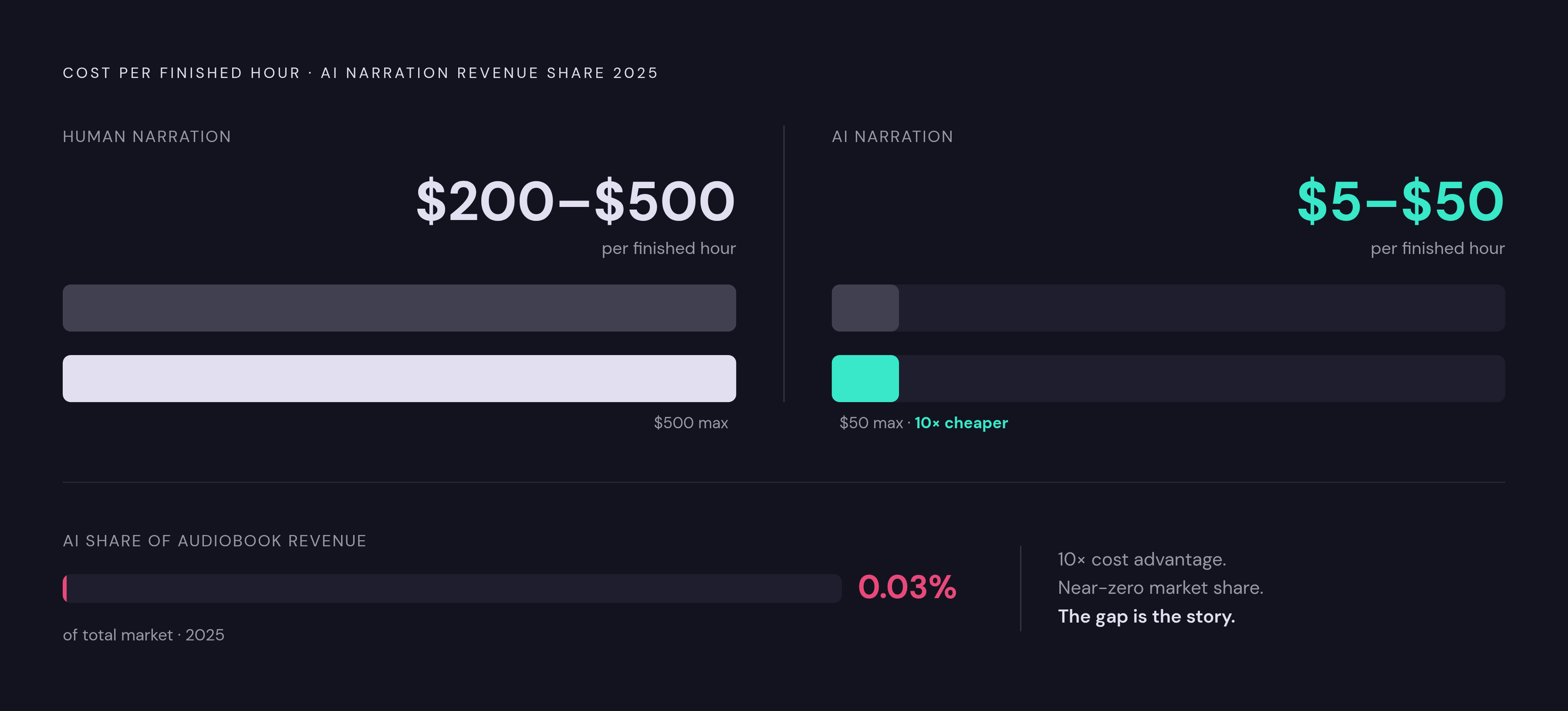
Here's the part the growth charts leave out: AI narration made up just 0.03% of total audiobook revenue in 2025. Supply exploded, but demand lagged behind it, and any pitch treating the two as the same curve is selling something.
The strongest case for AI narration right now is backlist titles that never had an audio edition, self-published books where the alternative is no audiobook at all, and non-fiction where clarity beats vocal expressiveness anyway. Fiction is the harder sell, and it should stay that way for now: attentive listeners can hear the gap between AI and human narration, and a 0.03% revenue share suggests the market noticed and priced it in already.
Cost is the real lever here. Professional human narration runs $200 to $500 per finished hour, while AI narration runs $5 to $50. That's an order-of-magnitude gap, but flat revenue numbers say cost savings alone don't make up for a listening experience that still falls short in fiction. The technology earns its keep mainly in the 95% of books sitting with no audio edition at all, alongside narrators already doing good work on titles that sell, rather than in replacing them outright. A pipeline built properly, clean text prep, sensible chunking, voice QA before bulk synthesis, automated error correction, delivery that meets platform specs on the first submission, produces AI narration that sounds like a deliberate production choice, one worth the cost behind it.