Transcribing Audio Files With Automated STT Tools
Accuracy alone no longer determines which transcription tool actually works for your needs.
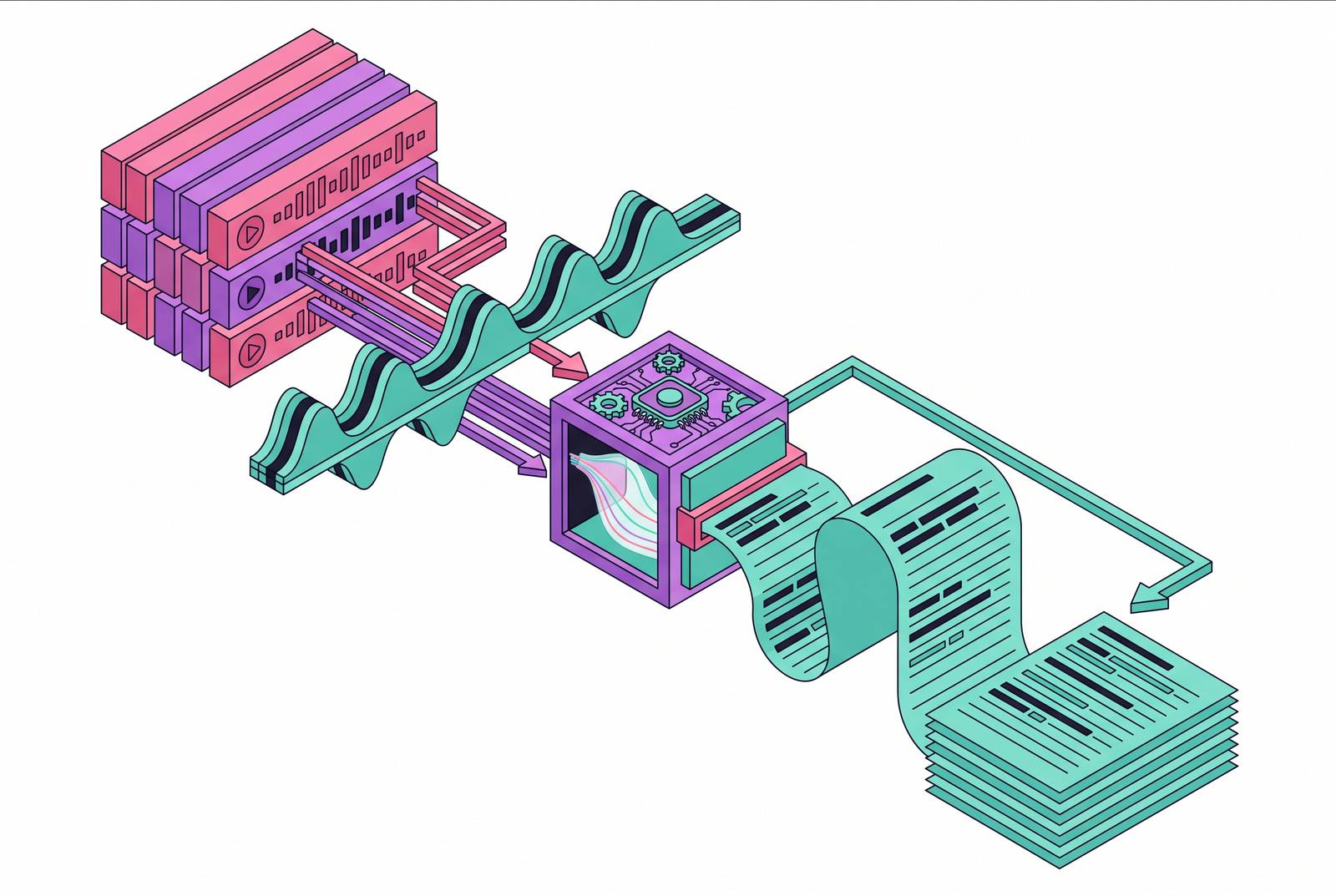
Transcribing audio files with automated speech-to-text tools used to be a one-metric game: whichever model posted the lowest word error rate won. That game is over. Clean audio is so easy to transcribe now that accuracy alone rarely separates one tool from another. The real differences appear in multilingual coverage, speaker diarization, noise handling, batch versus streaming architecture, and what a tool does with a transcript after it's generated. An STT deployment works when its capabilities match the job at hand, not when it chases a leaderboard score.
Why raw accuracy no longer determines STT tool quality
If you judge an STT tool by benchmark accuracy alone, you treat transcription like a spelling test, graded once, under ideal conditions, and then forgotten. That's a reasonable way to shop for a dictionary. It's a poor way to shop for infrastructure that has to survive a call center floor, a courtroom deposition, or a podcast recorded on a laptop mic in a coffee shop. One chases latency. The other chases accuracy and throughput. The rest of this piece maps the dimensions that actually separate one STT tool from another, because the dimensions, not the leaderboard, are where the real decision happens.
Where real-world accuracy breaks down
English STT on clean audio has reached accuracy levels that rival a human transcriptionist on standard benchmarks. That is true, but it is almost beside the point, since very little production audio stays clean. A Fortune 500 contact center found this out the expensive way: its STT pipeline looked flawless in testing and then collapsed once customers started calling from cars with the radio on. When a team tests on curated samples and then deploys against whatever audio actually arrives, you get this outcome by default. Published accuracy numbers predict little about your own audio; the real test is running the noisiest, most compressed, most accented recordings in your own dataset before any contract gets signed.
How multilingual support varies between languages
Accuracy breaks down along a second axis that's invisible to anyone testing only in English: language itself. Meta's SeamlessM4T takes a structurally different approach to the same problem: it transcribes audio across nearly 100 languages, including French, German, Hindi, and Japanese, and can translate directly to English within the same model call, which removes the latency and cost of running a separate translation step afterward. ElevenLabs's speech-to-text capability sits in a similar category: it's built on the same research infrastructure as the company's broader voice platform, with native-quality coverage across more than 70 languages, a relevant baseline for teams that need transcription folded into a larger multilingual content or agent workflow.
Speaker diarization and noise handling requirements
Diarization, the task of identifying who said what, is the capability that turns a transcript from a wall of undifferentiated text into something a team can act on without re-listening to the recording. It's also a capability where tools diverge far more sharply than they do on raw transcription accuracy. Solid diarization has to handle overlapping speech, keep speaker labels consistent across a long recording, and correctly attribute lines even when two speakers share vocabulary or a similar speaking style, and these are exactly the conditions that expose weak implementations. Noise robustness is a separate engineering problem from accuracy in general: a model can transcribe pristine studio audio competently and still degrade badly on a cheap microphone, a compressed phone line, or a noisy room, and those conditions dominate field recordings, call center audio, and remote interviews. Weak diarization and noise sensitivity do the most damage in contact centers and research settings, because recordings run long, involve multiple speakers, and get captured on whatever hardware is on hand. Podcast and media production face a different bar: audio conditions are usually controlled, but the transcript needs to be clean enough to use as a script outright, which makes punctuation quality and filler-word handling matter as much as speaker labeling. How a tool handles these requirements is tied directly to whether it was built for batch processing or real-time streaming, which is the next fork in the decision.
Batch processing versus real-time streaming
Batch and streaming are different architectures built to optimize for opposite priorities, so a tool designed for one is usually a weak fit for the other. Batch transcription has the full audio file available before processing starts, so it can make multiple passes and prioritize accuracy and throughput without worrying about latency. Streaming transcription has to produce partial results while someone is still mid-sentence, which forces different model architecture and different accuracy trade-offs; a streaming model that matches batch-level accuracy at low latency is a genuine engineering achievement, not something to assume by default. The use-case split is fairly clean: meeting transcription, podcast editing, audiobook production, legal and research recording, and film post-production are batch workloads, while conversational AI agents, live captioning, real-time call analytics, and voice-driven interfaces are streaming workloads. ElevenLabs's platform addresses both sides of that split: ElevenAgents is built for designing, deploying, and monitoring low-latency real-time voice agents, while ElevenCreative supports content creation and post-production batch workflows, making the platform relevant for teams whose needs genuinely span both modes. Edge deployment is emerging as a third path alongside batch and streaming: models like Moonshine v2 Medium, at 245 million parameters, have reached accuracy competitive with much larger models, making on-device transcription a viable option in latency-sensitive scenarios where a round trip to the cloud isn't acceptable.
Workflow integration and post-transcription intelligence as practical value
If a transcript sits alone in a text file, it rarely gives a team what it actually needs. What teams need is that transcript summarized, searched, routed into a CRM, or dropped into an editing timeline, and that downstream layer is where tools diverge most in everyday practical value. Export format flexibility carries real weight here too: timestamped SRT for captions, speaker-labeled JSON for analytics pipelines, plain text for editorial copy. Tools handle these inconsistently, and a mismatch in format can demand as much manual cleanup as the original transcription did. For developer teams building their own pipeline, the API surface functions as the integration layer, and the architectural choices there, batch versus streaming endpoints, managed inference with SLAs versus self-hosted open-source, general-purpose versus domain-tuned models, compound every trade-off already covered above. The next section maps specific tools against these criteria directly.
STT tools best suited to different use cases
No single tool wins across every use case, because the right fit depends on the specific combination of audio conditions, language requirements, batch-versus-streaming mode, diarization needs, and integration demands a project actually has.
ElevenLabs is built around the idea that transcription shouldn't exist in isolation from the rest of a voice stack. Because its speech-to-text sits on the same research infrastructure as its text-to-speech, dubbing, and agent products, it fits teams that need transcription as one piece of a larger pipeline, whether that's a multilingual content operation that needs localization alongside transcription, or an organization running real-time conversational agents through ElevenAgents while also handling post-production work through ElevenCreative. If your workload spans both batch and streaming needs, or your content already touches dozens of languages, you get the practical selling point from that integration.
Whisper, the open-source model family that includes the Whisper.cpp implementation, works for developers and researchers who need high-accuracy batch transcription, full data sovereignty, and flexible deployment. Whisper.cpp runs faster than real time on consumer hardware, even an Apple M2 Pro with Metal GPU acceleration on the medium model, so it's a genuine option if you want edge or local-first deployments. It remains a model, not a platform: streaming support, diarization, and post-transcription features all require additional engineering on top.
If your team is meeting-heavy, Otter.ai gives you live transcription wired directly into Zoom, Google Meet, and Microsoft Teams, paired with automated summaries and action items it generates without extra setup.
Sonix fits media teams and researchers who need transcripts that are organized and searchable, with AI analysis layered on top in the form of summaries, sentiment scoring, topic detection, and entity recognition, alongside integrations with Adobe Premiere, Zoom, Google Drive, and Salesforce. It supports more than 54 languages, and its SOC 2 Type 2 compliance and AES-256 encryption make it a reasonable fit for teams handling recordings that carry real sensitivity.
If AI transcription alone isn't enough and you need a human-verified result, TranscribeMe fits: its hybrid AI-plus-human-transcriptionist model supports multiple languages and file formats, and you get verbatim transcription. It performs well on clean audio, but like most tools in this category, the AI tier alone can struggle against heavy accents or significant background noise. That's why the human review option exists.
Open-source versus commercial API: what the trade-off costs in practice
On clean audio, top open-source models are competitive with commercial offerings, so the open-source-versus-API decision rarely comes down to accuracy. It comes down to what surrounds the model once it's running in production. Open-source gives a development team freedom, transparency, and control over where data lives, but it rarely arrives with the operational infrastructure an enterprise deployment needs: monitoring, logging, autoscaling, reliability guarantees, managed inference, built-in security and compliance tooling. If a small team has infrastructure expertise and a genuine data-sovereignty requirement, it has good reason to self-host. If an enterprise team needs uptime guarantees and compliance documentation it can hand to a legal department, it typically can't absorb the cost of building and maintaining that operational layer from scratch.
Edge deployment is shifting part of this calculation. You can run some models on consumer hardware, like Whisper.cpp on an Apple M2 Pro CPU, or Moonshine v2 at 245 million parameters, which matches the accuracy of models up to six times its size, so on-device transcription works when a cloud round trip isn't acceptable. These stay developer-assembled solutions rather than managed platforms, so the operational burden does not disappear, it just moves.
For teams building through ElevenLabs's ElevenAPI, the question changes shape. Whether transcription infrastructure should be assembled piece by piece or integrated into a platform that also handles synthesis, localization, and real-time agents under one reliability guarantee is the real question, not open-source versus commercial API in isolation. That's an operational question, not a cost question, and it leads directly into a separate category of risk: legal exposure, which depends heavily on whether a vendor is managing compliance on a team's behalf or leaving that burden with the team.
Consent, data privacy, and legal exposure in STT deployments
The legal exposure tied to STT deployment is concrete, and 2026 brought regulatory guidance that spells out what attorneys, enterprises, and any team using a cloud transcription vendor owe, if that vendor might reuse voice data to train its own models. The New York City Bar Association's Professional Ethics Committee, in Formal Opinion 2026-2, found that an attorney should get consent from all parties to a call before recording it and must disclose the intent to record, and it recommended that attorneys avoid recording conversations by default unless they have good reason to. The same opinion noted that recording a conversation can add an obligation to review transcripts and summaries for accuracy, which can add to costs and fees down the line.
If you operate under EU data protection rules, you face a parallel obligation from a different direction. If AI agents don't disclose they're non-human, they risk running into FTC deceptive practice guidelines.
None of this makes data residency options, SOC 2 compliance, encryption standards, or a vendor's data-use policy a procurement checkbox to skim past. Those details decide whether a deployment is legally defensible or not.
A practical framework for matching your use case to the right STT tool
Choosing an STT tool is a matching exercise, not a ranking exercise. The tool best suited to a podcast production team is often the wrong choice for a contact center, and what a legal researcher relies on may be far more than a developer building a simple voice agent needs.
Five questions, asked in sequence, settle most of the decision: Is the workload batch or real-time streaming? What languages and accents does the actual audio contain, not the audio used in a sales demo? Is speaker diarization required, and across how many speakers? What does the transcript need to connect to downstream, and in what export format? What data privacy and compliance requirements govern the recording?
Teams that need transcription as one component of a larger voice infrastructure, spanning synthesis, localization, and real-time agents alongside STT, should weigh platforms like ElevenLabs that unify those capabilities under a single API and a single reliability guarantee rather than stitching together a fragmented stack from multiple vendors. Teams with a narrower, well-defined use case, meeting notes, research interviews, legal transcription, should run the specialist tools covered above against the five questions directly, testing on their own audio rather than trusting a benchmark score to predict real-world performance. If you're planning a production deployment, test it against your own noisiest, most compressed, most multilingual samples before you sign anything, and read a vendor's data-use and retraining policy as carefully as you read its pricing page.
The boundary between transcription, language understanding, and voice synthesis keeps compressing, and the platforms that matter over the next phase of this field will be the ones building from original research rather than wrapping someone else's commodity model, a distinction that matters in any decision meant to hold up past the next product cycle.