Tool Use and Function Calling in Production Voice Agents
Function calling lets voice agents actually execute tasks, not just discuss them.
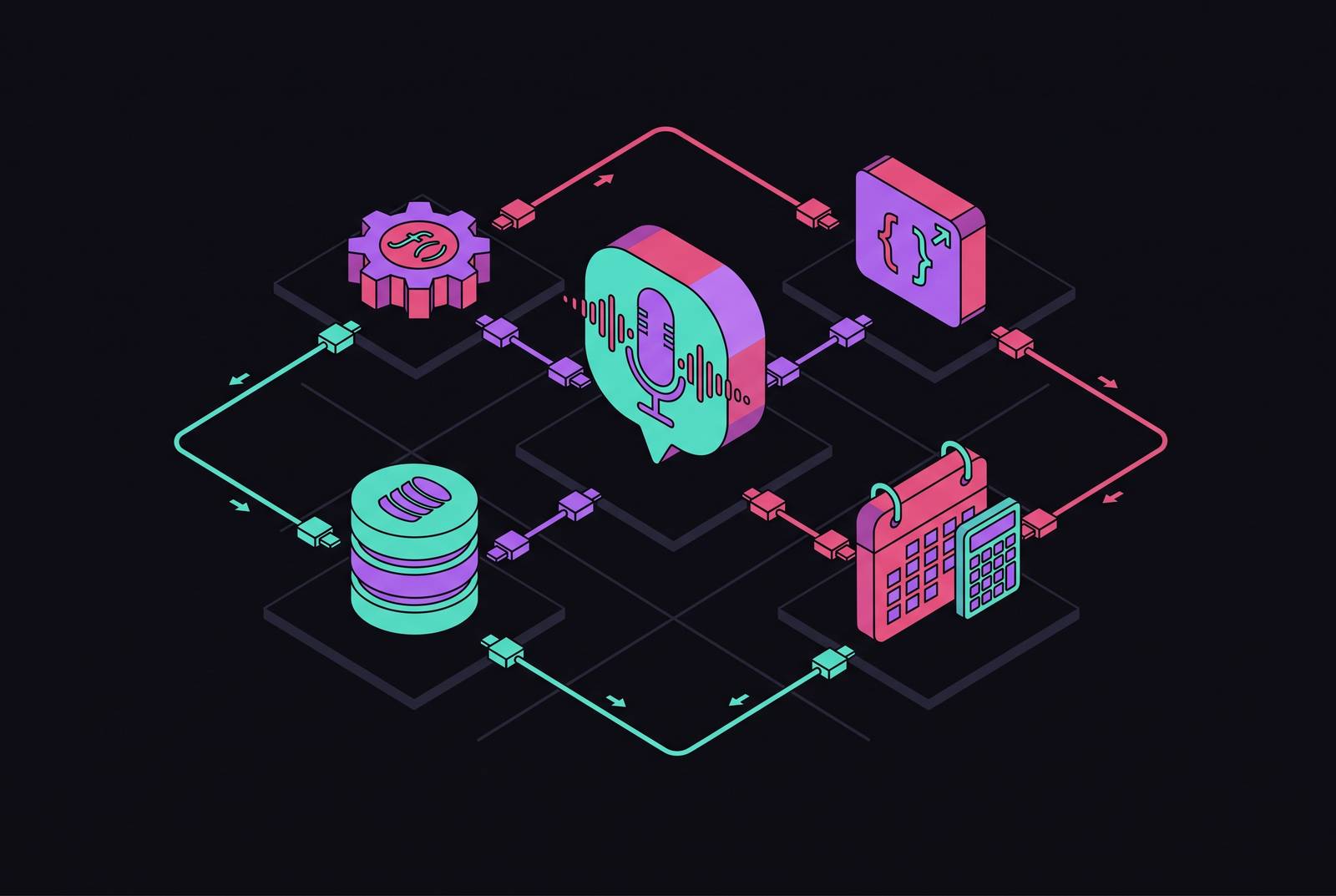
Function calling turns a production voice agent from a conversational interface into a system that can do useful work. It connects the agent’s reasoning to scheduling, CRM, payment, and telephony backends. The dividing line between a convincing demo and a deployable agent is how deliberately those calls are defined, sequenced, constrained, and monitored.
Why function calling is the dividing line between a voice agent that talks and one that acts
A voice agent needs function calling to book an appointment, look up an order, transfer a caller, or take a payment. It can discuss those actions, but discussing a booking does not put it in the calendar.
A working agent has four capabilities, namely listening through speech-to-text, thinking through an LLM with tools and knowledge, speaking through text-to-speech, and acting through backend function calls. The last capability gives the other three an operational purpose. It also separates an agent from an IVR, whose role is routing callers. An agent can hold context across turns, call an order system during the conversation, and read back a real tracking number returned by that system.
Why the cascaded pipeline (STT → LLM → TTS) is the architecture that supports function calling in production
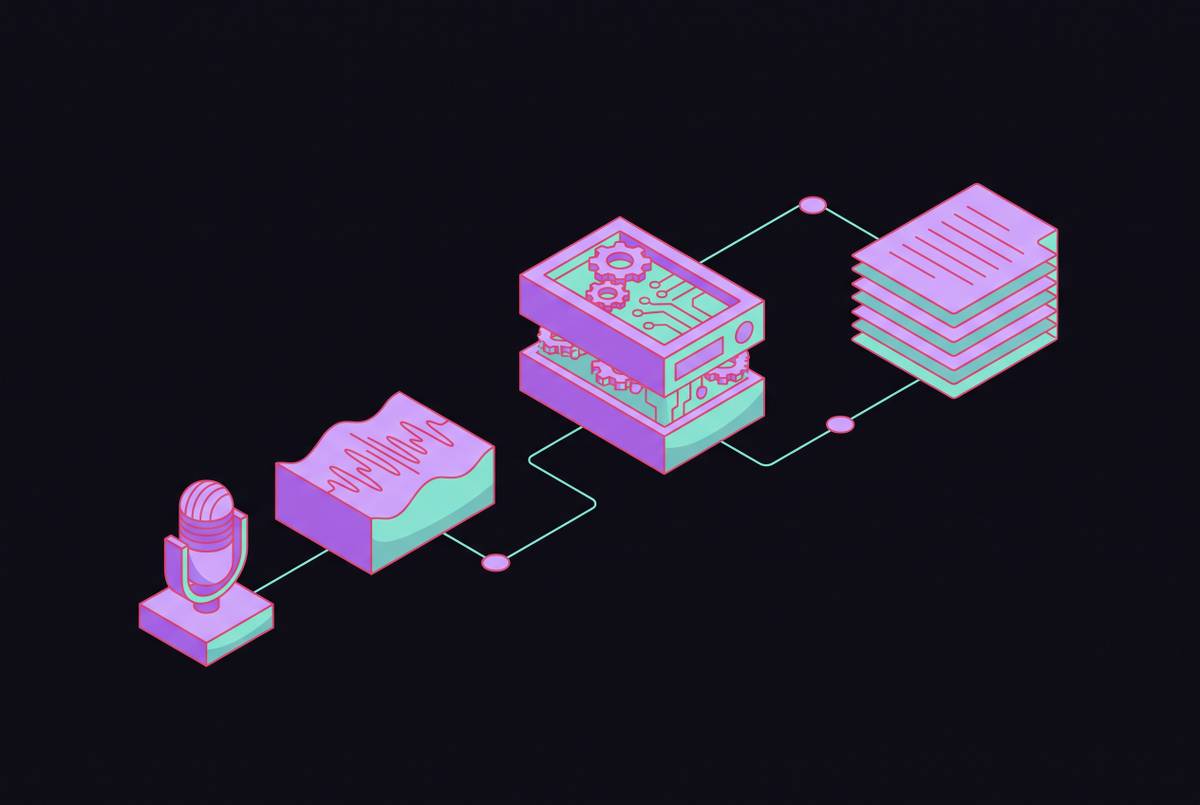
To carry out those actions, agents in production often use a cascaded streaming pipeline. Speech-to-text feeds the LLM, which feeds text-to-speech, and each part streams its output to the next. This gives the language model a place to choose and invoke tools between hearing the caller and producing a spoken reply. The pipeline is therefore not merely a way to assemble a voice.
Salesforce AI Research’s enterprise voice agent tutorial says this cascade is the industry-standard approach. Its investigation found that native speech-to-speech models such as Qwen2.5-Omni took roughly 13 seconds to produce their first audio, too slow for real-time interaction. The tutorial attributes real-time performance to streaming and pipelining across components working together. More decisively for backend work, the end-to-end audio models considered did not support function calling. Speed alone would not have supplied the missing ability to act.
The modular architecture also lets teams change transcription, language model, or voice providers independently. Custom tools can enter the pipeline without requiring the whole stack to be rebuilt. That flexibility matters because speech recognition, reasoning, and backend execution pose different problems. They share a conversation, but they need not share a component.
How the function-calling loop works inside a live conversation
At each decision point, the model reads the conversation history, system prompt, retrieved knowledge, and available functions. It then chooses whether to speak or call a tool. That choice can recur dozens of times during a call. The conversation is not one long generation with an occasional API request attached.
When the model chooses a tool, it emits structured arguments for that function. The orchestration layer executes the request against the backend API and returns the result as a new observation. The model then decides whether it has enough information to answer or needs another action. UniToolCall formalizes this sequence as the Query–Action–Observation–Answer loop, in which the backend result informs reasoning before the answer is settled.
An order lookup makes the distinction concrete. Selecting the lookup function is one decision, supplying the right arguments is another, and using the returned tracking number correctly is a third. Success depends on all of them. The quality of the model matters when callers give every detail in the expected order, and matters most when they go off-script. Even with the right function name, the wrong arguments lead to the wrong action.
Why latency is a revenue metric, not a technical one, and where function calls eat the budget
Every pass through that loop consumes time while the caller waits. Natural conversational timing sits around 200–300ms end-to-end, while Retell AI targets roughly 600ms as a practical threshold for unobtrusive responses. Above that threshold, the conversation starts to break down as callers interrupt, repeat themselves, or hang up. Retell AI uses a model just for turn-taking to help it meet that timing. Latency thus needs to be part of how teams discuss support deflection and lead conversion as well as engineering performance.
The relevant test is whether the agent sustains sub-second responses while doing useful work. A fast STT–LLM–TTS pipeline measured without backend calls does not answer that question. Sequential requests add waiting time, and a slow API can consume the budget even when the speech components are quick. Silence is still silence when its cause has an excellent technical explanation.
A design can aim to keep each tool call under 500ms. Where caller identity is known, preloading context before the call starts can avoid spending the opening turn on a lookup. On longer calls, teams also need to watch how much history the agent carries into each decision. Context management is thus part of both timing and reliability, rather than a problem solved simply by choosing a model with a large context window.
Sequential chaining, parallel fan-out, and multi-turn dependencies — the three structures that break naive implementations
The shape of a workflow determines how its calls consume that budget. In a sequential chain, each action depends on the result before it. In parallel fan-out, independent requests run simultaneously. In a multi-turn dependency, a later action must refer correctly to an earlier result despite intervening conversation. Treating all three as single-step calls repeated over and over hides the limits of each.
PwC’s “Bitter Lesson of Tool Calling” compared native JSON calling with programmatic tool calling on BFCL v4. In the programmatic approach, tools appear as typed Python stubs that the model invokes through code executed in a subprocess. The study found that its accuracy advantage grew with sequential chain length, reaching an 18.8% absolute gap at chains of 12 or more steps. That effect was absent in short chains and was driven by the extra inference turn JSON calling incurs per link.
Parallel execution has a different constraint. PwC found that native JSON calling dropped calls above a model-specific fan-out threshold, while programmatic calling maintained full enumeration accuracy by bypassing the per-turn tool-call cap.
Cross-turn state needs separate treatment again. UniToolCall introduces Anchor Linkage specifically to enforce dependencies between turns. A framework’s handling of earlier observations, and the calling paradigm used to act on them, determine which workflows it can reliably support.
How orchestration platforms handle tool calling in practice — and what the choice of platform commits you to
An orchestration platform determines how much of this machinery a team must build and maintain. Some platforms manage the function-calling loop behind a configuration surface. Others expose the underlying plumbing so developers can customize it directly. Neither arrangement is universally better. The tradeoff is control against the work required to keep that control useful.
Vapi, Retell, Pipecat, and LiveKit use the cascaded architecture, but a shared pipeline does not make their operational commitments identical. Managed orchestration places more of the loop under the platform’s control. Open-source frameworks give developers more direct control over how the loop works.
LiveKit Agents illustrates the open-source approach. Its official documentation describes support for voice, video, and text, with tool use, turn detection, and telephony over SIP. The framework uses the Apache-2.0 license, and full source-code access permits extensive tool-calling customization. That freedom comes with responsibility for uptime, scaling, and monitoring. An open-source orchestrator that a team cannot staff is not a shortcut merely because its source is available.
Where tool calls fail in production and how to design against the most common failure modes
Operational hardening starts by constraining what the model can do. An LLM can choose the wrong function, supply malformed arguments, or promise an outcome the backend cannot deliver. Narrow functions with typed arguments reduce ambiguity, while guardrails must prevent tool misuse and unsupported promises. The important boundary is between what the model can say and what the backend has actually done.
Recovery needs equal care. Callers who go off-script can lead an agent into dead ends or nonsensical state transitions, so guardrails must cover recovery as well as the expected path. Collections, bereavement, crisis lines, and other situations that need genuine human judgment must have a clear path for escalation. A named handoff function makes that path callable and testable. A fallback prompt alone does not perform a transfer.
Long calls also need a clear plan for context management, though the evidence gives no reason to treat every large history as a collapse. PwC characterized both calling paradigms as broadly stable under context flooding. It reported an average absolute accuracy change of -2.3% for JSON calling and +5.5% for programmatic calling.
Transcription errors present a more basic problem because later reasoning can proceed from the wrong input. A misheard account number can contaminate every dependent call, making entity accuracy a prerequisite for reliable execution. To diagnose such failures, teams need call-level visibility into tool execution, argument values, API response times, and error rates. Observability belongs in the design before launch.
Compliance and disclosure obligations that apply to every function call touching a regulated backend
The rules that apply to the call must also apply to that visibility. Telephony calls must meet applicable TCPA requirements, health-data workflows must operate within HIPAA constraints, and payment-adjacent calls must meet PCI DSS requirements. Those obligations constrain tool arguments, logging, and retention. A regulated backend does not become less regulated because a conversational model is operating it.
Disclosure also affects sequencing. The European Commission’s Article 50 FAQ says people must be notified that they are interacting with an AI system from the start of the first interaction, unless that is already obvious. The interaction-disclosure obligation applies from 2 August 2026. An agent that must meet that requirement has to give disclosure in the opening turn before it takes any other action. The tool-calling design should encode that order.
Article 50 also requires synthetic audio, image, video, and text to be marked in a machine-readable format and detectable as artificially generated or manipulated. The grace period to 2 December 2026 concerns only the Article 50(2) machine-readable marking obligation for generative systems already on the market before 2 August 2026. It does not postpone interaction disclosure.
These constraints also change platform economics. In regulated workflows, hallucination control and total cost of ownership over a multi-year horizon can outweigh the appeal of a polished demonstration. An unsupported action in healthcare or financial services can be a compliance event.
What a production-ready tool-calling design actually looks like end to end
A production-ready design starts by limiting the tools the agent can use. Each function has one unambiguous purpose and typed arguments, making misuse harder and auditing clearer. The workflow then distinguishes sequential dependencies from independent requests and preserves the observations needed across turns. Parallel paths keep fan-out within the limits of the model being used. For chains longer than a handful of steps, teams should weigh programmatic tool calling because studies found it was more accurate on longer chains.
Known caller identity and available CRM context can be front-loaded into the first turn, while backend response time remains part of the end-to-end latency budget. The workflow must place disclosure before action when the rules require it and apply data limits both to tool arguments and to the records of those arguments.
Finally, the agent has a named human-handoff tool and instrumentation for every function call. Records of function name, permitted arguments, response time, and outcome provide the evidence needed to detect drift, backend degradation, and emerging failures. These provisions make the system assessable beyond its best demonstration. A deployable voice agent is not defined by how persuasively it promises to help, but by how reliably it completes the permitted action or hands the caller to someone who can.